Tuesday, 17 July 2012

2012 Biennial, Whitney Museum of American Art

I am still trying to catch up with the backlog from our visit to New York in April...


Whitney Museum of  American Art, 2012 Biennial.

Designed to give a provocative overview of what is happening in contemporary American art, the Biennial was a disappointment. It was very light weight, the kind of stuff you would find at an art fair or in most commercial galleries, in my view. Is this the best of contemporary American art, I kept asking myself. The only exception was Werner Herzog's Hearsay of the Soul which you can read about here. I was intrigued by Andrew Masullos' oil paintings and K8 Hardy's photographs and sculptures. There is furthermore,  a post on the exhibits on the fifth floor which are part of their permanent collection which you can view here. 

The Biennial was heavily weighted towards film and performance so that most of the exhibition wasn't on view at any given time. 'Our ideal viewer is going to come seven or eight times' claimed the organisers - given that the entry fee was $18 I wished them good luck.


The fourth floor was set aside for scheduled performances of one kind or another and we watched one group rehearsing but did not linger there long.


Dawn Kasper's studio was recreated on the third floor: books, clothes, musical instruments as well as the bed she was going to sleep in for the next three months cluttered the space.


Untitled (The Crown), 1949

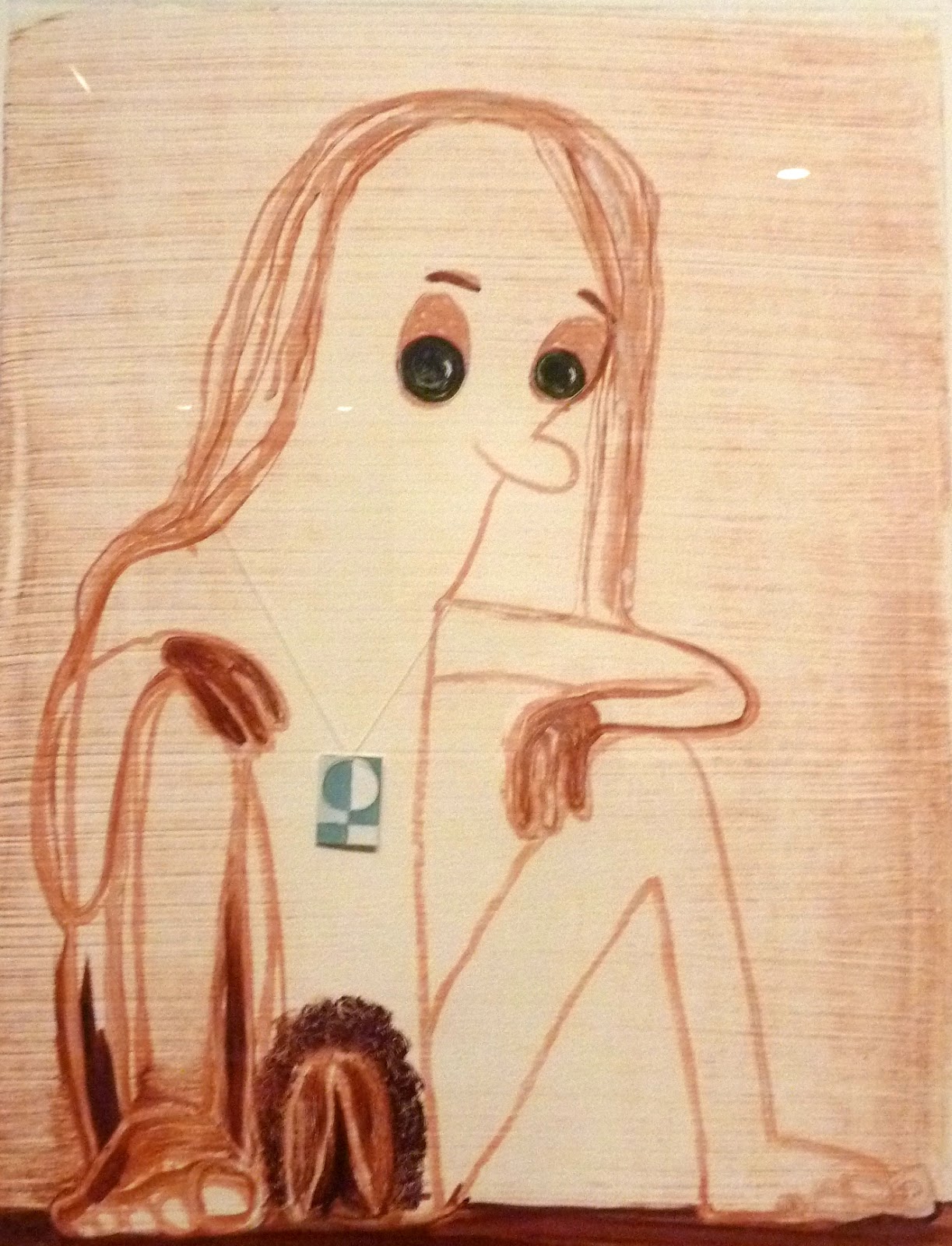
There was a micro-exhibition of the paintings of someone called Forrest Bess who lived in total isolation, fishing by day and transcribing his dreams onto canvas by night.


Complete Freedom, 1970

Convinced of his inner femininity and obssessed with a desire for unity, Bess performed a series of surgical interventions on his genitals.


Untitled, 1949

'All symbolism in art', Bess wrote, 'points to this mutilation as being the basic step towards pseudo-hermaphrodite as the desired and intended state of man'. Bess placed his anatomical experiments on a par with his art.


Jutta Koether, The Seasons, 2011


Charles Demuth, Eight O'Clock, 1917


Andy Warhol, Untitled (Cyclist), 1976


Garry Winogrand, Beverley Hills, California, 1978 from the portfolio Women are Better than Men. Not only Have they Survived, They Do Prevail, 1978-80.


The exhibition room with Nicole Eisenman's paintings and works on paper


a closer look


A look at some individual pieces


Liz Deschenes, Untitled, 2011 (four silver-toned silver gelatin prints)


Andrew Masullo's small paintings


Masullo is known as a  painter's painter partly because, despite their ostensible simplicity and modest scale, his works deftly resist being confined by content or artistic movement.


He works with unmixed oil paint in high-keyed colours on small canvases


his concerns are purely within the process of painting


Beginning with neither specific image or preconceived  idea he allows each painting to reach its own conclusion through an often visible series of trial and error.


An interplay of form, colour and surface.


K8 Hardy

Drawing on the fashion tropes of advertising, combining some of its most recognisable modes (product close-ups, meticulous styling and staging, eye-catching colours)  K8 Hardy's photographs and sculptures employ layering to confuse and undermine assumptions about race, gender and class


Rather than simply poking fun at fashion and its commercialisation K8 Hardy complicates our learned response to the conventions of advertising.


She obscures any glimpses of the model (typically the artist herself) while drawing attention instead to the messages projected by the model's physical features. In treating her body as an object Hardy upends a relatively recent yet deep history of women photographing themselves, itself a response to the millenia-old practice of male artists objectifying women as subjects of art.


Sunday, 15 July 2012

Heatwave

With temperatures above 40oC for over a week now,  it is all getting too much: shortness of breath, dizziness, nausea, headaches, feeling faint, are the symptoms that more and more people are experiencing.


This is the only reprieve.


Friday, 13 July 2012

Greece wounds me


'Wherever I travel Greece wounds me'.
        Giorgos Seferis.


The Greek Finance Ministry has been unable to collect court-ordered tax fines totalling 12.6 billion euros, or 6.2% of the country's gross domestic product, according to data posted on the Ministry's website.

The above amount includes the fine of 4.8 billion euros imposed on the Acropolis stockbrokerage  for its role in the structured bonds scandal three years ago. The state has not received a single euro of that yet.

There are in excess of 180,000 outstanding tax cases in the Greek courts. Under normal circumstances this would be extremely worrying, but given that such decisions of Greek courts are often not implemented, and given that the Greek State is administratively incapable of collecting taxes that are due, why should oustanding court cases surprise or worry us?

The answer is that the only way the Greek state is able to finance itself is by borrowing billions from the Troika of the European Commission, the European Central Bank and the IMF, and imposing ever harsher austerity measures on its citizens, which hits the poorest and most vulnerable the hardest, as the wealthy shift their money abroad and adopt all kinds of tax evasion manouevres.


This post is not about all those who have lost their jobs (unemployment has risen to 22.5%  and 52.1% for those aged 17-24), the homeless, the asylum seekers in detention camps, the immigrant workers living 25 in a room, the many who have killed themselves because they could not cope with the dramatic changes in their lives (Greece, which once had the lowest, now has the highest suicide rate in Europe), the young people who have no job and no hope of getting one, or the large families on subsistence levels.

This post is about a middle-class household who are still relatively well-off, who are managing and who have by no means joined the large numbers of those who are in despair. What has happened to this household, whose financial details I have access to, is a demonstration of the drip drip effect of loss of income and gradual reduction of living standards. It also shows how the Greek state responds to its inability and unwillingness to collect taxes by hitting out at every level of society, except for the rich.


M. retired three years ago, with a very good pension of 1900 euros a month. She owns her home, but has two loans that she has to repay every month. Her daughter, T,  who is in her twenties, was earning the 500 euros typical of her age group (hence commonly called the '500 generation'). M. had to occasionally help her daughter financially as she found that 500 euro a month did not go very far.

Then a series of unexplained and unexpected cuts to her existing pension started occuring. Within a year her pension was reduced to 1400 from the original 1900. Then the 13th and 14th salaries (an extra payment for Christmas, half for Easter and half for the summer) were abolished - another cut of  316 euros per month, bringing her pension down to 1184 euros per month.

The next change was lowering the tax threshold from 12,000 euros to 5,000 so that she is now expected to pay additional tax of 2100 euros  - a further drop of 180 euros, bringing her monthly pension down to 1004 euros .

By now M. was desperate: paying off the loans she was committed to was becoming extremely difficult.  But more was to come. Unable to collect taxes, last spring  the government had the 'brilliant' idea of imposing a property tax on top of the existing council tax, which would be collected through the electricity bills. No need to worry about collection here: if you did not pay then your electricity would be cut off.  M. had to pay 1200 euros property tax on the three bedroomed flat she owns and lives in and will have to pay this tax every year from now on. M.'s monthly income has now dropped to 904 euros.

But this was not enough. Four months ago, a further property tax was announced and she had to find another 400 euros to pay that. M.'s monthly income is now less than half  (46%) of what it was eighteen  months ago. 

Meanwhile, five months ago, T., M.'s daughter, lost her job as the company she was working for closed down because of the recession. M. now has to fully support her.

Yesterday came the ultimate blow, the twist of the knife, the message from a State that will bleed its citizens dry in order to feed its incompetence. T. was filling in her tax form. Income: none. She was doing this electronically, and immediately the None was changed to 3000. T., with no income at all, now has to pay tax of 116 euros.

This is the reality of an average middle-class household in Greece today. It's hard to imagine how grim life must be for the working class, the unemployed, the disabled, and the homeless.


(I took these photographs last summer in the Metaxourgeio area).


Wednesday, 11 July 2012

16th Anti-Racist Festival in Goudi


We went to the anti-racist festival in Goudi on Sunday, the second we have attended.


Lots of stalls around


with lots of literature


with some old favourites


including Ursula Le Guin.


Interesting banners: this one is asking for the closure of the immigrant/asylum seeker detention centres - the ones in Greece are a real disgrace


The passion for freedom is much stronger than any prison cells - let's fight for prisoners' rights


We do not live in order to work - we will not die while working


The whole world is our country


Immigrants are the damned of the earth - in the world of the bosses we are all foreigners


An end to fascist gangs - neighbourhoods of compassion not of racist hatred


some didn't need any words


and some were beautifully designed


Amnesty International were there


as well as Medicins du Monde and Medicins Sans Frontieres


As well as various anti-fascist organisations


There was a radical priests' stall: panclerical, panpopular fighting organisation - it is unthinkable that the pets of the rich lead better lives than the children of the poor, reads the placard.

I was very pleased to see that such an organisation exists given the conservatism of the Greek Orthodox Church and I really liked the priest who was giving out leaflets. He did not bat an eyelid when I told him I was an atheist - his response was: 'it does not matter'.


there was a children's corner


lots of workshops that were very well attended


food from various cultures: I had chicken from the Kongo stall and it was delicious


Unfortunately and unexpectedly we had to leave early, before the bands started playing. The festival is a three day affair and we chose Sunday because Maria Farandouri would be singing. So we were very disappointed to be leaving before the party started - there were masses of people arriving as we left and by the time the festival was  in full flow there must have been thousands of people there.