Thursday, 14 December 2023

Claudette Johnson


Claudette Johnson - Presence


at the Courtauld, London.

A few years ago I saw two paintings by Claudette Johnson at the Herbert Art Gallery in Coventry which I really liked. So, when I saw that there was an exhibition of her work at the Courtauld, we decided to go and find out more about this artist who creates such powerful paintings.


Throughout her career, Claudette Johnson has pioneered the use of drawing on an epic scale to create depictions of black women and men that are at once intimate and monumental. Johnson's drawings are carefully observed but she does not consider them portraits in any conventional sense. Her aim is to assert the presence of her figures in ways that are vivid and complex.

Born in Manchester in 1959, Johnson came to prominence in the early 1980s whilst still an art student at Wolverhampton Polytechnic. Inspired by the exhibition Black Art an' done at Wolverhampton Art Gallery, she joined the BLK Art Group, an association of young black artists seeking visibility within the British art establishment. Johnson became a powerful voice for black feminism and exhibited in pioneering shows curated by Lubaina Himid.

During the 1980s, Johnson began depicting black women, working either from her imagination, photographs she found inspiring, or from sitters. She sought to address the marginal presence of black women in art and visual culture with her first large-scale drawings. These monumental images of women, which often exceed the size of the paper, became a hallmark of Johnson's art.


Standing Figure with African Masks, 2018, (pastel and gouache on paper)


And I have my Own Business in this Skin, 1982, (pastel and gouache on paper)

Johnson created this work during her last year studying art at Wolverhampton Polytechnic. The work is partly a response to Pablo Picasso's painting Les Demoiselles d'Avignon.  Johnson has spoken of wanting to reclaim the image of the black female body, which as in that work, is too often controlled, fetishised and sexualised. In contast, Johnson's figure, brought to life from a fractured array of colours and forms, asserts her independent presence. The work's title is taken from a poem by the writer Gail Murray that concludes 'and I have my own business in this skin and on this planet'.


Untitled (Standing Woman), 1990, (pastel on paper)

This drawing is part of a group of works Johnson made of herself shortly after the birth of her second child. She has spoken of having 'ambivalent feelings towards working with images of women who are naked because of the exploitative history of 'nude' painting in art'. However, her ambition is to create drawings of women who 'are so obviously engaged in creating themselves' that they challenge and redefine those traditions, offering new ways of depicting black women.


Trilogy: Woman in Blue, Woman in Black, Woman in Red, 1982-86, (watercolour, gouache and pastel on paper)


I Came to Dance, 1982, (pastel and gouache on paper)

Full of movement and energy, this drawing depicts a woman who seems to twist and dance her way out of the sheet.


Blues Dance, 2023, (pastel, watercolour and gouache on paper)


Reclining Figure, 2017, (pastel and gouache on paper)

The drawing is based on a photograph that reminded Johnson of  'the position that my mum would adopt in the evening when she was tired and lay down on the sofa after a long day'. With this work, Johnson reclaims the conventional genre of the reclining female figure - a prominent feature of western art - and makes it her own.


Kind of Blue, 2020, (pastel and gouache on paper)

Since 2015 men have become a subject of Johnson's paintings.


Young Man on Yellow, 2021, (pastel and gouache on paper)


Figure in Blue, 2018, (pastel and gouache on paper)


Untitled (Yellow Blocks), 2019, (pastel and gouache on paper)


Figure with Raised Arms, 2017, (pastel and gouache on paper)


Figure with Figurine, 2019, (pastel, gouache and acrylic paint on paper)


Untitled, 2015, (pastel and gouache on paper)


Standing Figure, 2017, (pastel and masking tape on paper)


Tuesday, 12 December 2023

Fang Lijun - Portraits and Porcelain

Fang Lijun - Portraits and Porcelain at the Ashmolean Museum, Oxford.

This exhibition highlights works by Fang Lijun created over the last five years. Most are ink portrait drawings and porcelain pieces, the media of Lijun's early artistic training. Yet for some thirty years he enjoyed international fame for his bold colourful oil paintings and woodblock prints in a movement that art critics termed 'Cynical Realism' and he was the leading artist of 1990s China.

The motif that runs through all his work, from student sketches to complex, delicate porcelains, is that of the human head. While Fang's bald, expressionless faces in the 1990s symbolised the universal ennui of a politically controlled society, his recent works are personal portraits of friends, family, colleagues and acquaintances from throughout his life. In porcelain he challenges not the society around him but rather the precariousness of the material itself.


Paintings and woodcut:


Two Figures, (series 1, no. 5), 1991, (oil on canvas)

These figures are uncharacteristically expressive among Fang Lijun's paintings of this period, when most of his works depicted faces with exaggerated smiles or deadpan looks that emphasised disengagement rather than communication. Nonetheless, both figures here have questioning expressions. Lijun has painted this in oils, though the colours and tonal range rige it an appearance similar to ink and wash, or pencil.


Swimmer, 1998, (woodcut print on paper)    (apologies for the reflections on the head)

A lone swimmer is a subject Lijun chose frequently throughout the 1990s, and one of his best-known works of the period shows a single figure standing in an intensely blue pool. Many of his swimmers, inclucing the work shown here, appear to be self-portraits. Lijun suffered a fear of water as a child, only learning to swim after he had moved to Beijing as a student. 


Untitled, 1998, (oil on canvas)

From the mid-1990s for around a decade, Lijun's depictions of people became more colourful, with subjects that often turned towards nature rather than away from society. The combination here of a head, baby-like figures and small flowers, all in strong colours, is typical of this period.


Mr Li, 1998, (oil on canvas)

This painting is after an image or occasion from some years prior to its production. It depicts the art critic Li Xianting, a longtime friend of Fang Lijun who gave the name 'Cynical Realism' to the rebellious art movement of the 1990s in which Lijun became the leading figure. The painting stands apart from many of his depictions of swimmers in its use of monochrome oils, and the vivid actions of both the swimmer and the water.


Heads, 2016, (oil on canvas)

This image of multiple heads, shaven and viewed from the back, brings together elements common to much of Lihum's work from the 1990s onwards. The strong colours and golden look suggest some of the optimism of other works he produced during the late 1990s that included figures and flowers against strongly coloured skies, or the gold and orange swimmer paintings of the same period.


Porcelain:

Lijum's first artistic training was in ceramics. He went on to specialise in printmaking alongside painting and drawing, and has recently returned to making ceramics.


Porcelain, 2023

Lijun is interested in exploring the limits of the porcelain, and in this work he has created an exceptionally thin, delicate piece constructed around a matrix that burnt away in the kiln. 


In the centre is embedded a modelled head, the subject that has featured in his works on paper throughout his life.


Porcelain, 2023

This structure is the result of several thousand experiments in small pieces, shown below.  Part of its stability relative to other works comes from the use of a slightly thicker porcelain layer. The head embedded in the centre continues the use of the image that runs through his work from the 1980s onwards.


Porcelain is fragile, and Lijun is interested in discovering how thinly it can be made. He is interested in the fact that although succerssful production depends on the preparation of materials and control of the kiln, it is also the case that, in his own words, 'the final outcome depends on the interactive relationship between clay, glaze, water, temperature, weight and air'. It is this unpredictability that he uses as a creative starting point, testing the properties of the material in different constructions and various conditions.

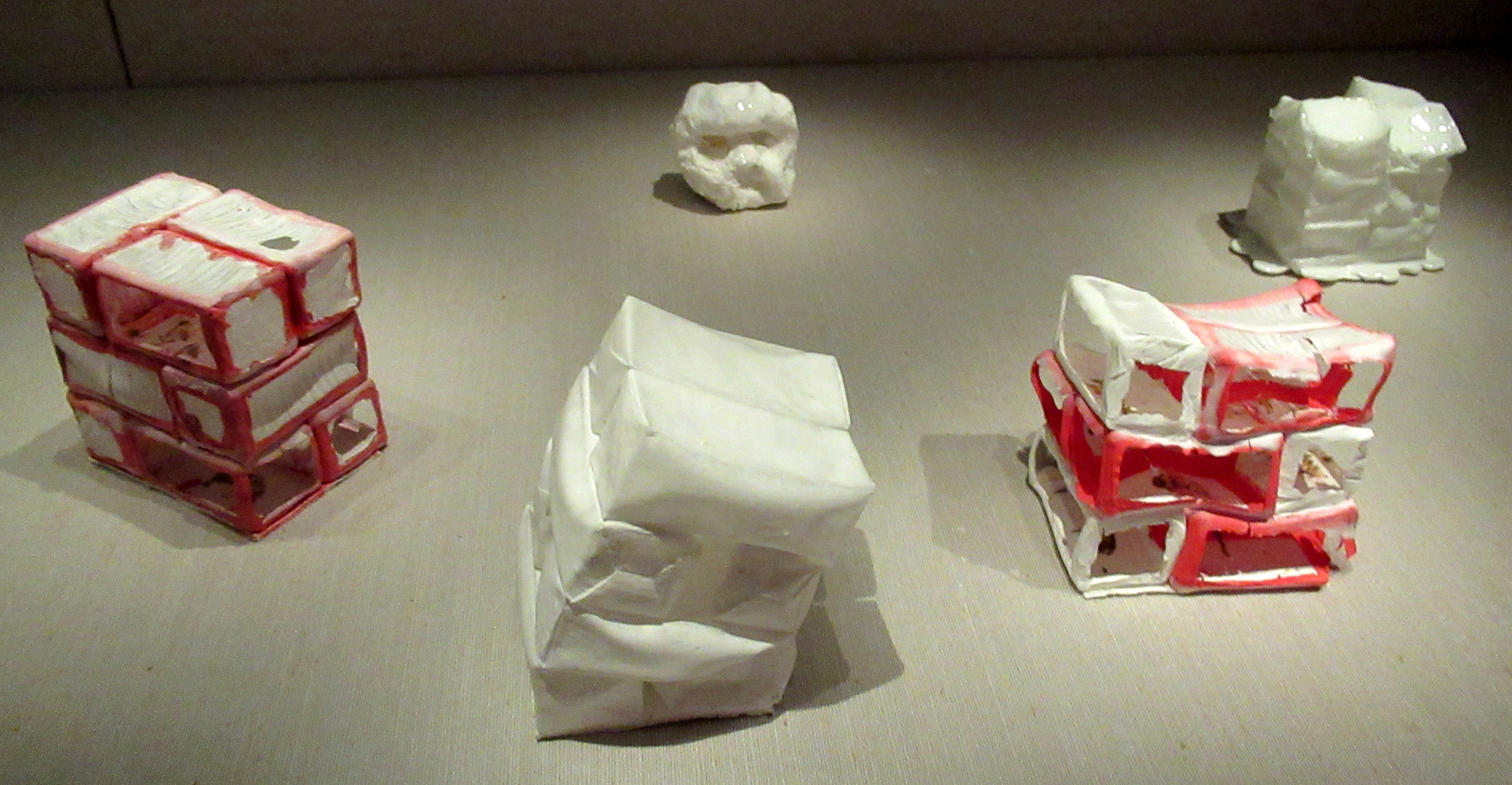
The objects displayed here were all produced to test materials and techniques for making viable sculptural pieces. The materials include wire and paper, both of which were used for constructing an internal matrix to support the porcelain.


This piece shows the risks of pieces slumping in the kiln that frequently affects even much sturdier, commercial porcelains.


Portrait Drawings, 2018-2023, (ink and colour on paper):

The subjects of these drawings are all people the artist knows. 


Saturday, 9 December 2023

John Caple - The Woodman and the Nightingale


John Caple - The Woodman and the Nightingale at the John Martin gallery, Mayfair.

Another John Caple exhibition at John Martin, and as always, such a delight. 

John Caple is completely self-taught. his family have farmed and quarried in Mendip in Somerset since the 18th century. The tight community in which he grew up has a rich history of people whose stories were passed down through successive generations. His paintings feature re-occurring faces of his mother, grandparents, uncles and others in scenes derived from his imagination through stories he is told of their pasts. Each painting describes specific episodes in the lives of these characters.

The artist's statement about this exhibition: 'The paintings for this exhibition are strongly influenced by Nature poetry, in particular the poems of Percy Shelley. The title of the exhibition, and indeed the titles of many of the paintings are taken from his poem 'The Woodman and the Nightingale', a poem which asks for a deeper connection with the natural world.

I began with a series of drawings to find the initial ideas and themes which could be developed in the final paintings. The Nightingale is important and appears in nearly every one of the paintings, representing both the mystery of nature as well as its fleeting and fragile presence. The Woodman I came to see as a force of renewal, replenishing all that is taken and so enabling a constant blance in nature. He is a protector of the physical environment and a guardian of the spirit of place.

There is such beauty in ancient wilderness. These elder places express a soulfulness and atmosphere that once lost can never be recovered. It is this 'spirit of place' which I hope can be felt in these paintings.'


The Woodman, 2023 (acrylic on canvas)


Dark Village, (acrylic on canvas)


How High beyond all High, (acrylic on canvas)


Woodland House, (acrylic on canvas)


Night Walk, (acrylic on canvas)


The Barn at Midnight, (acrylic on canvas)


River Journey, (acrylic on canvas)


Return to the Nests, (acrylic on canvas)


They Know Earth's Secrets, (acrylic on canvas)


Night Journey, (acrylic on canvas)


The Night Temple, (acrylic on canvas)


The Coombe at Dusk, (acrylic on canvas)


The Woodman's Cottage, (acrylic on canvas)


Whom Mortals Call the Moon, (acrylic on canvas)


Woodland House II, (acrylic on canvas)


Surrounded by Columns and the Towers, (acrylic on canvas)


The Nightingale, (acrylic on canvas)


The Woodman and the Nightingale, (acrylic on canvas)


River Journey - The Gleam of the Remoter World, (acrylic on canvas)


Wakening the Leaves and the Waves, (acrylic on canvas)