Tuesday, 28 May 2024

One of those natural, wonderful phenomena....


During our walk in Charlecote Park last week we came across this tree that looked like it was completely covered with cobwebs.


And then another.


And another. There was a whole row of them, all in all around eight.


So we had a closer look. It looked like something someone had prepared for Halloween, 


except these did not look like normal cobwebs


and then we noticed these worm-like creatures, moving about all over


They were everywhere


clustered around ... what? the spiders who had woven the web? Had they taken over and killed the spiders? We were totally mystified. Had never seen anything like it.


On closer inspection, this is what we saw. Alive and climbing... writhing...


As we were leaving we asked one of the people at the entrance who said he had not seen anything like what we described, the rangers had not reported anything, and no-one else had alerted them to this. After I showed him the photographs I had taken he said he had seen something on the BBC about an invasive form of caterpillar that has been seen in the UK recently. He said he would ask the rangers to investigate.

So, I did some research when we got home.

'Hungry caterpillars have covered a 30m expanse of trees in a huge ghostly-looking web', read the headline.

Caterpillar expert Andy Banthorpe said that the giant web is the larval feeding web of a small moth called the spindle ermine. They do it to protect themselves from predatory birds while they are feeding. The vast webbing could indicate a caterpillar population explosion after last year's warm summer, but it, and the caterpillars, were harmless.

'It looks quite ghostly, like some superb, natural Halloween display a few months too early', he said. 'It's one of these natural, wonderful phenomenon that you see occasionally', he added.


Sunday, 26 May 2024

Portraits at the National Portrait Gallery


We visited the National Portrait Gallery to see two temporary exhibitions but while we were there we also had a look at some of the permanent exhibits, some of which we had seen before. Most of the portraits (but not all) in this post are from the 'Reframing Women and Self-portraiture' section of the permanent collection 'where by choosing to represent themselves looking out at us, women have countered the idea of a passive feminine sensibility. Often their self-portraits disrupt past and contemporary representations of women made by male artists for the pleasure of other men'.


Laura Knight with model Ella Louise Naper, 1886-1972, Self Portrait. 

Laura Knight was a pioneering figure in British art. This self-portrait is a bold statement of her ambition at a time when men dominated the art world. Knight is shown painting a nude model at a time when women were not allowed to paint nudes. Knight also worked as a war artist, notably documenting the Nuremberg Trials in 1946. 


Vanessa Bell, 1879-1961, by Duncan Grant. 

Vanessa Bell was a pivotal member of the Bloomsbury Group. Bell embodies the Bloomsbury Group's progressive attitudes toward art, sexuality and relationships. 


Virginia Woolf, 1882-1941, by Vanessa Bell. 

This portrait of Virginia Woolf, was painted by her older sister, Vanessa Bell, who shows Woolf knitting in an armchair. The blurred eyes suggest the importance of her inner creativity.


Eileen Agar, Self-Portrait, 1899-1991


Barbara Hepworth, Self-Portrait, 1903-75,  (oil and pencil on board)


A self-portrait of one of Britain's foremost abstract sculptors, holding a sketch-board


Amy Grantham, City Portal, b. 1978,  (gelatin silver print)

A self-portrait of Grantham and New York, where it was taken 


Ajalvportratt, Akersberga, Everlyn Nicodemus, b. 1954,  (oil on canvas, 1982)

Through the layering of multiple faces, Nicodemus contemplates herself from multiple perspectives


Reaching Heights and Aphrodisiacs Being Social Constructed, by Chifa Kumari Singh Burman, b. 1957 (etching and aquatint, 1988)

Notions of selfhood are dismantled to reveal a determined artist and a young woman ready to escape the social constructions of womanhood.


Paul Venelay, 1892-1984, Self-Portrait, (oil on canvas, 1927)

Subtitled Harmony Vezelay's self-portrait blends the artist's abstract style with a figurative representation.


Issy Wood, Self-portraits, b. 1993, (oil on linen, 2021)

Wood points to the absurdity of life, while also shining a light on the artifice of image-making.


Human Toilet Revisited, Sarah Lucas, b. 1962, (inkjet print, 1998)

Lucas' provocative self-portraits challenge the cliched image of the modern artist at work.


Smoking, Sarah Lucas, b. 1962, (inkjet print, 1998)

By adopting an androgynous appearance, Lucas defies stereotypical representations of gender and questions of female objectification.


Gluck, 1895-1978, (oil on canvas, 1942)

Gender non-conforming painter Bluck adopts here a confident posture as a marker of strong pesonality.


Paula Rego, 1935-2022, Self-portrait, (pastel on canvas, 1994)

In this self-portrait, Rego shifts the focus onto herself by evidencing her artistic skill and the connection this has with allegorical representations of painting.


Germaine Greer, b. 1939,  by Paula Rego

Australian-born writer, broadcaster and critic, Greer came to the UK in 1964 to study at Cambridge University. Her book The Female Eunuch (1970), was one of the defining feminist texts of the period. Her radical views have attracted controversy throughout her career. 


The Moor, Salman Rushdie, b. 1947, by Bhupen Khakhar

This portrait celebrates the decades-long friendship between Rushdie and Khakhar. Indian-born Rushdie came to the UK as a teenager. Much of his work is set in the Indian sub-continent and combines magical realism and historical fiction. His second novel, Midnight's Children won the Booker Prize.

In 1989, Ayatollah Khomeini, leader of Iran, issued a fatwa condemning Rushdie to death for allegedly committing blasphemy with his novel The Satanic Verses. Rushdie lived in hiding for many years and narrowly survived a violent attack on stage in the US in 2022.  In this portrait Khakhar has surrounded his sitter with scenes from Rushdie's novel The Moor's Last Sigh, a semi-autobiographical text in which Khakhar appears as an accountant, his first career.


Self-portrait with Charlie, by David Hockney, b. 1937

Hockney is fascinated with the observation and depiction of relationships. He painted this large-scale portrait of himself and his close friend, Charlie Schelps, from his light-filled studio in the Hollywood Hills. Completed in just a few sittings, Hockney worked directly onto the canvas in oils, without photographic reference or preparatory drawings. The painting sets up a triangular exchange of gazes between viewer, artist and model. Hockney says: 'I am constantly preoccupied with how to remove distance so that we can all come closer together, so that we can all begin to sense we are the same, we are one'.


Sadie, Zadie Smith, b. 1975, by Toyin Ojih Odutola

Zadie Smith became a prize-winning author at the age of 25 for her first novel White Teeth. Smith has described Toyin Ojih Odutola as the 'central light in a thrilling new generation of black artists'. The map of north-west London connects the writer to where she grew up, while the shadow of a palm tree alludes to her mother's homeland of Jamaica. Ojih Odyutola gave the portrait Smith's original name, which she changed at 14 to make herself sound more interesting.

For Smith, the strong and self-assured pose chosen bhy Ojih Odutola is significant: 'this equality of gaze between subject and artist is not something I remember ever really seeing in any portrait of a woman, never mind any portrait of a black woman... it's an artist looking at a writer looking back'.


Self-portrait with Esme, by Chantal Joffe, b. 1969

The self-portrait is central to Joffe's practice. It is a way for her to consider time passing, something she feels acutely watching her daughter, Esme, grow up. The mother and daughter relationship is a recurring theme in Joffe's work. Approaching middle age and bearing her caesarean scar, the artist stands side by side with Esme, both of them unselfconscious in their nakedness. She says:'when I am painting me I feel exquisite, so beautiful - but that's what I feel about all my sitters'. Although Joffe's painting is expansive and gestural, every mark, which may appear casual, is carefully considered.


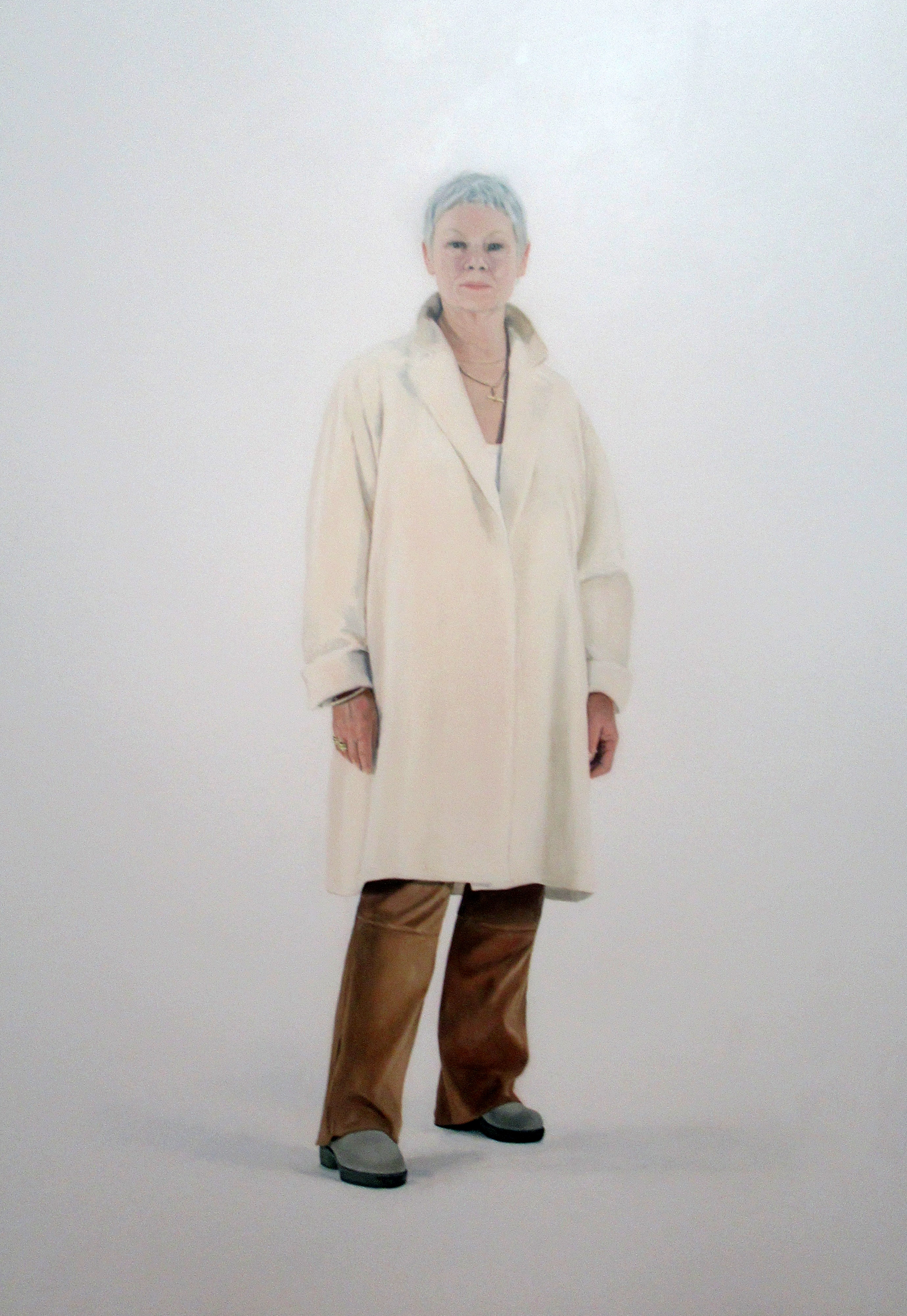
Judi Dench, b. 1934, by Alexxandro Raho

Dench has played many different roles, from Ophelia in Shakespeare's Hamlet to M in the James Bond films. However, Raho chose to portray the actor off-stage, as a version of herself in her everyday clothes, unadorned and without props. The artist has spoken of how he attempted to 'trap something I saw while she waited in the foyer of the National Portrait Gallery, unaware of me' when they first met. Raho's process involves taking hundreds of photographs, yet the portrait retains painterly qualities such as the delicate brush strokes and soft tonal effect, which make the figure appear to shimmer.


Amy-Blue, Any Winehouse, 1983-2011, by Marlene Dumas

Many portraits in the collection are painted from life, but this painting of Amy Winehouse, the Grammy-winning singer and songwriter, was made in commemoration following her death at the age of 27. Moved by the news, the artist searched through images of Winehouse on the internet. Dumas cropped and simplified the singer's characteristic features, choosing to include the dramatic sweep of eyeliner but not her recognisable beehive hairstyle. The translucent blue colours refer to Winehouse's troubled life and her musical influences. She encompassed genres including soul, R&B and jazz. Her voice was described by journalist Jenny Elisco as 'husky and sultry and sad, like a broken heart marinating in whisky and cigarette smoke'.


Friday, 24 May 2024

Covent Garden


During our last visit to London we went to the National Portrait Gallery where we spent a very pleasant morning exploring both the temporary exhibitions and the permanent exhibits. We then started exploring. We walked around Trafalgar Square, Leicester Square and moved towards Covent Garden. I was not going to take any photographs as I am so behind with my blogging but then


we came across this very interesting little street, Cecil Court, and I started snapping as I wanted to remember this loveliness, hidden in the middle of London that I had not come across before. It's full of art galleries and interesting bookshops. A real treat.


One gallery in particular caught my attention as I liked most of the pictures in the window and inside as well. I was told by the assistant that most of them are Swedish, bought in Europe, artists unknown - like me, they liked the paintings and bought them. Because of this, the prices are very reasonable.


The bookshops here are also very interesting


This one sells predominantly books on witchcraft


and they have witches and wizzards in the window to reinforce the point


Another private gallery


Feeding the Birds by Lena Gurr


Open Shutters by Robert Louis Banks


As you can see here, Mozart stayed here for a while


The Art Deco Gallery has some fabulous things - unfortunately the owner did not want me to take any photographs


Another gallery and so it went on....


The next little street we explored was full of bars and restaurants


By now we were approaching Covent Garden central square.


As always here, street entertainment going on


The central square is simply called Covent Garden, often marketed as Covent Garden Piazza to distinguish it from the eponymous surrounding area. Designed and laid out in 1630, it was the first modern square in London - originally a flat, open space or piazza with low railings. From about 1635 onwards there were many private residents of note living in the Great Piazza. A casual market started on the south side, and by 1830 the present market hall had been built.  

The square was originally laid out when the 4th Earl of Bedford, Francis Russell, commissioned Inigo Jones to design and build a  church and three terraces of fine houses around the site of a former walled garden belonging to Westminster Abbey. Jones' design was informed by his knowledge of modern town planning in Europe, particularly Piazza d'Arme, in Leghorn, Tuscany; Piazza San Marco in Venice; Piazza Santissima Annunziata in Florence; and the Place des Vosges in Paris. The centre piece of the project was the large square, the concept of which was new to London, and this had a significant influence on modern town planning as the metropolis grew, acting as the prototype for the design of new estates, such as the Ladbroke Estate and the Grosvenor Estate. 


Before entering the market itself, we had another look at the street entertainment which was happening in front of the church of St Paul. The church was the first building and was begun in July 1631. 


The church was damaged by fire in 1795. The columns are thought to be original but the rest is mostly Georgian or Victorian reconstruction.


It's always very crowded here, but we visited on a weekday and it was manageable


The stalls sells mostly crafty things


and there are lots of places to eat or to just have a drink.


The space is popular with street performers, who audition with the site's owners for allocated slots in a number of venues around the market, including the North Hall, West Piazza, the South Hall Courtyard. There are street performers every day of the year except Christmas day. Shows run throughout the day and are about 30 minutes in length.

Street entertainment at Covent Garden was noted in Samyel Pepy's diary in 1662, when he recorded the first mention of a Punch and Judy show in Britain. Impromptu performances of song and swimming were given by local celebrity William Cussans in the 18th century.


We left the market briefly to have a look outside - it was a sunny day and lots of people were sitting out enjoying a drink and the sunshine


Back inside, we wandered around


looking at shop windows - slabs of chocolate in this case


looked down at the courtyard space which is full of eateries


and decided to have a look as by then we were looking for somewhere to have lunch.


The courtyard space is dedicated to classical music


quite often, opera.


We decided to move on and started walking down Henrietta Street


which is full of bars and eateries.


We chose Ave Mario


flamboyant decor and it was packed and booked out


because of this we were led to one of the back rooms


to one of the few free tables. The food was as flamboyant as the decor - very tasty and very rich.


Part of the decor was an abundance of crucifixes, which were everywhere


angels,


as well as other religious artefacts


and ... knickers


I discovered another dining room where the kitchen was also, when I went down to the basement to visit the toilet


which was another surprise


Indeed.


This is the toilet. Note the tube which is the water cistern.


After lunch we walked around for quite a while longer


Went in WA, a Japanese patisserie to have a look


Walked along The Strand, past Euston train station


past the Royal Society of Arts


the Savoy


such different styles, and yet there is symmetry in these two corner buildings


Somerset House


retraced our steps and arrived at Covent Garden again


another street performance


a living statue


who occasionally moves


and then, full circle, back to Trafalgar Square to get the bus who would take us to the train station. It was a good day.