Friday, 19 August 2011

Apollonia in Sifnos

In the evenings we would take the bus and to go Apollonia, the Hora, the capital of the island. In order to get to Apollonia from Camares you have to drive up and down two mountains, so the bus ride was quite adventurous as well as being spectacular. Apollonia itself is spread over three hills and is joined with Artemonas, another town which is also built over hills.


The streets are very narrow


so as to protect from the dazzling sun,


all the houses are white and are whitewashed regularly.


You are always walking uphill or downhill


going up steps or coming down steps


and if you look through the alleyways between the houses you can see all the way down the mountain and onto the sea.


The main street, called Cyclades Place, is full of bars, restaurants and traditional coffee shops


as well as some very nice shops. This is a jewellery shop, one of my favourites, and even though when I took this picture it was after 8:30 in the evening, it was still closed. The shops, bars and  restaurants stay open until 4:00 in the morning, so some are quite late in opening.


The sweets, pastries, jams and bonbons in this place are utterly delicious and we brought some back with us.


Sunsets are beautiful in Apollonia, whether you look at them directly, or indirectly, as in the reflections of the bougainvillea on the wall in this photo


One evening we went to eat at this restaurant, called Elia kai Kapari, Olive and Caper, because we wanted to enjoy the fantastic view. Unfortunately, it was extremely windy


so instead we sat at the inner terrace. We were later joined by the three people who were brave enough to sit on the outer terrace as seen in the previous photograph. They'd evidently decided they might blow away...


this place used to be an olive oil factory


and you can still see the presses. It looked cosy inside


but we were happy on the terrace


which was beautifully lit.


Thursday, 18 August 2011

Camares in Sifnos

Our hotel was in Camares, the sea side village and main port.


This was the view from our balcony in the hotel and we had breakfast here every morning. The bakery was just a few yards from the hotel and the homemade jam we bought in Apollonia was the most delicious I have ever had.


the view is good even through the net curtains.


We very quickly settled into a routine. With one exception, we used the same beach every day, a few metres walk from the hotel


We went to the beach very early as it is the best time of the day: it is quiet, relatively cool and the water is at its best


this is a blue flag beach, with loungers and umbrellas.  This is the view from my lounger


We tended to have a picnic on the beach but sometimes we went to Simos' because the food was fantastic: traditional Greek cuisine, cooked by an inspired and talented cook. Absolutely delicious! It was always packed  (I took this photograph in the morning).


We always tried to get a table at the front so that we could look at the sea at our feet and feed the fish.


After our siesta, at approx. 7:00 we would walk the few yards to the Old Captain bar for our ouzos.


It is owned by a Greek guy and his wife who is from Oklahoma


it is by the sea


so as the light changed


so did our view.


Wednesday, 17 August 2011

Sifnos

On our way to Sifnos, travelling on a high-speed boat which will  get us there in three hours.


On the way we stop at Serifos for just enough time to take a few pictures. We went to Serifos last year and had a wonderful time. We stayed in the town by the sea which you can see in the picture, and loved having the opportunity to look at Hora, the capital of the island, which is nestling on the side and top of the hill. It looks spectacular and no photograph will do it justice.


and here is a closer look.


and the obligatory church!


And then we get to Sifnos. Like most of the Cyclades, Sifnos is a rock stuck in the sea with a few trees, a few bushes, and settlements of the characteristic white architecture, surrounded by the deep blue water of the sea and bathed in  the dazzling light.


Sifnos has 227 churches and they are everywhere


on top of mountains (this one is the monastery of St Simeon, perched on top of this mountain overlooking Camares. At night it was lit up and the first time we saw it we gasped: the lighted monastery was up there with the stars, looking down on us, almost reaching the heavens)


in towns, (this one is in Artemona)


and another view of the same one


Churches are perched on hillsides (this one was near Agia Marina, just above where we swam every day)


They dominate the sky line (this one is in Artemona, seen from Apollonia)


they suddenly appear as you are walking in the cobbled narrow alleyways (this one is in the centre of the Hora, Apollonia)


they are always white  (another one in Apollonia)


they can be very big (Apollonia again)


and the same church in Apollonia, at night.


and sometimes they have elaborate bell towers.


Sifnos is also full of dovecotes. They are everywhere: in towns, villages, as part of houses, or in the middle of nowhere, perched on the side of a mountain. This one is in the main  square in Artemona.


This one is in Apollonia, part of the Beija Flor complex (more about that later).


There is no flat land anywhere on the island - it is all mountains and hills. More than half of them have been terraced and we marvelled over and over at the hard work that this would have involved.


Monday, 15 August 2011

Arrrgh! Monsters in Fashion


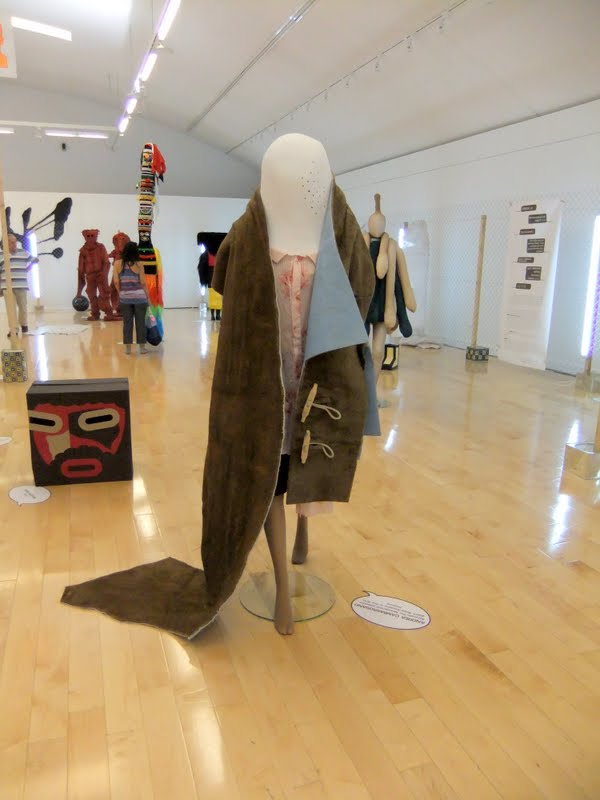
Arrrgh!  Monsters in Fashion exhibition at the Benaki Museum on Pireos Street.

In Greek, the word monster can also mean: the unusual, or object that causes surprise.


We had to pull two black curtains open, walk through a dark corridor and then enter through a hole in the plasterwork to get to the exhibition.


Mareunrol's Private detective collection, 2008


Wire fencing surrounds us all around, and there are rolls of wire on the floor


There is a wire cage with two manequins trapped inside (note the multiple lips, as well as the lip imprints on the floor)


Charlie Le Mindu, Kiss Freak, 2011


The whoke spectacle is totally overwhelming and great fun. We wandered around the manequins for hours, pointing, exclaiming, admiring. There were lots of people around, the look on children's faces was a real pleasure to see.

This is how the organisers of the exhibition introduce it:

"In contemporary fashion the human body is constantly mutated and transformed into an unknown, bizarre and many times monstrous figure. Designers and artists experiment, give shapes to textiles, forms and volumes and dress the human body by creating hybrid creatures with supernatural shapes, vibrant colours and surprising abstract elements. These experimental creations become parallel worlds proposing and bringing to surface different realities".


"In globalised society, the meaning of 'natural' beauty is questioned. What is attractive and desirable in one culture can be repulsive in another. If we go back to human history, in different cultures, as well as in the subcultures of today's society, we realise how impressively the human body is reinvented again and again in totally different ways; ways that have a strange, unnatural, outrageous and constantly unpredictable innovation. Here, fashion is not much about 'who I am' (the impression I make with what I wear) but 'what I experience' (the effects that this body and appearance have on my brain)".


Ne-Net/Kazuaki Takashima, Hero Nostalgia collection, 2009-2010


"What lies hidden behind a person or an identity? And what constitutes identity in a globalised, secularised society in which we see ourselves both as a citizen of the world and as a member of a local community? Besides our real lives we now also lead virtual, digital lives on the internet. And who do we become when we look within ourselves and give our fears and fantasies free rein? These are the issues and uncertainties addressed by designers and artists in the exhibition. Here, as viewers our imaginations are stimulated and doorways to imaginary worlds, full of fears and colouful fantasies are opened wide".


Andrea Cammarosano, Serenada por Neanderthal collection, 2007, Royal Academy of Fine Arts, Antwerp


Andrea Ayala Closa Denominate a Space collection, 2007, Royal Academy of Fine Arts, Antwerp


Andrea Ayala Closa, Denominate a Space collection, 2007, Royal Academy of Arts, Antwerp


Bronwen Marshall, Give me Back my Name, graduate collection, 2009 Royal College of Art, London


Rozalb De Mura, The Remains collection, 2010


Pierre-Antoine Vettorello, Bonnie Magnum vs Samantha Beretta collection, 2009, Royal Academy of Arts, Antwerp


Pierre-Antoine  Vettorello, Bonnie Magnum vs Samantha Beretta collection, 2009, Royal Academy of Fine Arts, Antwerp


Mareunrol's, Nightmare collection, 2006


Issey Miyake and Dai Fujiwara, 'Monkey' , 2001


Issey Miyake, ' Flying Saucer', 1994 


Ara Jo, Whitemare, graduate collection, Central Saint Martins, London


Shin Murayama, Amadeus, 2010


and a different view


Luis Lopez-Smith, graduate collection, 2009, Royal College of Art, London, and Charlie Le Mindu


Bernhard Willhelm, Ghosts, 2003, Collection ModeMuseum, Antwerp, Belgium


Dr Noki's NHS, Dr's Noki Purple Reign, 2011


Hideki Seo, Swimming in the Garment, graduate collection, 2005, Royal Academy of Arts, Antwerp


Walter Van Beirendonck, Sexclown collection, 2008


 Walter Van Beirendonck, Stop Terrorising our World collection, 2006-07


Isabel Mastache-Martinez, The Soldiers collection, 2010


Ara Jo, Whitemare, 2009, graduate collection, Central Saint Martins, London


and a side view


Charlie Le Mindu, Girls of Paradise, 2010


Christophe Coppens, 'Hug', Cape, 2006


Isabel Mastache Martinez, Tin Soldiers collection, 2010


and a closer look, just in case you missed it!


Pyuupiru, Mercury/PLANETARIA, 2001


Unfortunately I did not record the name of the designer for this one,


but here is a closer look


Bernhard Willhelm, Ghosts, 2003, Collection ModeMuseum, Antwerp, Belgium


Kazuaki Takashima, Moyamoya collection, 2008-09


Maison Martin Margiela, 2009


Charlie Le Mandu.


We had such great fun!