British Ceramics Biennial at The Potteries Museum and Art Gallery
Having spent a considerable amount of time at the Spode factory (which you can see
here,
here,
here and
here ) we moved to the Museum and Art Gallery to view the work of the finalists. The Museum itself was a wonderful experience with a fantastic atmosphere and it was teeming with people. There were Diwali performances going on both in the theatre and the entrance hall. The permanent exhibits were quite interesting and I wish we had been able to look at the considerable number of Lowrys in the gallery, but we were totally 'arted out' by the end of the day. We had delicious Staffordshire oatcakes in the café and were impressed by how friendly the people serving there, are.
The gallery space where the work of the finalists was exhibited.
Nicholas Lees
'Whilst considering cast shadows as an example of transition between two and three dimensions I became fascinated by the penumbra, the half shadow between light and shade. I am attempting to realise potential ambiguity and uncertainty in its material equivalent, the boundary between matter and space. The edge of the clay, the difference between its presence and absence, is finite and abrupt. However the boundary between light and shade appears infinite in its gradation and is indistinct...'
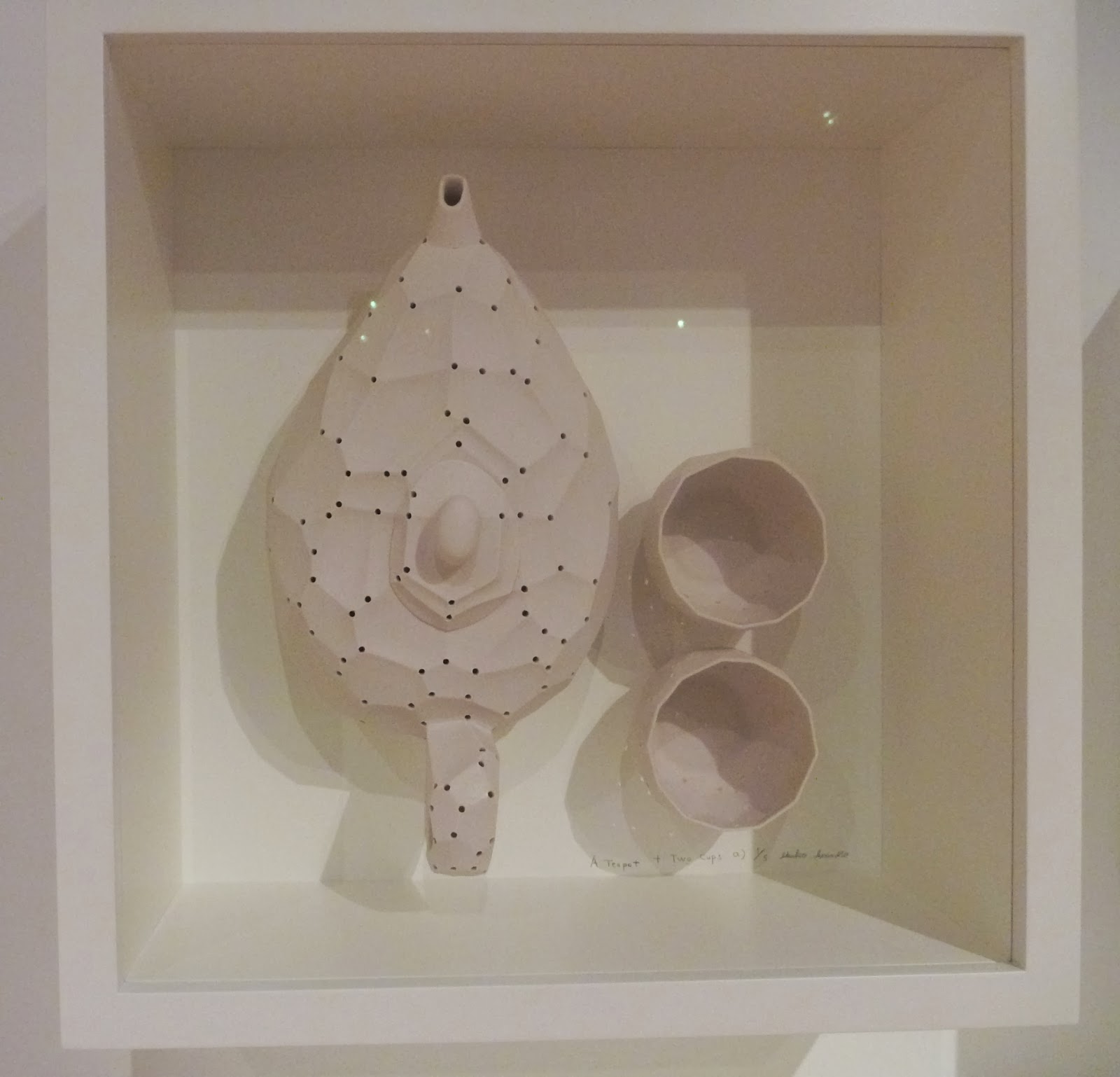
Ikuko Iwamoto
'I started planning this framed sculpture project two years ago. The shape/form is the central thing with this project and I regard these ornamental things such as spikes, dots, holes and so on as simply vocabularies to express my work.
I keep my work unglazed and without colour. When it comes to ceramic sculpture I have thought that having lots of colours will lessen the rawness and intensity of the work'.
looking closer
Malene Hartmann Ramsmussen
Skifting
A Skifting (Changeling) is a creature found in European folklore and folk religion. It is typically described as being the offspring of a fairy, troll, elf or other legendary creature that has been secretly left in the place of a human child. Some Norwegian tales tell that the change was made to prevent inbreeding: to give trolls and humans new blood, humans were given children with incredible strength as a reward.
James Rigler
'Clay is the stuff of palaces and plates, and material both architectural and domestic. With no form of its own, it's peculiarly able to shape-shift, adopting the forms and symbols of other things. And if it's all about finding the right signs, can we begin to transform one place into another, just by playing the game?'
Edith Garcia
Jonathan Keep
'3D printing enables me to get information out of the computer and made directly in the clay. Like automated coil building the printer constructs the pot layer by layer offering a physical object that can be held in the hand in a very short time span.'
Christie Brown
The Uncanny Playroom
'My figurative ceramic work is informed by a relationship with the past through history and narrative. Archaic fragments and legends associated with origin offer a glimpse of continuity with our ancestors and provide a key source of reference for the work. In the uncanny realm of the figure, an idealised or perhaps disturbing representation of ourselves, the potential exists to for the imagination to create an animated narrative. As we humans project a rage of emotions onto objects, perhaps these objects have a life of their own.
In the Uncanny Playroom the figures are seated in a pose reminiscent of the one adopted for over 3,000 years in Egyptian art. The work evolved over many months as additions of found objects and clothing were added. As a child I had a playroom school in which all dolls and teddies had their own personalities and levels of ability. This memory has developed into a range of connected but individual characters, preoccupied within their own dream-work narrative'.
Jin Eui Kim
'I am a ceramic artist engaging with concentric three-dimensional ceramic forms, exploring ways in which the perception of these forms can be manipulated by the arrangement of tonal bands on their surfaces.
On the surface, I restrict information (data) of reality by monochromatic palette, matt surface and simple forms so that I can create ambiguity which makes viewers confused between reality and illusion. The duration of the viewer's attention, viewer's position, tone or colour of the background are also crucial influencing factors for the creation of such illusions.
I create the majority of my works mainly by wheel-throwing and applying the eighteen tones of engobes onto the surface by brushing. The eighteen tones range from light as white to very dark almost black. The gradation of tones is achieved by the addition of the correct percentage of black stains and the right firing temperature at 1120oC. While earthenware is essential to this firing temperature as it gives a lower percentage of shrinkage in the firing'.
Louisa Taylor
'The source of inspiration for my work stems from museum collections of 18th century wares. The 18th century was a time when new foods such as rice, pasta, and cocoa were being imported into the country.
The Papillion series explores the 'landscape of the table'. I like the use of trompe d'oeil and in the base of each piece, a moulded texture of foodstuffs relevant to the historical period is revealed as the contents of the vessel are served'.
Matthew Chambers
Crossover blue
'I consider much of my work to be an abstract expression of my making history, as it drives the rhythm into the pattern and the pattern into the form in many of my sculptures. Crossover blue is made to fully express this commitment and a harmony in the handmade, with a rhythmical sequence of my production past and my sculpture today'.
Lara Scobie
'Working with clay is as exciting and frightening as a roller coaster ride, presenting as many challenges as rewards'.
Claudia Clare
'I make pots to tell stories. The pots in this show depict British royal events, the funeral of a North London gangster, the execution of a sixteen-year old girl in the name of religious and national honour and the meeting of the character from Irish fiction with an English writer of 'bonkbusters'.
I thought this was a very strong exhibition. Had I been on the judges' panel I would have found it extremely hard to choose the winner, being torn between Ikuko Iwamoto's delicate, beautiful framed sculptures and the magical world that Christie Brown created.