Wednesday, 22 January 2014

Cindy Sherman - 2


Cindy Sherman - A Retrospective, at the Museum of Modern Art in New York.
 
We saw this exhibition in New York in April 2012.  This is the second post on this vast exhibition that spanned the majority of Sherman's working life - you can see the first post here .
 
 
Even though Cindy Sherman always photographs herself, her photographs are not self-portraits, but rather an investigation of contemporary identity and the nature of representation. In her photographs she reveals and critiques the artifice of identity and how photography is complicit in its making. Through the variety of characters and scenarios that she employs she addresses the anxieties of the self in our society by projecting personas and stereotypes that are deep seated in our shared cultural imagination. Her work reveals how surface appearances and the fleeting images that we are bombarded with are often mistaken for content and depth.
 
Sherman insists that she is not a photographer but instead, an artist who uses photography. She is concerned with the way photography has shaped our world, particularly in the construction of female identity. She presents female identity as masquerade, and consequently places herself in the centre of postmodern discussion on the nature of femininity, defining Woman as a construct that depends, for social, political and erotic reasons, upon masks and masquerade. The woman who is constructed by culture, is according to Joan Riviere, already an impersonation. Womanliness is mimicry, it is masquerade. Gender exists only in representation. 


The Centrefolds (1981):
 
 
The Centrefolds are send-ups of men's erotic magazine centrefolds, depicting a variety of young women, mostly in supine positions, photographed close up and cropped so that they seem compressed into the frame. In many of the pictures the women are in a state of reverie of day-dreaming, staring outside the picture frame. The characters are in extreme emotional states, ranging from terrified


#92 


to melancholic


#88.
 
 
Sherman plays into the male conditioning of looking at photographs of women, but she takes on the roles of both male photographer and female pinup. They are the antithesis of what a viewer expects to see in a centrefold. 


#96


#94


#85


 #87


#95


Fashion photographs:

Sherman's photographs for her first fashion commission for a New York boutique are parodies of fashion photography combining elements of slapstick humour and theatricality. Rather than projecting glamour, sex or wealth, they feature characters that are far from desirable : they are goofy, angry, challenging conventional notions of beauty and grace. These are powerful and strong women and the characters have an eccentric almost gothic quality. 'I'm disgusted with how people get themselves to look beautiful. I'm much more fascinated with the other side... I was trying to make fun of fashion'.

Her next commission was for Vogue: 'This is going to be in French Vogue. I've really got to do something to rip open the French fashion world. I so wanted to make really ugly pictures... The first couple of pictures I shot they didn't like at all... That inspired even more depressing, bloody, ugly characters'. The characters have bloodshot eyes, bruises, and unflattering pancake makeup  with a suggestion of implicit violence, but the clothes are luxurious and expensive.

When Harper's Bazaar and Comme des Garcons hired Sherman, they were embracing her challenge to the conventions of high fashion and beauty and were acknowledging that their own clothes and media influence were complicit in the masquerade of fashion. The ideas of the postmodernists were now co-opted by the very media they were commenting on.


# 122
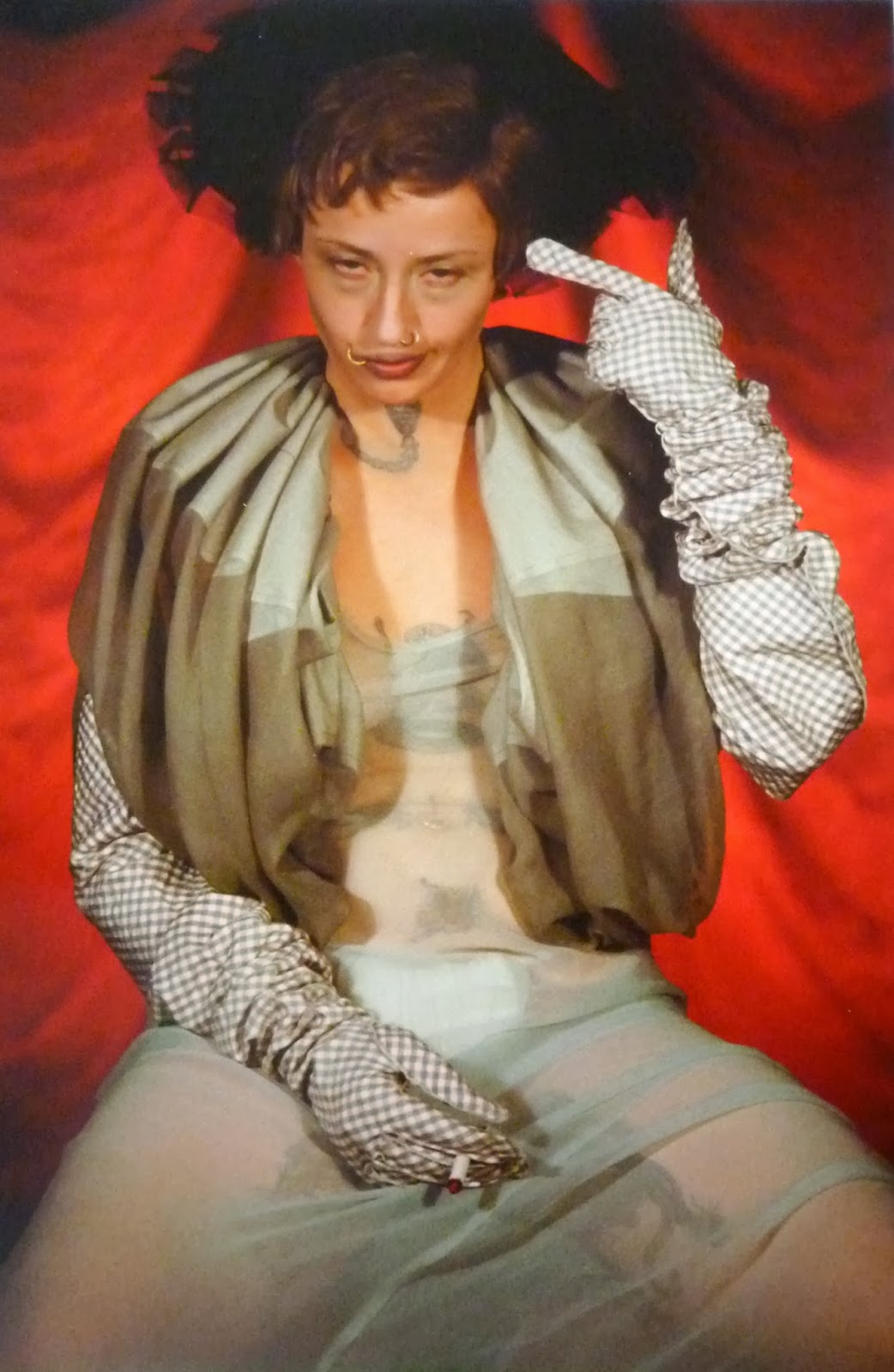


#299


#458
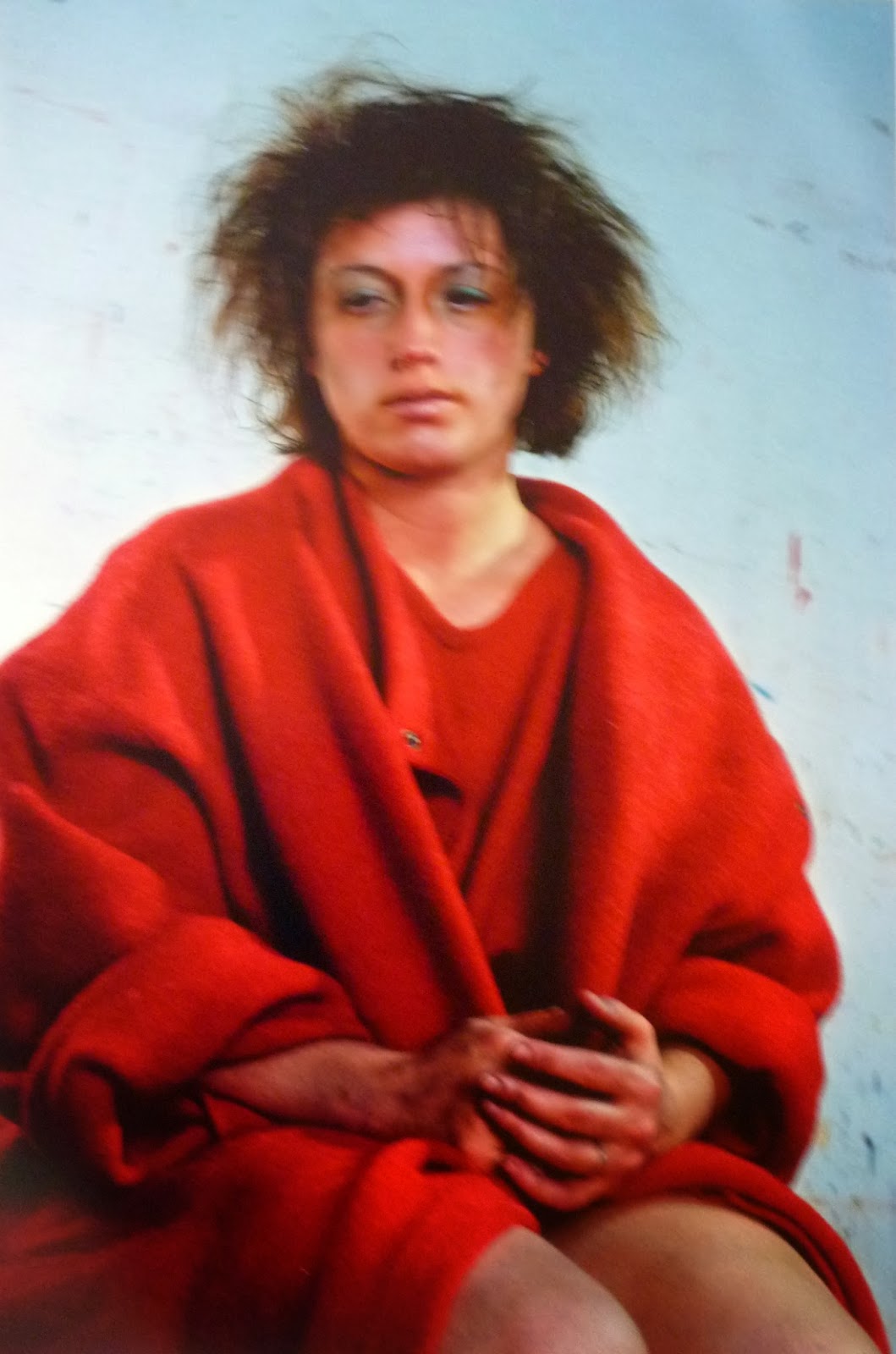


#137


#131


#461


The Fairy Tale Series (1985):
 
Jewel-like colours and menacing visions, encompassing a nightmarish perspective on the world - something that becomes increasingly pronounced in Sherman's work in the years to follow. With the Fairy Tales she introduced prosthetic parts as a stand-in for the human body, a practice that would soon replace the figure altogether.


#140


#150


#153
 
 
Disasters (1986-89)
 
In this series she continued with the themes and motifs explored in the Fairy Tales: mutilated body parts, blow-up dolls, rotting food and substances that look like vomit, faeces and blood. 'I wanted something visually offensive but seductive, beautiful, and texture as well, to suck you in and then repulse you'.  These grotesque works marked a turn away from the representation of women. 'I'm pretty disgusted with the art world in general. The boy artists, the boy painters, the collectors, the crawl, the climb, and stabbing each other to the top sort of competition. I don't know why that work would come out from those feelings, but I think I wanted to make something that I couldn't imagine anybody buying'.


#182


#191


#177


The sex pictures (1992):
 
Sherman wanted to make explicit pictures but was not interested in photographing herself nude, so she used dolls bought from medical supply catalogues, arranged them to simulate sex acts and mimic hard-core pornography, and photographed them, sometimes in extreme and disorienting close-up - a mix of female and male that evoked the crossbreeds from the fairy tales.
 
Mannequins and sex dolls are usually idealised versions of women's bodies with unrealistic proportions and Sherman's use of medical dolls with gaping orifices and her mix of female and male parts


#263
 
 
challenge fetishized female sexuality. She forces viewers to confront their own preconceived ideas about sex, pornography and erotic images. 'They were a refusal to make a sexy image about sex' she argues. 'I never wanted to do that. Nudity can be a cop out. That is why I use fake tits and asses, to avoid sensationalisms, which I wanted to subvert'.
 
The sex pictures are distinctly unerotic. While the scenarios are pornographic, the bodies themselves are sterile and medical, and they simply mimic erotic poses and acts. They make one keenly aware of the cycle of fetishism and voyeurism on which pornography thrives. 'I got the feeling at the opening and at the other times I would walk into the gallery that people would look around and quickly leave. I think someone told me that they couldn't stay in the gallery very long... I think the show made people very uncomfortable'.
 
At one level, the sex pictures were Sherman's response to Jeff Koon's paintings of himself having sex with his wife, a former porn star also known as Cicciolina. 'The censorship issue is important... I felt that my previous show was so commercially successful that it made sense to go out on a limb in these difficult times. I thought I might as well really try to pull out all the stops and just make something that directly deals with sexuality and censorship without compromising my values'.
 
Her sex pictures reflect a fear of the body and suggest the degeneration and dehumanisation of sexual desire. Her photographs are also a critique of the Surrealists who engaged a fantastical dismemberment of the female body.


#155


#250


#258


Uncomfortable viewing indeed.


Source:
 
 Cindy Sherman: Johanna Burton, John Waters, MOMA.


Monday, 20 January 2014

Bridget Riley

 
Bridget Riley at the White Room Gallery, Leamington Spa.
 
 
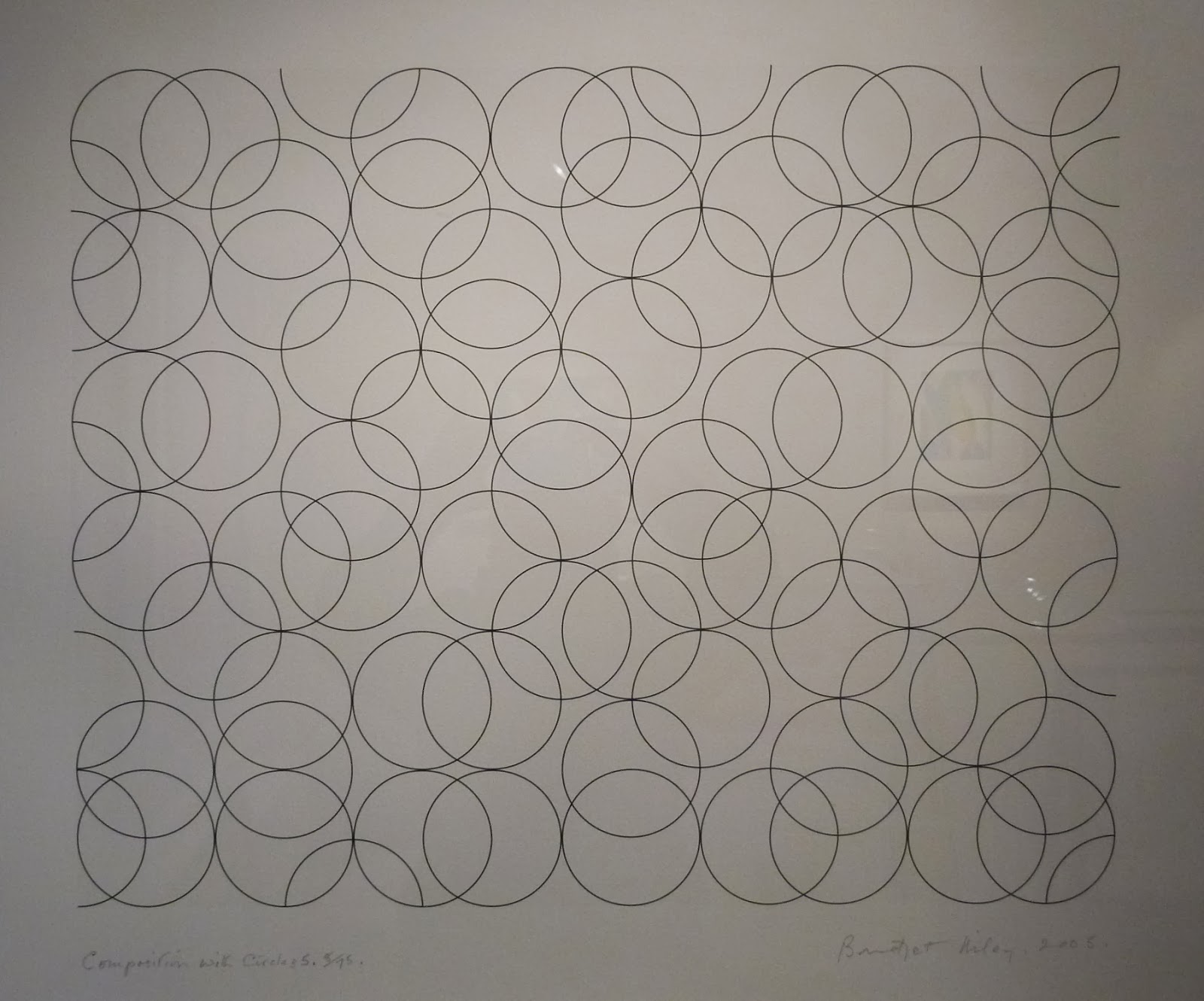
Famous as an early proponent of Op Art,  Riley flirted with pointillism before discovering her own method of treating optics in paint. Around 1960 she began to develop her own style consisting of black and white geometric patterns that produce sensation of movement, explore the dynamism of sight and produce a disorienting effect on the eye. Some viewers have said that her works induce a sensation of being seasick or that of sky diving. The sensations you experience as you look at one of her paintings change as you look, generating what Riley calls 'a stimulating, an active, a vibrating pleasure'. It is furthermore difficult to fail to observe that in her writing and interviews Riley likes the word 'sensation' better than 'perception'.
 
Visually, her works relate to many concerns of that period: a perceived need for audience participation, the Happenings, CND marches, student protests - Riley pulled this energy and activity back on to the surface of the canvas, creating paintings that were themselves Happenings; challenges to the notion of the mind-body duality which led Aldous Huxley amongst others, to experiment with hallucinogenic drugs; concerns with a tension between a scientific future which might be very beneficial or might lead to a nuclear war; and fears about the loss of genuine individual experience in a Brave New World.
 
Riley began investigating colour in 1967 when she produced her first stripe paintings. 
 
'For me, drawing is an inquiry, a way of finding out - the first thing that I discover is that I do not know. This is alarming even to the point of momentary panic. Only experience reassures me that this encounter with my own ignorance - with the unknown - is my chosen and particular task, and provided I can make the required effort the rewards may reach the unimaginable'.
 
'You cannot deal with thought directly outside practice as a painter: 'doing' is essential in order to find out what form your thought takes'.
 
Apologies for the poor quality of the photographs, not just the reflections and the lights, but of my shadow too.


Magenta and Blue 


Magenta and Yellow 


Magenta and Green 


And About 


Fold 


Large Fragment 


Composition with Circles 5, 2003 


Untitled (La Lune en Rodage - Carlo Belloli)


Untitled (Elongated Triangles 5) 


Untitled (Elongated Triangles 2)


Saturday, 18 January 2014

Herbert Art Gallery: Re-hang


 Roderic O'Conor, Trees at Montigny, 1902 (oil on board)


Robert Bevan,  Brimley Hill, Devon, 1915 (oil on canvas)
 
Bevan lived in Brittany in the 1890s where he worked alongside Paul Gauguin. His use of strong outlines and areas of flat colour was heavily influenced by Gauguin and other post-impressionist artists. In the 1900s he moved to London and became a member of the Camden Town Group of artists.


Christopher Nevinson, Summer in the Downs, before 1946 (oil on canvas)


Frank Salisbury, The Enchanted Road, 1927, (oil on canvas)


Paul Nash, The Stackyard, 1925 (oil on canvas)

Nash's use of colour and short, expressive brushstrokes in this painting show the influence of Paul Cezanne.


L.S. Lowry, Northleach Church, 1947 (oil on canvas)

A scene from the Cotswolds, a contrast to the heavily peopled northern industrial scenes for which he is best known.


Harry Norman, No. 1 Composition, 1938, (oil on board)


David Bomberg, Evening, Cornwall, Towards St Ives, 1947 (oil on canvas)


Joan Eardley, Glasgow Boy with Milk Bottle, 1948 (oil on canvas and board)

Eardley's works exposed child poverty in post-war Britain, particularly in slum areas.


L.S. Lowry, Ebbw Vale, 1960 (oil on canvas)

A mining town in South Wales, this is one of the largest pictures Lowry painted.


George Chapman, Miner Returning Home from Work, 1960, (oil on canvas)

The mining valleys of South Wales were the focus of Chapman's paintings. He saw his work as visual history and chose to depict the Rhondda Valley from the viewpoint of a stranger in the street. His paintings feature the simple shapes of the houses and streets of the mining villages, dominated by looming slag heaps in the distance.


Henri Matisse, Odalisque with a Dish of Fruit, 1925 (lithograph)


Henri Matisse, Two Female Figures, (lithograph)


Graham Sutherland, Final Trial Piece for Coventry Cathedral Tapestry, 1958 (wool tapestry)


Rosie Lee, It's Nice to be Nice II, 1969 (oil on canvas)

Many of Lee's paintings feature landscape gardens and sculpted hedges, often from perspectives that reveal only glimpses of what may lie beyond. In this painting the sense of seeing and not seeing is heightened. The faces of the figures are obscured and the person in the dark foreground is hidden from the view of the people in the sunny garden, lending an air of mystery to the scene.


George Wall, Wedge, 1972 (oil on canvas)


Gavin Jantjes,  The first in the Korabra series, 1986, (acrylic, sand and pigment on canvas)
 
All the paintings in the Korabra series relate to slavery and use symbols to convey the suffering caused by the transatlantic slave trade. In this painting the stakes form a trap and represent the white people who took the slaves as prisoners from Africa. The anvil in the centre symbolises the process of hammering the leg irons and chains that bound the slaves.


John Keane, Scenes on the Road to Hell (V), 1991, (mixed media on paper)

John Keane was commissioned by the Imperial War Museum as an official war artist during the first Gulf War. In this painting he uses rapidly applied brushstrokes to evoke the chaos of the front line, in contrast to the more sanitised images that appeared on our television screens. He also references the increasingly voyeuristic nature of war reportage by showing a cameraman looming over the body of a dead soldier.


Ori Gersht, Afterwars, 1999, (photographic print mounted on aluminium) 
  
The Afterwars series was made in and around Sarajevo in the aftermath of the conflict that saw the break-up of the former Yugoslavia in the 1900s. Each photograph shows the scars of war upon the landscape but also the re-building of life. Through the subtle and familiar signs of everyday life, this work explores how people strive to return to normality after conflict.


SPQR, Super Soft, 2010, (spray paint on canvas)

SPQR is a Bristol-based artist who works on the street and on canvas, using complex stencils, freehand spraying and screen prints. He feels that there has been a shift in perceptions of street art and that people are now much more willing to engage with it rather than seeing it as vandalism.

He sees his work as a form of protest, both against wider issues in society and against the intellectual snobbery of the traditional art world. Super Soft encourages the viewer to question the legal system and the role of the police in the UK today.


Peter Howson, Snow Road, 1995, (oil on canvas)

Peter Howson was the official war artist for the Bosnian war, visiting the region in 1993. Many of the drawings and paintings he produced were based on accounts of victims and witnesses.

This painting shows civilians, including small children, travelling down a road as armed soldiers force them on. Howson uses the ghostly, bleak landscape and a muted, cold palette to convey the sense of terror felt in Bosnia at the time, as a policy of ethnic cleansing was enforced. It also demonstrates Howson's own harrowing experience as a witness of war.


Bruce Maclean, Jug,  1987 (handbuilt earthenware)


Edmund de Waal, Lidded Jar, 2001 (porcelain)