Thursday, 25 January 2018

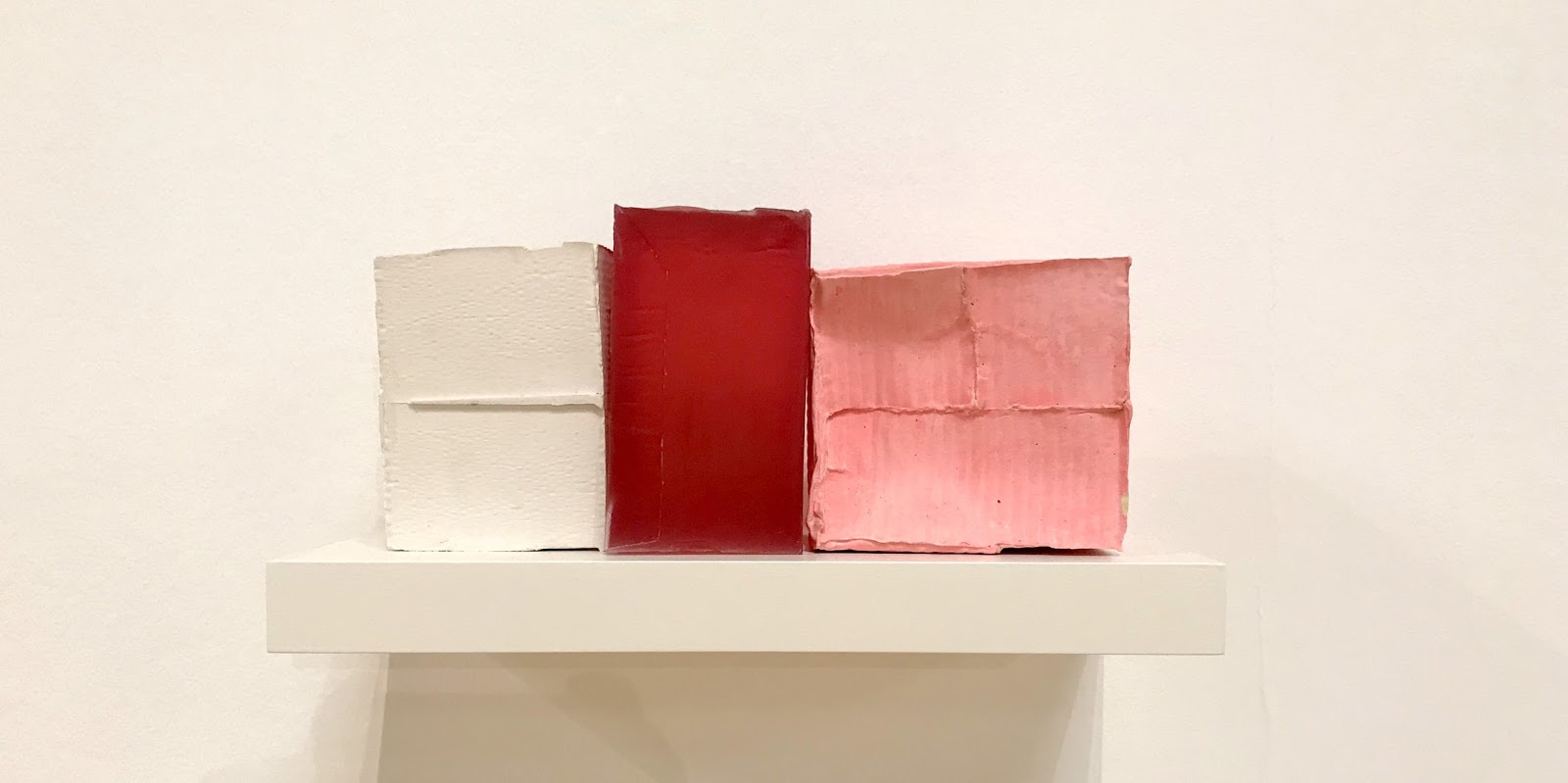
Rachel Whiteread


Rachel Whiteread


at Tate Britain.

Even though I have been a fan of Rachel Whiteread's work for a long time, this is the first exhibition  dedicated entirely to her work that I have seen. I was not disappointed...

Whiteread's spare sculptures are made using the technique of casting, with materials such as plaster, rubber, resin, concrete and metals. Unlike traditional cast sculpture, which is intended to replicate objects, Whiteread's works instead cast the space inside or around everyday forms - such as furniture or boxes - or architectural structures - such as floors, staircases or entire rooms - recording their surfaces and allowing their shapes to determine the form of her sculpture. In this way she explores the human imprint on our everyday environment.


Untitled, (One Hundred Spaces), 1995


This installation is made up of 100 component parts arranged in a grid, the configuration depending on the location. In the Duveen Galleries at Tate  Britain, the parts are placed in a five by twenty formation. Each piece is the cast of the underside of a found chair, made in coloured resin, a material Whiteread began to use early in her career. The process of casting retains the imperfections of the wear and tear of the original objects. As with much of Whiteread's work, the casts are the result of a time-consuming, labour-intensive and technically ambitious method of casting.


Untitled Tiles, 1005, 2017 (lithographic print screen with printed spot varnish on Somerset satin)


Room 101, 2003


Room 101 is a plasticised plaster cast of a room in Broadcasting House, the British Broadcasting Company's headquarters when novelist George Orwell worked there during WWII. The room is believed to have inspired Room 101, the chamber of horror in Orwell's dystopian masterpiece 1984. Whiteread's cast of the room is all that remains of this literary artefact. Every element of the room's surface, including the cracks in a wall or the space between skirting boards and floors, was painstakingly prepared before the room was cast in sections, and the original walls removed.


Untitled (Floor), 1994-95, (polyester resin)


Untitled (White Slab), 1994-2017 (rubber)


Table and Chair (Clear), 1994, (resin)


Ghost, 2009, (polyurethane)


Untitled (Air Bed), 1992, (polyurethane, rubber)


Untitled (Hive), 2007-8, (resin)


Untitled  (Stairs), 2001, (plaster, fibreglass and wood)


Due Porte, 2016, (resin)


Untitled Floor (Thirty Six), 2002, (cast aluminium)


Torsos, 1998, (concrete, resin, dental plaster)


Torsos, 1998, (concrete, resin, dental plaster)


Maquette for Holocaust Memorial, 1995, (mixed media)

You can see more about the Holocaust Memorial in Vienna, here


Wednesday, 24 January 2018

Upside down moon


We had an upside down moon last night. It was also a bright orange colour, which unfortunately does not show in this photograph. It was spectacular.

An upside down moon is a result of the moon's orbit around the earth, and the earth's orbit around the sun. And exactly when you see the moon in the shape of a U (lit on the bottom) rather than a backward C depends on what latitude you are at.

We see the moon in the night sky because it is reflecting light from the sun. So the lit part of the moon always points towards the sun. As the earth travels around the sun, the tilt of the earth on its axis sometimes points the northern hemisphere towards the sun and sometimes points the southern hemisphere towards the sun. But this also changes the apparent path of the moon across the night sky when you are on earth looking out at it.  Sometimes it travels at an angle towards the horizon and sometimes it travels straight down toward the horizon. When the crescent moon travels straight down the horizon, you will get the U shaped moon. This can happen once or twice a year, depending on the latitude of your location.

Monday, 22 January 2018

Elysian Plains - Panayiotis Pasantas


Elysian Plains by Panayiotis Pasantas


at the Athens Art Gallery.


Pasantas' minimalist, off-white clay figurines are inspired by the prehistoric and the archaic sculptures of Cypriot votive offerings. In those ancient Greek and ancestral votive offerings, the inhabitants of rural areas sculpted miniature sets of figurines which were influenced by their everyday lives in order to entrust their protection to the gods. Moreover, their offerings were also intended for use by their loved ones, as they believed in the afterlife.

The Elysian Plains, or the Island of the Blessed, as Paradise was referred to in antiquity, is transformed by the work of this artist to a theatrical stage where his figurines portray the very actors who reflect life and the afterlife. The sculptor indirectly refers to Orphic beliefs where the world emerged 'from the unseen to the visible', through 'Phanes' or the 'Orphic Egg' that is the 'Cosmic Egg'. In this work Pasantas is revealing his inner self by breaking the shell of his own 'egg', in a narrative that is influenced by his ancestral roots and stories. Some of humanity's universal issues relating to the living and those who are on their way to the 'Elysian Plains' are therefore depicted in those sculptures. They are exquisite.


Hope


Breaking Through


looking closer


Connected


looking closer


Incubation


Mirage


Ejection


looking closer


Anima Corda


Welcoming 


Parting


Strife


Hatch


Offspring


Birth


Trapped 


Comforter


Indicator


Death


Saturday, 20 January 2018

Fallen Angel


Phylax, by Kostis Georgiou, a 8-metre high sculpture displayed in Palaio Faliro near Athens, was torn down on Wednesday night. A group of 13 black-clad individuals tied it to the back of a truck and drove away, pulling it down. The bright red sculpture shaped like an angel has been the subject of intense protests by religious conservatives and far right groups since it was installed on December the 5th. The statue had suffered two vandalism attacks before being torn down. The first act of vandalism was covering it with white paint. A couple of days later, unknown perpetrators cut the wires of the tram nearby, apparently thinking that they would cut the power that illuminates the Phylax at night.


Phylax in ancient Greek means guard, watcher and protector. The protesters argue that the image of the red naked man with wings is provocative and symbolises Lucifer, the Dawn-Bringer, the satanic Morning Star, and Devil - red is the colour of the devil, they argue.


Furthermore, on January 3 over 100 Christian residents led by one of the local priests marched to the site and demanded its removal. The protesters held Greek flags, icons and sang humns. The priest sprinkled 'holy water' on the statue in order to 'exorcise its demons'. The protest included an open letter written by the priest declaring that 'the sculpture is a demon and a soldier of Satan, that instead of being honoured must be despised as blasphemous to the holy trinity. It is an affront to Orthodoxy and the Christian faith'.


The final act was on Wednesday night. The wings of the sculpture are now broken.

....

There is no separation between the state and the church in Greece. For the last 600 years the church has embraced conservatism as its credo and has vehemently opposed any form of liberal social, political and cultural change.

Furthermore, the Greek Orthodox Church has long been not just a religious force but also an economic one, with a stake in the Greek National Bank, landholdings second only to the Greek government and has a clergy bankrolled by the state. There are more than 10,000 priests on state payrolls, who cost taxpayers $238 million a year. Tax breaks on the church's landholdings keep even more money away from government coffers at a time when the country is crippled by austerity. The Greek church and its monasteries don't have to pay the unpopular property tax, making the church exempt from austerity.

According to the Kathimerini newspaper, the church was worth 700 million euros in 2008. Stefanos Manos, a former finance minister, reckons the figure is at least 1 billion euros. These figures however do not take into account the many parishes, some of which are very rich, nor property under the direct ownership of Greece's 80 bishoprics, which enjoy considerable independence. It also overlooks the wealth of 450 monasteries. 'There is no accounting system to detail the church's actual income, and no one really knows quite how much land it owns because there is no land register. This situation suits both the church and the state, because politicians are reluctant to upset the Orthodox authorities' says Manos.

The church is too involved in government life and a series of corruption scandals have dogged church leaders in recent years. Those include a thousand-year old monastery's land swap with the Greek government that cost taxpayers an estimated $130 million.

This is the context in which the controversy over Phylax is being played out. The economic and political power that the church yields in Greece has immense influence on its social and cultural life, particularly since the Greek people are one of the most religious in Europe. The Church is opposed to any form of abortion, is against homosexuality and strongly promotes traditional family values.

The Corpus Christi riots in 2013, where the Church united with the neo-fascist group Golden Dawn in their opposition to a play which depicted Jesus and the Apostles as gay men living in modern day Texas is a good example of the role the church plays in Greek society today. Bishop Seraphim, of Piraeus, along with four of Golden Dawn's MPs, filed a joint complaint to stop the play's premiere. They lost in court but won in the streets by stopping Corpus Christi from ever debuting in Athens because conditions at the playhouse proved too dangerous for the actors.

Following the riots, in a public statement Metropolitan Ambrosios of Kalavryta praised the neo-fascist party as protectors of Greece's nationalist identity, calling it a 'sweet hope' for Greece's suffering citizens. In a separate remark, Bishop Andreas, of Dryinoupolis, Pogoniani and Konitsa, referred to Golden Dawn as the 'lads in black shirts, the good fighting lads'.

I don't think I need to say more....

...

You can read more about the Corpus Christi riots here  (second long paragraph). Or, Greece's Fascist Homophobes Have God and Police on Their Side, by Laurie Penny here .