Sunday, 17 January 2021

Chris Offili


Chris Ofili at the National Museum of Contemporary Art, Athens.

Chris Ofili is famous for shocking the world by using elephant dung on a painting of the Virgin Mary. In 1998 Ofili was the first black artist to be awareded the Turner Prize. As well as being provocative, his work is embroiled in a nuanced and complex set of religious and socio-political issues.

His early works draw on a wide range of influences, from Zimbabwean cave painting to blaxploitation movies, fusing comic book heroes and icons of funk and hip-hop. While adopting a simplified colour palette and pared-down forms, his recent works continue to draw on diverse sources of inspiration and are full of references to sensual and Biblical themes as well as explore Trinidad's landscape and mythology.

His primary interest is in documenting and celebrating Black experiences and memorialising and challenging instances of racist violence. He also often returns to themes of religion, particularly as displayed throughout art history.

His paintings often mix Western and Nigerian iconography and ideas in one canvas and also use collage and multimedia techniques to suggest multiplicity and diversity coming together in one space. Almost all of his work deals with elements of Black experience. The work is explicitly anti-racist and often challenges while supremacy and its real (in the streets) and symbolic (in galleries) violence. Ofili is also one of the few artists to make work about police violence against black people, here using a subdued, dark palette, very different to his bright, dynamic paintings.


Liar, (Flue), 200902015 (watercolour, charcoal, pencil on paper)


Black Paranoia, 1997, (mixed media)


Calypso 13, 2019, (watercoour, pastel, gold leaf, and charcoal on paper)


Untitled, 2003, (watercolour and graphite on paper).


Thursday, 14 January 2021

African Art - 1


Ubuntu, African Art 


at the National Museum of Contemporay Art (EMST) in Athens.

An exhibition of contemporary African art which embodies a reflection of the political, historical and cultural pluralism that characterises post-colonial Africa. The South African expression Ubuntu is a bout a collective humanity: 'I am because we are'.

The exhibition spanned five rooms in the museum.


Yinka Shonibare, Winged Victory of Samothrace, 2017


Kemang Wa Lehulere, 2018, (chalk and carved drawing on painted plaster board and plywood, mounted on iron)


Kemang Wa Lehulere, Back to the Wall, 2018,  (reconfigured wood from salvaged schooldesks, 42 glass bottles with cork tops, sand, paper, ribbon 2 resin hands)


Mohau Moddisakeng, Passage, 2017, (inkjet print on epson hot press natural) 


Kader Attia, Untitled, 2017, (ancient Dogo wooden mask, rosary beads, black paper and metal base)


Sanford Biggers, For Alesa, 2016, (bronze)


Sanford Biggers, Us and Them, 1970, (antique quilt, assorted textiles, tar, spray paint, acrylic, glitter)


Tschabalalala Self, Skirt, 2019, (fabric, painted canvas and acrylic on canvas)


Zanele Murholi, Phila I, Parktown, 2016, (silver gelatin print)


Hank Willis Thomas, Only God Can Defeat Us, 2017, (mixed media, sport jerseys)


Mary Evans, Mirror Image, No. 3, (Brown), 2012, (cut and paste paper)


Mary Evans, Mirror Image, No. 2, (Brown), 2012, (cut and paste paper)


Rashid Johnson, Untitled Mask Collage, 2017, (vinyl, spray enamel, oil stick, black soap on panel with walnut lattice frame)


Ifeoma Anaeji, Umu Ada (The Children of the First Daughter, 2016, (mixed media)


Kari Newkirk, Solon 6:46, 2000, (plastic pony beads, artificial hair, metal)


Ellen Gallagher, Abu Simbel, 2005, (photogragure, watercolour, colour pencil, varnish, pomade, plasticine, blue fur, gold leaf and crystals)


Ellen Gallagher, Morphia, 1965, (ink, pencil, gesso, egg tempera, polymer medium, varnish and cut paper on paper)


Laura Halsey, That Fuss Wus Us, 2018, (mixed media, white cement, carpet, foam and wood)


looking in the cubby holes


Monday, 11 January 2021

Kara Walker at EMST


Kara Walker at the Museum of Contemporary Art, (EMST), Athens.

Having missed going to art galleries because of the lockdown in the UK in the spring, once we got to Greece, where the pandemic situation was much calmer, we went to a lot of exhibitions. Knowing that there would be another lockdown in the UK in the winter, I refrained from posting much on art, saving it for the long, dark, grim winter ahead. In the coming weeks and months I will be revisiting some of those exibitions we visited and enjoyed.


Untitled, Kara Walker, 1996 (cut paper and paper mounted on canvas)

Painter, silhouettist, print-maker, installation artist and film-maker, Walker is an artist who explores race, gender, sexuality, violence and identity in her work. 

She is best known for her room-size tableaux of black cut-paper silhouettes. The silhouette is essential to the meaning of her work. It is a potent metaphor for the steotype, which, as she puts it, also 'says a lot with very little information'. The silhouette also allows Walker to play tricks with the eye. There is often not enough information to determine what limbs belong to which figures, or which are in front and behind, ambiguities that force us to question what we know and see. 

At first, the figures in period costume seem to hearken back to an earlier, simpler time. That is, until we notice the horrifying content: nightarish vignettes illustrating the history of the American South. Drawing from sources ranging from slave testimonials to historical novels, Walker's world features mamminies, picaninnies, sambos and other brutal steoreotypes in a host of situations that are frequently violent and sexual in nature. Furthermore, her use of silhouettes allows her to exhibit more violent truth because silhouettes do not show facial expressions.  Initial audiences condemned her work as obscenely offensive, and the art world was divided about what to do. Was this a step backward or forward for racial politics? Several decades later, Walker continues to make audacious, challenging statements that question and challenge.


Her images are really about racism in the present, and the vast social and economic inequalities that persist in dividing America. Racism is a topic most white Amercans are afraid to discuss and admit. Walker wants viewers uncomfortable with the subject to think about why racism is challenging for them to confront. More like riddles than one-liners, these are complex, multi-layered works that reveal their meaning slowly and over time.

For more of her work go here and here


Saturday, 9 January 2021

Christmas cactus


 The Christmas cactus, a gift from a friend to welcome us home, is birghtening our kitchen window sill.


Wednesday, 6 January 2021

The Stratford Gallery - the Japanese collection


The Stratford Gallery have moved to Broadway.

We visited on our first day after self-isolation and it was such a pleasure to be able to look and touch their new collection.


We started our exploration from the third floor, the attic, where the Japanese collection is housed. The works here were curated by Rob Fornell who has selected works that are in some degree a new interpretation of the Japanese tradition in ceramics.

This is only a small selection of what was on show.


Akiko HIrai, Cocoon, (white vase with bud ash, stoneware)


Hiroshi Yamada, Shino Chawan (Echizen hand dug clay body, anagama fired)


Hiroshi Yamada, Ebi (Wild Grape) Shino chawan, (Echizen Hand Dug Clay Body, fas fired with Feidsar Onita details)


Hiroshi Yamada, Shino chawan, (Echizen hand dug clay body, anagama fired)


Hiroshi Yamada, Setoguro (Black-Seto) chawan Hikidashi, (Ecbizen hand dug clay body, natural ash and iron glaze)


This piece had no label as the gallery had only opened the week before and labelling of the pieces was still not completed


Akihiro NIkaido, White Yakishime Vase, Nara period style, (red clay body with white slip, hand built, reduction fired in oil)


Takashi Tanimoto, Raku chawan, (Iga clay body, Frit glaze, oil and charcoal fired)


Takashi Tanimoto, Iga Chawan, (Iga clay body, natural ash glaze, oil and wood fired)


Takashi Tanimoto, Iga Chawan, (Iga clay body, Feldspar, natural ash glaze, oil and wood fired)


Take Nanimoto. Iga Vase,(Iga Clay Body, Feldspar, natural ash glaze, oil and wood fired)


Kiyoshi Yamato, Engraved Vase, (red and white clay body with alumina glaze, gas fired)


Kiyoshi Yamato, Mottled Ash Glaze Vase, (Noborigama fired, red clay body with straw ash glaze)


Kiyoshi Yamato, White Hagi Chawan, (Hagi clay body)


Kiyoshi Yamato, White Hagi Floer Vase, (Noborigama fired red clay body with white Hagi straw ash glaze)


Shigemasa Higashida, Shino Guinomi, (stoneware)


Akira Satake, Tokkuri, (wood fired stoneware)
HikidashinYunomi, (wood fired stoneware)
Tokkuri, (stone fired stoneware)


Masamcichi Yoshikawa, Oribe style chawan, Seihakuji glaze, porcelain


Masamichi Yoshikawa, Oribe style Sakazuki, (Seihakuji glaze, porcelain) 


Akhiko Watanabe, Celadon guinomi (wood fired in a sagar)


Akihiko Watanabe, Guinomi Anagama (wood fired in a sagger with celadon glaze)


Akhiko Watanabe, Tokkuri (Anamgama fired in a sagger with celadon)


Mami Kato, Chokoku Katachi, (sculptural form in porcelain)


Mami Kato, Katakuchi, (porcelain, ice glaze)


Mami Kato, Chawan, (porcelain, ice glaze)


Mami Kato, Guinomi, (porcelain, ice glaze)


Mami Kato, Vase, (porcelain, ice glaze)


Mami Kato, Guinomi, (pocelain, ice glaze)


Mami Kato, Chokoku Katachi, (sculptural form in porcelain) 


looking in.


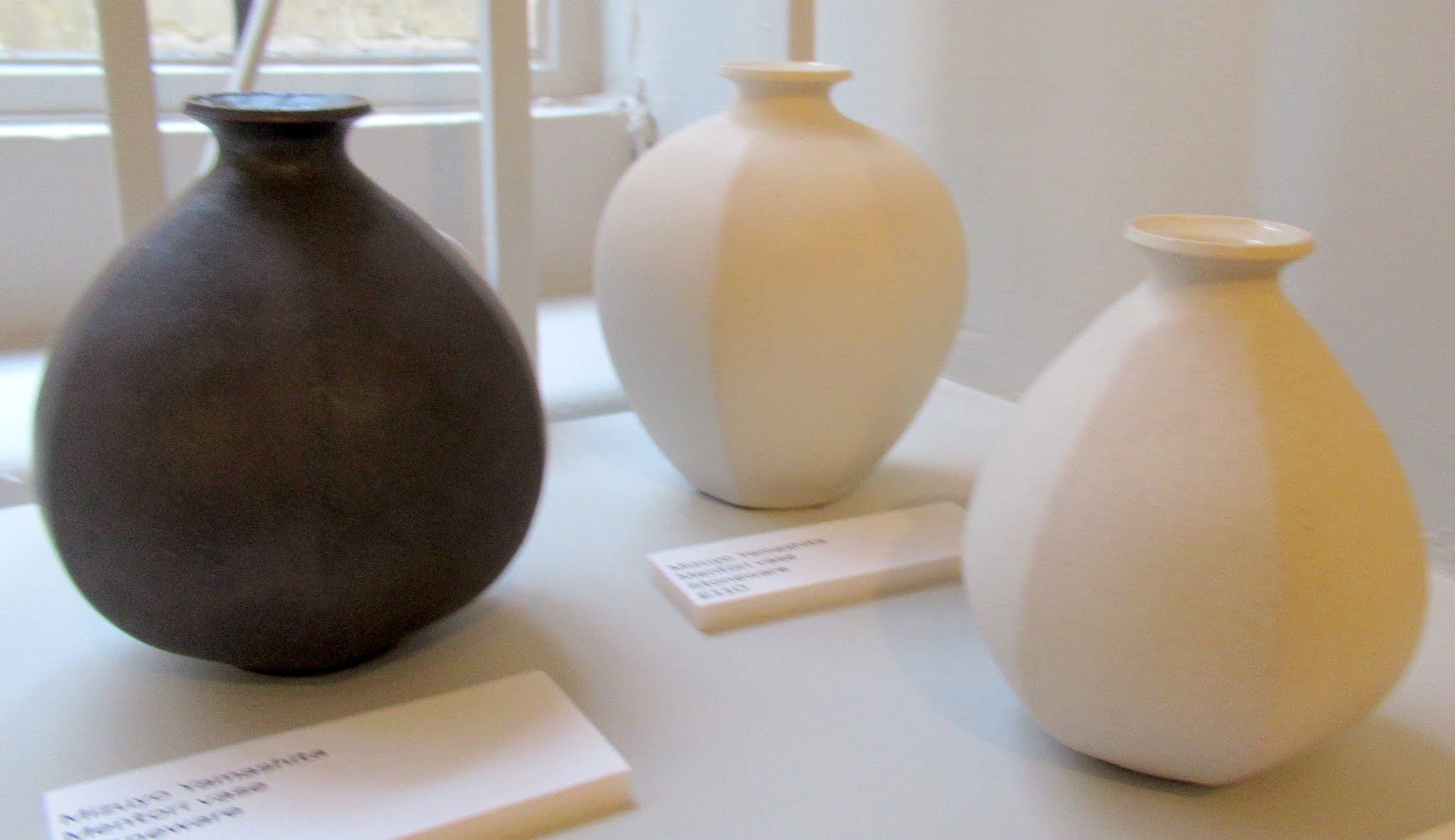
Mizuyo Yamashita, Core Vessel Set


Mazuyo Yamashita, Core Vessel Set


Mitzuyo Yamashita, Mentori Vases, (stoneware)