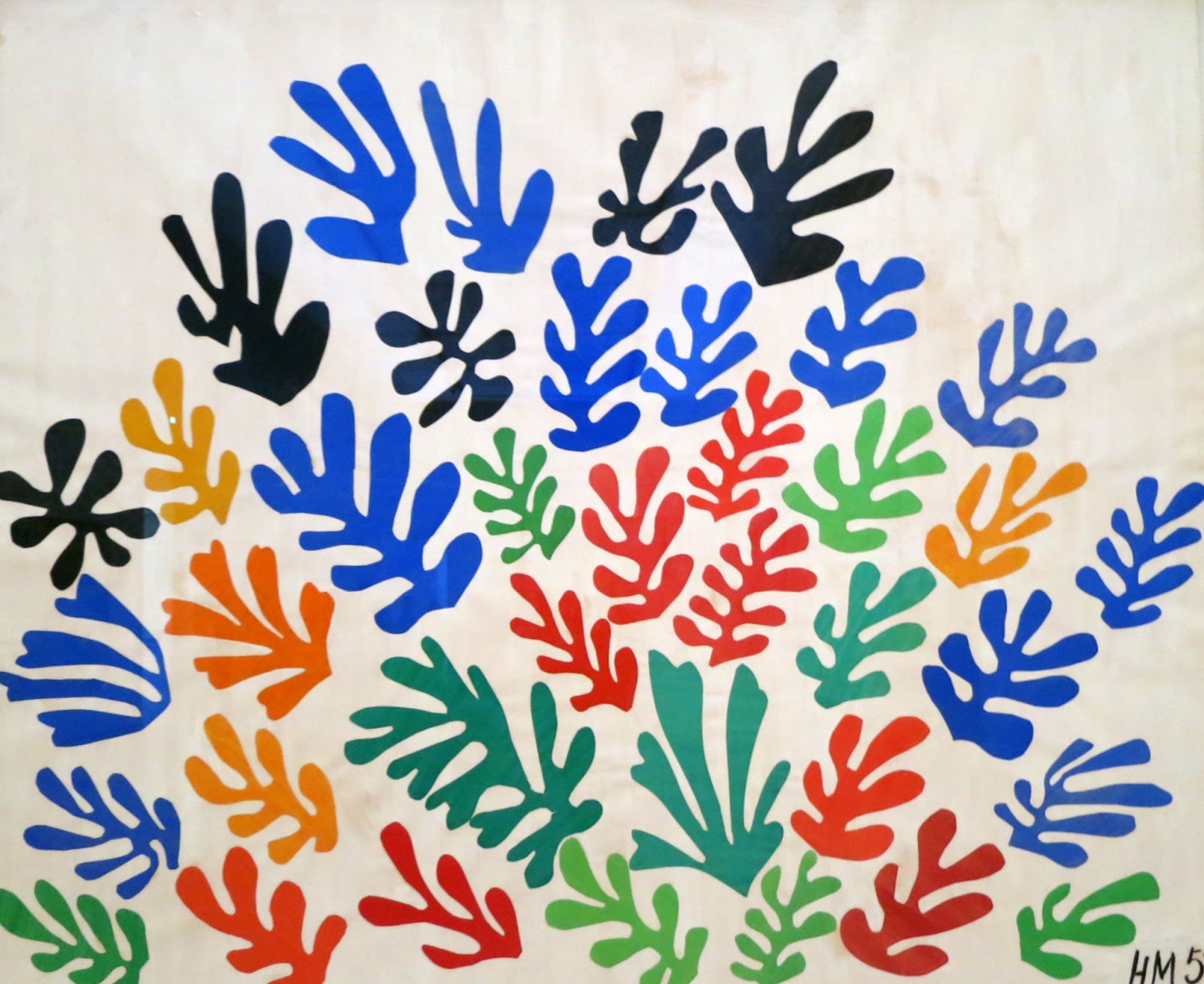
The Oasis of Matisse
at the Stedelijk, Amsterdam.
A large retrospective, this exhibition traces the development of Matisse's artistic practice from his early experiments to the cut-outs of his final years. The exhibition comprises two parts. The first part features paintings, drawings and sculptures by Matisse in dialogue with works from the Stedelijk's collection, including works by Cezanne, Van Gogh, Picasso and others.
The second part of the exhibition features Matisse's cut-outs and will be the topic of a different post.
Still Life with Books, 1895.
Under the influence of Paul Cezanne (see painting below), Matisse simplified his forms and increasingly broke up his compositions into surfaces.
Paul Cezanne, Bottles and Peaches, 1890
The Reader, 1895
Edouard Manet, Woman Reading, 1881
In Manet, Matisse looked for techniques like the reduction of a face to a flat plane.
Vincent Van Gogh, Augustine Roulin, (Woman Rocking the Cradle), 1889
Matisse learnt from the luminous, expressive colours of Van Gogh.
In 1887, Matisse first became fully acquainted with Impressionism. Soon after he broke away from the conventions of the Academy: the dark hues gave way to light colours. He also encountered the work of Paul Signac and Georges Seurat, the founder of Pointillism. Unlike the Impressionists, these artists strove to create carefully constructed compositions consisting solely of light and colour, rather than capturing a fleeting impression of reality.
In 1886, also influenced by Seurat, Van Gogh painted the vegetable gardens of Montmartre in a Pointillist style. This technique failed to satisfy him and like Matisse, he soon abandoned it. After several successful attempts to paint in the Pointillist style, Matisse developed a new approach, creating areas of pure colour. This style later came to be known as Fauvism.
Parrot Tulips, 1905
Pierre Bonnard, L'Esterel, 1917
Une Rue a Arcueil, 1904
Paul Cezanne, La Montagne Saint-Victoire, 1888
For four months in 1905 Matisse devoted his energies to developing a new style, painting with greater freedom than ever. With supersaturated colours, he hoped to create a sensation that imprints the feelings of the artist onto the objects in the work. Later that year his lushly coloured landscaped and portraits caused a scandal. Fauvism was born.
Bather, 1909
Kazimir Malevich, Bather, 1911
Malevich's Bather of 1911 reveals Matisse's influence in both its style and use of colour.
Ernst Ludwig Kirchner, Nude Behind a Curtain, 1910/1926
Standing Nude, 1907
The angular forms are reminiscent of African sculpture, an art form which Matisse was one of the first Modernists to discover
Otto Mueller, Two Boys and Two Girls, 1917
Max Pechstein, In the Dunes, 1911
Nude by the Sea, 1909
Marc Chagall, Self-Portrait with Seven Fingers, 1912-13
Leo Gestel, Reclining Nude, 1913
Vue de Notre-Dame, 1914
A view of Notre Dame as seen from Matisse's studio. In spite of the abstract character of this painting, almost all lines are deductible to reality.
Still Life with Basket of Oranges, 1912
'If one were to compare Henri Matisse's work to something, it would have to be an orange. Like the orange, Matisse's work is bursting with dazzling light'. (Guillaume Apolllinaire)
Standing Nude, 1900-02
* * *
In one of the galleries different forms of abstraction from the period 1915-40 were presented: paintings, works on paper, and applied artworks, all with a strong emphasis on compositional elements and geometric patterns.
The stage and costume designs Matisse created for the ballet Le
Chant du Rossignol (The Song of the Nightingale) produced by
Sergei Diaghilev's Ballets Russes, highlight Matisse's interest in decorative elements. In search of the most effective composition, Matisse cut shapes out of paper and arranged them onto the paper patterns for his designs. He completed the assignment in less than two days, praising the surprising fluidity of scissors for being
'as sensitive as pencil, pen or charcoal - perhaps even more so'.
These early cut-out experiments are remarkably abstract and call to mind Malevich's Russian Suprematism or the abstraction of De Stilj. Matisse would never take abstraction to the extremes of Mondrian and Malevich, but was satisfied with the outcome and the method. Later on, the cut-out technique would play an increasingly large role in his work.
Bart Van Der Leck, Composition, 1918-1920
Piet Mondrian, Composition with Blue, Yellow, Red, black and Gray, 1922
Bart Van Der Leck, Rug, 1930
Costume for a Mourner, design for the ballet Le Chant du Rossignol, 1920
This design for a mourner's costume iterates the geometric forms in Bart Van Der Leck's abstract works
compositions by
Kazimir Malevich
Kurt Schwitters, Untitled, 1941
Theo Van Doesburg, Counter-Composition IV, 1924
* * *
In the 1920s, after a period of experimentation with abstraction, Matisse returned to a more figurative, naturalistic style. He painted harmonious, luxuriant interiors crammed with colourful fabrics and other decorative elements. With a myriad of props, costumes and accessories, he evoked a paradisiacal dream-world inhabited by exotic women in indolent, seductive poses. This is a well-known motif in art history and frequently appears in 19th century 'Oriental scenes'. By taking on such a classic theme, Matisse was measuring himself against such classical masters such as Renoir or Ingres.
He gave a modern interpretation of 19th century Orientalism. The early paintings are strikingly realistic, but from 1928 onwards he increasingly integrated the female form as a decorative element in his composition.
Henri Laurens, Autumn, 1948
Matisse was intrigued by the fluid movements and lines in the sculptures of Henri Laurens. In his celebrated cut-out series of blue nudes Matisse used a similar visual language.
Jean Brusselmans, Woman on a Sofa, 1937
Two Odalisques, One Undressed, Ornamental Background and Checkerboard, 1954
Odalisque, 1920-21
Pablo Picasso, Nude in Front of a Garden, 1956
After Matisse's death in 1954, Picasso said:
'When Matisse died, he left his odalisques to me'.
Therese Schwartze, Reclining Nude in a Landscape, 1912
Charles Dufresne, Recling Nude, 1927
* * *
The Striped Dress, 1938
Grand Figure, 1941-42
Top: :
Picasso, Heads, 1943
Picasso, Head of a Woman on a White Background, 1943
Bottom:
Matisse, Portrait of a Woman, 1945
Matisse, The Tiare, 1930
* * *
A new and final phase in Matisse's development as a painter began in the 1940s when he started creating an exuberant series of exuberant series of paintings.
Red Interior: Still life on Blue Table, 1947
This new visual language is made up of contrasts: between interior and exterior, between still life and landscape, between straight and curved lines, and more than anything, between flatness and perspective. His gradual development towards a flat, decorative style now attains its final phase, in which the scene is transformed into a composition of areas of dazzling colour and dramatically simplified contour lines.
Interior with Black Fern, 1948
The Dance, 1938.