Showing posts with label neon. Show all posts

Tuesday, 23 December 2025

Connecting Thin Black Lines


Connecting Thin Black Lines


at the ICA, London.

We saw this exhibition in London in August. The exhibition is curated by Lubaina Himid, (one of my favourite artists) who wanted to remember and celebrate a landmark moment in art history, 40 years ago, when a group of black women exhibited together in The Thin Black Line in 1985, at the ICA. The exhibition was challenging the marginalisation of Black and Asian, British women artists within the British art world.


Eleven artists presented their work at the exhibition highlighting the intersections between race and gender and which took on a political definition  of 'blackness' to include British Asians too, due to a shared postcolonial experience. Their practices were as varied then, as they are now, through figuration, abstraction, iconography, minimalism, realism and fantasy.

Himid wrote at the time: 'All eleven artists in this exhibition are concerned with the politics and realities of being Black Women... We are claiming what is ours and making ourselves visible. We are eleven of the hundreds of creative Black Women in Britain. We are here to stay'.


Jennifer Comrie, Coming to Terms through Conflict, 1987, (pastel, photocopy collage and paper on board)


Ingrid Pollard, Seventeen of Sixty-Eight (detail), 2018, (digital print, glass-mounted)

This work forms part of Seventeen of Sixty-Eight, a larger mixed-media installation that examines the recurring figure of the Black boy in British pub names and signage. The title regfers to the 68 pubs in the UK that include 'Black Boy' in their name.


Maud Sulter, Zabat:Polyhumnia (Portrait of Dr Ysaye Barnwell, 1989, (cibachrome print on paper)

Part of a series of nine photographic portraits of creative Black women, staging each as a muse of the arts from Greek mythology, seeking to challenge the lack of representation Black women artists have in art institutions and art history.


Sonia Boyce, Rice n Peas, 1982, (pastel on paper)


Lubaina Himid, Venetian Maps: Shoemakers, 1997, (acrylic on canvas)

Part of a series of works on Venice. Himid observes that 'Venice is a symbol for me, to how people of the black diaspora have for centuries been the backbone of the cultural development of many European cities but that this presence is invisible... Venice looks like it does because Venetians were impressed by North African/Arabic culture, its richness and sophisti ation, its intricacy and its colour and spectacular shifting moving symbolism'.

To see more of Lubaina Himid's work go here


Claudette Johnson. Trilogy: Woman in Blue, Woman in Black, Woman in Red, 1982-86, (watercolour, gouache and pastel on paper)

Johnson instructed the sitters to pose in a way to take up as much space as possible. She also asked them to adopt poses that were reflective of who they are, ensuring that they could 'be seen to exist beyond the trope of the 'strong Black woman''.

You can see more of Johnson's work here


Veronica Ryan, Threads, 2024, (crushed plastic bottles, Himalayan salt, crocheted cotton)


looking closer


Chila Kumari Burman, 2+2 Equals Whatever They Say, 2025:

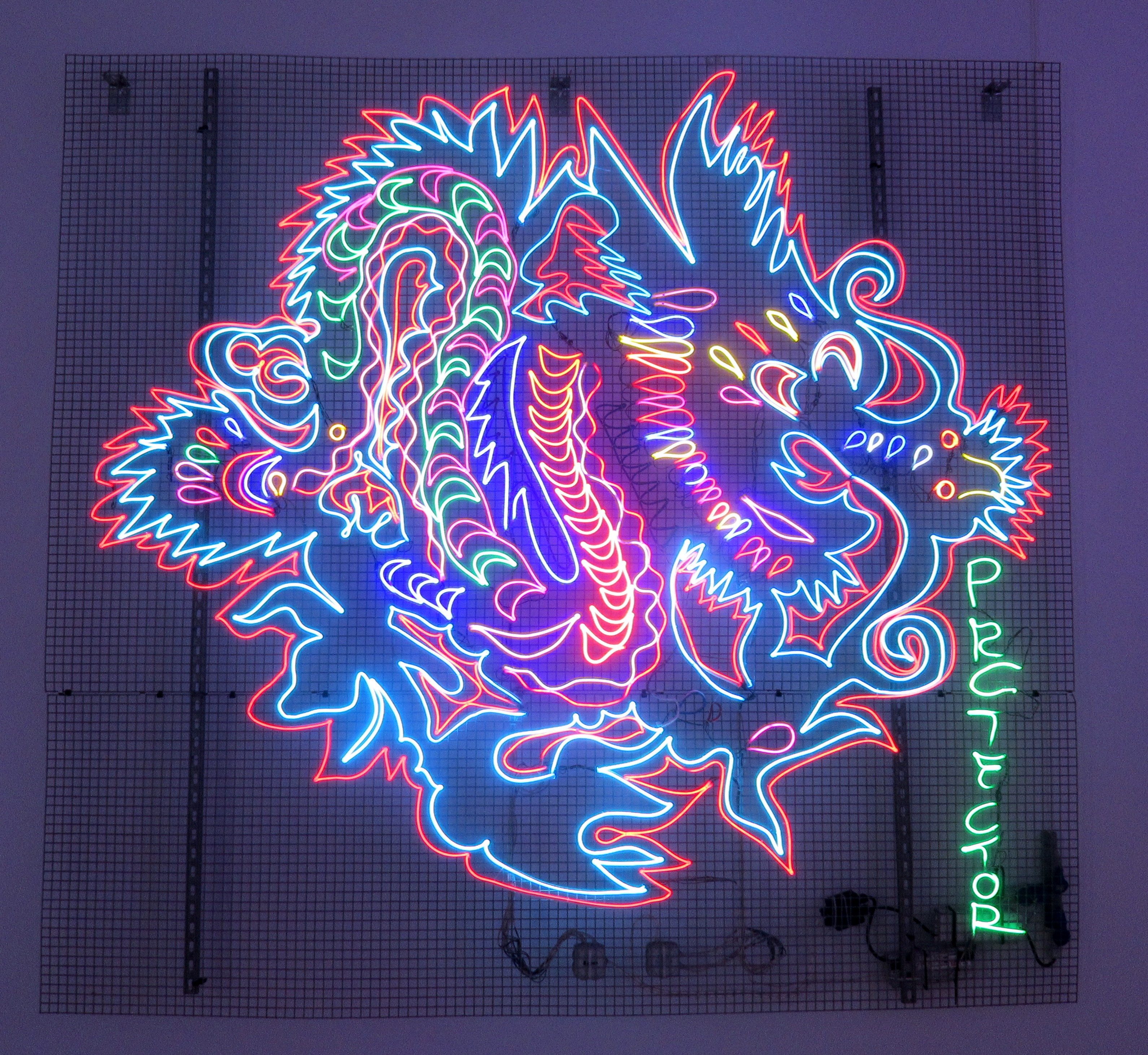
Burman's vibrant neons frequently draw upon everyday objects, popular culture and high art. Her playful style belies a serious belief in challenging stereotypes and positioning alternative perspectives of Britishness in the centre of debate. 

To see more of Burman's work go here  and here


Tiger, 2021


Ice Cream Van, 2020


Protester - Without Us There is No Britain, 2022


Saturday, 14 December 2024

Spectacular Diversions - Chila Kumari Singh Burman: part 2, Neons and Installation


Spectacular Diversions - Neons and Installation, by Chila Kumari Singh Burman

This is the second post on this exhibition. You can see the first post here

As I mentioned in my previous post, Burman is a Punjabi-British artist whose work explores cultural identity and the experiences and aesthetics of Asian femininity. Over the last 40 years her practice has encompassed printmaking, drawing, painting, installation and film to explore the intersection of feminism, race and representation, placing alternative perspectives of Britishness within art history.

In recent years Burman has become known for her colourful neon sculptures which have adorned the facades of historic sites including Tate Britain, Liverpool Town Hall, the Holburne Museum in Bath, Covent Garden's piazza and Brighton Pvilion, as well as being exhibited internationally.

Working with neon has given Burman the opportunity to translate many of the motifs that appear in her prints and drawings into sculptural forms which are infused with energy and retain her bold use of vivid colour. Through careful observation, Burman translates Hindu deities, mythical creatures, animals, ice lollies and ice cream vans into linear constructions that immerse the galleries and public places alike in a kaleidoscopic glow of light, colour, belief and pop culture.


As you can see, Burman has embellished the entrance to Compton Verney with a neon installation of neon sculptures of Hindu gods and goddesses.


We tend to go for a walk around the grounds before going in to see the exhibitions at Compton Verney and during our walk we discovered more neon installations


We then moved in to the galleries and what a delight that was


Snake, 2023, (neon sculpture)


Manga Girl, 2023, (neon sculpture)


Mermaid, 2020, (neon sculpture)


Dancing Girl with Catherine Wheel, 2020, (neon sculpture)


Rainbow Heart, 2021, (neon sculpture)


Hand, 2023


Home Grown Bull, 2022


Playing the Feather Flute, 2020


Dead Souls, 2024


Dragon, 2022


Ice Cream Lips, 2024


Punjabi Rocker, 2022


Tuk Tuk, 2022, (tuk tuk with wallpaper embelished with stickers and faux gems)

Burman's vivid pink tutuk has been decorated with an array of badges, stickers and glittering embellishments and a specially designed collage. The tuk tuk has been adapted to serve as a vehicle for Burman's film works, which immerse the viewer in her Punjabi Liverpudlian world.


Four days after seeing this exhibition we went to Bath for a few days, and what a coincidence it was to find that the Holburne museum also had an exhibition by Burman, albeit a very small one.


The Glowing Canopies (2023) 

This neon installation celebrates the power and beauty of our natural environment. Illuminated neon trees, bees and insects transform the museum's front facade in the artist's largest individual neon sculpture to date. The work highlights the symbol of the tree as a source of life, growth and connectivity, sustained by intricate relationships with other creatures in our ecosystem.

Inside, in one of the galleries, 


My Tiger Janu, (2022)

The sculpture rerferences Burman's ice cream business that was owned by Burman's father in 1960s Liberpool. Her father's ice cream van was crowned with a magnhificent Bengal tiger, an iconic symbol for the family business. Many in the Indian community at that time ran ice cream businesses. For the artist, the tiger symbolises both childhood nostalgia and the resilience and strength of Indian working class communities after migrating from India to Britain.


You can see a similar tiger in my previous post on Burman, but that one is a collage where the tiger is outlined in electric blue.