
Half-a-Wind Show, Yoko Ono - a Retrospective, at Louisiana Contemporary, Copenhagen.

A leading avant-garde artist and pioneer, a feminist who, ironically, has been often defined in relation to her famous husband, referred to as 'the world's most famous unknown artist', Yoko Ono is a unique figure not only in the art world but also in the peace and feminist movements. Very few people are aware of the work she has created or of the important pioneering role her early performances and conceptual works of the 1960s played, and continue to play, in the development of contemporary art.
A lot of her art is based on ideas and on verbal instructions for actions. Much of it is an expression of harsh social criticism motivated by feminist concerns.
She forged a fundamental departure from the convention of the 'work of art' created by the artist at a fixed point in time. She developed her concept of art during the era of the 'dematerialization of the work of art' and she was part of the movement known as Fluxus whose aim was to 'purge the world of bourgeois sickness, intellectual, professional and commercialised culture... to promote a revolutionary flood and tide of art, to promote living art, anti-art, promote non-art reality'.
An integral part of her art was asking for viewer participation in a new way.

We are all Water, 1967 and 2006
'Water is one of the most important constants in our lives. We are also carriers of water. 90% of us is water. In pagan times, water is emotion, love ... 'Water thinks, feels and heals'.

water talk
you are water
I'm water
we're all water in different containers
that's why it's so easy to meet
someday we'll evaporate together
but even after the water's gone
we'll probably point out to the containers
and say, 'that's me there, that one'.
we're container minders

Water Event, joint art work first featured at her first museum exhibition at the Everson Museum in 1971.
Numerous friends and acquaintances of the artist were invited to participate in this event: they were asked to provide containers for water, in to which she added water, or, let's say, conceptual water. Water is described as an element of communication and unity.

You and Me, 1966, 2013

Air Dispensers, 1971/2013
Collecting air, capturing it as a precious commodity, and offering it for sale.

Balance Piece, 1997 (kitchen furniture and utensils, magnets)
Striving for a 'balance of the mind' in accordance with the basic principles of Zen Buddhism, for tranquillity and self-awareness: a process of acceptance and of balancing opposites and attempting to bring them into equilibrium.
Looking at the photograph I took, I am struck by the black and white nature of the installation, something that I was not particularly aware of, at the time.

Half A Room, 1967
Exactly that - half of everything.

Touch Me, 2008, 2009

looking closer

and again

and again,
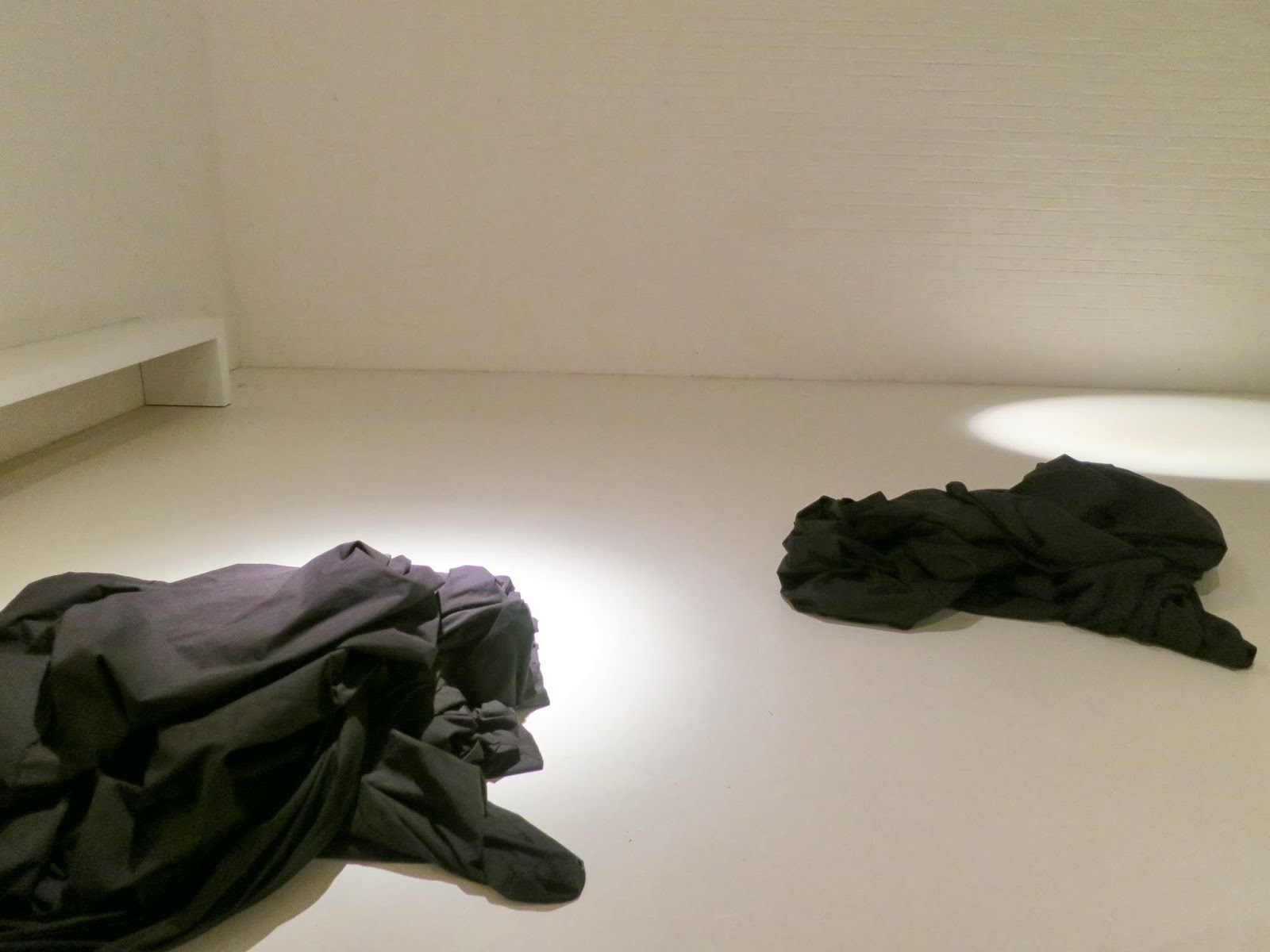
Moving Mountains, 2013.
This work was conceived especially for the exhibition in Copenhagen. Visitors were invited to get into the provided cloth bags and form moving sculptures, on their own or with others. Ono's song Moving Mountains was being played. During the course of the exhibition, photographs were taken of the moving sculptures and displayed on the walls.
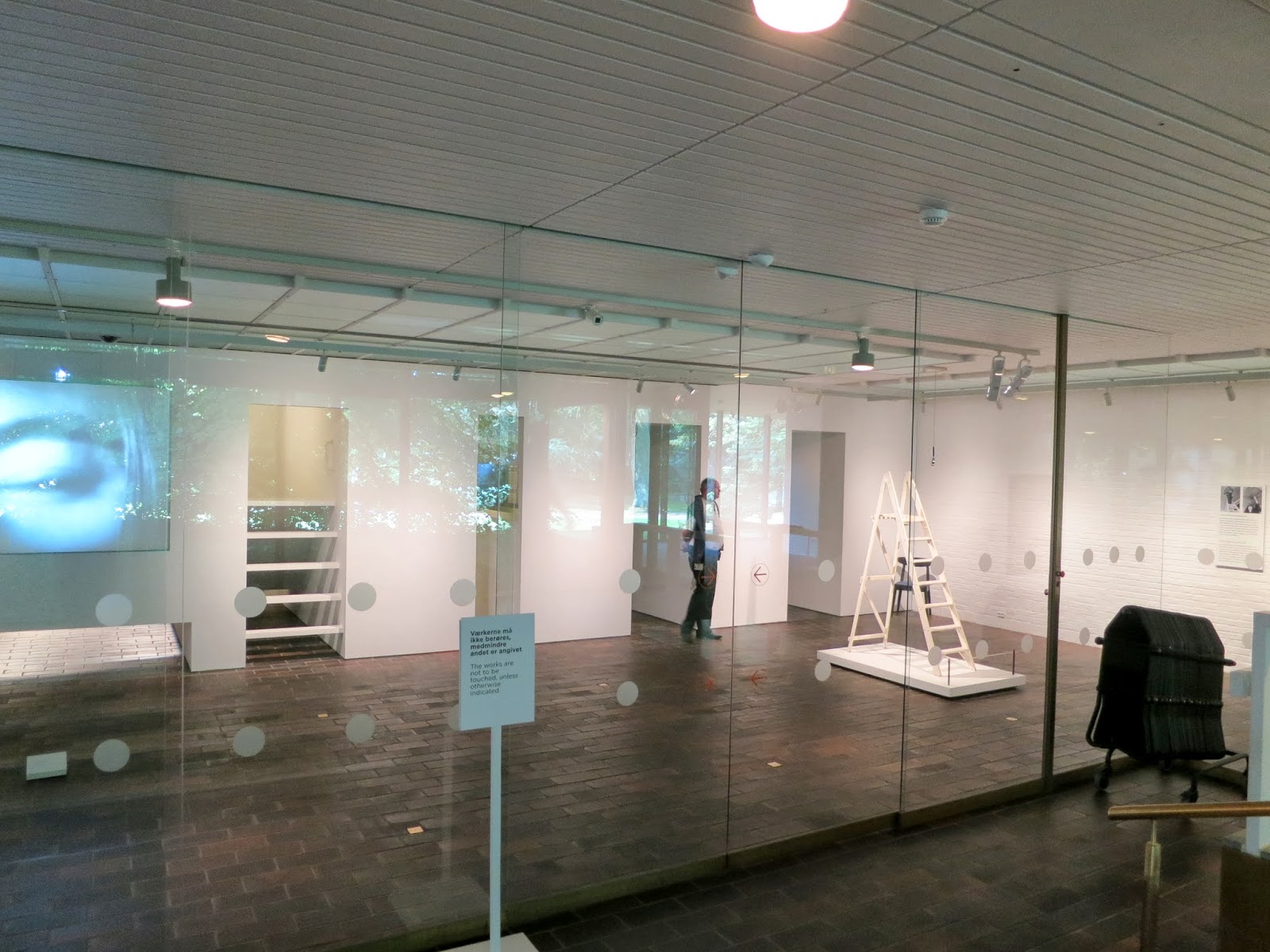
Ceiling Painting (the white ladder on the right of the first exhibition space, featured here). 1966
An interactive installation. The viewers were invited in his or her mind to climb to the top of the ladder, where a magnifying glass hang from a frame on the ceiling. The viewer used the reading glass to discover an instruction beneath the framed sheet of glass: it said YES. It was through this that she and John Lennon met.

Infinity

This was our gateway from the main gallery space to the ones at the back

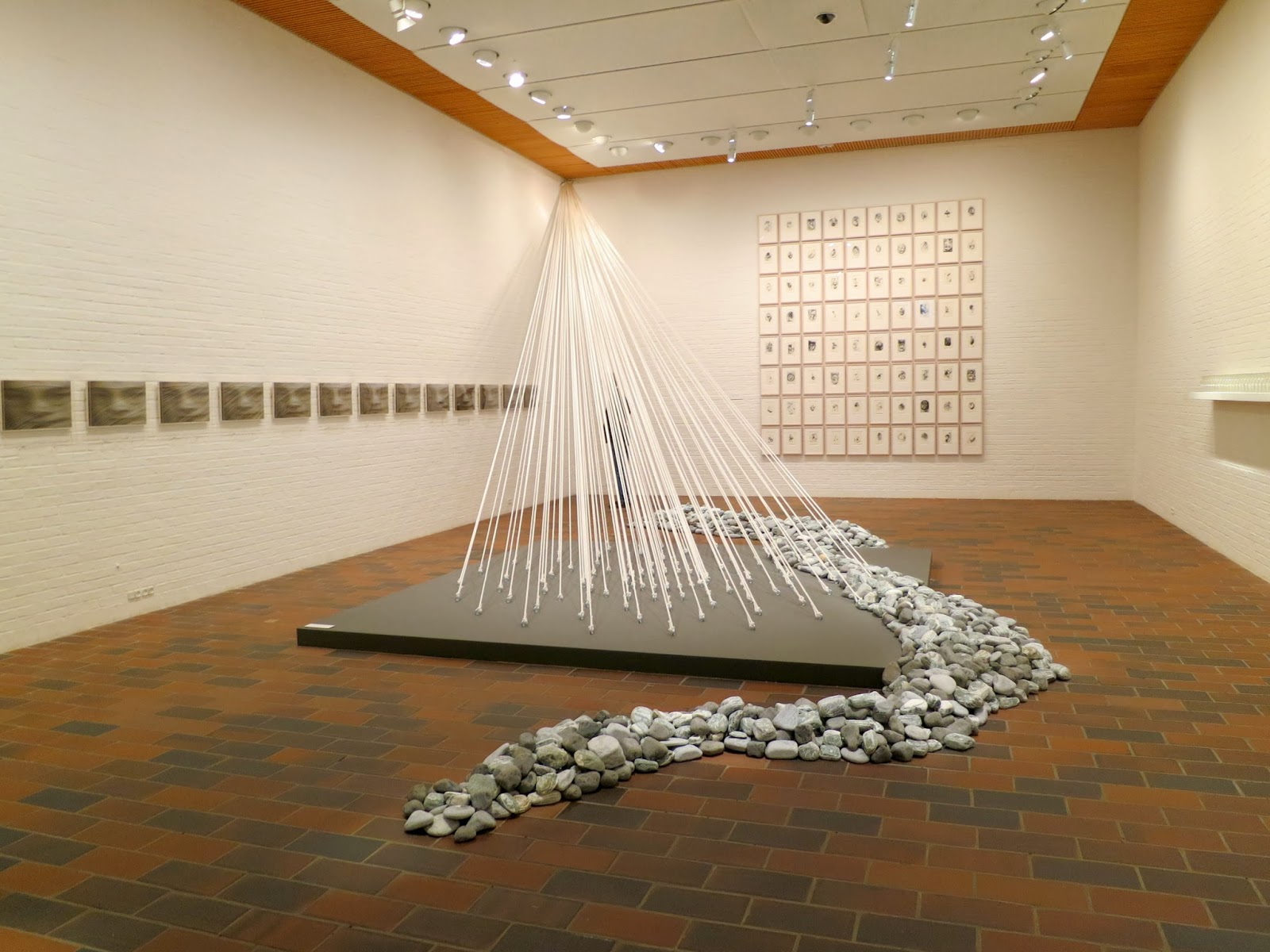
Morning Beams, (1997 and 2012)
'One day I went into my kitchen in the morning and found that the room was filled with all sorts of light beams emanating from various objects' .
This was my favourite piece - it was awesome.


Four Spoons, 1988, (patinated bronze)
A friend casually suggested I should do some objects in bronze. The suggestion was so offensive to me that my smile froze and tears ran down my cheek. 'This man doesn't know anything about my work', I thought. I realised that I had an absolute fear of bronze. But why? Then the thought of the sixties flashed in my mind. The air definitely had a special shimmer then. We were breathless from the pride and joy of being alive. I remembered carrying a glass key to open the sky.
I thought I had moved forward right into the eighties and further. But a part of me was still holding onto the sixties sky. The eighties is an age of commodity and solidity. We don't hug strangers on the street and we are also not breathless. When the two big boys shake hands at the summit, maybe it's better that they exchange bronze keys rather than glass ones. In my mind bronze started to have a warm shimmer instead of the dead weight I had associated it with. Bronze is o.k., I thought. Eighties is o.k. It has to do. One day, I would become a person who could handle bronze with grace and ease'.

Untitled, 1988
'Artists must not create more objects, the world is full of everything it needs. I'm bored with artists who make big lumps of sculpture and occupy a big space with them and think they have done something creative'. (1971)

Glass Keys to Open the Skies, 1967

Vertical Memory, 1997
'It was created by putting together photographs of my father, my husband and my son. I selected photographs of them facing the same direction, overlapped them and morphed it. Every photo represents the man who was looking over me in the precise moment when I went through an important situation in my life'.

Doctor
'I remember being born and looking into his eyes. He picked me up and slapped my bottom. I screamed'.

Father
'I was two-and-a-half when I arrived in San Francisco on a liner to meet him for the first time. He came on board, kissed my mother and then looked at me looking up at him'.

Amaze, 1971
Walking around the maze was very disconcerting as you could not quite tell the difference between the people walking around with you and the people outside the maze, looking in. Great fun.

Cricket Memories, 1998
'This work is a metaphor for catastrophic loss in our lives - referring not just to one time or one country, but all countries - all lives, and the horrors committed by one people against another.'

We were invited to write our own Cricket Memories.

Performance:

Cut Piece, performed at least six times, first in 1964 and last in 2003.
There was no performance in Louisiania when we viewed the exhibition, as Yoko Ono was not there, but this photograph was part of the exhibition, given that this was a retrospective of her work.
Even though the 70s are seen as the golden age of performance art, with artists like Marina Abramovic, the pioneer phase of this art dates to the early 60s with Yoko Ono playing an important part in this. It is therefore odd that her contributions in this area are completely neglected.
This is what she said about Cut Piece in 1974:
'Traditionally the artist's ego is in the artist's work. In other words, the artist must give the artist's ego to the audience. I had always wanted to produce work without ego in it. I was thinking of this motif more and more and the result was Cut Piece. Instead of giving the audience what the artist chooses to give, the artist gives what the audience chooses to take. That is to say, you cut and take whatever part you want; that was my feeling about its purpose. I went onto the stage wearing the best suit I had. To think that it would be OK to use the cheapest clothes because it was going to be cut up anyway would be wrong: it's against my intentions. I was poor at that time, and it was hard. This event I repeated in several different places, and my wardrobe got smaller and smaller. However, when I sat on the stage in front of the audience, I felt that this was my genuine contribution. This is how I really felt. The audience was quiet and still, and I felt that everyone was holding their breath. While I was doing it, I was staring into the room. I felt like I was praying. I also felt that I was willingly sacrificing myself'.'
Another remark she made calls attention to the latent violence to which she was exposed in her performance of Cut Piece: 'One person came on stage... He took the pair of scissors and made a motion to stab me. He raised his hand, with the scissors in it, and I thought he was going to stab me. But the hand was just raised there and was totally still... with the scissors... threatening me.'
Body art, a form of art in which the artist's body becomes a tool, was dominated by male artists at the time, artists like Jackson Pollock and Yves Klein. The idea of a young woman allowing herself to be 'undressed' with scissors is a testimony to the radical character of Ono's art as well as her feminist concerns. In 1969 she collaborated with John Lennon in writing Woman is the Niger of the World.

Film:
Ono wrote in 1971 during the Cannes Film Festival: 'Violent revolutionaries' thinking is very close to establishment-type thinking and ways of solving problems. I like to fight the establishment by using methods that are so far removed from establishment-type thinking that the establishment doesn't know how to fight back'.
The films she made address the political issues that are a benchmark of her work.


Bottoms, 1966
This film consists of a sequence of the bottoms of a group of New York artists and friends of Yoko Ono. She wanted to 'expand consciousness' by enabling viewers to view this part of the body from a new point of view as opposed to the eroticised images we are bombarded with every day which invariably present women as sex objects.
Works outside the gallery space:

White Chess Set, Chess Set for Playing As Long as You Can Remember where All Your Pieces Are, 1966
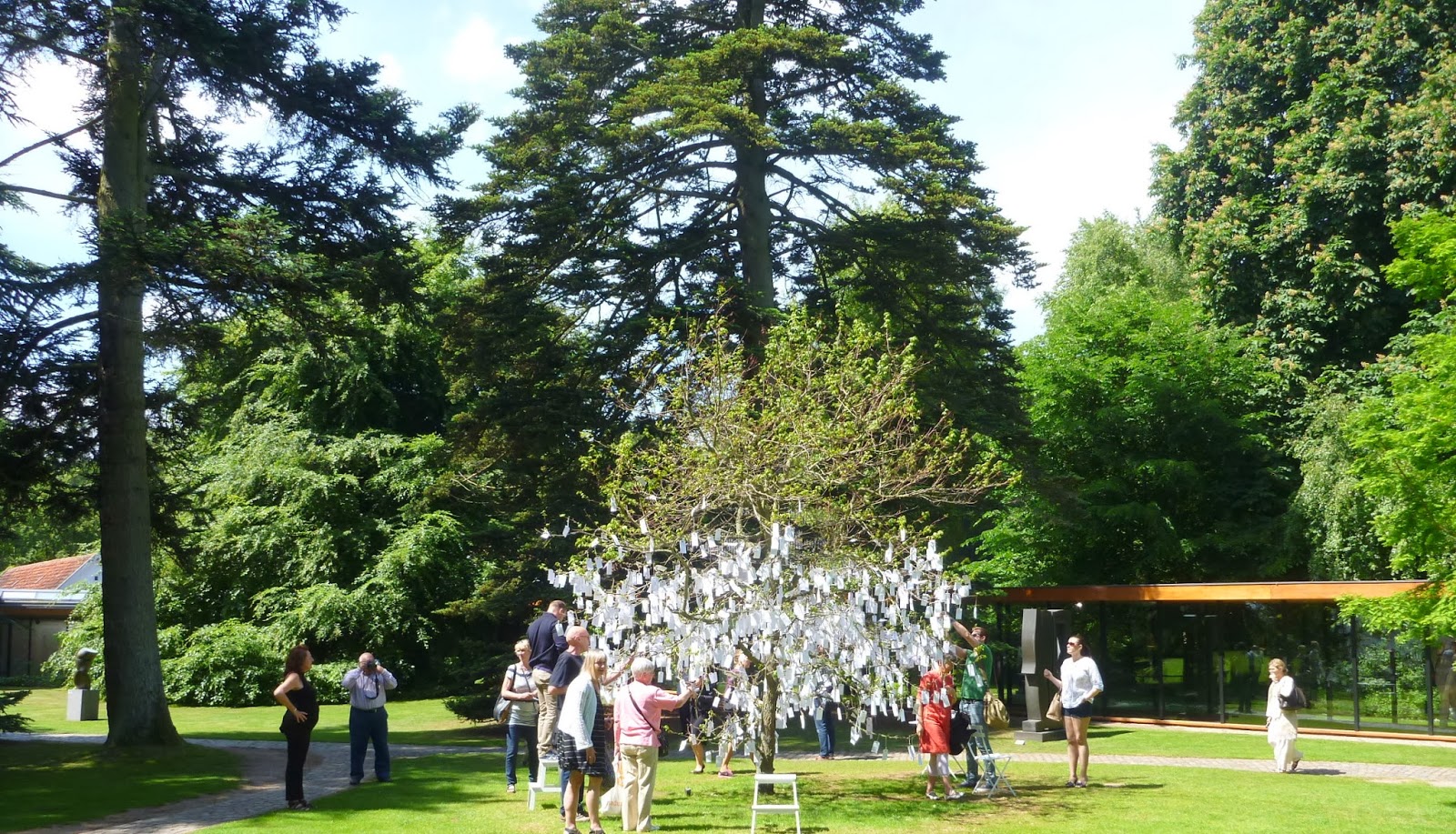
Wish Tree, 1996
Viewers wrote a wish on a piece of paper and attached it to the tree.

Source:
Yoko Ono, ed. Ingrid Pfeiffer and Max Hollein.


