Rena Papaspyrou at the National Gallery, Athens.
Baalbeks:
What a discovery! I love Papaspyrou's work. And why have I not seen any of it before?
Baalbeks, (Images through Matter), 1986-88, (detached wall surface, extension with polysterene, canvas, colour)
This artwork was on the wall of the lobby of the National Gallery when we visited. I was immediately drawn to it. I loved the whole composition and found it fascinating, loved the way the female figure emerged in space, and I was drawn to the material that the piece was made of, which looked like old terracotta pots you see in museums. Overall, fascinating.
On closer examination I realised that it was not clay, so, what was it? I looked at the list of materials and it said 'detached wall surface' - what the hell does that mean? It was not until I got home, and looked at the book on the exhibition that I bought that it all started making sense.
For more than six decades, Papaspyrou's signature technique has involved projecting large shadows onto walls and then meticulously recording what she terms 'episodes' and later 'images in matter'. Initially she uses pencil as the minimal colouring tool, ensuring a discreet intervention and preserving the material's surface. Over time, she expanded her toolbox to include unconventional surfaces like boards and metal sheets as her canvas. This technique gradually evolved to encompass materials inherent to the domestic sphere: floorboards, paper, wood, metal, even remnants of the city itself, such as pieces from demolished buildings, asphalt, and fragments of mosaics and plastic surfaces.
This approach leads her to discover what she calls 'episodes in matter': tiny or slightly larger 'random occurences on the material surface'. These are the specific marks left by time and use on each surface, essentially the history of each material.
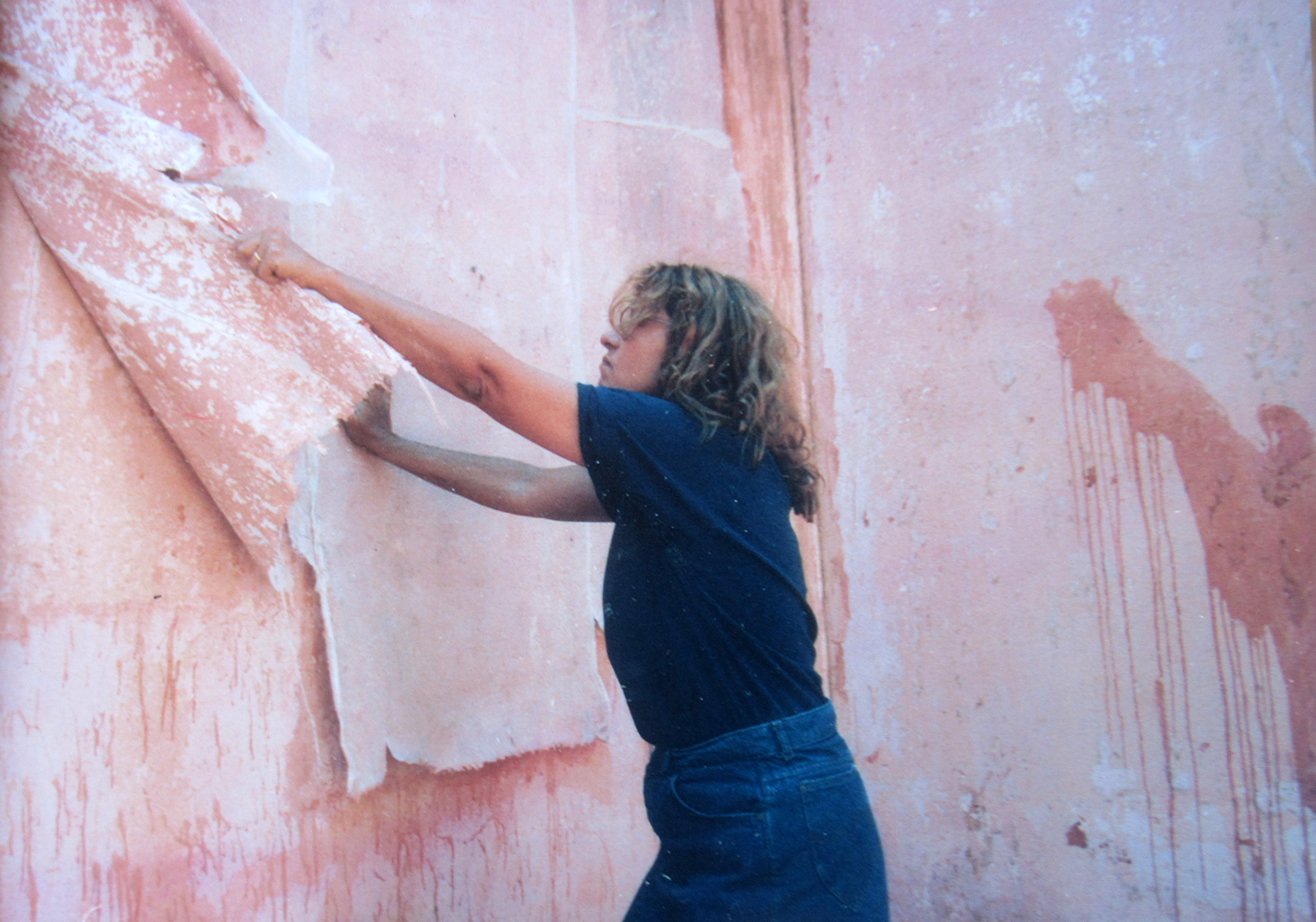
For this piece, she used the surface of the pink walls of a burned house - hence detached wall surface.
This is what she says about it: 'During the summer of '86 I saw in a magazine a colour photograph of the temple of Baalbek and I stripped part of the surface of the pink walls of a burned house at Melissia.
The colour, altered through the effects of the fire, the vertical strikes from the rain and the remains of a painted frieze are reminiscent of the vertical columns, the reliefs and colours as they were rendered in the photograph'.
'It was in this way that I started Baalbeks, a work unrelated to the architectural elements and colours of the temple, but rather to the 'imaginary' elements depicted in the photograph and these, I utilised only as motivating information, since the form of the work arose exclusively from the images given by the surface materials. During the development of the work, the protuberances and the undulating texture of the material necessitated the addition of a powerful volume capable of coexisting with the volume of the stripped surface'.
Preliminary drawing
A closer look at the figure as she emerges from one space to another, a transition, in the same way as the seemingly useless, discarded materials undergo a transition and become works of art. So, the piece becomes the intermediary space, the critical point where the transition takes place, where the subject moves from one state to another, thus making the transition to a new world (the movement of opening the 'curtain').
And with their positioning of the artwork, the curators have achieved just that.
Surfaces, A User's Manual:
In addition to Baalbeks there was an exhibition of Papaspyrous' work in the gallery in the basement. The exhibition takes it cue from Baalbeks featuring selected works by the artist that trace the distinct phases of her creative career from 1976 to the present.
Papapyrou's work raises fundamental questions about the multiplicity of the image, the image-making power of the human mind, the relationship between objectivity (matter) and subjectivity (the gaze, the process of association), highlighting the centrality of ordinary aesthetic experience. Her work activates the gaze and nurtures free association. This is what she says about it:
'The mental process involved in my work shifts between two poles: the objective the subjective/associative.
Objective is the realm of the matter, recognizable by anyone anywhere. Recognizable as well are the particular micro-morphological features in the surfaces of the matter, their manner and time of appearance, their place of origin and their simple mental extensions.
Subjective/associative is the human psychological mechanism that recognises random unexpected images on these surfaces by using the random shapes that are created from the very composition of the surface as pictorial elements/points of departure. The surface features, recognisable by everyone, compose imaginary images, through personal associations. Oddly, however, this process is repeated by everyone - as an invocation of the Platonic ideas about objects. Perhaps this is the reaon why the viewer's eye and mind recognise these images spontaneously.
These images are therefore unexpected, simple and random, created on the surfaces by uncontrollable visual, psychological and mental mechanisms.
I believe that it is from this other reading of the surface, that the other views of the transformative image results - given that one can connect the same points differently each time and bring one's own imagimary image to the surface'.
Episodes in Matter, 1980, (paper)
Episodes in Matter, 1980, (anodised aluminium, intervention)
Episodes in Matter, 1980, (anodised aluminium, intervention)
Images in Matter, 1980 (pencil on cement and sheet metal) Complete Vision Makes Me Blind, 2005, (photocopies, intervention with colour)An installation that expands diagonally through the exhibition space. A paper wall. It consists of repeated photocopied small pieces of paper that depict small faces in variable dimensions. 'The core of this work is an A4 photocopy that was taken directly from a plastic floor surface on which I had interfered by pointing and then drawing accidental shapes. Using colour, fluctuated sizes, different cuttings and different neighbouring position in every case, I tried to preserve a small personal characteristic for every one of these shapes'.
'What happens when an image is changed many times and repeated even more times? Does it become a non-image in the end? Or an image-fairytale, an image that suggests stories. The ultimate vision makes me blind'. (Gaston Bachelard, 'The Poetics of Space')
Images in Matter, 2023, (plasticised stickers, drawing with marker)

looking closer
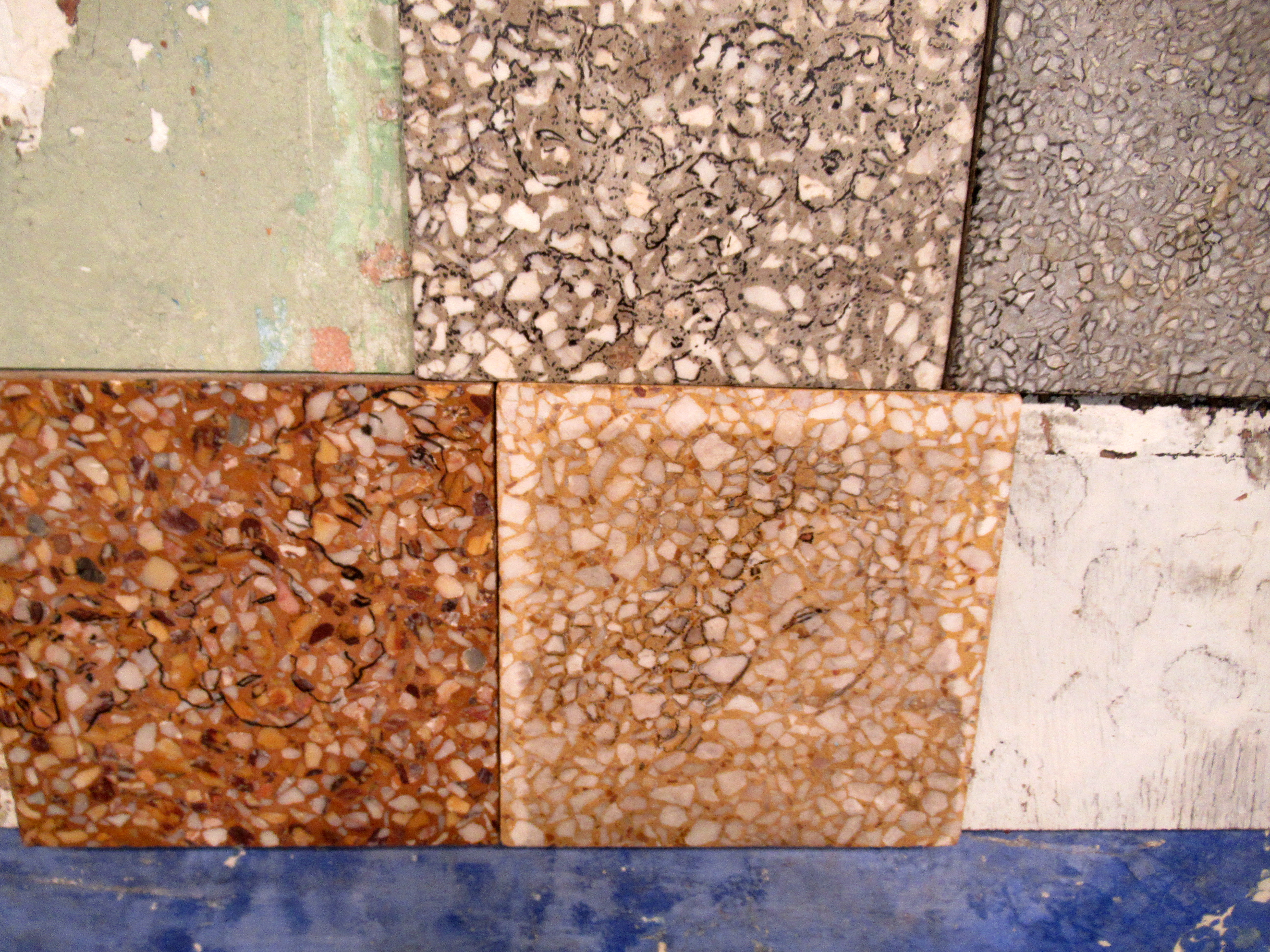
Images in Matter, 1995, (detached wall surface, wood, metal, floor tiles, intervention with ink)
looking closer
Georgraphy (Images in Matter, 1981), (detached wall surface, drawing with pencil)
looking closer at this fabulous surface
Images in Matter, 2023, (floor tiles, intervention with ink)
looking closer
Episodes in Matter, 1977, (detached wall surface, intervention)Episodes in Matter, 1980, (detached wall surface, intervention)
looking closer