
Jack of Diamonds - Early 20th century Russian Avant-Garde Art at the Courtauld Gallery, Somerset House.
Jack of Diamonds was an exhibition that opened in Moscow in December 1910. A stated objective was 'to offer young Russian artists who find it extremely difficult to get accepted for exhibitions under the existing indolence and cliquishness of our artistic spheres, the chance to get onto the main road'. Subsequently the title was adopted by a newly formed artistic society in Moscow and soon after the group became the largest and one of the most significant exhibition societies of the early Russian avant-garde. Their activities effected a qualitative shift in Russia of the 1910s: a democratisation of the art society in Russia, amongst other things. The combination of European innovation and Russian national traditions was a distinctive feature of this group.
When the exhibition opened in Moscow the show was considered 'a slap in the face of public taste'. Critics dismissed it as youthful 'hooliganism'. Kazimir Malevich on the other hand compared it to the 'eruption of the biggest volcano'.
Dr Natalia Murray who has curated the exhibition at the Courtauld notes that 'by allowing their brave creative experiments to break into the very essence of artistic life, Russian avant-garde artists changed not only the historic development of Russian art, but the face of European modernism of the early 20th century'.

Mikhail Larionov, Bathers at Sunset, 1909

A. Lentulov, Flowers, 1913

Mikhail Larionov, Rayist Painting, 1913
Between 1912 and 1914 Larionov and Goncharova experimented in non-representational painting, exploring the optical qualities of refraction and the dynamics of light. They called this technique Rayism. Impressed with scientific discoveries, including x-rays, as well as contemporaries ideas of a Fourth Dimension, Larinov started creating paintings representing networks of interweaving rays.

Natalia Goncharova, Magus (costume design), 1915
This costume design for the astronomer Magus was created for an unrealised ballet called Liturgie that Goncharova worked on between 1915-17.

Alexandra Extr, Greeks, (Costume Design), 1916
Vivid colours inspired by folk art from the artist's native Ukraine.
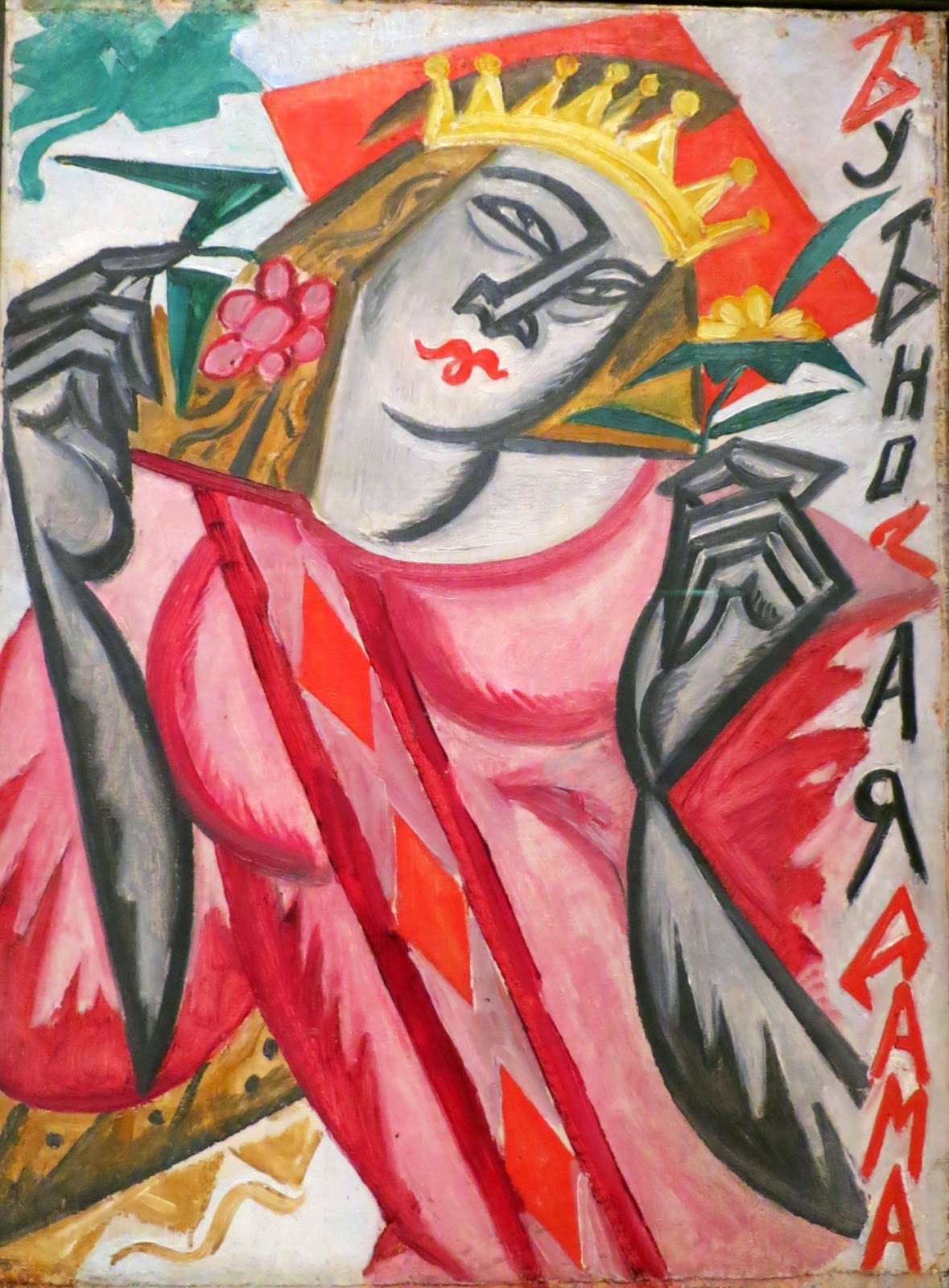
Olga Rozanova, Queen of Diamonds, 1915

Natalia Goncharova, The Little Station, 1912
Time, space and movement are compressed and flattened to create a moment that encapsulates the sensation of 'passing through'. We are once inside and outside the train: bits of words and numbers flash by. Figures rush along the platform, and faces are reflected in the window of the carriage. A celebration of the dynamic, fragmented experience of the modern world.

Vladimir Burliuk, Landscape, 1913
Influenced by Paul Cezanne and Cubism, Burliuk often fractured his paintings into interlocking irregular segments, as if translating the principles of stained glass into painting.
Source:
http://en.wikipedia.org/wiki/Jack_of_Diamonds_(artists)
http://rbth.co.uk/arts/2014/08/20/rough_gems_who_shone_in_a_dazzling_new_era_39153.html

