Issa Touma:
I really liked this part of the exhibition, I was moved by the stories of the women, and even though the reflection on the glossy paper of the photographs resulted in poor quality reproductions, I decided to go ahead with the post.
On the 26tth of April 2015, when radical Islamic opposition forces announced the 'Great Attack' on Aleppo, young women of various religious and ethnic backgrounds took refuge in Le Pont gallery: most of them were former participants of Art Camping, a collaborative art project initiated in 2012 by Le Pont in response to the outbreak of the Syrian conflict in 2011.
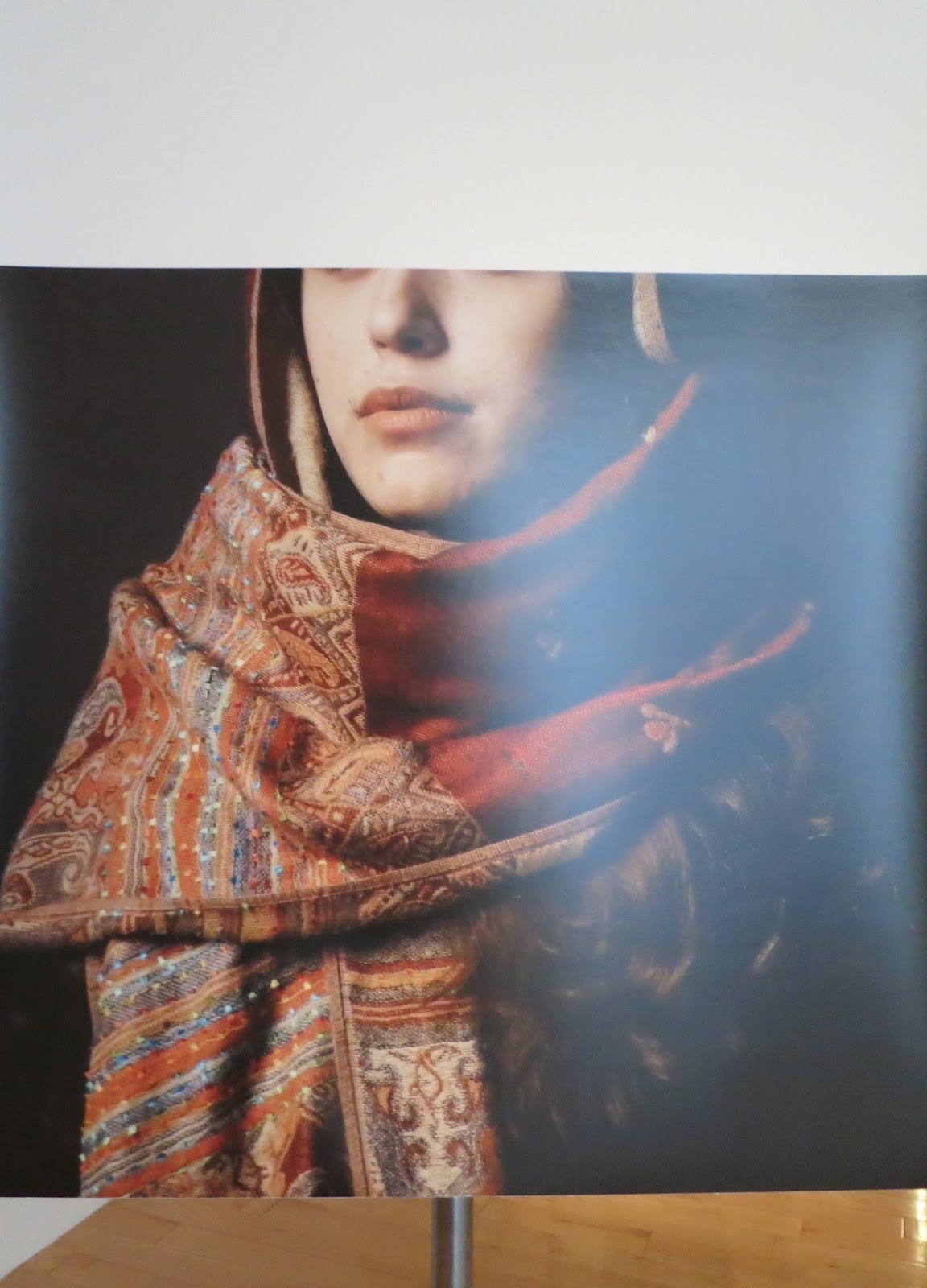
Issa Touma, a photographer and director of the gallery, believes that art is essential for surviving the horrors of war and preserving the principles of an inclusive society - principles that are threatened by political and religious fanaticism. This project is the outcome of the spontaneous photo sessions he held at Le Pont during the week of the Great Attack. It is a cry for freedom from the women that Syrian society has not lost yet - to death, exile or oppression.

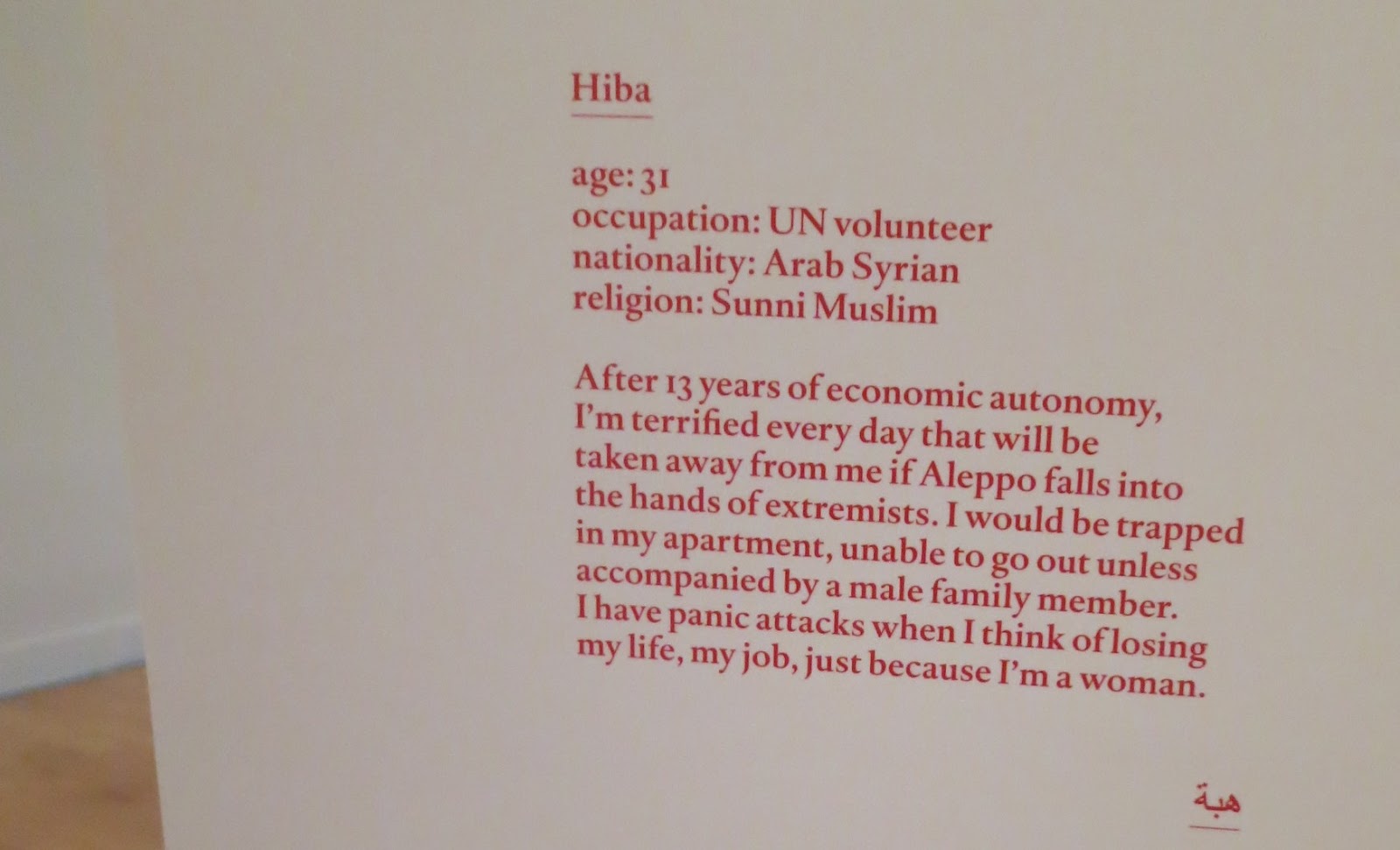
I did not immediately realise that there are two sides to each exhibit: the faces in the front are incomplete - the rest of the photograph is at the back, with some information about, and a statement by, the woman pictured.
Zanous
age:26
occupation: jewellery maker
nationality: Kurdish Syrian
religion: Yazidi

'I am not afraid to die, but I am afraid of a mental or physical handicap. I believe that God is the almighty saviour, and I intend to stay here in Aleppo'.

Diana
age:25
occupation: English literature student
nationality: Kurdish Syrian
religion: Muslim

'In March 2014, I went to Istanbul to look for work. It had become too hard to live in my neighbourhood in Aleppo. But I couldn't find a job and had to leave again. In a way, I wasn't sorry. Syrians - especially women - are exploited in Turkey. Now I'm back in Aleppo'.

Enfwan:
age: 24
occupation: graphic designer
nationality: Arab Syrian
religion: Sunni Muslim

'When the war started, I convinced all of my relatives and friends to leave town so that I wouldn't have to worry about their safety. As for me, I didn't have the courage to leave. I love my life here. But day by day, with the ongoing destruction, Aleppo is changing. And more and more people have gone. It's no longer the city I know. I've now decided to leave as well'.

Hiba Allah
age:24
nationality: Arab Syrian
religion: Sunni Muslim

'My engagement party is in two months. I'm looking for a job and I don't know what to do. I live here, where there's war, loss, destruction, insecurity and a permanent feeling of deprivation. I'm trying to hang on to hope but maybe it doesn't exist. Someone advised me to hold my engagement party by candlelight since there's no electricity in our city. We're falling apart as a result of our own mistakes. We've done everything wrong and things will remain as bad as they are now'.

Dima
age: 21
occupation: student
nationality: Arab Syrian
religion: Sunni Muslim

'Since the war started I've said goodbye to so many people. I stopped meeting people so I wouldn't have to say goodbye any more. I've lost any sense of being alive. I'm staying in Aleppo to finish my studies, and every night I count the bombs exploding around my house until I fall asleep.'

Hiba
age: 31
occupation: UN volunteer
nationality: Arab Syrian
religion: Sunni Muslim

'After 13 years of economic autonomy, I'm terrified every day that will be taken away from me if Alepo falls into the hands of extremists. I would be trapped in my apartment, unable to go out unless accompanied by a male family member. I have panic attacks when I think of losing my life, my job, just because I am a woman'.
That was in April 2015.
Today, aid groups have warned that hundreds of thousands of civilians face starvation in Aleppo as government forces tighten a siege on the city. Roads are virtually impassible since early July when troops loyal to the Syrian president, Bashar al-Assad moved within firing range of the last supply corridor. 'Today there is no way at all to bring anything into Aleppo', Rami Abdulrahman, director of the Syrian Observatory for Human Rights, told Reuters. Food will run out within weeks and regime bombing raids have targeted several of the few remaining working hospitals. A food warehouse with almost 10,000 parcels was destroyed and fuel needed to power medical facilities and water pumps is running dangerously low.
The plight of the people in Aleppo continues ... how and when will this end?
Source:
https://www.theguardian.com/world/2016/jul/27/dozens-dead-in-syria-bomb-blast-qamishli