
The Oasis of Matisse - the Cut-Outs, at the Stedlijk, Amsterdam

In the years following WWII, Matisse's cut-outs - the gouaches decoupees - gradually expanded to a monumental scale. In these large works, his attempts to deconstruct light and colour, dating back to the early 20th century and his use of strong colours during his Fauvist period in particular, ascended to new heights. The technique of using cut-out paper to create such vast compositions is every bit as inventive: Matisse was the first artist to employ cut-outs or collage elements on such an extraordinary scale. These artworks represent a new genre in his oeuvre. He was one of the few artists who continued to innovate well into old age and the cut-outs are a vibrant grand finale. As Matisse himself remarked, these enormous cut-outs allowed him 'to create a truly large space'.
You can see more of Matisse's cut-outs here .

Blue Nude with Green Stockings, 1962
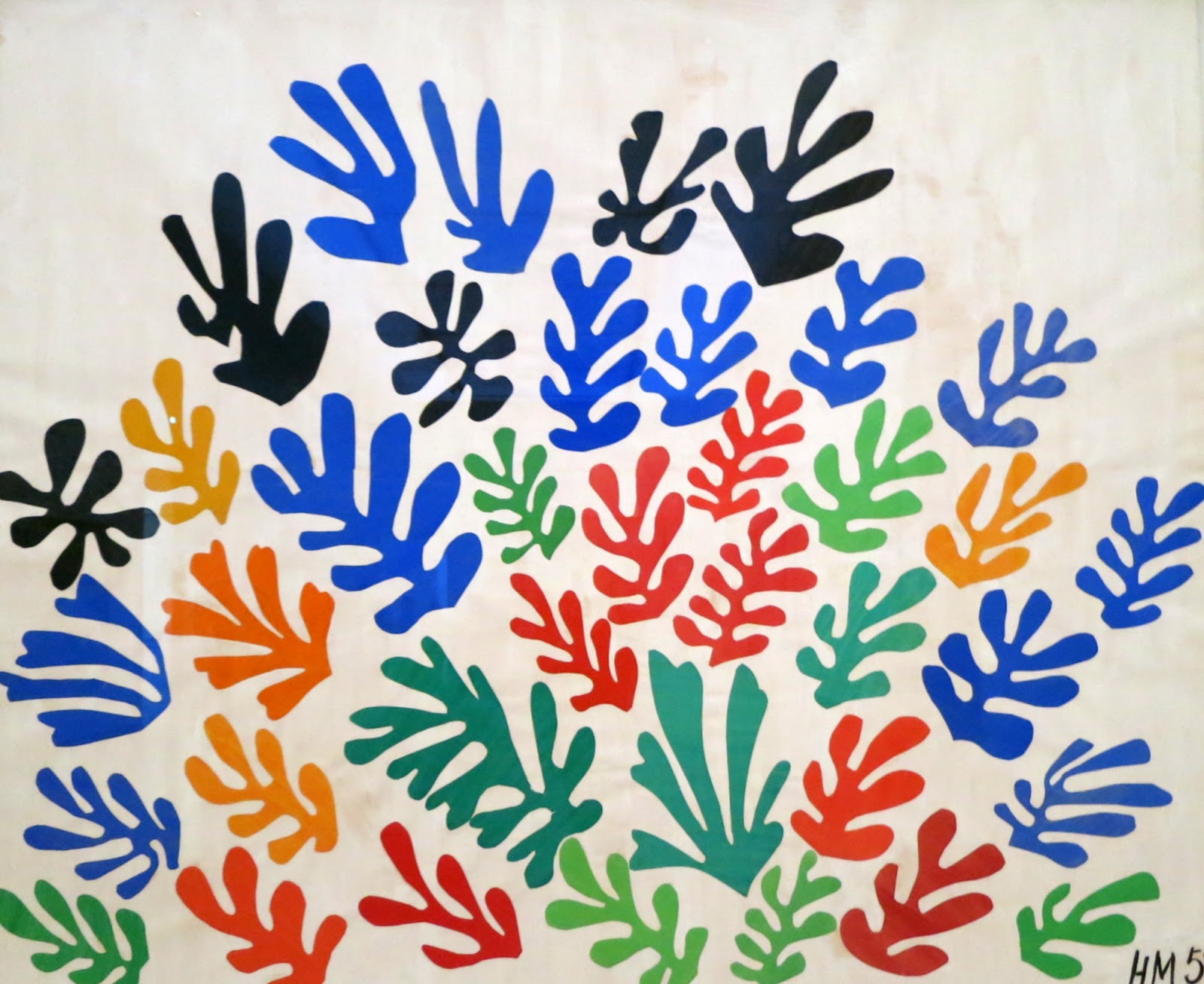
The Sheaf, 1953

The Parakeet and the Mermaid, 1962-63
'I have made myself a little garden all around me where I can walk', was Matisse's comment on this work.
* * *


Chasuble, 1954

Chasuble, 1954

Chasuble, 1954

Christmas Eve, 1952 (stained glass)

Window in Tahiti, 1936
Views through an open window are an important theme in Matisse's oeuvre. Here we see the view from his hotel window in Tahiti.

Woman with a Lute, 1949-50 (tapestry)

Polynesia, The Sea, 1947-48

Polynesia, The Sky, 1947-48
It is these abstract works that inspired artists of the 1950s such as Elsworth Kelly and Mark Rothko to create their Colourfield Paintings.

Robert Mangold, Two Colour Frame Painting, 1984

Elsworth Kelly, Blue Curve VI, 1962

Mark Rothko, Untitled, 1962

The Snail, 1963.


