Showing posts with label modernist architecture. Show all posts

Tuesday, 3 June 2014

The Jozsefvaros and Ferencvaros districts in Budapest


During our first full day in Budapest we decided to explore the Jozsefvaros and Ferencvaros districts, where our hotel was situated.


On Lorinc Pap square, across from the hotel is the Heart of Jesus Jesuit Church - we had very loud bell ringing every evening at 7:00.


Jozsefvatos' grand but neglected apartment blocks speak of an old middle class suburb that fell into decline. Gentrification is spreading through the district now though. 


The hospital on Maria Utca


On Maria Utca again, this four-storey building, in szecesszion style, was built by Imre Benes in 1909-10 and was designed to be a tenement house. The apartments facing the courtyard were meant for the servants and the ones facing the street were the beautiful ones for the middle class. During WWII the building was hit by a bomb and during the revolution of 1956 this was the first building that collapsed and had to be rebuilt.


 Detail from a building on Ulloi Ut


A bit further down Ulloi Ut, a modernist building that houses, what else? a bank


not many modernist buildings in Budapest,


so when we saw this we had to go and investigate.


The Holocaust Memorial Centre, just off Ulloi Ut  - there will be a separate post on this but much later on, as I need to do some research.


One of the things that delighted me while we wandered around the city, are the intricate, wrought iron doors that so many of the buildings possess - I photographed lots of them and they will be appearing in the posts on Budapest


As for the buildings! So many styles: Gothic, Baroque, Classical,


but Hungarian Art Nouveau, Szecesszio style, dominates the city. Many buildings were commissioned in this style, as Hungarian Art Nouveau flourished in Budapest's golden era when its population tripled, the number of its buildings doubled and the city turned into a metropolis.
 
This is the Applied Arts Museum, the most flamboyant creation of Odon Lechner - there will be a separate post about that too.


When we reached the Danube, the view took our breath away: the Gellert-Hegy district of Buda with all its grand buildings as well as the green Buda hills


Looking closer


The Liberation Monument of a female figure brandishing the palm of victory, and the Citadella behind it. At the bottom of the picture is the Cave Church created in the 1930s to mark the return of the white-robed monks of the Pauline order, the only religious order indigenous to Hungary.
.  


An excellent view of the Lanchid, the Chain Bridge, the first permanent link between Buda and Pest which was a tremendous spur to the country's economic grown and eventual unification, linking the rural hinterland to European civilisation so that Budapest became a commercial centre and transport hub. The bridge symbolised the abolition of feudal privilege as nobles, hitherto exempt from taxes, were obliged to pay the toll to cross it.

In 1945 the Wehrmacht bombarded all of Budapest's bridges in a bid to check the Red Army and their reconstruction was one of the first tasks of the postwar era.


There is a little green oasis on the embankment


with one of the many Holocaust Memorials that are dotted around the city. This one is dedicated to the Roma that were killed by the Nazis


and if you look inside one of the slits you can see a face in agony and despair


Further down the embankment is a glass come that houses a mall


and an art gallery which unfortunately was closed that morning.


The Cornivus University is the next building we came across. 


We then reached the back entrance of the Great Market Hal.


We walked through the market and came out in a square by Vamhaz Korut. Lots of people cooling off in the fountain - temperatures reached and stayed at 31oC while we were in Budapest.
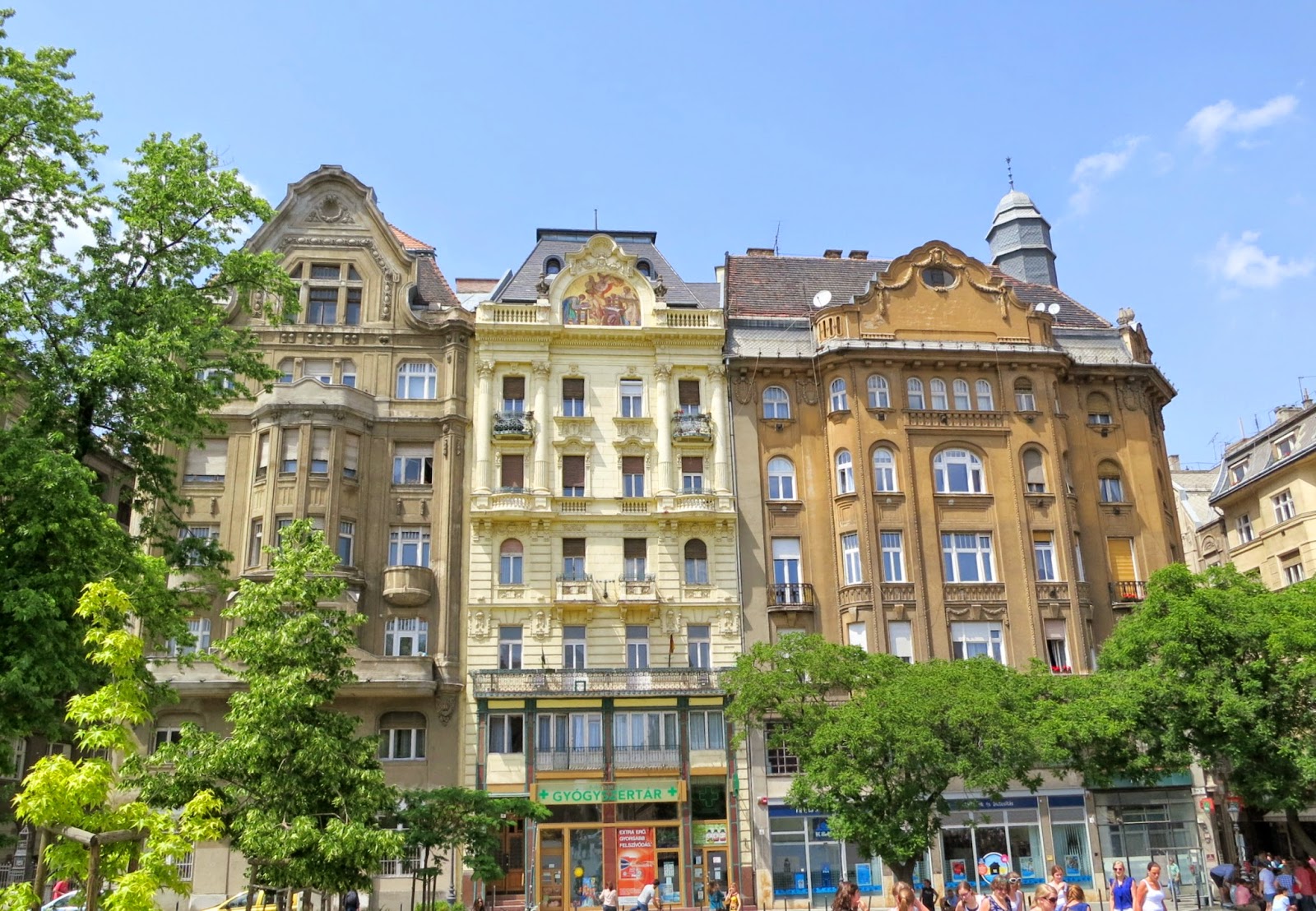


Three wonderful buildings facing us, the one in the middle a fine example of Art Nouveau style


as is this one


 looking closer


another great wrought iron door


and another one further down the road


another majestic building


 another Art Nouveau building


detail of its Art Nouveau relief work - so typical of the period


sculpture of a cyclist


very different to the majority of the majority of sculptures around the city featuring famous men quite often riding their horses,  celebrating Budapest's golden period


lovely face looking up at the sky.


This is Lorinc Pap square a few nights later. 


There was a real treat in store for us that evening. At seven o'clock we heard a choir singing outside our hotel window. They were singing classical songs and it was beautiful. 


When we went out to eat and chose the restaurant in Lorinc Pap Square, just outside our hotel, we were able to see and hear the choirs


There were 8 different choirs: they would stay in one location for half and hour and then move on to be substituted by another group singing. The music ranged from classical songs to folk music, and even a Mikis Theodorakis song, yalo-yalo pigainame, which was sung in Greek to my delight.


Such a good idea! It's always wonderful to come across excellent singing like this when you least expect it.


Monday, 10 March 2014

Coventry Cathedral

 
Having met through our blogs and after a correspondence of almost two years, fellow blogger Mick of Down by the Dougie and I finally met face to face. We spent last Monday together and one of the things we did was visit Coventry Cathedral. It was great meeting him after all this time, and we had a very good day together.


Coventry Cathedral.

Bombed almost to destruction on 14 November 1940 by the German Luftwaffe, St Michael's Cathedral now stands ruined. The current Cathedral was built next to the remains of the old, the two buildings effectively forming one church.


The new, modernist Cathedral was designed by Basil Spence and Arup and built by John Laing. Hollington sandstone was used.


 The arresting bronze statue of St Michael and the devil was sculpted by Jacob Epstein


 a closer look at that stunning sculpture


 The spire, known as a fleche, rises to 90 m and is the tallest structure in the city


 A view of the building from the South side


The tower, spire, the outer wall are all that remains of the old Cathedral 


the old superimposed by the new


Reconciliation by Josefina de Vasconcellos


Ecce Homo by Jacob Epstein


carved from a block of  Subiaco marble in 1934-35, representing Christ before Pilate with his hands bound and crown of thorns on his head


The entrance to the new Cathedral


 we entered the Cathedral, the large tapestry of Christ, designed by Graham Sutherland, facing us


 one more photograph with a better view of the magnificent ceiling


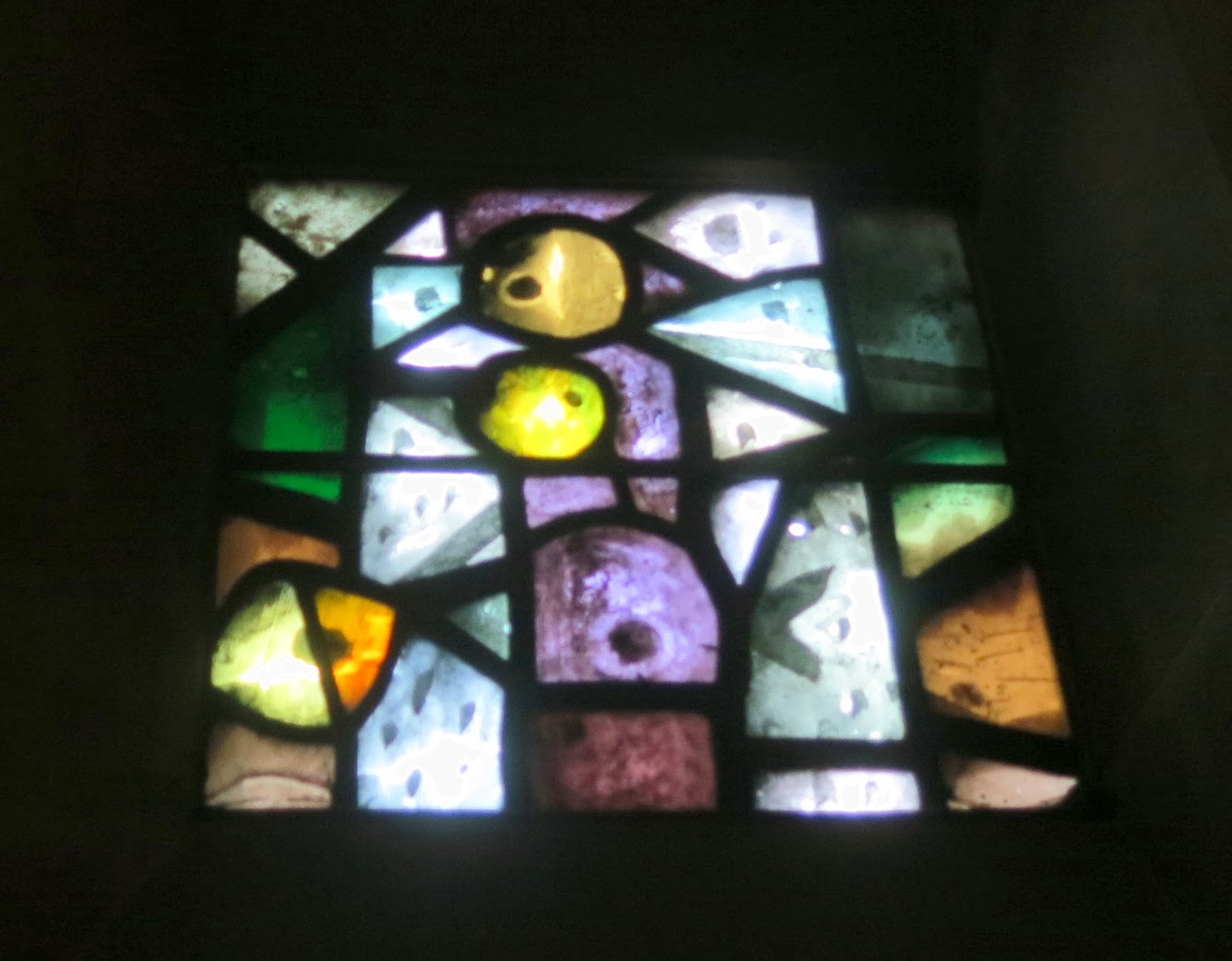
 To our right John Piper's Baptistry stained glass window - absolutely awesome


 and a closer look


 detail


detail


 detail


 detail


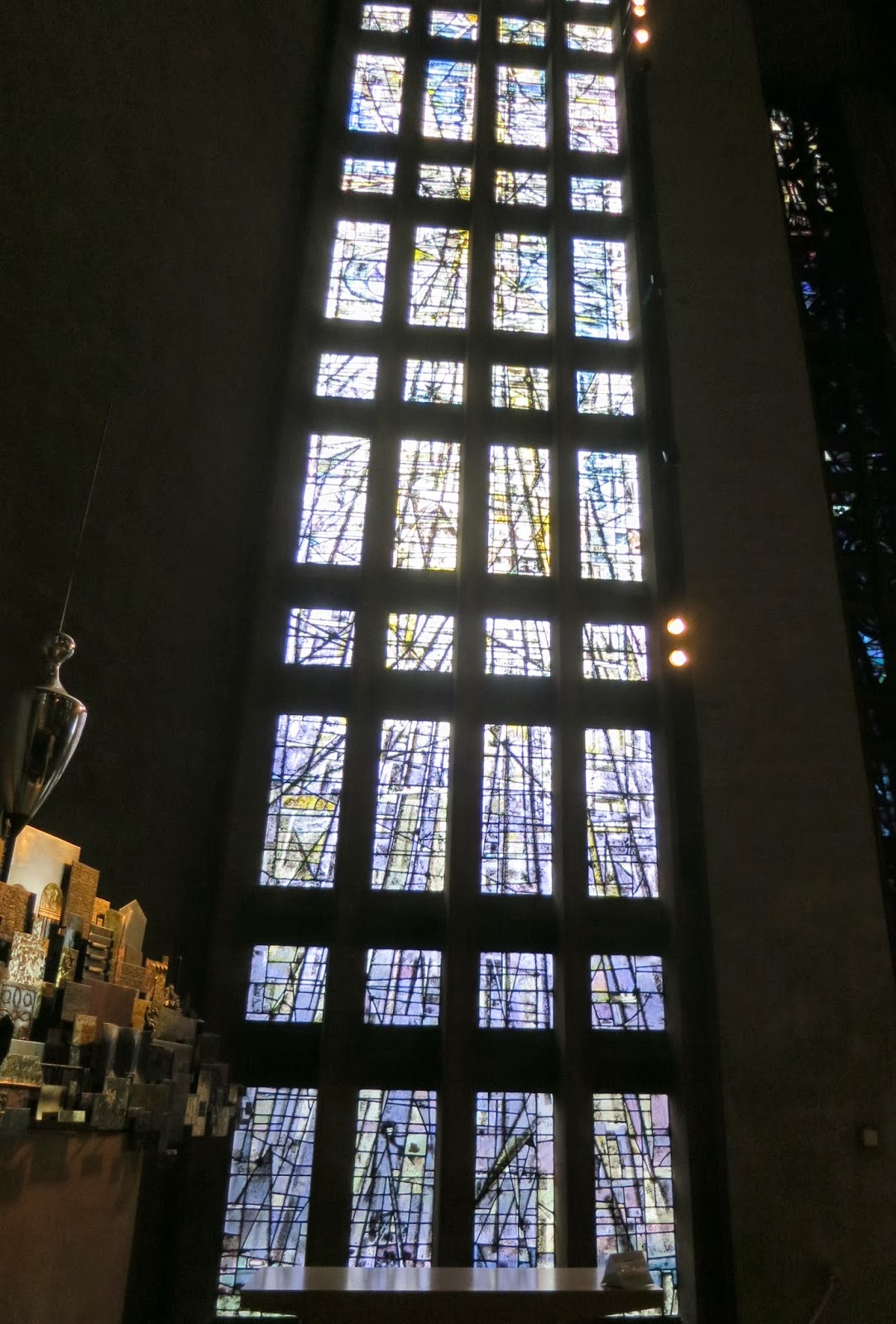
We walked around the Cathedral starting from the right hand side.  The stained glass windows in the Nave, by Lawrence Lee, Keith New and Geoffrey Clarke, face away from the congregation.  Spence's concept for these Nave windows was that the opposite pairs would represent a pattern of growth from birth to old age, culminating in heavenly glory nearest the altar - one side representing Human, the other side, the Divine.


Detail


I photographed and have included all of the stained glass windows as I think they are wonderful and for me, the best feature of the Cathedral.


I particularly like this one as I always find blue glass particularly appealing


looking closer


This is my favourite - very abstract and the pale lilac is very attractive in my view


looking closer


The Plumb-line and the City, by Clarke Fitzgerald


Now we have reached Graham Sutherland's tapestry of Christ


 looking closer


Three of the six candleholders made by Hans Coper which stand on the huge concrete altar.


 Also on the concrete altar the Cross incorporating the Cross of Nails


The Mater Dolorosa by John Bridgeman


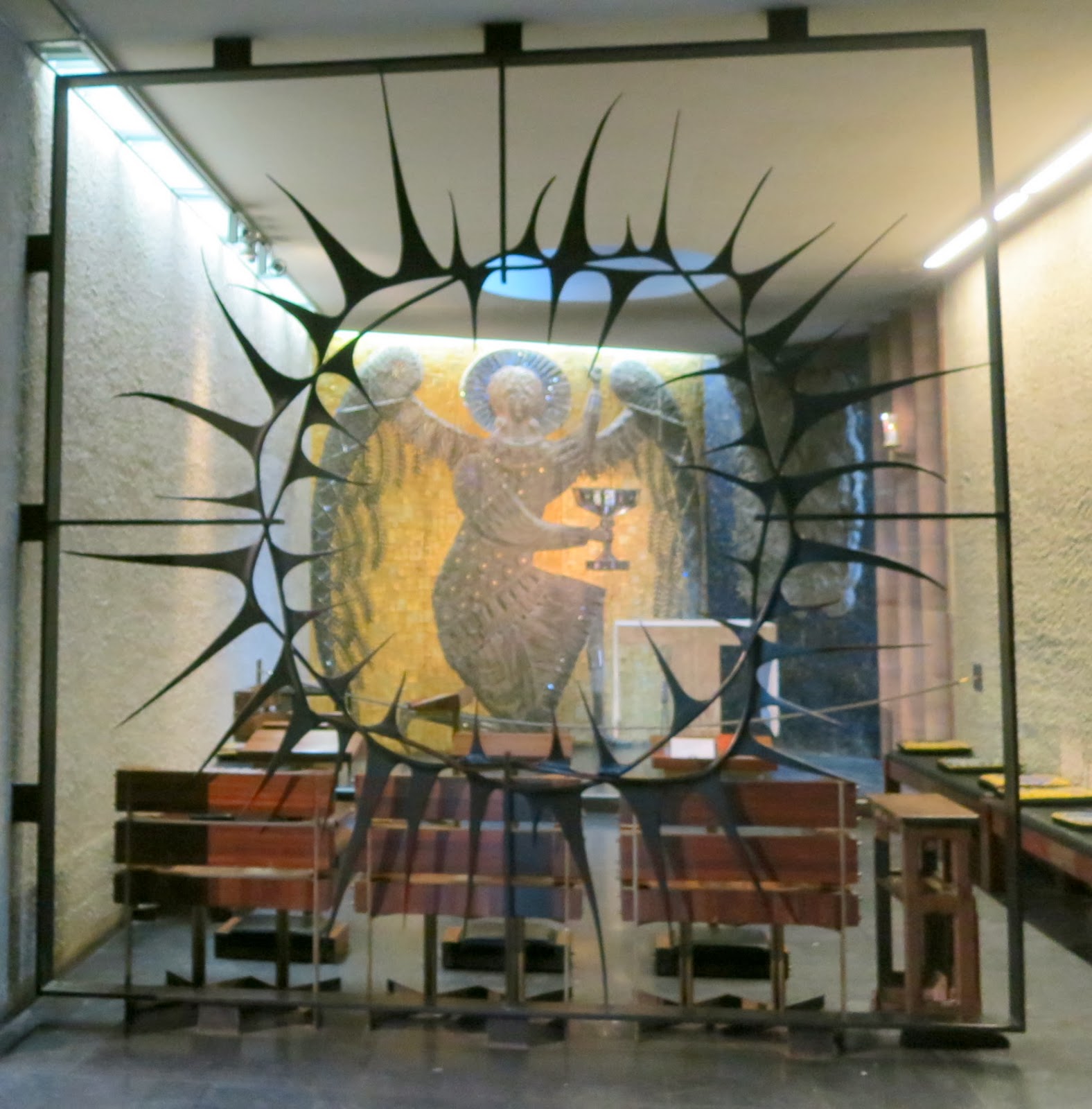
The Chapel of Christ in Gethsemane. The mural by Steven Sykes depicts Christ holding the cup of suffering. The screen that encloses the chapel represents the crown of thorns, designed by Basil Spence and made by the Royal Engineers.


The chapel of Christ the Servant, the suspended crown of thorns designed by Geoffrey Clarke.


I love the contrast of the stained glass at the bottom with the clear glass above - very striking


The Charred Cross made from two medieval roof beams found in the rubble in the shape of the cross after the bombing of the Cathedral.  


Akton Zuhnezeihen Friedensdienste, the work of German artist Fritz Kuhn. ASF was founded in Germany after the war to enable young Germans to make amends for the suffering caused in other countries by their parents' generation.


The drained glass windows on the left hand side of the cathedral


looking closer


a gorgeous blue, again


detail of the red down the bottom


Next to each stained glass window are stone panels inset into the walls, called the Tablets of the Word 


detail


looking closer again


jewel-like gorgeous colours


blue and green, a favourite combination


looking closer


The Chapel of Unity 


the floor of the chapel designed by Einar Forseth, a gift from the Swedish people


one more photograph of the mosaic floor


I particularly liked the very narrow, tall windows of this chapel, shafts of coloured light streaming through


rather than being framed by lead these particular 'windows' are set in concrete that resembles granite


designed by Margaret Trahearne


looking closer


these were my favourites


I love the way the coloured light reflects on the concrete of the sides and the floor


I really couldn't get enough of them


so I had to include all of them


so many colours and different combinations 


all absolutely stunning


We then retraced our steps and behind the altar and down the steps we came upon the Millenium Chapel of the Stalingrad Madonna


a closer look once we were inside 


On our way out we had a closer look at the Great West Window, known as the Screen of Saints and Angels, engraved directly onto the screen in expressionist style by John Hutton


a closer look 


A final look at the stunning stained glass by John Piper


and I can't help but include some more close-ups of this marvellous work


Sources:

Wikipedia
The Cathedral leaflet