
The Ashmolean Museum in Oxford. We went to see the Bacon Moore exhibition which was very thought-provoking and interesting. There will be a post on it eventually, but not for a while as I want to buy the book of the exhibition first, and then read it. The course I am doing this year is also taking up a lot of my time, so time-consuming posts will have to wait for the Christmas period. In the meantime, you can read about it here .

We did have a look at some of the permanent works of the museum however, and this is a selection.

Tai chi Art by Ju Ming

I really like the new wing of the Ashmolean, it's very open and airy, and a real marriage of the old and the new

As one art critic has commented, art galleries and museums have become the modern equivalent of the Cathedrals of the past, temples to art and a place for people to meet

The Ashmolean was packed, and it was only a Thursday

The dining room which we have yet to visit.
We started on the third floor, the Impressionist room was our first stop:

The Age of Bronze, Auguste Rodin

The Tuileries Gardens, Rainy Weather, Camille Pissarro, 1899 (oil on canvas)
Pearly light and subdued effects. Painted from the window of his apartment.

La Toilette, Henri du Toulouse-Lautrec, 1891 (oil on board)
The painting was sketched very rapidly in oil paint greatly thinned with turpentine, on rough board, which gives it the dry appearance of a pastel.

The Restaurant de la Sirene, Asnieres, Vincent Van Gogh, 1887, (oil on canvas)
Painted during the two years he spent in Paris, this is the time when Van Gogh began to paint with short brush-strokes and bright colours. The stillness of the scene contrasts strongly with the jaunty flags displayed on the restaurant.

View from my Window, Eragny-sur-Epte, Camille Pissarro, 1888, (oil on canvas)
Painted in the Pointillist technique that Pissarro used for only a few years, this is a composition that the artist referred to as 'modern primitive'.

Jeanne Holding a Fan, Camille Pissarro, (oil on canvas)
The artist's daughter, painted when she was eight. The subdued colouring and tentative handling gives an added intimacy to the scene. She holds a Japanese fan, reflecting her father's increasing interest in Japanese art.

Farm at Montfoucault, Camille Pissarro, 1876, (oil on canvas)

Dancer Looking at the Sole of her Right Foot, Edgar Degas, (bronze)
We then moved on to other galleries and came upon this:

Queen's Grove, St John's Wood, Robert Polhill Bevan, 1918 (oil on canvas)
The flatness of the picture plane reminded me of the work of Edward Hopper.
And then we went to look at modern painting and sculpture:

Like an Open Book, Howard Hodgkin, 1989-90, (oil on wooden panel)
Sweeping and staccato strokes with wide brushes, painting over the integral frame, creating the illusion of space and form.

Murnau - Staffelsee I, Vassily Kadinsky, 1908, (oil on paper laid on board)
Fluid brush-strokes and dark colours. Although the individual elements of the landscape are still recognisable, the essential quality of the painting is moving towards abstraction, a synthesis of colour, line and form, rather than representation.

Interior with a Nude Figure, Pierre Bonnard, 1905, (oil on canvas)
Bonnard was one of the original members of the group the Nabis (the Prophets) established in 1891 to proclaim the genius of Paul Gauguin. By 1901 he had moved away from the flat colours of the Nabis, towards a more fluent style influenced by Impressionism. This small painting of a nude is characteristically intimate: the figure seems to be adjusting the chair before sitting in it.

Breton Woman with a Hayfield, Paul Serusier, 1890s? (oil on canvas)
Serusier met Paul Gauguin in Brittany in 1888 and changed his style as a result. He became the leader of the artistic group the Nabis. They advocated a highly subjective and anti-naturalistic approach, painting with bright, raw colours and simplified forms.

Nude on a Sofa, Henri Matisse, (oil on canvas)
After WWI, Matisse abandoned his earlier aggressively Fauve style and concentrated on sketch-like studies of the female form. He abandoned the strong and intense colours he had formerly used, preferring a reduced palette of greens, greys and pinks, which led to a softening of forms and a new sense of space and atmosphere.

Blue Roofs, Paris, Pablo Picasso, (oil on millboard)
Picasso arrived for his second visit to Paris in late May 1901. Although much of the work he did there was influenced by artists such as Toulouse-Lautrec, several paintings herald Picasso's 'blue period', which began in earnest on his return to Spain later in the year. Blue Roofs, Paris is one such work, painted in a restricted palette of blue, yellow and white, in the light tones of Renoir.

Talisman II, Barbara Hepworth, 1960 (white marble)

View of Silwan, David Bomberg, (oil on canvas)
We then went down the stairs, the view in front of us a testament to the vision of the architect

We looked at the collection of musical instruments, and then came across these two beauties:

Lady and Cavalier, Frans van Mieris, (1635-1681), (oil on panel)

A Young Woman Pouring Beer and a Young Man Smoking in an Interior, Gabriel Metsu, (1629-1667), (oil on panel)

and reached the ground floor, dominated by a modern replica of probably Zeus or Poseidon, the original of which we saw in Athens in the summer

We had a quick look at the Egyptian mummies

mainly because I find Fayum portraits incredible beautiful and poignant.
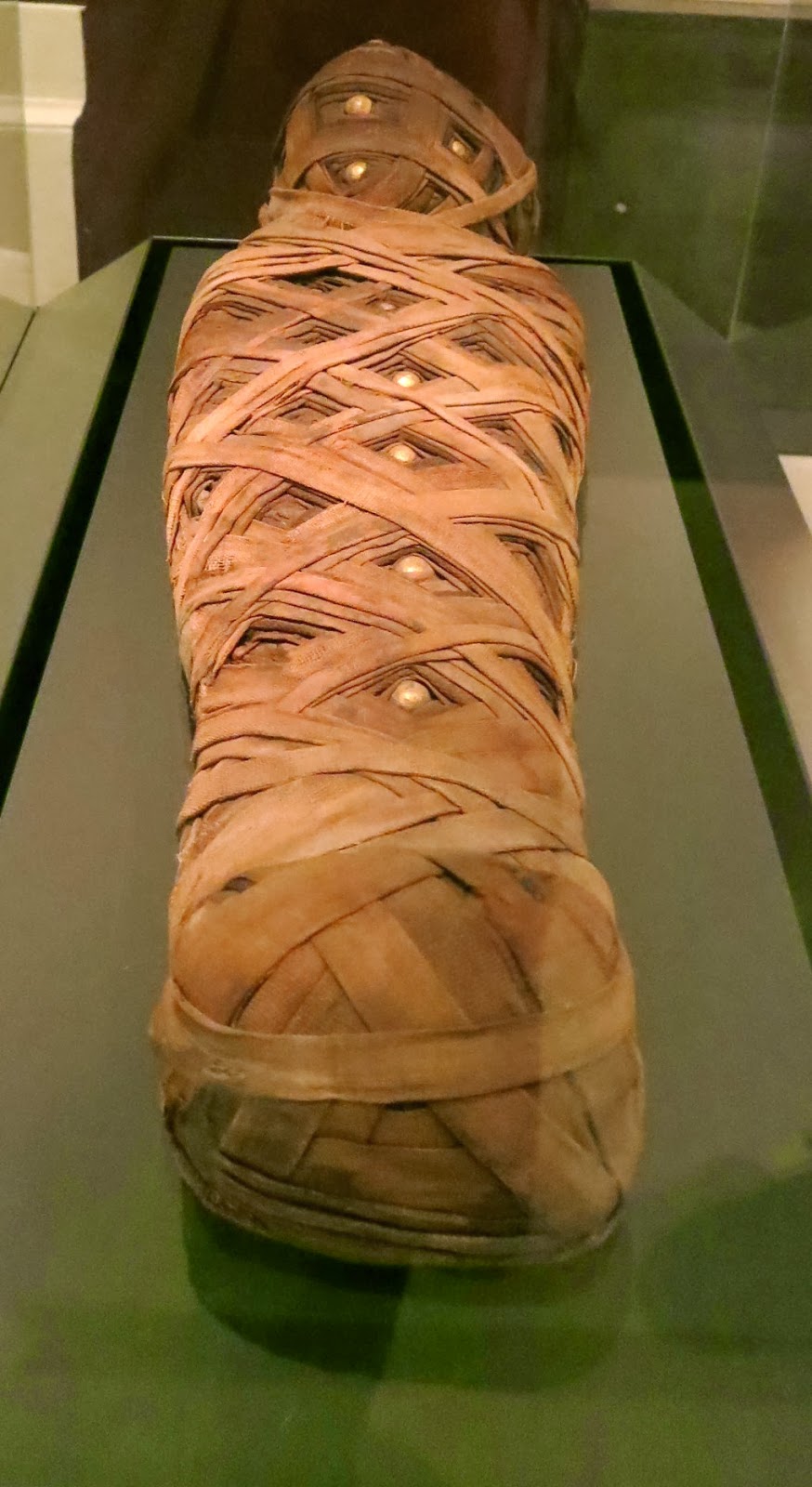
The mummy of a boy who died from pneumonia before he was two years old was interesting

as was the ink drawing on 111 sheets of glass by Angela Palmer (2011). The drawings are based on CT scans of the young boy taken at the John Radcliffe Hospital in Oxford.

