Showing posts with label open-air museums. Show all posts

Tuesday, 1 December 2015

Skansen


Having posted on the Beamish Museum in the Northeast of England, I thought it would be appropriate to write about Skansen in Stockholm. Skansen was the inspiration for Beamish, and we visited it last year.

Skansen is located on the island Djurgarden and was founded in 1891 by Arthur Hazelius to show the way of life in the different parts of Sweden before the industrial era. The 19th century was a period of great change and as the rural way of life was rapidly giving way to an industrialised society, many feared that Sweden's many traditional customs and occupations might be lost to history. After extensive travelling, Hazelius bought around 150 houses from all over the country and had them shipped piece by piece to the museum, where they were rebuilt to provide a unique picture of traditional Sweden. Only three of the buildings in the museum are not original, and these were painstakingly copied from examples he had found.

The 75 acre site includes a full replica of an average 19th century town, in which craftspeople in traditional dress such as tanners, shoemakers, silversmiths, bakers and glass-blowers demonstrate their skills in period surroundings.


The first thing we encountered when we entered the museum were replicas of Ppipi Longstocking (Pippi Langstrump) a favourite amongst Swedes.


We entered the town


and visited the glass blower's workshop


the adjacent shop sold glass items that were made in the workshop.


The furniture factory, from about 1920,  was the next place we visited
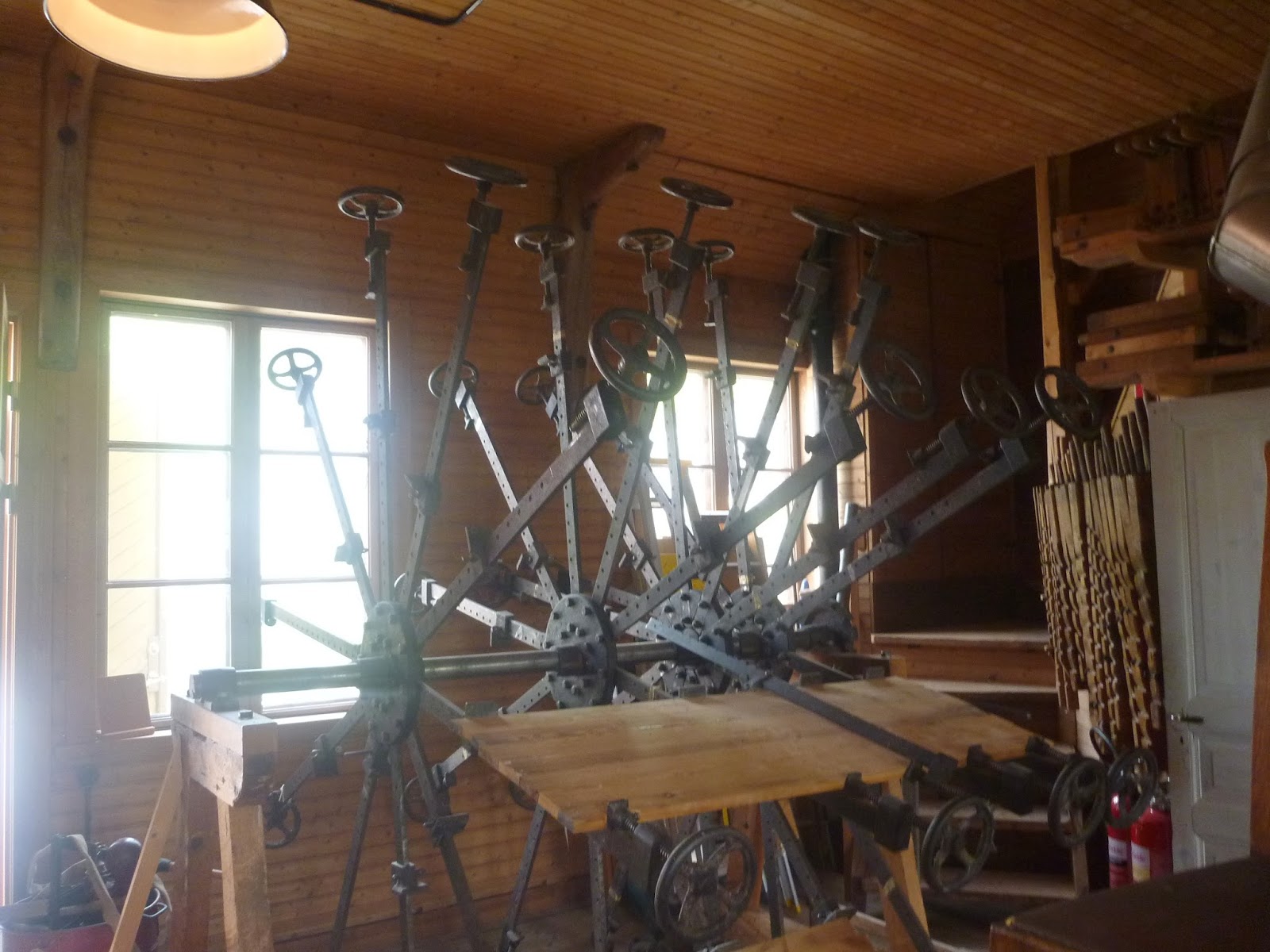


new sources of power and new machines made it possible to mass produce furniture. This machine holds glued pieces of wood together


The hardware store


sold various housewares


which we could purchase, if we wished.


An old telephone booth stood outside the store


and a petrol pump was nearby


In the dairy shop school children were told how butter was made,


were shown the churns


and if they wanted to purchase anything, it would be weighed


We wandered around for a while. Some of the shops and houses were closed


but we enjoyed looking at the architecture


of the houses


some of which are quite quirky.


We entered the printer's house


I fell in love with the stoves in Sweden


here's another one


Most of the people working in the museum wore period costume


We entered another home, this one depicting life in 1923


the kitchen


and another gorgeous stove


a cubbyhole for keeping things warm


and where the wood went


and another one, much more ornate


We moved on to Charles Tottie's residence, an example of how a wealthy tradesman would live in the 18th century. Charles Tottie was a Scotsman who became one of Sweden's wealthiest merchants. This is only part of his house, but unfortunately, it was closed and we could not go in.


We were able to have a look at his back yard though.


The goldsmith's workshop was closed even though there was someone sitting on the step outside.


So we moved on to the pottery


a lot of these traditional pots are very similar to traditional Greek pottery


On the grass roof of the pottery workshop sat a visitor


a closer look


The savings bank was closed


we liked the windows and shutters.


The octagonal corn-chandler's summer house, built in the middle of the 18th century, is very cute.

We spent the whole day at the museum - the town is only a small part of what's available to see.

Saturday, 28 November 2015

The Beamish Museum


The Beamish Museum is an open-air museum replicating a northern town of the early 20th century. The museum's guiding principle is to preserve an example of everyday life in urban and rural North East England at the climax of industrialisation. It depicts chiefly Victorian buildings in an evolved urban setting of 1913.

The museum was the vision of Frank Atkinson who was the museum's founder and first director. Having visited Scandinavian folk museums in the early 1930s, Atkinson was inspired to create an open museum for the North East. He adopted a policy of 'unselective collecting' - 'you offer it to us and we will collect it'. The people of the region responded with donations of all kinds ranging from everyday objects to steam engines and shops, filling an entire army camp of 22 huts.


One of the donations was this bus which was one of the first things we saw during our visit.


A closer view


We decided to take the electric tram


We were the only passengers. My companions went to the upper deck while I decided to stay downstairs which resulted in a very interesting conversation with the conductor


On our way to the village we passed the mine, another exhibit at the museum, which unfortunately we knew we would not have enough time to visit this time, and then we arrived at the village.


Our first stop was the Masonic Temple


which was originally in Sunderland.


The bank was next, Barclays


where components from Southport and Gateshead were used.


I liked the wallpaper.


A brewers' van was parked outside the bank when we came out


and we moved on to the Jubilee Confectioners


and sugar lovers' paradise (note the wonderful ceiling)


the displays made our mouths water but we resisted and did not buy anything.


We were able to visit the workshop which is adjacent to the shop. The confectioner was in the process of making sweets - these long strips are cut into small rounds. We helped ourselves to the samples that were available for visitors to take


on the wall you can see the various cylinders that are used to make the different shapes of sweets.


Our next stop was the Post Office


which also sold sweets and newspapers.


And then it was time to go to the pub


no customers, because it was early in the morning.


We then visited some house in the Victorian terrace (from Gateshead)


Our first stop was the house of the teacher of music


No musical instruments but we had a look at the parlour


and one of the bedrooms


It was then time to pay a visit to the dentist. We were pleasantly surprised to see that the dentist was a woman. When we mentioned this she explained that, given the times she lived in, she'd had to make a choice: marriage or her career, and she decided to choose her career.


The gas cylinders looked scary, particularly after she explained that the amount of gas administered was completely ad hoc. So ad hoc in fact, that one patient died every two weeks. The back stairs were used to take the bodies away, so as not to frighten the rest of the patients.


The dentist demonstrated how the gas was administered. The drill was powered by foot. It took approximately half an hour to do a small filling and because the drill would get very hot, long breaks were necessary.


We also visited the nursery


the parlour


the kitchen


and the bathroom. The dentist was the richest person in the village and her house was the only one with an indoor bathroom.


The bandstand (from Gateshead) is in the middle of the green which we had to cross on our way to


the tearooms. A vast space, and no wonder, they get so many visitors in the summer. When we visited it was relatively empty though.


We also went to see the dining hall which was out of use when we visited


but we loved the booths and their folding seats.


It was then time to visit the Co-op across the road


First stop, the Drapery Department


I loved the advertising chair - it's amazing what people donated to the museum


then the grocery department - note the coffee grinder.


The garage is huge


selling all kinds of oils and parts


but it was the vintage cars that we particularly appreciated


as well as the motor bikes.


The bakery was next


the shop


the working area where the two bakers were busy


and we loved the machine where they mix the dough.


A quick walk to the train station, and by the tracks we saw this advertisement


and then it was time to take the tram for our return.