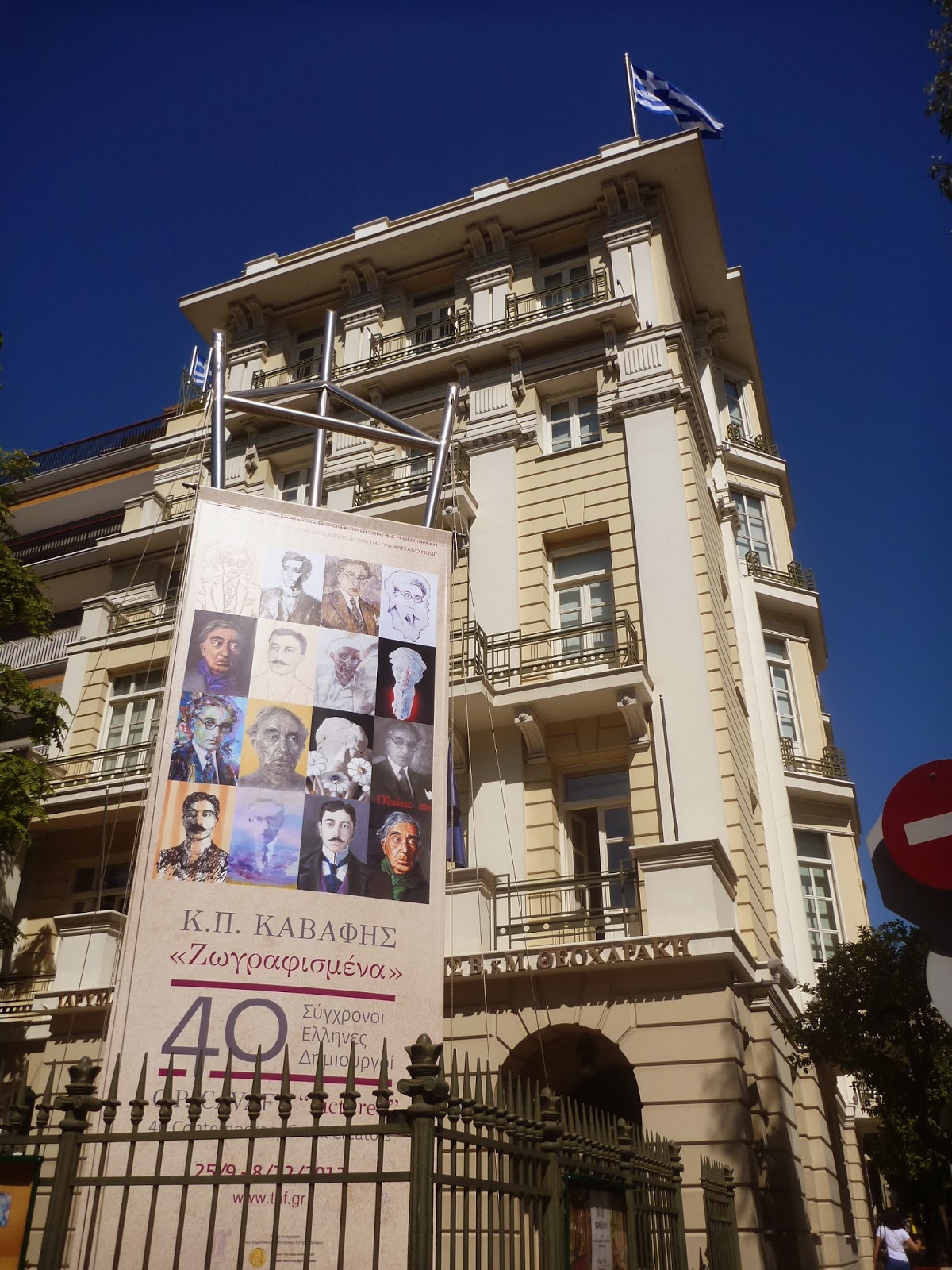
Painted: C.P. Cavafy, at the Theoharaki Foundation in Athens.
Forty Greek visual artists in dialogue with the poems of C.P. Cavafy.
This is an extremely long post, my longest probably, but it was a wonderful exhibition and I wanted to have as much of it as possible on record, so that I can revisit. As well as the paintings, drawings, etc. I have also included some of the Cavafy poems that were posted next to the art.
Morning Sea, Manolis Haros, 2013 (oil on canvas)
Beach Party, Alekos Fassianos, 2002, (acrylic)
Tomb of Lanis, Dimitris Mytaras, 1992 (acrylic)
A Sketch for 'Afternoon Sun', Alekos Levidis, (mixed technique)
The Afternoon Sun
This room, how well I know it.
Now they're renting it, and the one next to it,
as offices. The whole house has become
an office building for agents, businessmen, companies.
This room, how familiar it is.
The couch was here, near the door,
a Turkish carpet in front of it.
Close by, the shelf with two yellow vases.
On the right - no, opposite - a wardrobe with a mirror.
In the middle the table where he wrote,
and the three big wicker chairs.
Beside the window the bed
where we made love so many times.
They must still be around somewhere, those old things.
Beside the window the bed;
the afternoon sun used to touch half of it.
... One afternoon at four o'clock we separated
for a week only ... And then -
that week became forever.
Lovely White Flowers, Christos Carras, 2013 (oil on canvas)
Illustration for 'Lovely White Flowers', Yannis Tsarouchis, 1964 (gouache on paper)
Lovely White Flowers
He went inside the café where they used to sit together.
It was here, three months ago, that his friend told him:
'We're completely broke - so hard up, the two of us,
that we're stuck with the cheapest places.
I can't go around with you anymore - it's no use hiding the
fact.
I've got to tell you, somebody else is after me'.
The 'somebody else' had promised him two suits, some silk
handkerchiefs.
He himself, to get his friend back,
went through hell rounding up twenty pounds.
His friend came back to him for the twenty pounds -
but along with that, for their old intimacy,
their old love, for the deep feeling between them.
The 'somebody else' was a liar, a real bum:
he'd ordered only one suit for his friend,
and that under pressure, after much begging.
But now he doesn't want the suits any longer,
he doesn't want the silk handkerchiefs at all,
or twenty pounds, or twenty piastras even.
Sunday they buried him, at ten in the morning.
Sunday they buried him, almost a week ago.
He laid flowers on his cheap coffin,
lovely white flowers, very much in keeping
with his beauty, his twenty two years.
When he went to the café that evening -
he happened to have some vital business there -
to that same café where they used to go together,
it was a knife in his heart,
that dead café where they used to go together.
CP. Cavafy, Panagyiotis Tetsis (etching)
C.P. Cavafy, Bust, Apostolos Fanakidis, 2013 (polyester and neon)
The City
You said: 'I'll go to
another country, go to another shore,
find another city
better than this one.
Whatever I try to do
is fated to turn out wrong
and my heart lies
- buried - as though it were something dead.
How long can I let my
mind moulder in this place?
Wherever I turn,
wherever I happen to look,
I see the black ruins
of my life, here,
where I've spent so
many years, wasted them, destroyed them totally'.
You won't find a new
country, won't find another shore.
This city will always
pursue you. You will walk
the same streets,
grow old in the same neighbourhoods,
will turn gray in
these same houses.
You will always end
up in this city. Don't hope for things elsewhere:
there is no ship for
you, there is no road.
As you've wasted your
life here, in this small corner,
you've destroyed it
everywhere else in the world.
Narcissus' Sleep, Ilias Papailiakis, 2011 (oil on cloth)
Study for a Greek Statue, Ilias Papailiakis, 2011 (oil on cloth)
Lying Nude, Yannis Tsarouchis, 1957 (oil on cloth)
Seated Male Nude and Furniture with Spears, Yannis Tsarouchis, 1954 (oil on cloth)
David, Yannis Tsarouchis, 1974 (oil on cloth)
Yannis Tsarouchis, Illustration from 'C.P.Cavafy, Poems', (watercolour on paper)
The Forgotten Guard, Diptych, Yannis Tsarouchis, 1956 (oil on cloth)
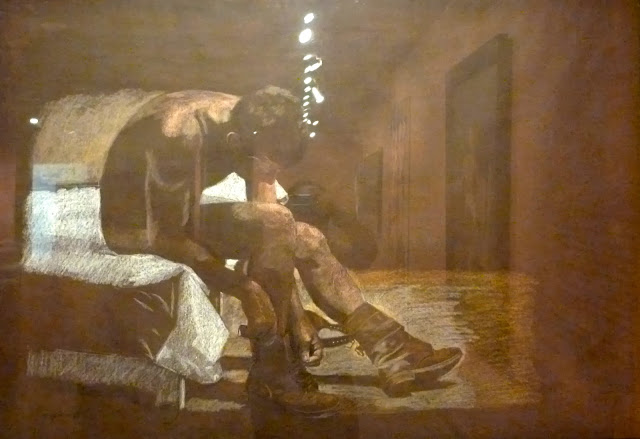 Untitled, Yannis Tsarouchis, 1981, (coloured chalk on cardboard)
 Candles, Christos Bokoros, 2012 (polished gold, cloth and oil on wood)
Candles, Achilleas Droungas, 2013 (oil on canvas)
Candles
Days to come stand in front of us
like a row of burning candles -
golden, warm, and vivid candles.
Days past fall behind us,
a gloomy line of burnt-out candles;
the nearest are still smoking,
cold, melted and bent.
I don't want to look at them: their shape saddens me,
and it saddens me to remember their original light.
I look ahead at my burning candles.
I don't want to turn, don't want to see, terrified,
how quickly that dark line gets longer,
how quickly one more dead candle joins another.
Candles, Kostas Tsoklis, 1995, (inox, oil and burning flame)
Painting of a Fellow Student, Giorgos Rorris, 1983 (oil on canvas)
Picture of a 23-Year-Old Painted by his Friend of the Same Age, an Amateur
He finished the picture yesterday noon.
Now he looks at it detail by detail.
He's painted him wearing an unbuttoned grey jacket,
no vest, tieless,
with a rose-coloured shirt,
open, allowing a glimpse
of his beautiful chest and neck.
The right side of his forehead is almost covered by hair,
his lovely hair
(done in the style he's recently adopted).
He's managed to capture perfectly
the sensual note he wanted
when he did the eyes, the lips ...
that mouth of his, those lips
so ready to satisfy a special kind of erotic pleasure.
Untitled, Edourados Sakayan, 2012-2013, (oil on canvas)
Longings
Like the beautiful bodies of those who died before growing
old,
sadly shut away in a sumptuous mausoleum,
roses by the head, jasmine at the feet -
so appear the longings that have passed
without being satisfied, not one of them granted
a single night of pleasure, or one of its radiant mornings.
Portrait of Cavafy at a Young Age, Michalis Madenis, 2013 (oil on canvas)
To Sensual Pleasure
My life's joy and incense: recollection of those hours
when I found and captured pleasure as I wanted it.
My life's joy and incense: that I refused
all indulgence in routine love affairs.
Portrait of a Young Man from Antioch, Michalis Makroulakis, (egg emulsion on linen glued on plywood)
Temethos, Antiochian, A.D. 400
Lines written by young Temethos, madly in love.
The title: 'Emonidis' - the favourite
of Antiochos Epiphanis; a very good-looking young man
from Samosata. But if the lines come out
ardent, full of feeling, it's because Emonidis
(belonging to another, much older time:
the 137th year of the Greek kingdom,
maybe a bit earlier) is in the poem
merely as a name - a suitable one nevertheless.
The poem gives voice to the love Temethos feels,
a beautiful kind of love, worthy of him. We, the initiated -
his intimate friends - we the initiated
know about whom those lines were written.
The unsuspecting Antiochians read simply 'Emonidis'.
C.P. Cavafy, Michalis Makroulakis, (egg emulsion on linen glued on plywood)
Windows, Yannis Adamakos, 2013, (graphite on paper)
Windows, Yannis Adamakos, 2013, (graphite on paper)
Windows, Yannis Adamakos, 2013, (graphite on paper)
Windows, Yannis Adamakos, 2013, (graphite on paper)
Windows, Yannis Adamakos, 2013, (graphite on paper)
The Windows
In these dark rooms where I live out empty days,
I wander round and round
trying to find the windows.
It will be a great relief when a window opens.
But the windows aren't there to be found -
or at least I can't find them. And perhaps
it's better if I don't find them.
Perhaps the light will prove another tyranny.
Who knows what new things it will expose?
Flag, Kostas Varotsos, 2011-13, (glass)
Walls, Vana Xenou, 2013, (charcoal on paper)
Walls, Telis Sofianopoulos, 2013, (mixed technique, ink on canvas and digital printing)
Walls
With no consideration, no pity, no shame,
they've built walls around me, thick and high.
And now I sit here feeling hopeless.
I can't think of anything else: this fate gnaws my mind -
because I had so much to do outside.
When they were building the walls, how could I not have
noticed!
But I never heard the builders, not a sound.
Imperceptibly they've closed me off from the outside world.
C. P. Cavafy, Yannis Psychopedis, 2013 (oil on canvas)
C. P. Cavafy, Yannis Psychopedis, 2013 (oil on canvas)
In the Same Space, Michalis Manousakis, 2011-2013 (mixed media)
In the Same Space
The setting of houses, cafes, the neighbourhood,
that I've seen and walked through years on end:
I created you while I was happy, while I was sad,
with so many incidents, so many details.
And, for me, the whole of you has been transformed into
feeling.
Manuscripts, Alexandra Athanassiadi, 2013 (mixed technique)
Voices
Loved, idealised voices
of those who have died, or of those
lost for us like the dead.
Sometimes they speak to us in dreams;
sometimes deep in thought the mind hears them.
And, with their sound, for a moment return
sounds from our life's first poetry -
the distant music fading away at night.
Votive Offering, Kostas Tsoklis, (inox, mousetrap)
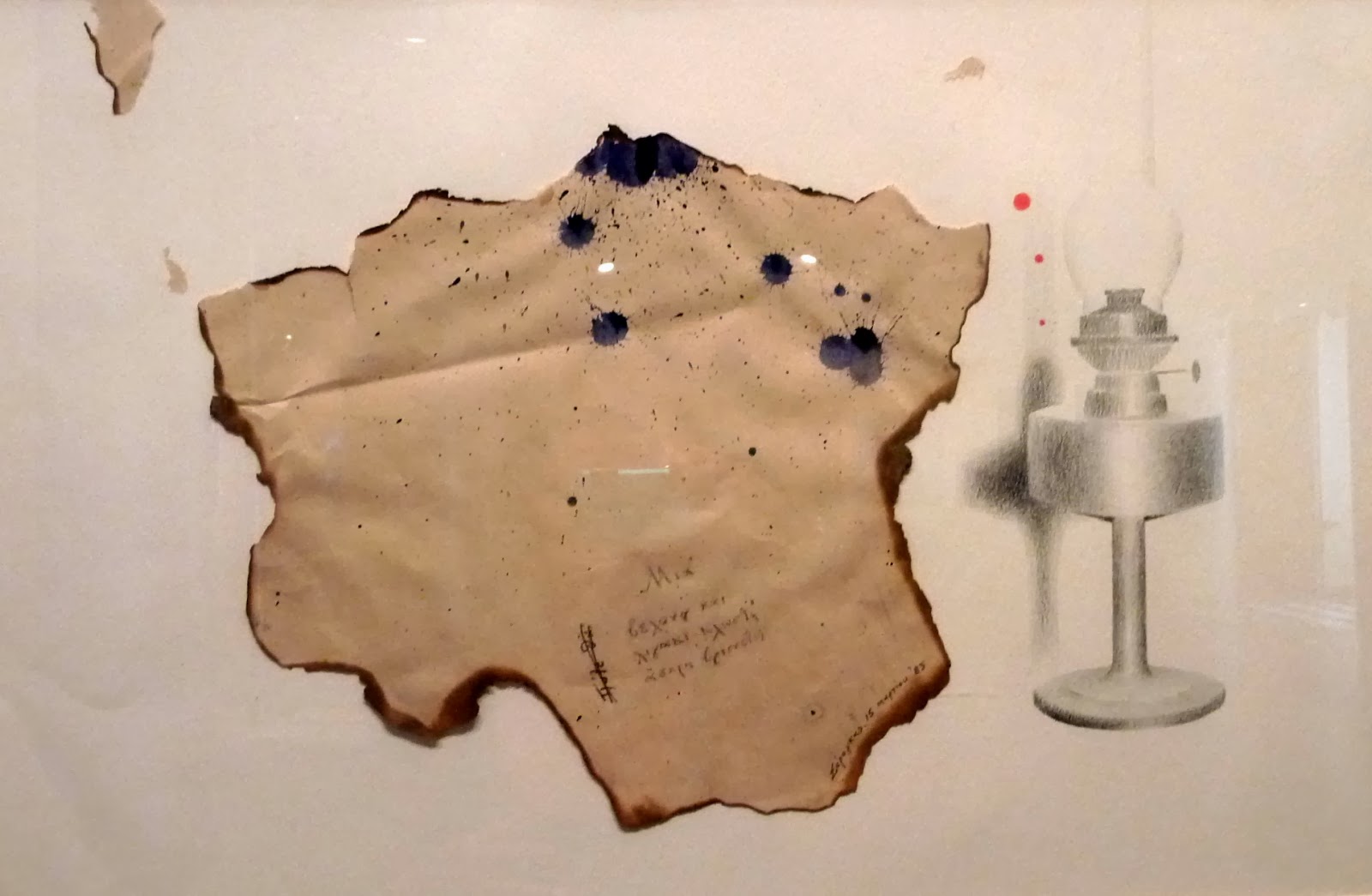
Portrait of C.P. Cavafy, Sotiris Sorogas, 1985, (coloured pencils on burnt paper)
Since Nine O'clock
Half past twelve. Time's gone by quickly
since nine o'clock when I lit the lamp
and sat down here. I've been sitting without reading,
without speaking. Completely alone in the house,
who could I talk to?
Since nine o'clock when I lit the lamp
the shade of my young body
has been haunting me, reminding me
of shut scented rooms,
of past passion - that daring passion.
And it's also brought back to me
streets now unrecognizable,
bustling night clubs now closed,
theatres and cafes no longer there.
The shade of my young body
also brought back the things that make us sad:
family grief, separations,
the feelings of my own people,
of the dead so little recognized.
Half past twelve: how the time has gone by.
Half past twelve: how the years have gone by.
C.P. Cavafy, Poems, illustrated by Yannis Tsarouchis
Ithaka, Constantinos Xenakis, 2003 (mixed technique)
Ithaka
As you set out for Ithaka
hope your road is a long one,
full of adventure, full of discovery.
Laistrygonians, Cyclops,
angry Poseidon - don't be afraid of them:
you'll never find things like that on your way
as long as you keep your thoughts raised high,
as long as a rare excitement
stirs your spirit and your body.
Laistrygonians, Cyclops,
wild Poseidon - you won't encounter them
unless you bring them along inside your soul,
unless your soul sets them up in front of you.
Hope your road is a long one.
May there be many summer mornings when,
with what pleasure, what joy,
you enter harbours you're seeing for the first time;
may you stop at Phoenician trading stations
to buy fine things,
mother of pearl and coral, amber and ebony,
sensual perfume of every kind -
as many sensual perfumes as you can;
and may you visit many Egyptian cities
to learn and go on learning from their scholars.
Keep Ithaka always in your mind.
Arriving there is what you're destined for.
But don't hurry the journey at all.
Better if it lasts for years,
so you're old by the time you reach the island,
wealthy with all you've gained on the way,
not expecting Ithaka to make you rich.
Ithaka gave you the marvellous journey.
Without her you wouldn't have set out.
She has nothing left to give you now.
And if you find her poor, Ithaka won't have fooled you.
Wise as you will have become, so full of experience,
you'll have understood by then what these Ithakas mean.
Translations of poetry are always problematic, and Cavafy in English is not as moving or immediate as reading him in Greek. I have found the translation by Edmund Keeley and Philip Sherrard the closest to the original, and theirs is the translation I have used in this post. The etching on the cover is by David Hockney.
What is missing from this exhibition of course, are David Hockney's drawings. Hockney loved Cavafy's poetry so much that went to Alexandria and Beirut, where many of the poems are set, to get in the mood. But, this is an exhibition of Greek artists. There is however, an exhibition of Hockney's work that includes some of these drawings from 1966, at the Walker in Liverpool, which hopefully, I may be able to visit. I would love to see those drawings again. You can see a small sample
here.