Showing posts with label printmaking. Show all posts

Wednesday, 11 December 2024

Spectacular Diversions - Chila Kumari Singh Burman: part 1, printmaking


Spectacular Diversions - Chila Kumari Singh Burman at Compton Verney

Burman is a Punjabi-British artist whose work explores cultural identity and the experiences and aesthetics of Asian femininity. Over the last 40 years her practice has encompassed printmaking, drawing, painting, installation and film to explore the intersection of feminism, race and representation, placing alternative perspectives of Britishness within art history.


The exhibition consists of prints, drawings, paintings, collage, sculpture, film, and installation. Burman explores these media to draw out recurring themes that are ongoing preoccupations in her work including her Hindu Punjabi heritage and upbringing in Liverpool, feminism, activism and the relationship between high art and popular culture.

The first part of the exhibition which will be covered in this post explores printmaking.  Burman often combines multiple processes in single works and brings together a wide range of imagery and textual elements from sources including magazines, family photographs, posters, comic strips, advertisements, protest flyers and badges, She uses this material to create complex and meticulously planned compositions.

As you can see in the picture above, Burman has embellished the entrance of Compton Verney with her art, covering the temple-like neoclassical facade in neon sculptures of Hindu gods and goddesses.


My friend, 2023, (fibreglass, mixed media)


looking closer


Mint, 2024, (inkjet print)

Burman spent countless hours working in her father's ice cream van. She has adopted her father's trademark tiger as a mascot - both the technicolour treats sold in the van and the tiger have become recurring motifs in her work.


Rage and Treats, 2006-8, (mixed media)

Burman's art has been described as 'beguiling surface with a hidden sting', her vivid colours and visually appealing imagery are often used to convey hard-hitting messages. In this work, imagery of Indian warrior queen Jhansi ki Rani going into battle is juxtaposed with an oversized ice lolly, which looms over her. Burman sometimes uses the ice lolly as a metaphor for the objectification of women - their phallic shapes are used to comment on the ways in which women are reduced to objects of desire.


Let's Take You Higher, 2022, (inkjet print, faux gems and rhinestones on paper)

Here, Burman has juxtaposed imagery of a Hindu deity with a detail from the work Shipboard Girl by Roy Lichtenstein, which has been covered with embellishments.


Electric Joy Aka Indian Cinderalla, 2023, (24 thermoplastic monotypes)

Here, images of the artist's drawings and collages were screen printed onto plastic sheets, which were then moulded around three-dimensional objects including toy ice cream vans, sweet packaging and animals in a vacuum to form a plastic shell. An exploration of consumer culture: vacuum formers are used to mass produce a range of products.


The Smile you Send Returns to You, 2024, (steel, LED lights, plastic embellishments, graphic vinyls, fibreglass, carbochon stones and sound system)

This year Burman was one of seven artists shortlisted for the Fourth Plinth commission in Trafalgar Square. This maquette for her proposed sculpture tells of her father's voyage to the UK from India on board MS Batory. It presents a turbo-charged reimagining of his ice cream van complete with her signature motifs including embellished tigers and sweet treats. In the windows, we see Bollywood film stills and the figure of Burman's father. The title could be interpreted as a call for kindness amid a fractious world.


The Other Side of Paradise, 2024, (collage and mixed media on paper)


looking closer


looking closer


Embelished Works, 2022-24, (stickers, bindis, faux gems, glitter, letter transfers and pen on paer)

These works highlight Burman's delight in materials that would usually be considered disposable - in her hands inexpensive adornments are transformed into glittering works of art.

These works are also inspired by her ongoing exploration of the visual culture of Asian femininity. 'The feminism I have long assumed as a matter of course is now rubbing shoulders with the playful feminity associated with trinkets, baubles, tinsel, sequins....henna patterns and bindis'.  Many of these works originagted as line drawings of female figures, which have then been covered in embellishments to create 'ironic ex-votos to woman-as-image revelling in [the]specious glitter of kitsch as a perverse element of female embellishment and empowerment'.


Bindi Girl Doing a Poo, 2022, (stickers, bindis, faux gems, glitter, letter transfers and pen on canvas)


looking closer


Parvati, Hindu Goddess, 2022, (inkjet print embellished with faux gems, bindis and stickers)


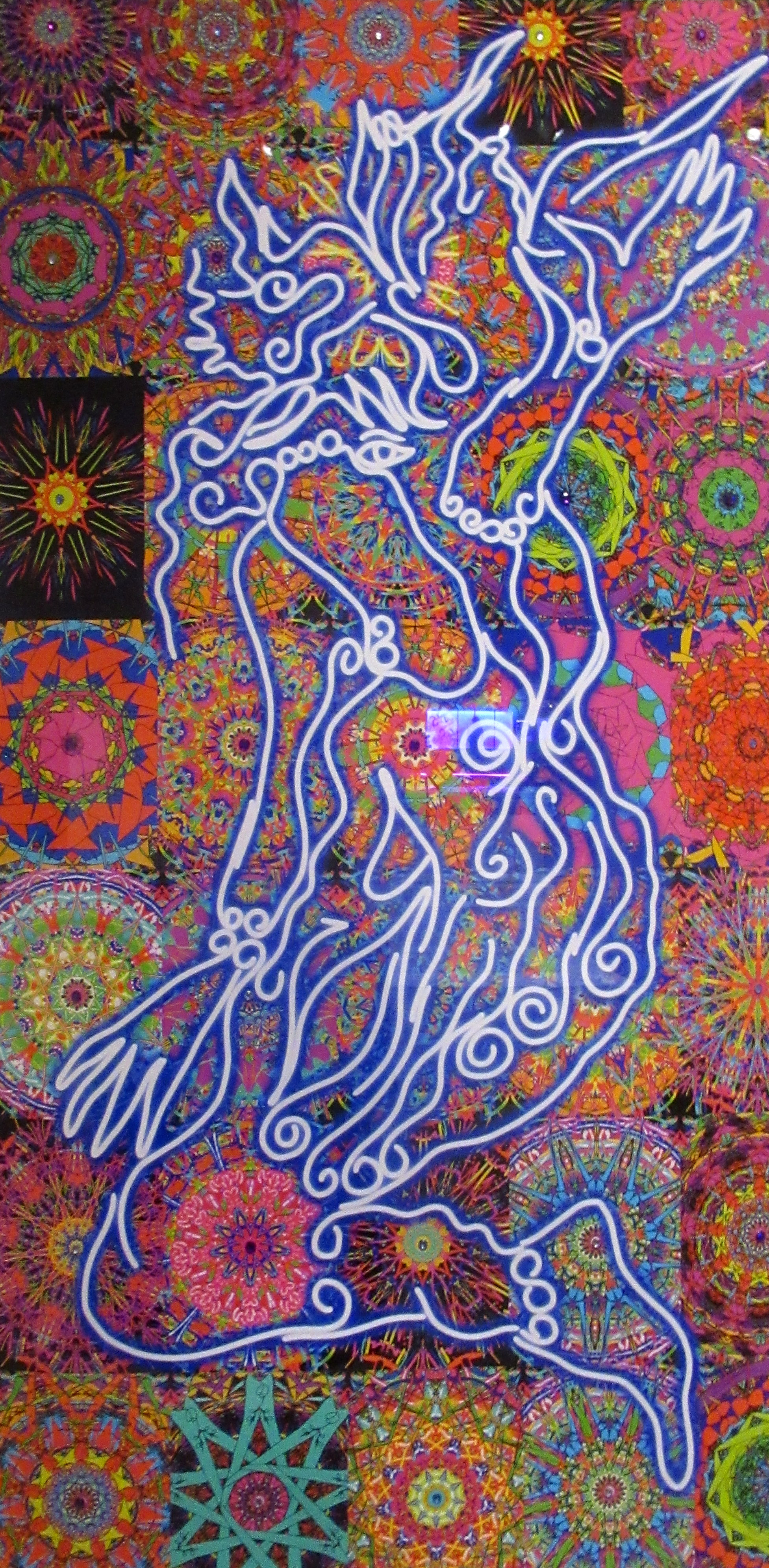
Kaleidoscopic Self-Portrait Doing Shotokan, 2023, (embelished collage)

The surface of this work is richly embellished with sequins, faux jewels and bindis. In the centre, Burman has included an image of herself performing a high kick from the Shotokan form of karate. Outlined in electric blue, the figure conveys a sense of energy similar to Burman's neon sculptures (see next post) whilst projecting an image of power.


Tiger, My Jaan, 2021


Friday, 16 December 2022

Art in China


Art in China, 1949-1999, at the Ashmolean Museum, Oxford

Chairman Mao declared the founding of the People's Republic of China in 1949 and until his death in 1976, art was subject to strict political controls. Oil painting replaced the centuries-old tradition of ink landscape painting, and the Socialist Realist style adopted from the Soviet Union remained influential until the late 1970s. Pictorial woodblock printing developed from a folk craft to an increasingly creative medium used for both propaganda purposes and more subtle landscapes.

During the Cultural Revolution (1966-76) political images and messages were also produced in the historic media of woven or embroidered silks and papercuts. From 1978, the Reform Era ushered in new possibilities as China re-engaged with the world, and artists encountered ideas and cultural practices from elsewhere. Brush and ink however, had never ceased to be used, and the scrolls and albums in this exhibition include works by some of modern China's most distinguished painters.


Zeng Shanqing, Black Horse, Yellow Horse, around 1990 (ink and colour on paper)


Xu Bing, Lost Letters, 1997, (relief print, printed with oil-based ink)

Bing's work often questions the idea of communiating meaning through language. Lost Letters reflects his interest in the marks and traces of the past, relating not only to historical memory but also to his own personal memories and experiences.


Song Yuanwen, The Sleepless Land, 1979, (woodcut, printed on paper with oil-based ink)

Yuanmen taught at the Central Academy of Fine Arts and was also at one time Chairman of the Chinese Printmakers' Association. His social role and academic position represent an official stand and have influenced the direction of modern Chinese printmaking. His woodcuts are predominantly monochrome, poetical depictions of the vast northern land.


Wang Qi, Spring Outing, 1979 (woodcut, printed on paper with oil-based ink)

Qi is one of the first generation of modern Chinese printmakers. After the Cultural Revolution, artists regained the freedom to depict daily scenes without any political content. The period after 1977 has been described as the 'spring of arts and literature'.  With mostly monochrome and finely cut images, Qi's highly realistic prints vividly reflect the transformation of modern China since the late 1930s.


Chao Mei, The First Track of Footprints, 1960, (multi-block woodcut printed on paper with oil-based ink)

This work records an event during the late 1950s when ten million soldiers were sent to the Great Northern Wilderness (Beidahuang) in northeast China to become agricultural workers. Chao Mei was one of them. The print presents the soldiers' first experience of the wasteland in extremely harsh conditions. 


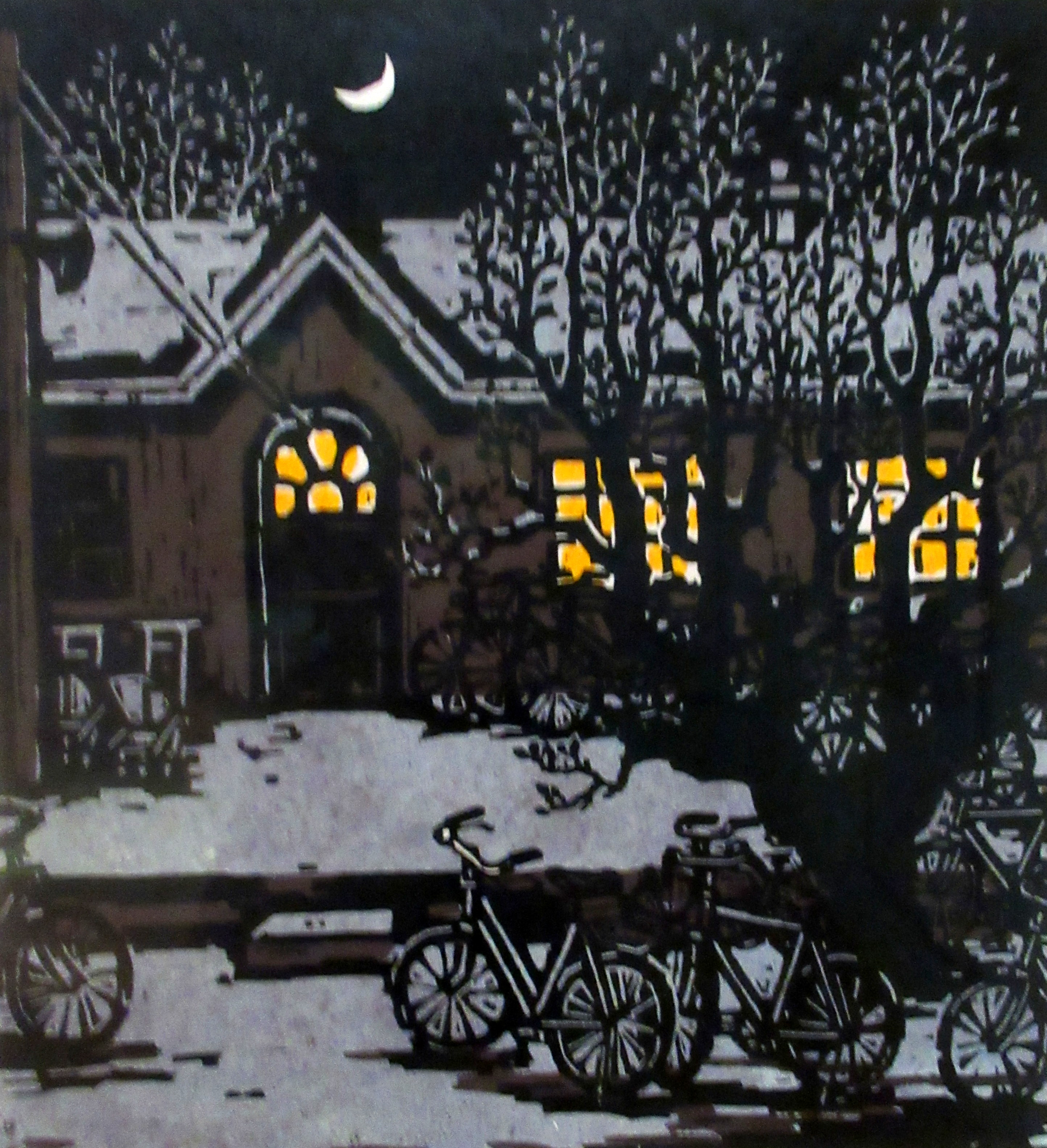
Li Qun, Spring Night, 1962,  (multi-block woodcut printed on paper with oil-based ink)

This print depicts an early spring night in a commune village of the northwest region, with bicycles and seeders outside the village office.


Zhao Xiaomo, Golden Sea, 1972,  (multi-block woodcut printed on paper with oil-based ink)

This print records how during the Cultural Revolution school graduates followed Mao's call to 'receive re-education from poor and lower-middle peasants', and settled in the countryside to become state farmers. Formulaic smiling is a typical symbol of that period. The artist was among the 'intellectual youths' sent from the city to the remoted Great Northern Wilderness state farm, where she began to create woodcuts together with a group of other intellectual youths from different parts of China. Since the 1980s the style of her work has increasingly used elements from folk art.

Zhao's early woodcuts reflect the strong influence of Soviet socialist realist style, whilst since the early 1980s her interest has changed to folk style Chinese ink painting.


Zhu Xiuli, Contentment, 1989, (ink and colour on paper)


Xie Zhiguang, Peony, 1974-75, (ink and colour on paper)

Peonies have a long history in both art and literature in China; in Zhiguang's home region of Zheijiang peony festivals were held in temples during the Song dynasty (960-1279), with hundreds of varieties displayed.


Tao Yiqing, River Landscape, 1965, (ink and slight colour on paper)


Wednesday, 13 January 2016

A. Tassos


A. Tassos at the Benaki Museum, Pireos Annex.


A. Tassos studied at the Athens School of Fine arts under the master of Greek engraving, Yannis Kaphallinos. He joined the Greek Communist Party in 1930, and during the Nazi occupation of Greece he joined the National Liberation Front (EAM) creating resistance propaganda material. From 1954 to 1967, while working for the Greek Postal Service, he implemented innovatory techniques in stamp design. In 1959 he became director of the pioneering Department of Graphic Arts at the Technological Institute. In the years of the military junta he lived in self-exile abroad, creating works of social protest.

His work focuses on ordinary people, their everyday lives and their struggles. Until the end of his life he remained faithful to his beliefs and the hope for a new society, a just, democratic, socialist one.


The artist's studio recreated in the gallery


Figure, 1963 (woodcut)


Young Woman with Small Trees, 1963 (woodcut)


Composition, 1963 (woodcut)


Tribute to Aliki, 1962 (wooden plate)


Tribute to Aliki, 1962 (wooden plate)


Young Woman, 1950 (lithograph)


Tavern Boy, 1957 (woodcut)


A. Tassos and Loukia Maggioros, The Cultivation of Tobacco (maquette), 1959-60


Mulberry Trees, 1960 (lithograph)


Still Life, 1950-55 (woodcut)


Farmers of Messinia, 1957  (woodcut)


Pasture, 1959 (lithograph)


Fruit Harvest, 1958 (woodcut)


Fruit Harvest, 1958, (woodcut)


Women Farmers, 1958 (lithograph)


Every Morning, 1932, (woodcut)


Slave, 1, 1967 (woodcut plate)


Slave 2, 1967 (woodcut plate)


Slave 3, (woodcut plate)


Federico Garcia Lorca, 1966 (woodcut) 


Freedom Burning (triptych) 1972 (wooden  plate)


Cyprus 1974, 1974 (woodcut)


17 November 1973, 1974 (pencil and ink drawing)


Yorgos Seferis, 1979 (ink drawing)


Yorgos Seferis, 1979 (wooden plate)


Yorgos Seferis, 1979 (woodcut)


Girl by Window, 1983 (preparatory drawing)


Girl by Window, 1983 (lithograph)


Tree Trunks, 1980-81 (wooden plate)


Finally:


Loukia Magiorou, A. Tassos engraving, 1948 (oil on canvas)


 Yannis Moralis,  Loukia Magiorou, 1939 (oil on canvas)


Stamatis Mitsios, Tribute to A. Tassos, 2015