Showing posts with label video art. Show all posts

Monday, 31 January 2022

Turner Prize 2021


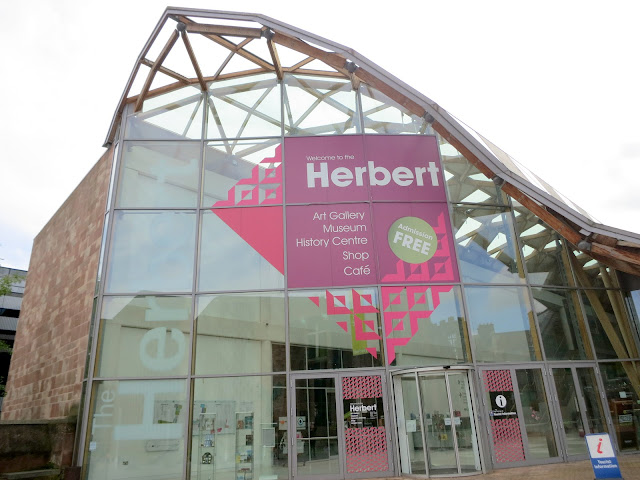
The 2021 Turner Prize was held at the Herbert Art Gallery and Museum in Coventry as part of the City of Culture celebrations.

This year the jury selected not several individual artists but a shortlist of five art collectives. The five participants work closely with their communities to use art as a catalyst for social change: given that for the last two years our lives have been consumed by the coronavirus, it only seems right the jury selected a shortlist of groups who champion a collaborative process by responding to the pandemic in solidarity and reflecting on the importance of community. 

Each of the art collectives has gone beyond the Turner Prize, as they go back to the roots of their community, advocating change and beginning (and continuing) to think about how art can change people. 

The artists who participated were: Array Collective; Black Obsidian Sound System; Cooking Sections; Gentle/Radical; Project Art Works.

I was mortified when I heard that all five entries were video art. I hate video art. It bores me. I just cannot bear to sit or even worse, stand, and watch a video in a gallery and I always move on when there is a video on show in an art gallery. But, I thought I would give it a go.

I walked into the first room, saw the television screen and walked straight out. I proceeded, walked into an Irish pub and I was hooked.


Array Collective - The Druithaib's Ball:
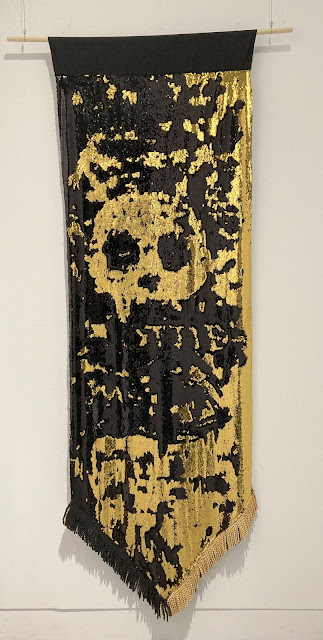


Array are a collective of artists and activists rooted in Belfast. They create collaborative actions in response to social issues - for example, around language, gender, reproductive rights - affecting themselves, their communities and allies. Array reclain and question traditional identities associated with Northern Ireland in playful ways that merge performance, protest, ancient mythology, photography, installation and video.
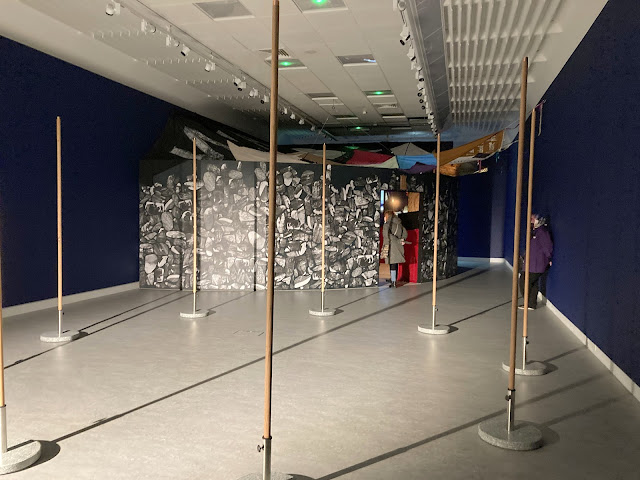


We approached through a circle of flag poles, that references ancient Irish ceremonial sites and contemporary structures, which is illuminated by a dawn-to-dusk light.
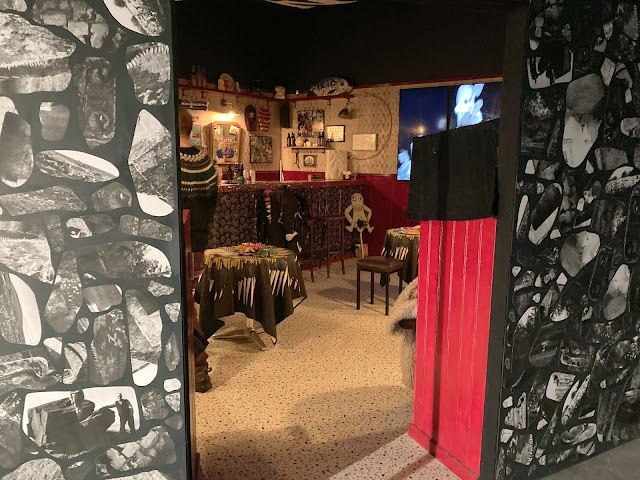


Through the door we could see
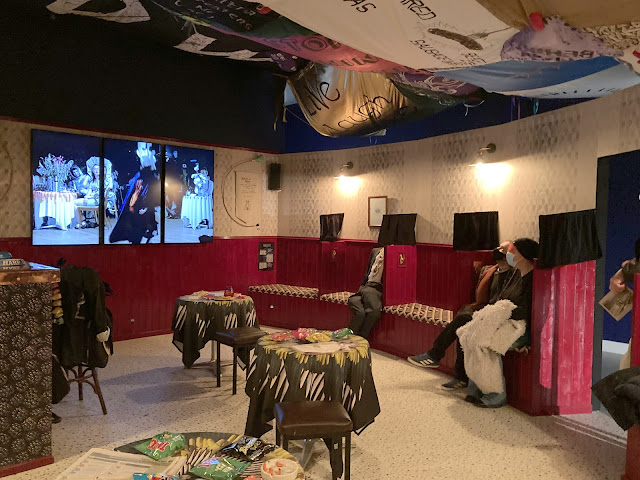


an Irish pub, an imagined sibin (a 'pub without permission') that hosted a film created for the Belfast event. In the dimly light, cozy bar, a video plays an unfolding night of performative fun. The people of Belfast gather to drink and party; one by one, they take to the stage to compete for the title of Diva, some in drag, some in T-shirts and jeans. Songs are sung, stories are told, stand-up routines are played out. Each performer is driven by the same desire: for Belfast to put its past behind and come together.
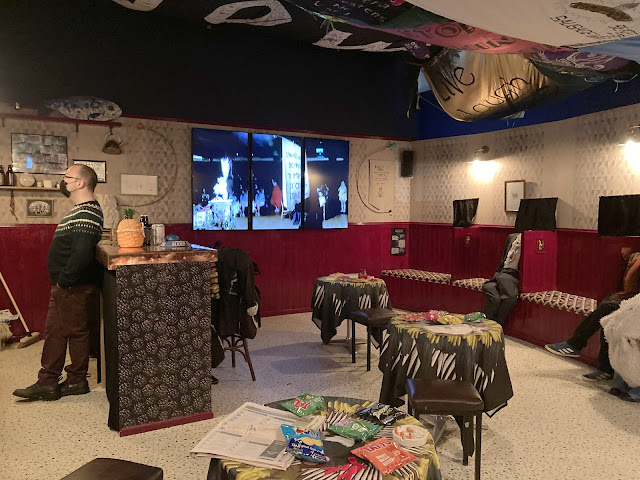


Array Collective work, the blub says, to complicate religious identities. They do this in among the bar's lifesize dolls, protest posters and comfy niches. One man tells a story of religious homophobia, remembering paranoia about sharing the chalice in church during the 1980s Aids epidemic.

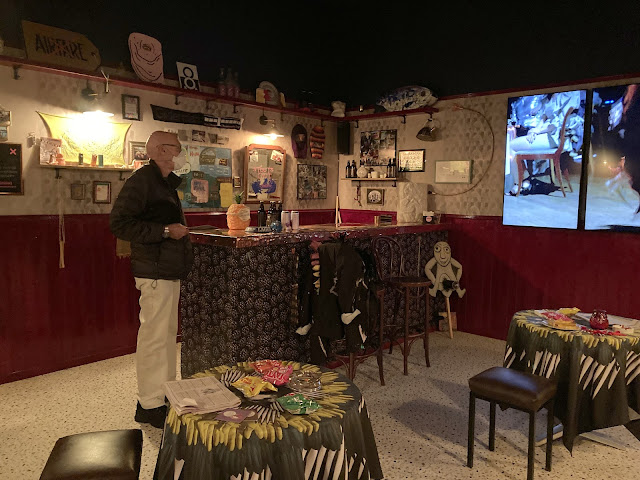


At first, the bar feels deeply traditional but, when you look deeper, it reveals hidden political messages about sexuality and identity. Might this be a gay bar?
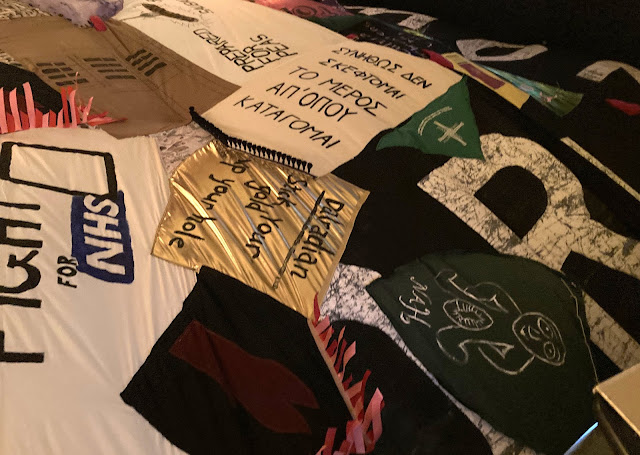


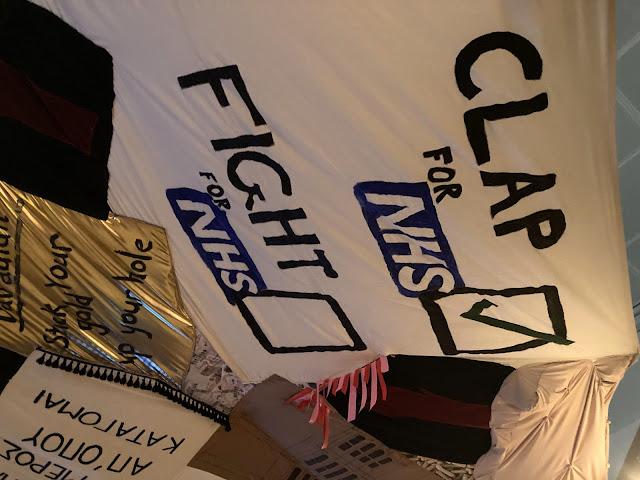
 A large canopy styled from banners provides a floating roof. 


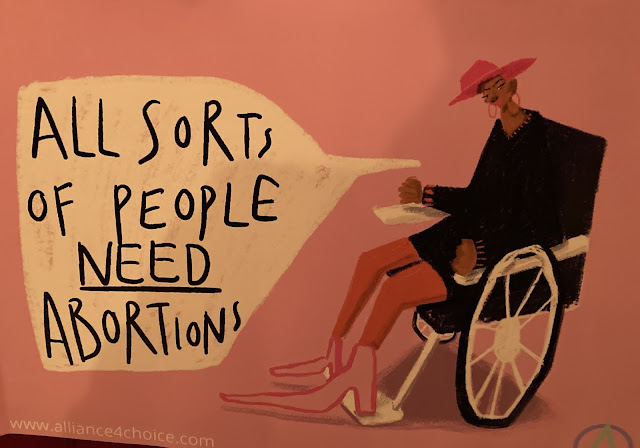
On one wall is a pink poster, depicing a woman in high heels, sat in a wheelchair: 'All sorts of people need abortions', she says in a speech bubble.
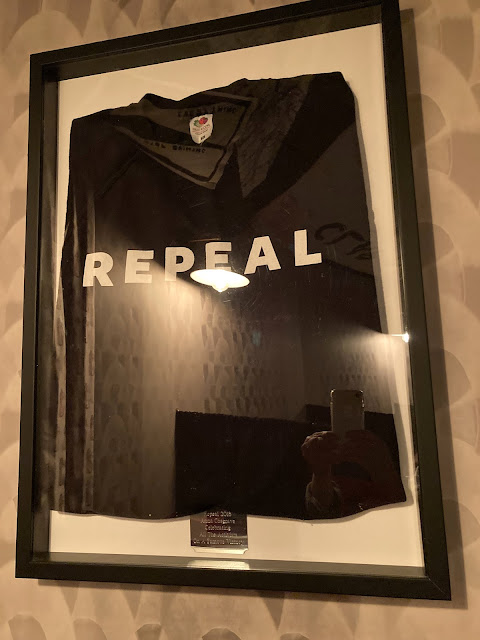


A flag is stitched with the word REPEAL.
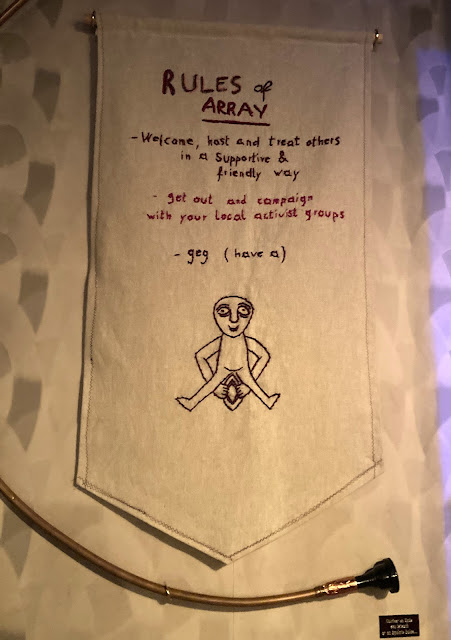


This was the winner of the Turner Prize. The judges praised the group for addressing social and political issues in Northern Ireland, and for translating their activism into artwork. 'What they deal with is really serious stuff, LGBT issues, feminist perspectives on issues today in a divided society, even a sectarian society... what the jury feels is remarkable is that kind of amazing lightness of touch and play and conviviality and sense of hospitality, and the sense of carnival that they bring to the work'.


Salmon: Traces of Escapees by Cooking Sections:

Cooking Sections address the environmental impact of intensive food production. Established in London in 2013 by Daniel Fernandez Pascual and Alon Schwabe, their work uses food as a lens to observe landscapes in transformation, and as a tool for intervention in those very systems of food production and supply. Using site-responsive installation, performance and film, they explore the overlappping boundaries between art, architecture, ecology and geopolitics.
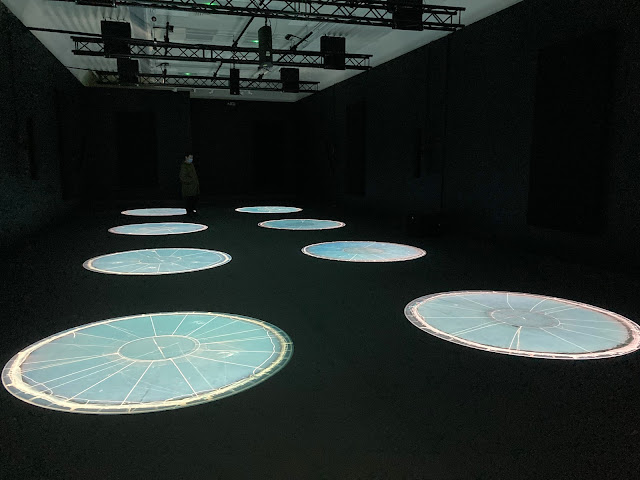


Salmon: Traces of Escapees is an audio and film installation that explores the environmental impact of salmon farms in Scotland. It reveals the gap between common perceptions of farmed salmon as an affordable luxury, and the reality of its mounting environmental costs - with excrement, drugs, synthetic colour and parasites polluting the surrounding waters.

The installation continues Cooking Sections' questioning of the impact of food habits on climate change, and promotes Climavore (rather than herbivore or carnivore) as a form of eating that adapts to the climate. Originated and based in the Isle of Skye since 2016, the project works with communities towards ocean regeneration, promoting alternative ingredients which improve water quality and cultivate marine habitats.
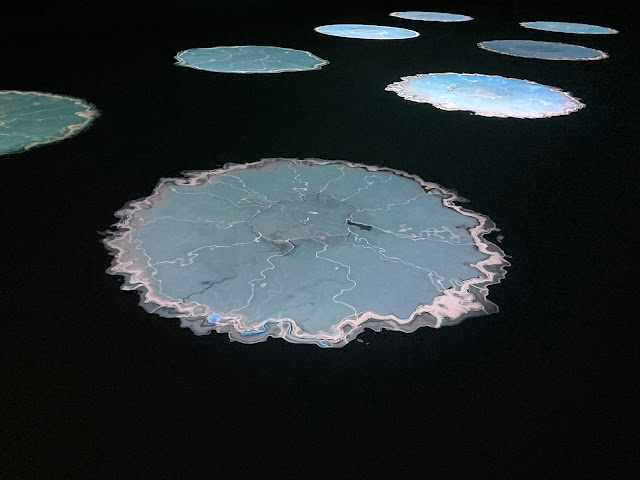
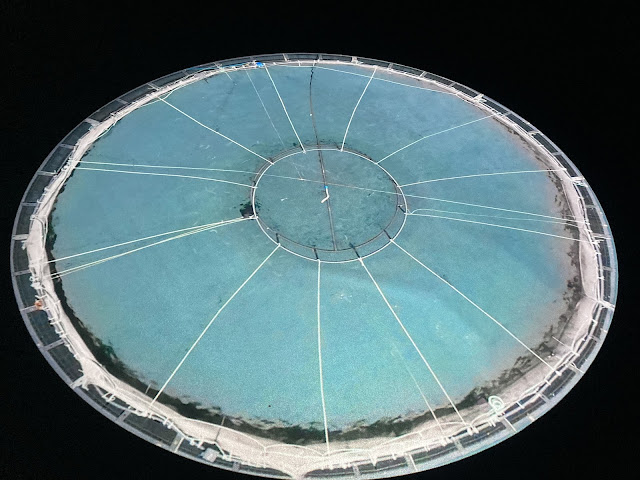
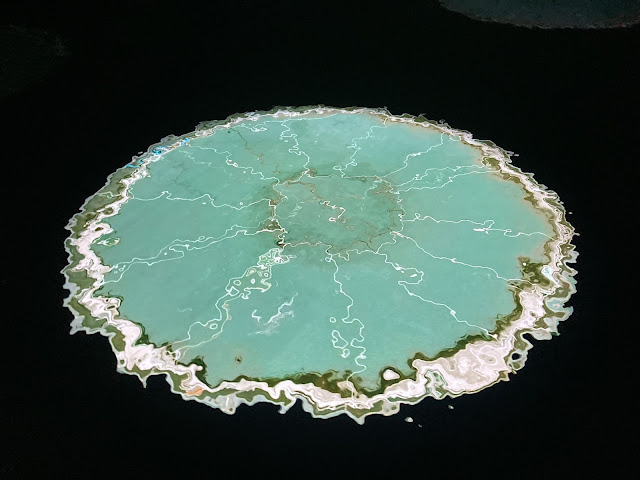
We moved through a darkened space where circles of water were projected on the floor, stepping between these slightly sinister ocean enclosures as we listened to a commentary wax lyrical, yet angry, about how we are modifying nature, remaking species in our capitalist fish farming and corruption of 'human fish relations'. The genetic modifications of the farmed fish were made very clear to us, and the way 'humans are the virus that the salmon can't escape'. It was compelling.


Open-net salmon farms are made of holes, the key structure of these undewater feedlots. Excrement, drugs, synthetic colour, and parasites billow out, polluting the surrounding waters. But even if the nets break, farmed salmon remain captive; they can no longer escape their own modified bodies.


Project Art Works:

Project Art Works collaborates with people who have complex support needs. Their work is at the intersection of art and care, and takes multiple forms. Their studios provide the conditions for a broad range of independent and collaborative practices with neurodivergent artists, who take part on their own terms to produce paintings, drawings, sculptural objects and film. Project Art Works organise events and projects that work towards greater visibility and understanding of neurodiversity in culture.


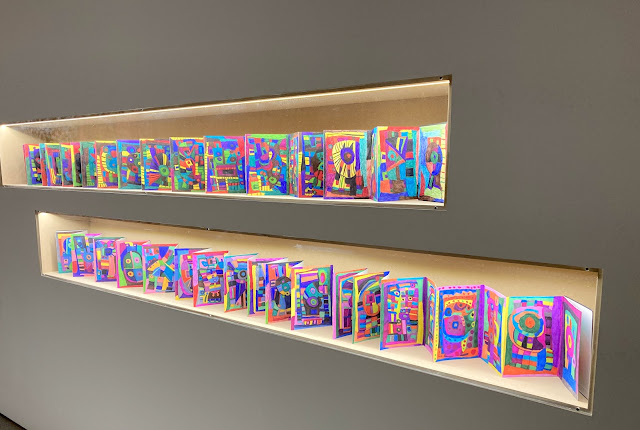
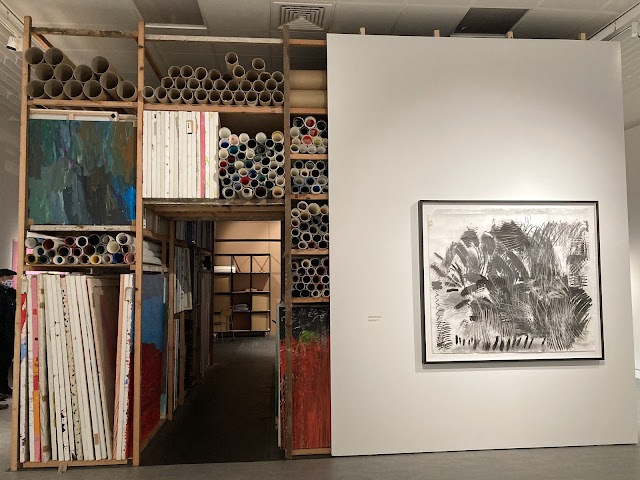
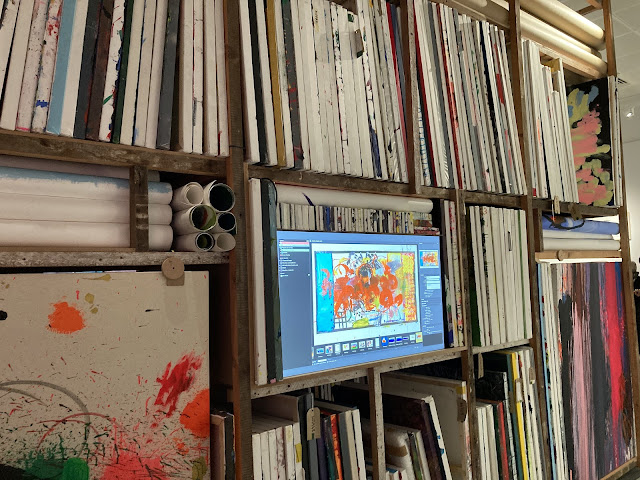
At the heart of their presentation for Turner Prize 2021 is a constructed space that holds physical and digital archive of over 4,000 works produced by neurodivergent artists and makes over two decades. The archive embodies a visible trace of people who are otherwise hidden in the world. 


A new edited film of the whole archive sits within the central structure and a small number of works have been selected for exhibition in collaboration with the Herbert's curational team.
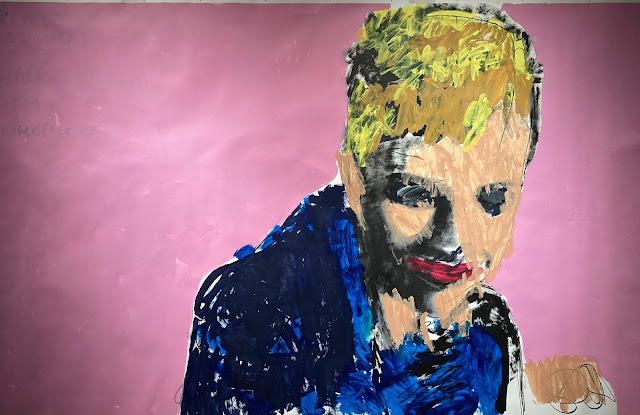
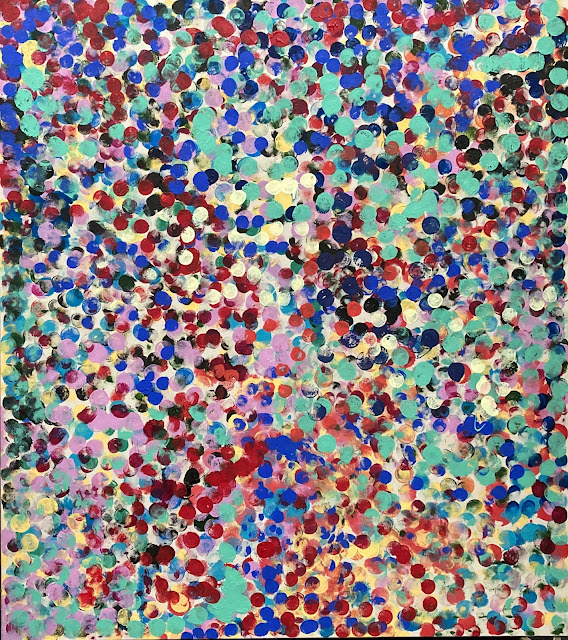
Many of the works are stacked unseen together in the centre of the exhibition space, a statement, perhaps, of how such art is never properly considered by the wider world.


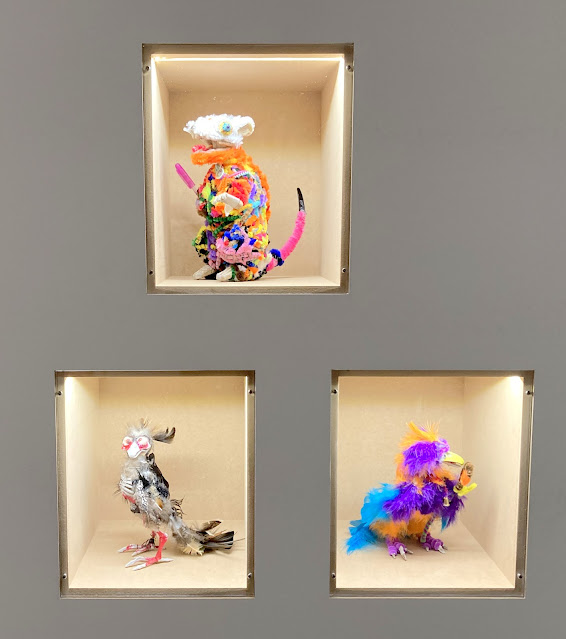
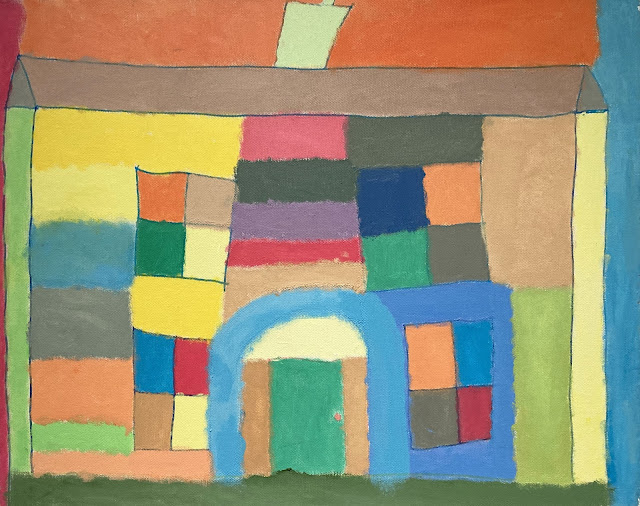
Jack Denness, Self Portrait, 2015


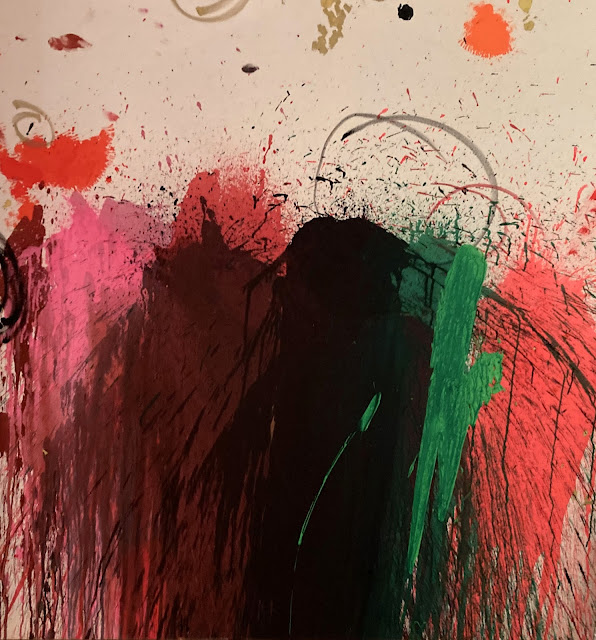
Albert, Geere, Nouse No. 6/8, 2016


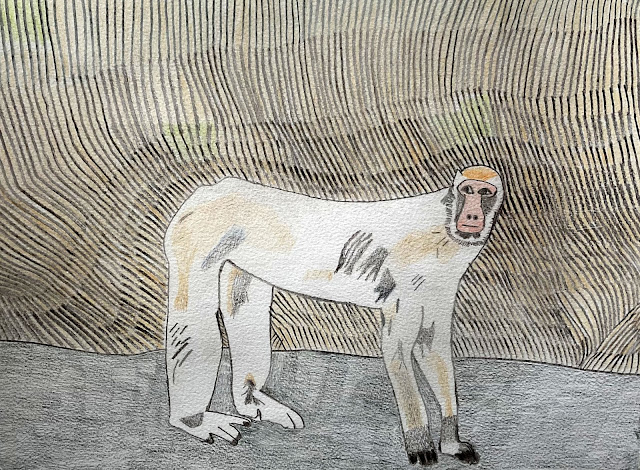
Neville Jermyn, Barbary Ape, 2014

Thursday, 22 February 2018

Face Forward ...


Face Forward ... 


at the Museum of Contemporary Art, (EMST) Athens.


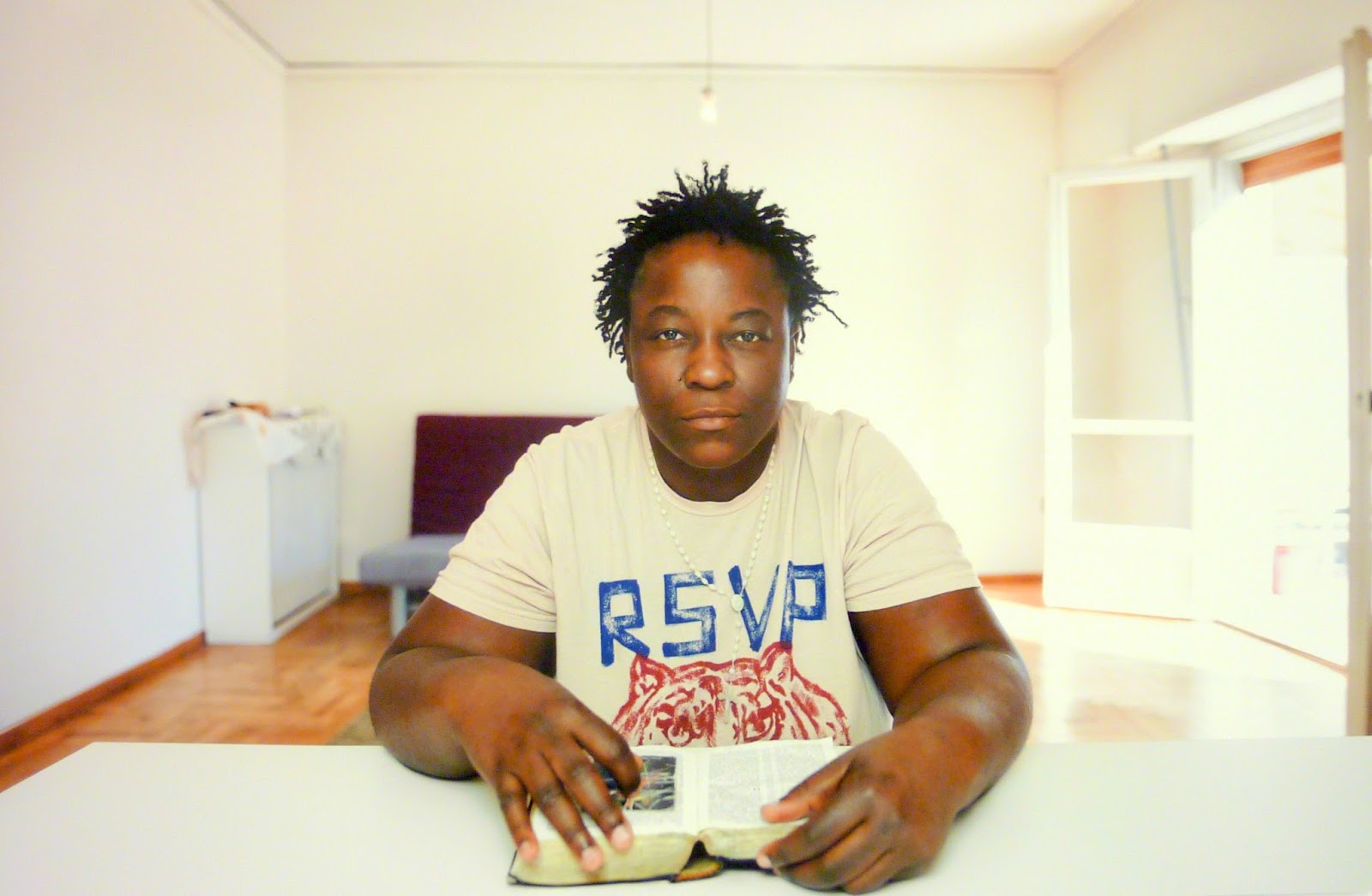
Face Forward... is an ambitious and  thought-provoking, interactive art project focused on the stories of people who have been forced to leave their homelands and are rebuilding their life in Greece.  The project was proposed by EMST and supported by the UK Refugee Agency (UNHCR). Twenty refugees took part in the programme. As part of the project, the participants were introduced to artworks from the Museum's collection as incentives for discussion. Some were art lovers, some were being introduced to modern art for the first time. Through this process, a series of personal narratives emerged, all very different, but with a common need to communicate. The outcome of  many months of interaction and communication, as well as the refugees'  contact with works of art from the EMST collection, is this exhibition of photographic portraits and personal narratives.

The organisers wanted to move beyond the image of refugees' lives projected in the media as one of hardship, cruelty and despair. Instead, we are invited to see each refugee as an individual, full of  hopes for their future.  The aim is to cultivate solidarity, acceptance and social cohesion. Furthermore, the notion put forward by Alma Wittlin in 1970 that 'museums are not islands in space, but have to be considered in the context of life outside their walls', was at the centre of this project.


There were a number of school groups visiting the exhibition when we were there. I listened in on this particular group for a while: having looked at the exhibition, each member had to 'introduce' one of the refugees featured in the photographs and catalogue, detailing their life in their home country, their voyage to Greece, and their hopes and aspirations.

This is an ambitious project and one that I found fascinating and extremely touching. I also found the idea of using art as triggers for discussion an excellent one.


The art works:


Janine Anton, Slumber, 1994, (maple loom, wool yarn, bed, nightgown, blanket, artist's REM reading on computer paper, REM decoder)


Kostis Velonis, Swedish Flying Carpet, 2001, (wood, fringe)


Bill Viola, The Raft, 2004, (video, sound installation)


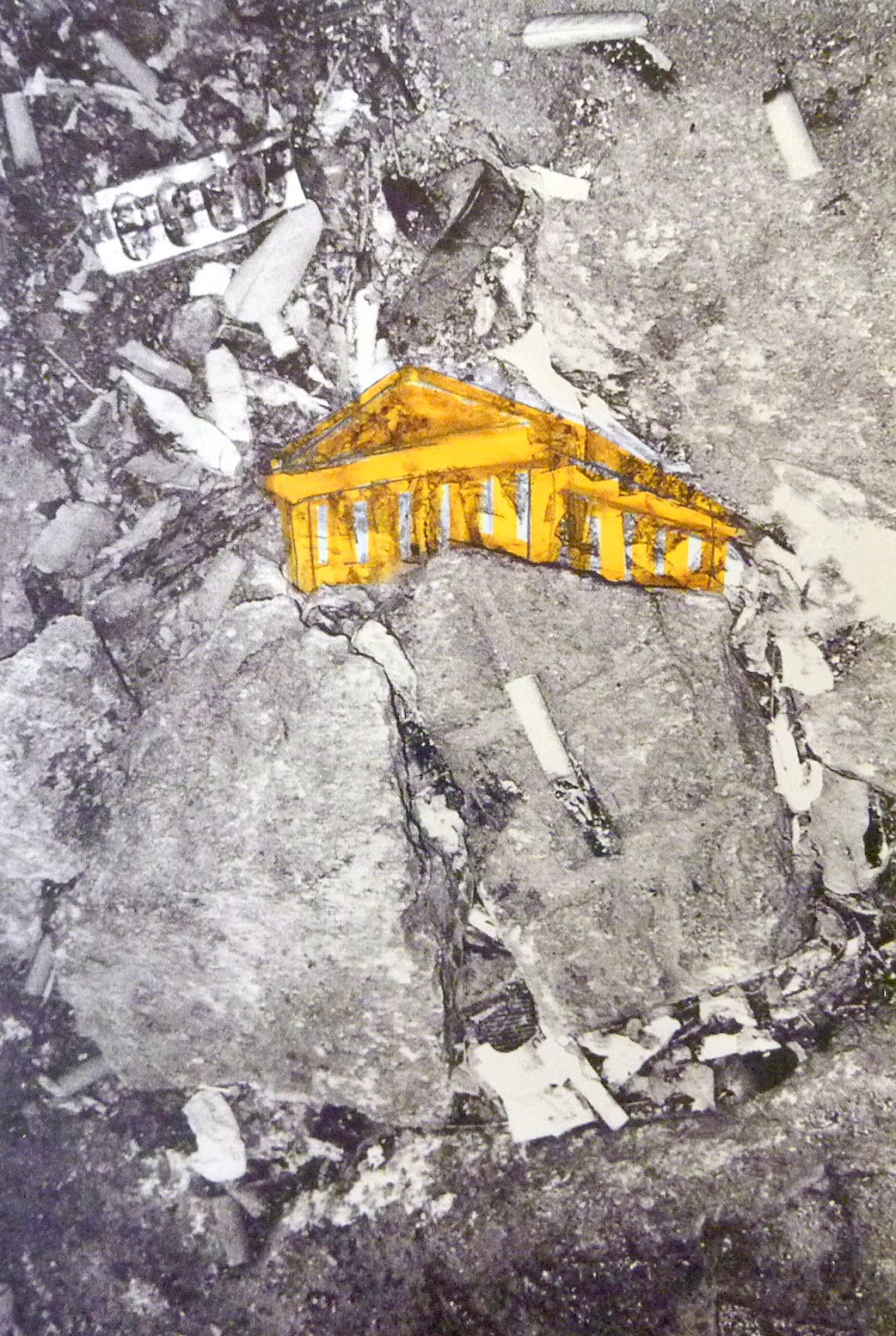
Alexandros Georgiou, Athens, Parthenon, 2007-08, (mixed media on photograph)


Yael Kanarek, Heart in Heart, 2004, (sheer organza ribbon, two metal meat hooks, aircraft cable)


Vlassis Caniaris, Hopscotch, 1974, (6 human figures, 9 suitcases, 1 cage, tar paper base and hopscotch chalk drawing)


Kimsooja, Bottari, 2005-17, (6 bottari made from traditional Korean bed covers and used clothes from Athens and Kassel)


Bia Davou, Sails, 1981-82, (fabric, ink)


Do-Ho Suh, Staircase II, 2004, (translucent nylon)


Costas Tsoclis, Portraits, 1986, (5 video projections in colour on 5 paintings with acrylic on cloth)


Mona Hatoum, Fix It, 2004, (factory fixtures and furnishings, light bulbs, programmable lighting equipment, electric cable, amplifier, mixer, 2 speakers)


The people:

As one would expect, the majority of the people who took part in the project are from Syria and most are men. I have tried to use a sample that is representative of those involved.


Ali, (40 years old), Syria

When I was informed about the Museum's programme, I was not sure I wanted to participate. I had never been to a museum and had never visited an exhibition. But something made me go to the first meeting and then to take the decision to take part...

Of the projects we saw in the Museum I was moved the most by Hopscotch by Vlassis Caniaris. I think that the work expresses all refugees. Personally, it reminded me of how I felt as soon as I arrived in Turkey. I did not know anyone, or the language and I did not know what to do, where to start and how to go on. My suitcase was the only object I could lie down on, rest and think for a while.

I identified with the man sitting on his suitcase, who looks as if he was tortured by the decision he had to take, by the dilemma of whether he should stay in his homeland or leave. I experienced this dilemma too. Deciding to leave was not easy for me. I had my doubts. I had to leave my wife and two daughters behind. This doubt still exists deep inside. Even now, I sometimes think I shouldn't have left them. But if my one hand was burdened by the concern for my wife and children, preventing me from leaving, the other hand was pulled by the need not to take part in such a war. I dislike violence. I do not want to hold a weapon. I do not want to harm anyone. I do not like blood. I want to live a peaceful and safe life with my family.

What worries me the most is that two years have passed since I left Syria and I haven't yet managed to do anything for my family, to be able to bring my wife and daughters here...

The last month and a half I've been living in a building, in a room of my own. I'm very happy that it has a balcony where I can sit and relax... You see, back in Syria I used to take my coffee on the terrace... On my balcony in Athens I have the opportunity to continue this favourite habit I have from home...


Maya, (26 years old), Tunisia

... I avoided going out in Tunisia because it was too dangerous.... I identified with the harpooned fish in Costas Tsoclis' artwork. For me, the people around the fish were like the members of my family, who ignored me. I was right there, but they couldn't see that I was suffering, that I wasn't comfortable with who I was and that I wanted to be something else. I wanted to live as a woman. That's why it was dangerous for me to walk down the street in my country. I had to hide who I was. I could only be myself when I worked on the stage. I have a mark on my body, just like the harpooned fish does, a scar from the time I was attacked on the street. But, in the end, the mental trauma it left was even bigger. It may not show, but I feel it inside me all the time. Maybe Tsoclis' work is talking about mental trauma. ..

In Alexandros Georgiou's work I could see cigarette butts, empty packets of medicine, and other garbage lying about. It could be a place that was destroyed in some war. At first I could not understand what this black and white environment had to do with the Parthenon, which is tinted gold. I thought maybe the work was talking about life itself, how anything can be destroyed unless it's very strong. And symbols which have lasted throughout the ages are very strong; they're the culture and values we've inherited from the past. When we come into contact with these values, we become stronger. That's why he made the Parthenon gold; to show that it's something of value...


Mahdi, (student), Iran

... One of the works we saw at the Museum which made a big impression on me was the Swedish Flying Carpet by Kostas Velonis. Its waves reminded me of a seagull, flying to leave a country where it's cold to go to one where it is warm. Just like I wanted to leave my country. That's what I kept saying - I want to leave - because I didn't like the situation there. I wasn't safe. And in the end, I managed to get away...

We played hopscotch in Iran too. In this artwork [Vlassi Caniaris] each square shows something a refugee has to go through when he gets to a foreign country. He waits for his papers and goes from office to office, to different agencies, and waits until the whole process is finished and he can stay there legally. There are a lot of people coming to Greece from a lot of different countries. ...

I liked Costas Tsoclis' work with the fish a lot. The fish has lost its freedom. I wouldn't like to be in its place, no way. If each painting of this artist shows a different country, then mine is the one with the harpoon in it. And because I didn't want to see all the awful things that were happening there, I wanted to go to a country which is at peace. Like the people in the paintings next to the fish, who are leaving to go to another country without looking at the fish. One of those people could be me, someone who doesn't want to live in a country that's being bombed...


Patricia, (34 years old), Cameroon

... Although I had never visited a museum before and I had no previous contact with art, the projects and the discussions at the Museum created strong emotions and gave me the opportunity to focus on issues that concern me a lot. I kept thinking about them even after I got home. I saw in them pieces of myself, pieces of my life...


Kimsoja's Bottari reminded me of the boats we all started out in when we left Turkey for Greece. The Raft by Bill Viola brought to mind the time we got ashore; we left the inflatable and were so happy we all cried. It is a very powerful feeling, hard to describe. It is important when you become aware of your own existence and how close to death you can be at any moment. But once we set foot on land, we had already our first victory - a victory over death. I saw something like that happening in Viola's work, when all these different people, who were standing together in the same space, were suddenly hit by a jet of water. I saw it as a divine intervention, a threat, a shock sent by God, after which the people realised they needed to come together to better face danger. We, too, faced this danger in the boat in the rough sea, when we all tried to save ourselves.

What we experienced was a transition from dark to light. This is what Mona Hatoum's work Fix It, made me think. Light always symbolises life, regeneration. When light lights up this space, with the old, rusty objects, it resembles the moment you turn back to light, you find yourself after a deeply thoughtful or difficult phase of your life when you have sunk in the dark.

But the work that influenced me most is Heart in Heart by Yael Kanarek, which looks like a wedding dress hanging from hooks. There is something hard and violent about it, far from gentle, cheerful and pleasant. When I learned that the love letters of two people living apart from each other are written on the ribbons, my thoughts immediately travelled to my relationship, to my girlfriend who stayed back. It is the first time I've had a relationship from a distance, and I can see how painful it is. We think about each other, we communicate through social media. But as time goes by, I feel despair, because I see that, there can be no relationship....

Although thinking about all this made me cry, in the end I felt positive. I was even keener to work, earn money and be able to go for a few days to see my girlfriend and then return to Greece...


Wednesday, 22 April 2015

Video Portraits of Lady Gaga - Robert Wilson


Robert Wilson - Video Portraits of Lady Gaga

Shot in October 2013 and premiered in November 2013 in the Louvre, these works are the product of a collaboration between the Louvre, Robert Wilson and Lady Gaga, based on three classic works belonging to the permanent collection of the Louvre Museum: Mademoselle Caroline Riviere, by Jean-Auguste Dominique Ingres (1806); The Death of Marat, by Jacques Louis David (1793); The Head of Saint John the Baptist by Andrea Solari (1507).

The collaboration began after Wilson received a phone call from the singer, saying she'd like to discuss projects they might work on together. Wilson chose themes from the museum's collection, all dealing with death. 'She's sort of serious, not your ordinary pop star', he explained. They shot the videos in a London studio over three days, Gaga standing for 14 or 15 hours at a time. Wilson was very impressed with her stamina and emotional intelligence.


Mademoiselle Caroline Riviere, by Ingres. A large-format video references this painting, which is the portrait of a 15-year old young woman who passed away soon after the completion. Gaga managed to capture both the young woman's dignified beauty and the knowledge that she was about to die.


The slow-motion looped video is ever so slightly animated by tiny blinks and other small movements, such as a bird flying through the scene.


I read in the iKathimerini review that Lady Gaga had to stand still for 9 hours for this particular video. She was in such distress that at one point she started crying. But, nothing else moved - she continued posing as directed. If you look closely enough at the photograph above you will see the tears running down her face.


 The Death of Marat by Jacques Louis David is referenced in another large-format video: no animation this time, but the light and colours changed slowly, almost imperceptibly. As in David's painting, there is dignity and grandeur: Marat seems heroic while the circumstances of the death are kept precise, as recorded by the police.


Marat was killed by a fellow revolutionary who felt disillusioned by the direction the Revolution was taking. While taking his bath, Marat was reading the letter the young woman had sent him and was about to sign the petition she had handed him when she struck him down.


Holding the petition in one hand and a quill in the other.


Eleven video screens around the room depicted the same subject in different stages:


The Head of Saint John the Baptist on a Charger by Andrea Solario


The singer's bearded face was filmed and was superimposed over the painted head of the martyr.


'She would look at the image and after a while she would look at her face in a mirror and something happened and I would shoot her', said Wilson.


Each portrait is unique, due to the size of the slash at her throat, her lips being parted or closed, her eyelids fluttering or her expression changing.