Monday, 17 December 2012

Sunny


Today on the other hand, it was sunny and the reflections on the water were beautiful


ripples breaking on the shore


and when the sun went in you just had a line of light in the horizon


and then one shaft of light....


Sunday, 16 December 2012

Calm


Impossible to find the horizon or to diffferentiate sea from sky this afternoon


at the end of our road in Athens.


A dreamy atmosphere.


Friday, 14 December 2012

Mark Rothko


Room 3, the Mark Rothko Room, at Tate Modern.

During my visit to Tate Modern two weeks ago, I took the opportunity to go and sit in the Mark Rothko Room for a while.

It is one of the strangest, most compelling experiences I have ever felt in a gallery and this room is one I visit most times when I go to the Tate. The silent, dimmed atmosphere of the room suits the paintings. 'Here we are in the presence not of religion, but of something at once premordial and all too contemporary', reflected John Banville. These paintings take modern art back to Chinese art, whrere art was seen as a vehicle for contemplation.

Rothko himself said: 'When I say that my paintings are Western, what I mean is that they see the concretization of no state that is without the limits of Western reason, no esoteric, extra-sensory or divine attributes to be achieved by prayer and terror. Those who can claim that these limits are exceeded are exhibiting self-imposing limitations as to the tensile limits of the imagination within those limits. In other words, that there is no yearning in these paintings for Paradise, or divination. On the contrary, they are deeply involved in the possibility of ordinary humanity'.


The paintings originated in a commission to the Four Seasons Restaurant


in the Seagram building in New York,


designed by Mies van der Rohe.


Rothko had clear intentions when he took on the commission: 'I accepted this assignment as a challenge, with strictly malicious intentions. I hope to paint something that will ruin the appetite of every son of a bitch that ever eats in that room. If the restaurant would refuse to put up my murals, that would be the ultimate compliment. But they won't. People can stand anything these days'.

He did change his mind however, after having dined there and the following spring he returned the $35,000 fee, withdrew from the commission and eventually decided to donate the paintings to the Tate.

The Rothko room opened at the Tate in 1970. Rothko had a list of suggestions of how the pictures should be hung: the walls should be coloured 'off-white with umber and warmed by a little red,' the pictures should be hung 'as close to the wall as possible, no more than six inches above it'.


Untitled, 1950-52
 
 
This painting is just outside Room 3. And then, inside we have the seven:


Black on Maroon, 1958


Black on Maroon, 1959


Red on Maroon Mural, Section 4, 1959


Red on Maroon Mural, Section 5, 1959


Red on Maroon Mural, Section 74, 1959


Red on Maroon Mural, Section 2, 1959


Red on Maroon Mural, Section 3, 1959. 


Wednesday, 12 December 2012

Tuesday, 11 December 2012

Fog


Very cold and foggy today - everything shrouded in mystery.


Monday, 10 December 2012

The Tanks at Tate Modern


During our last visit at Tate Modern we went to see the Tanks, the three buried concrete cylinders that held the fuel that powered the turbines, that generated electricity for a large section of London. Each has a height of 7 metres and a diameter of 30m, made of concrete in order to withstand the risk of explosion.


They were converted by Herzog and de Meuron, whose approach was largely to let the size and mass of the cylinders speak for themselves. One of the cylinders has been converted into a performance space, another for temporary installations and the third one has been subdivided into small areas to serve as dressing rooms, toilets, etc.


With an exhibition area of 1,800 sq metres, there is a lot of scope here.


 'It is an underground space. Each tank has a door and that's it. It's just very straightforward',  stresses Jacques Herzog. 'It is mostly good advice to disappear, as you leave your traces anyway. It looks as it has been so forever but it was actually different before', adds Pierre de Meuron.


This is a small, round room, with a diameter of 3-4 metres, dark, womb-like. I do not know what the function of it was.

                                           
Suzanne Lacy, The Crystal Quilt, 1985-87


Suzanne Lacy, The Crystal Quilt, 1985-7 Photo: Gus Gustafson LIMITED

On 10 May 1987 in the central atrium of the Crystal Court shopping mall in Minneapolis, 430 women over the age of 60 took part in this performance, dressed in black and seated at tables arranged in a pattern based on a quilt designed by painter Mirriam Shapiro. The women shared their views on growing older. An accompanying soundrack by the composer Susan Stone mixed the voices of 75 of the women with personal observations interspersed with social analysis. Witnessed by 3,000 people the women talked and moved their hands at prearranged intervals in gestures choreographed by Sage Cowles. The performance ended with the audience joining the stage, transforming the formal pattern of the quilt. The resulting performance, The Crystal Quilt, was broadcast live on television. The event was an attempt to consciously comment on the representation of older women in the media.

Lacy has stated: 'In some sense the Crystal Quilt was successful politically, in that the work was bigger, it had more social impact in the region, but do one or two events change the way people - other than those who directly experience it - see? This raises this issue of whether you can expect art to create social change, and at what point it is no longer art'.


The Crystal Quilt now exists in the form of a video, documentary, quilt, photographs and sound piece, combining performance, activism and broadcast in a work that fuses activism and aesthetics.


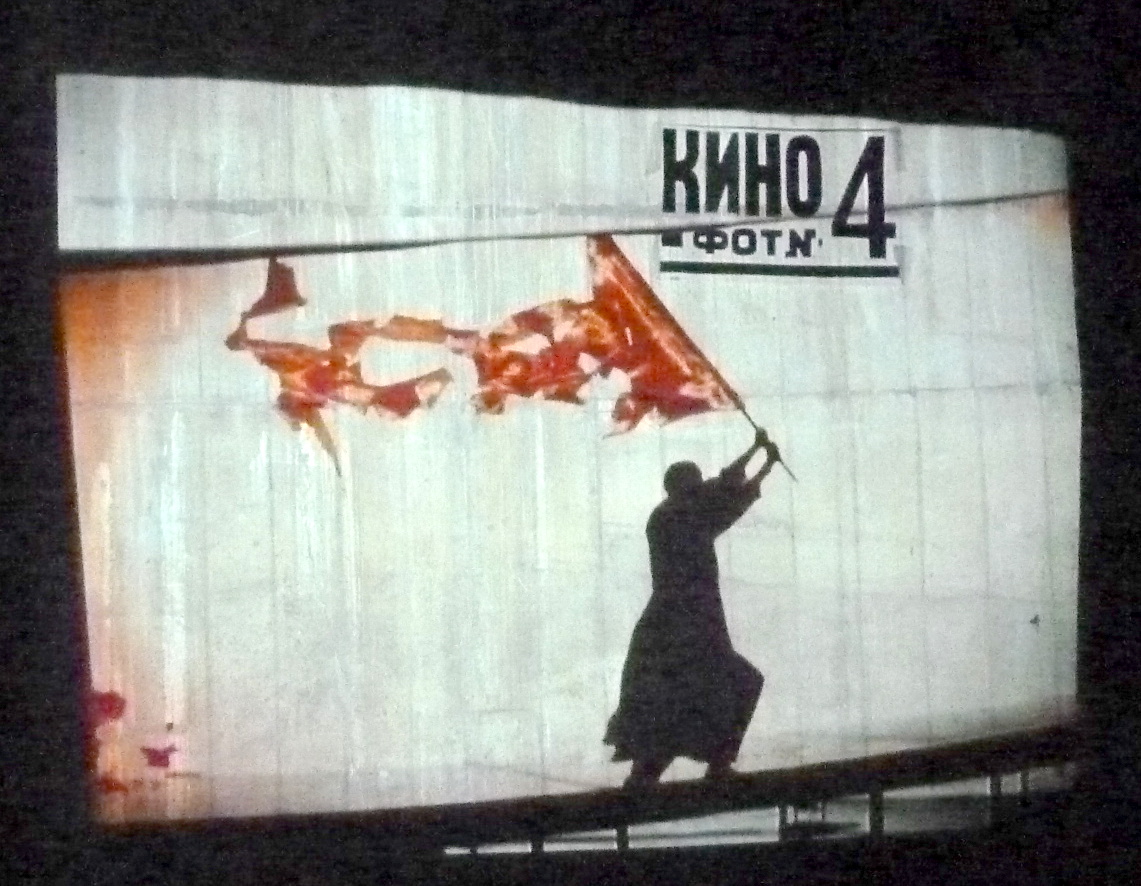
William Kentridge, I am Not Me, The Horse is Not Mine


The South African artist's eight-channel video installation is simultaneously projected across the walls of the larger space of the Tanks, each film played on a continuous loop. Each film contributes layers to a story that references Russian  modernism, from Soviet film of the 20s and 30s to the calamitous end of the Soviet avant-garde.


These videos were made as part of the preparation for Kentridge's production of Dmitri Shostakovich's 1928 satirical opera The Nose. The opera is based on Nikolai Gogol's story about an official whose nose leaves his face and develops a life of its own. The title I Am Not Me, The Nose is Not Mine is a Russian peasant saying used to deny all guilt.


The phrase is borrowed from the transcript of a meeting of the Central Committee of the Communist Party at which the Bolshevik politician Nikolai Bukharin - executed during Stalin's purges - attempted to defend himself.


Kentridge has described this work as 'an elegy for the formal artistic language that was crushed in the 1930s and for the possibility of human transformation that so many people hoped for and believed in, in the revolution'.


Friday, 7 December 2012

Tate Modern


Tate Modern.


A few of the works in the permanent collection.


Alberto Giacometti, Seated Man, 1949

Seated Man depicts Giacometti's brother Diego, one of his most frequent models. Even this familiar face became an object of investigation and discovery for the artist who commented 'when he poses for me I don't recognise him'.


Alberto Giacometti, Man Pointing, 1947

This was made very rapidly for Giacometti's first exhibition in New York. He recalled: 'I did that piece in one night between midnight and nine the next morning. That is, I'd already done it and demolished it and did it all over again because the men from the foundry were coming to take it away. And when they got here, the plaster was still wet'. It was originally intended to be part of a larger composition, with the left arm  positioned loosely around the second figure. He later abandoned the idea and considered Man Pointing to be a completed work.


Henri Moore, Upright Internal/External Form, 1952-53

This sculpture reflects the interplay between figurative and abstract forms in Moore's work. 'I have done other sculptures based on this idea of one form between protected by another'  Moore recalled. 'I suppose in my mind was also the Mother and Child idea and of birth and the child in embryo. All these things are connected in this interior and exterior idea'.


Later versions of the sculpture were made in bronze and elm wood and a twenty foot high cast is sited on First National Plaza in Chicago.


Lee Crasner, Gothic Landscape, 1961

Although this is an abstract painting, the thick vertical lines that dominate its centre can be seen as trees, with thick knotted roots at their base. It was probably this that led Krasner to call the painting Gothic Landscape, several years after completing it.

Krasner was married to Jackson Pollock and during their years together she relegated her work to second place so as to support and encourage him and to promote his work. This painting was made in the years following his death and belongs to a series of large canvases whose violent and expressive gestural brushstrokes reflected her feelings of grief.