Monday, 23 December 2013

Art and Love...


'... Between 'reality' on the one hand, and the point where the mind strikes reality, there's a middle zone, a rainbow edge where beauty comes into being, where two very different surfaces mingle and blur to provide what life does not: and this is the space where all art exists, and all magic.

And - I would argue as well - all love'.


Saturday, 21 December 2013

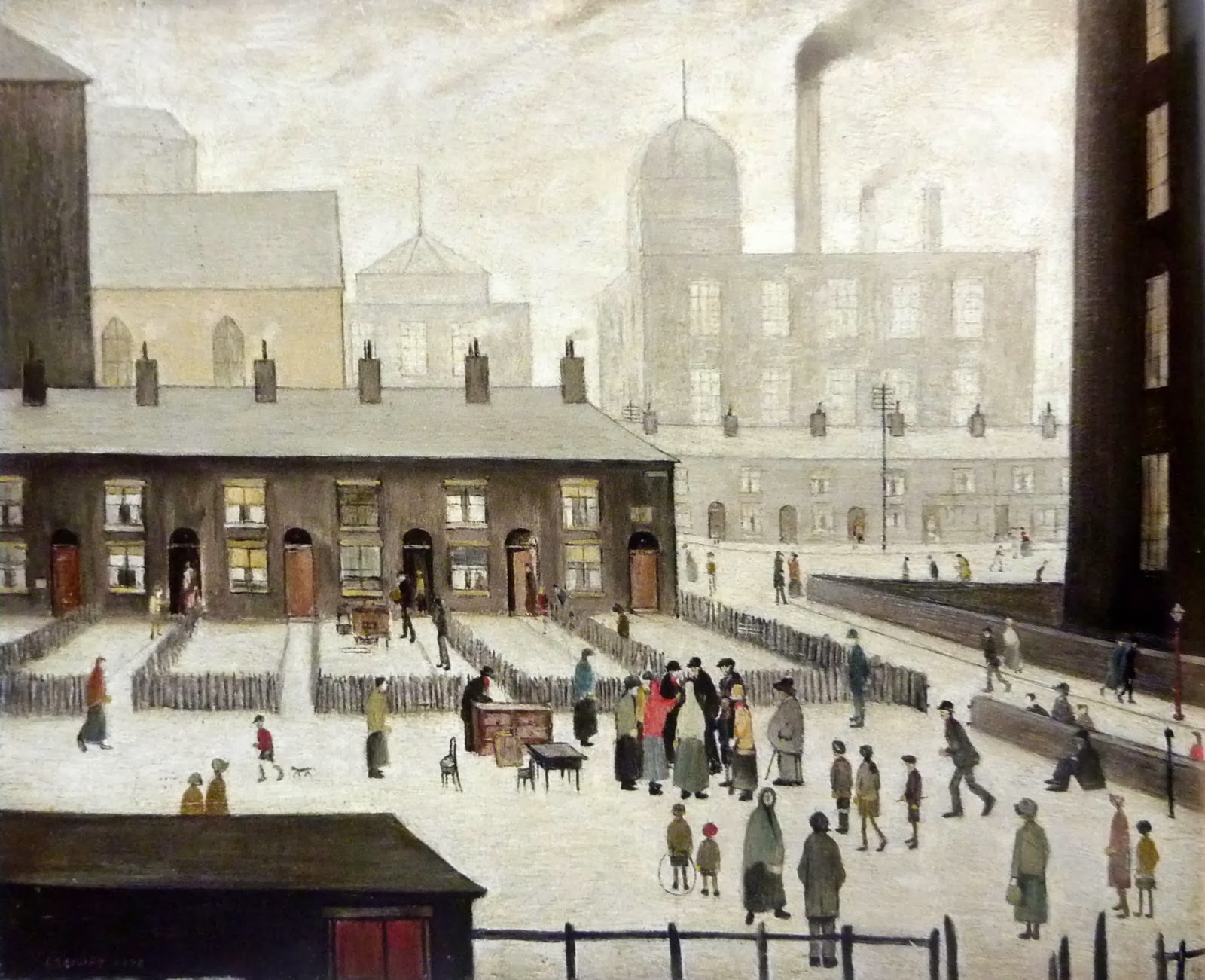
Lowry and the Painting of Modern Life


Lowry and the Painting of Modern Life, at Tate Britain.

This exhibition was very powerful, particularly for someone who has not been a great fan of Lowry's work. Seeing so many of his paintings, row upon row, room after room, the impact, the force of the depiction of the North of England and what industrialisation did to the land, the towns and the people, was quite overwhelming and the power of the work just hit you.  T.J. Clarke is a sharp art critic whose work I greatly admire and his, and Anne Wagner's vision of what Lowry's work means came across in a very powerful way.

The curators made the connection between Lowry, a painter of modern life, and the work of the Impressionists who embraced the beauty and ugliness of their time. Lowry's paintings are reminiscent of Van Gogh's early paintings when he first went to France, who depicted the desolation, the grime and poverty of the banlieues' , where the working class had been banished after Haussman started restructuring Paris. They are reminiscent of Pissarro's and Utrillo's depictions of how the new social order changed the city, all following Baudelaire's call for the depiction of modernity:

'Everyone is painting better and better this year, more's the pity... No one turns their face to the wind that blows from tomorrow. And yet the heroism of modern life crowds in on us, all around. - We are stifled by our true feelings, therefore cannot recognise what they are.- Subjects and colours for a new epic are everywhere. The painter, the true painter, will be the one who can seize from the life of the present its epic dimension, and make us see and understand, in colour or contour, how great and poetic we are in our neckties and patent-leather shoes'. (Charles Baudelaire, 'The Salon of 1845').

It is ironic that a painter who supported the Tories all his life, a man who was a rent collector, would become a painter of the working class, the only painter who depicted the ecological disaster, the ruined landscape, the rivers that turned into polluted swamps, the smoke that poured out of chimneys, the 'dark Satanic mills' that stretched as far as the eye could see, the feelings of hopelessness, the sense of waste and catastrophe that was the industrial North. 'My ambition was to put the industrial scene on the map because nobody else had done it, nobody had done it seriously' said Lowry. And another time: 'I've a one-track mind , I only deal with poverty. Always with gloom'. Life in the slums that was cramped and monotonous was depicted by Lowry over and over, in the same repetitive way, mirroring the life of the thousands who worked in the mills.

'His portrait of Lancashire is more grimly like than a caricature, because it is done with the intimacy of affection. He emphasises violently everything that industrialism has done to make the aspect of Lancashire more forbidding than most other places. Many of us may comfort ourselves a little with contemplating suburban roads, parks, or gardens in public squares, or with the lights and colours of morning and sunset. Mr Lowry has refused all comfortable delusions... His Lancashire is grey, with vast rectangular mills towering over diminutive houses. If there is an open space, it is of trodden earth, as grey as the rest of the landscape' wrote Bernard Taylor in the Manchester Guardian in 1921.

George Orwell's description of the North mirrors Lowry's work: 'I remember a winter afternoon in the dreadful environs of Wigan. All round was the lunar landscape of slag heaps, and to the north, through the passes, as it were, between the mountains of slag, you could see the factory chimneys sending out their plumes of smoke. The canal path was a mixture of cinders and frozen mud, criss-crossed by the imprints of innumerable clogs, and all around, as far as the slag heaps in the distance, stretched the 'flashes' - pools of stagnant water that had seeped into the hollows caused by the subsidence of ancient pits. It was horribly cold. The 'flashes' were covered with ice the colour of raw umber, the bargemen were muffled to the eyes in sacks, the lock gates wore tears of ice. It seemed a world from which vegetation had been banished; nothing existed except smoke, shale, ice, mud, ashes and foul water'.

Lowry saw how industrial technology impacted on workers' lives: separate neighbourhoods for the social classes; an 'us and them' consciousness; a forced uniformity in working class life who, because of the condition of their housing, had to live life publicly, in the street. Lowry depicted this in his paintings: a vertical format that conveyed the claustrophobic closeness of working class life; stooped figures depicted in profile, mere outlines to evoke the sameness, the repetition of their existence. And most of all, repetition. Repetition was the means to represent the social order, the modern landscape of the mill and tenement and the experience of life and death in those surroundings.

This was the world depicted, and in order to comprehend it, to really understand what it was about, one or two paintings will not do - it was the force of the sameness of working class life reproduced by Lowry in endless repetition, over and over, that brought it home and made this exhibition such an unmissable event. I was awed.


Mill Gate ('Going to the Mill'), 1916 


A Lancashire Village, 1920 


A Manufacturing Town, 1922 


St Augustine's Church, Pendlebury, 1924 


View from the Window of the Royal Technical College, 1924 


Coming out of School, 1927 


The Market Place, 1927 


The Procession, 1927


The Removal, 1928


Outside the Mill, 1928


Coming Home from the Mill, 1928


Returning from Work, 1929


Rebuilding of Rylands, Manchester, 1929


Rebuilding of Rylands, Manchester, 1929


Coming from the Mill, 1930


Junction Street, Stony Brow, Ancoats, Manchester, 1929


Excavating in Manchester, 1932


View of a Town, 1936


The Lake, 1937


Britain at Play, 1943 


Our Town, 1941 


Industrial Town, 1944 


Lancashire Fair, Good Friday, Dairy Nook, 1946 


Industrial City, 1945-48


The Canal Bridge, 1949 


Ancoats Hospital, Outpatients Hall, 1952 


Industrial Panorama, 1953 


Early Morning, 1954 


A Protest March, 1959 


Town Centre, 1966 


Mill Scene, 1971
  
 
Works by other artists that were part of the exhibition: 


Adolphe Valette, York Street Leading to Charles Street, Manchester, 1913 


Maurice Utrillo, La Place du Tertre, 1910 


Georges Seurat, The Zone (Outside the City Walls), 1882-83 
 

Wednesday, 18 December 2013

A room of one's own

Debilitating pneumonia on the way out, seven-day stay in hospital over, and I am home!  Bliss!

Awed by the level of care I received in hospital: the efficiency, professionalism and compassion of all the staff was inspiring, but oh! the joy of being home where I feel happy, safe and loved.

Convalescence will take quite some time, but here I am in my room, with everything I treasure around me and I can just get on with things albeit a bit slowly.


This is my space where I come to think, to read, to contemplate  or to work. I have always had a room of my own, and it's something I treasure. I think all women need such a space.


This print by Nikitas Flessas hangs above my sofa opposite the window. I am extremely fond of it even though with the sun beating on it directly, it has faded somewhat.


I keep the 'waiting to be read' books on these shelves.


One of Tim Andrews' 'humbugs' which is one of the favourite ceramics I own.


Colette, hanging above the 'humbug' - very faded now but I cannot bear to part from it.  I bought this poster many years ago when I was visiting Paris with a friend, and we were delighted to discover the 'Galerie des Femmes'. Good memories.


I made this porcelain bowl when I was doing ceramics and it sits on my bookshelves.


Ditto


Two windows in my room and I love looking out.


This raku bowl was a birthday present from Ken, bought during our first visit to Amsterdam. There is a lane off Kalver Straat where you can buy the best chips in the city: they serve them with ketchup or with mayonnaise. The shop, alas, does not exist anymore. That was 18 years ago and we have been there many times since - one of my favourite cities.


The bowl with the orchid is smoke fired made by Nicola Richards, a local artist. The two bowls on the left I bought in New York.


A section of my desk


Detail on my desk. I can't remember the name of the ceramicist who made the candlestick, and the same goes for the three delightful little bowls. The box was a Christmas present from Ken, bought from Judith Haan's gorgeous shop in Amsterdam. The dotty bits are small pieces of ostrich eggshell which were embedded in the wood before it was French polished.


This print of Wivenhoe by Glynn Thomas I bought many years ago, the first time I visited Brighton. We had gone to visit a friend who lived in Cambridge, and on the second day of our visit we decided to go to Brighton for the day. I immediately fell in love with the town, its energy, its mix of different types of people, its alternative feel. We parked by the pier and when we went back to the car in the evening the windshield had been smashed. We decided to drive back to Cambridge rather than wait to have it fixed. I remember sitting on the back seat, freezing, cuddling my friend's little girl to keep her warm.

While in the town, I saw this print in the window, liked it and bought it straight away. I love the print but I also like the fact that it's a representation of Wivenhoe, the village where I lived when I was a student at Essex University.

My time in Wivenhoe was charmed. I was young, independent, open to any possibility that presented itself, and hungry for experience. Life did not disappoint. I had great friends and comrades and together, we had the unshakable belief that we would change the world. A whole new set of ideas was also starting to emerge, women speaking out, questioning the status quo, their position in society and the images that were presented of women - all that was such a revelation for me, all these feelings and half-formed thoughts that I had had in my head from a very young age being articulated and developed and put into action. Heady days. And it's in Wivenhoe where I met Ken who has been my dear companion through life ever since.


A vessel by Tim Andrews sitting on an Art Deco box I picked up in a junk box, on the edge of my desk.


This water colour of a rose by Kay Elliot, a local artist, hangs above the box with the Tim Andrews.


We had left the Whitney Museum of Modern Art in New York, which is opposite Central Park, and decided to walk all the way down Madison Avenue, to Times Square, and then Hell's Kitchen, which is where our hotel was. We found this delightful shop on Madison Avenue that sold Japanese ceramics. I felt like a kid in a sweet shop. And the prices were not too bad. I love this tiny vessel with the oxide line running down the side. I keep it on my desk.


A small bowl, porcelain with blue oxide which I made in my ceramics class.


Three ceramic spinning tops by Eleni Vernadaki. This was the first work of hers I bought. I am a bit obsessed with her ceramics and I try to get one piece every year, particularly since she is nearing 80 so will probably not be working for much longer. I keep all the other pieces of hers I own in Greece.


This is another of my pieces. I had great fun making these - I used a ball as an inverted mould. It's stoneware with various oxides.


We bought these in a flea market in Berlin. I don't buy antiques or vintage items anymore, in fact, I have lost interest, but I really liked these. The one on the right is Art Deco and the one on the left is from the 50s.


This is the view out of my windows. I spend most of the time working at my desk, or sitting on the sofa reading.


The two yews were trimmed two weeks ago and I think they look fabulous.