Sunday, 21 December 2014

Two walks


My first walk yesterday was in Jephson Gardens and the Mill Gardens


Bright, sunny, crisp and cold, the pond in the Mill Gardens sparkled


a different view when facing the sun


the reflections were stunning.


Synchronised eating.


It was such a gorgeous day that I could not help myself and went for another walk after pilates, Victoria Park this time.


The river sparkled


gorgeous autumn colours


I saw a rainbow. It must have rained somewhere, but not where I was


vibrant red berries


and some fungi on a tree trunk.


Friday, 19 December 2014

Worry Will Vanish, by Pipilotti Rist


Worry Will Vanish, Pipilotti Rist, at Hauser & Wirth, Saville Row, London.

The gallery was transformed into a sensory environment for this exhibition. We were asked to remove our shoes before entering the main installation space. Plush carpet and duvets scattered all over the floor. We lay on the duvets and watched the animation that was projected against two walls.


Worry Will Vanish Horizon, 2014 (audio video installation; corner projection on two walls, sound, carpet, white duvets). Music by Anders Guggisberg.
 
Worry Will Vanish is a journey inside the human body: creases of skin, blood vessels, veins and arteries, human flesh in all its varied textures was projected against the two walls, periodically overlapping with close-up fragments from nature. The boundaries between the self and organic structures were blurred suggesting our relationship with the universe at large.


Rist draws on principles of Autogenic Training to facilitate a process of relaxation. Autogenic Training involves a repeated set of visualisations, practised in recommended postures, which includes lying down, which are intended to alleviate stress.


The whole experience was certainly extremely relaxing, particularly since we had been walking for a long time around London before we arrived at Hauser & Wirth.


Wednesday, 17 December 2014

Met Tere Huid (Of Tender Skin) by Berlinde De Bruyckere


Met Tere Huid (Of Tender Skin), by Berlinde De Bruyckere, Hauser and Wirth, Saville Row.

We stumbled upon this exhibition by chance. We went to Hauser and Wirth intending to see the other exhibition that was on, Worry Will Vanish by Pipilotti Rist  (post to follow) but as we were there, we thought we'd pop in the South Gallery as well. I am so glad we did. De Bruyckere's work is a revelation and she's an artist that I want to find out more about. I was awed by the texture of the work, its resemblance to human flesh, and the thinking, the conception behind it.

I did some research when I got home, and one of the things I found out is that she has cooperated with J.M. Coetzee and they have produced a book together, which, needless to say, I intend to get. What he has to say about her work echoes my own feelings:

'I have long admired the work of Berlinde De Bruyckere. More, importantly, I have been touched by her work in ways that are often obscure to me. I would not wish it otherwise. Her sculptures explore life and death - death in life, life in death, life before life, death before death - in the most intimate and most disturbing way. They bring illumination, but the illumination is as dark as it is profound'.

Her forms are made of wax, leather, rope and resin and they evoke decay, but it's active decay. They are reminiscent of flesh, but it's flesh at its most active in the process of decay: writhing, rotting, a hub of activity. Paradoxically, they also reminded me of the flaccid folds of Jenny Saville's nudes (which you can see here ).

In their stillness, De Bruyckere's works confront the connection between mortality and life.


After Cripplewood, IV, 2014 (wax, iron, cloth, blankets, ropes, epoxy)
 
An enormous wax installation of a fallen tree trunk with branches that are twisted round it. Looking closer at the form, it resembles the muscles, tendons and bones of the human form. De Bruyckere has used exactly the same colour that she uses in her human-like figures (which you can see here ), giving the tree parts the appearance of human flesh. She has wrapped pieces of fabric around the knobs and ends of many of the branches, like bandages on broken limbs.
 
In an interview she explained how she had brought an elm tree that had been destroyed by a storm to her studio and began making wax casts of it. 'I was touched by its having been uprooted', she said. 'People who are uprooted, you never can really place them again. It's much more violent than cutting a tree down. Uprootedness gives a feeling of loneliness'.


A different view 


looking closer


Met Tere Huid, 2014 (watercolour, pencil and collage on paper)
 
A series of drawings that are connected to the sculptures.


After Cripplewood, 2014 (watercolour and pencil on paper)


After Cripplewood, 2014, (watercolour and pencil on paper)


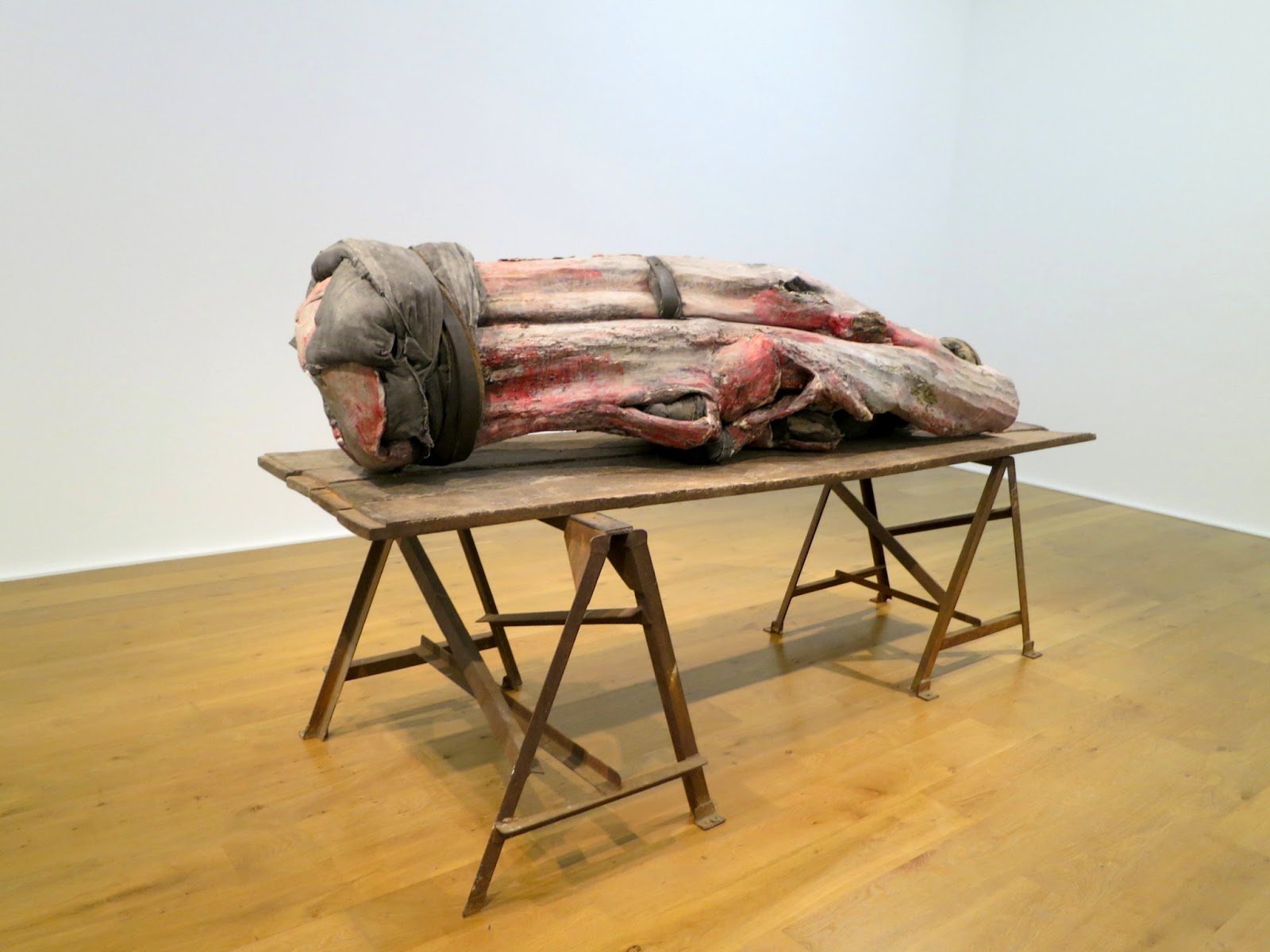
After Cripplewood I, 2013-14, (wax, cloth, wood, iron, polyester, epoxy)


Another abstraction of a fallen treetrunk, bound together with tattered fabric which is again subtly pigmented using a palette that subtly resembles human flesh. The anthropomorphic waxy forms appear as rheumatoid joints and bone, bandaged as if undergoing a prolonged healing process. The work rests on a makeshift trestle that recalls a medical stretcher. In contrast to the bare wooden planks forming the trestle, the gnarled and calcified mass on top appears living, though momentarily silenced.


looking closer


Met Tere Huid I, 2014 (wax, cloth, rope, leather, wood, iron, epoxy)


looking closer


Glassdome with Cripplewood III, 2014 (watercolour, wood, glass, cloth, epoxy, iron)


Finally, a photograph of the artist working on Cripplewood.  (Image taken from here )


Monday, 15 December 2014

Indian Waves, Howard Hodgkin


Indian Waves by Howard Hodgkin, Gagosian Gallery, London. (image from the gallery's website).
 
Thirty gouaches painted by Hodgkin between 1990 and 1991 which were inspired by India were brought to light recently. Hodgkin said he had forgotten all about this series until they were sent to him in brown paper wrapping earlier this year. 'When I did see them properly I felt very happy. I'm very pleased'. We saw eight in this exhibition.
 
Using handmade Indian Khadi paper, Hodgkin employed the carborundum printing technique for the first stage, in readiness for the next stage of handpainting. Beginning with the same foundation - a blue wavy line that fills the lower half of each sheet with an arc of green above - he then used a vibrant palette of cadmium red and yellow, rose, orange, black, white and Veronese green.
 
Although often termed as abstract, Hodgkin describes his work as representational of emotional situations. This very modern view has its roots in the end of the 19th century when painting was revolutionised, when a new era began and modern art was born. It was first held by Gauguin who believed that colour could act like words; that it held an exact counterpart for every emotion, every nuance of feeling. That painting should be seen first as ordered patches on a flat blank surface. Its task was not to describe but to express.
 
Seamus Heaney once said that Hodgkin celebrates what Dylan Thomas called the 'force that through the green fuse drives the flower'.