Marlene Dumas - the Image as Burden
at Tate Modern.
Born in 1953 in Cape Town, South Africa, Dumas moved to the Netherlands in 1976. Her intense, psychologically-charged works explore themes such as sexuality, race, love, death, culture and politics, often making reference to art history, popular culture and current affairs. Dumas never paints directly from life, instead choosing to use pre-existing images for her source material. One of her main interests is the complexities of representation.
This is art that requires you to think, that demands your whole attention and your active participation. In this post I have reproduced extracts of analyses of specific paintings by art historians which show the various ways they have interpreted her work.
This is what Jan Andriesse has to say about her technique: 'When Dumas draws a line, the line says 'I am aware and conscious'. Very few lines do that. Most lines are either illustrative or anecdotal and fade away into instant oblivion. And when it comes to paint, no one I know has the guts to slosh it around the way she does, to not be worried or scared/sacred as to where the paint will end up, to allow it to move and wander beyond the edges. In short: to play. At times the paint is a light, atomised, ephemeral breath on the surface, other times it can be sullen, clotted and coagulated. Depending on the place, or the place the paint/surface/matter can be graphic, ambiguous, tenderly touched or it can return to an enigmatic simulacra. .. It is the vast range of a painter's world, generated through paint, where anything is possible, along with having something to say... Dumas' way of constructing with paint is... ignored by most people'.
Portraits:
My people were all shot
by a camera, framed,
before I painted them.
They didn't know that I'd do this to them.
They didn't know by what means I'd call them...
My best works are erotic displays
of mental confusions
(with intrusions of irrelevant information)'. (M.D.)
Dumas began to explore and struggle with the limits of representation by experimenting with portraiture. Each work was painted in a different style and based either on a Polaroid or found photograph, to create faces that became sites of psychological exploration. She describes these portraits as a series of 'situations'. The tight cropping of the portraits isolates the subject and evokes photographic and film techniques, which Dumas cites as important influences on her practice:
'from blowing-up to zooming-in, the close-up was a way for me to get rid of irrelevant background information, and making facial elements so big increased the sense of abstraction concerning the picture plane'. (M.D.)
Allusive titles attached to each work encourage the viewer to consider portraiture as a cultural construct.
Martha - Sigmund's Wife, 1984 (oil on canvas)
Genetic Longing, 1984, (oil on canvas)
Martha - the Maid, 1984 (oil on canvas)
Martha - My Grandmother, 1984 (oil on canvas)
Evil is Banal, 1984 (oil on canvas)
'These portraits are not the customary depictions of faces. They could be called monumental representations; here familiar forms become terrifying images. Using various styles, Dumas paints them in a remarkably refined way... What they express can be described as death and destruction... It seems as though Marlene Dumas wishes to unmask evil itself with her portraits, to drive it from all the places where it hides, and thereby show that 'evil spirits' actually do exist'. (Betty van Garrell).
The White Disease, 1985 (oil on canvas)
The Jewish Girl, 1986 (oil on canvas)
The Particularity of Nakedness, 1987 (oil on canvas)
'The title was inspired by the re-reading of John Berger (Ways of Seeing) in which he draws a distinction between the 'nude' and the 'naked' in European oil painting'. (M.D.)
The Teacher, 1987, (oil on canvas)
School children in uniform. Uniforms make uniformity, they abolish distinction. In the context of South Africa this portrayal emphasizes how Apartheid culture fixed identities on the basis of the most superficial exteriority. The children's faces have the same empty, uniform expression as their clothes. The uniform expression of the students is that of their teacher.
The search for meaning:
A series of small intimate paintings where Dumas developed her concerns about viewers' insistence on establishing clear meaning in artworks. The figure of the nude takes on an allegorical function, often in relation to politics and as a commentary on art itself. This was the time of the dismantling of Apartheid and many of the works negotiate ideas about democracy and the vulnerability of the public.
Losing (her Meaning), 1988
Waiting (for Meaning), 1988, (oil on canvas)
Snowwhite and the Broken Arm, 1988 (oil on canvas)
Snowwhite in the Wrong Story, 1988 (oil on canvas)
Dead Man, 1988 (oil on canvas)
Liberation (1945), 1990, (oil on canvas)
'When asked by the Jewish Museum as one of the eight artists to do a work on the theme of 'liberation', I was very reluctant to do something relating to the Second World War... Later... I painted Liberation. It was the face of a man that after all the traumatic experiences he'd been through could not convey any expression of joy when the liberators entered the concentration camp to free the survivors'. (M.D.)
Black drawings:
Black Drawings, 1991-92, (ink on paper and slate)
'In the famous paintings in Western art history, black people are usually depicted as servants - for example, Manet's Olympia
. There are very few paintings of black people anyway. If the world was truly rid of racism it would not be seen as a strange thing not to see white as the norm...
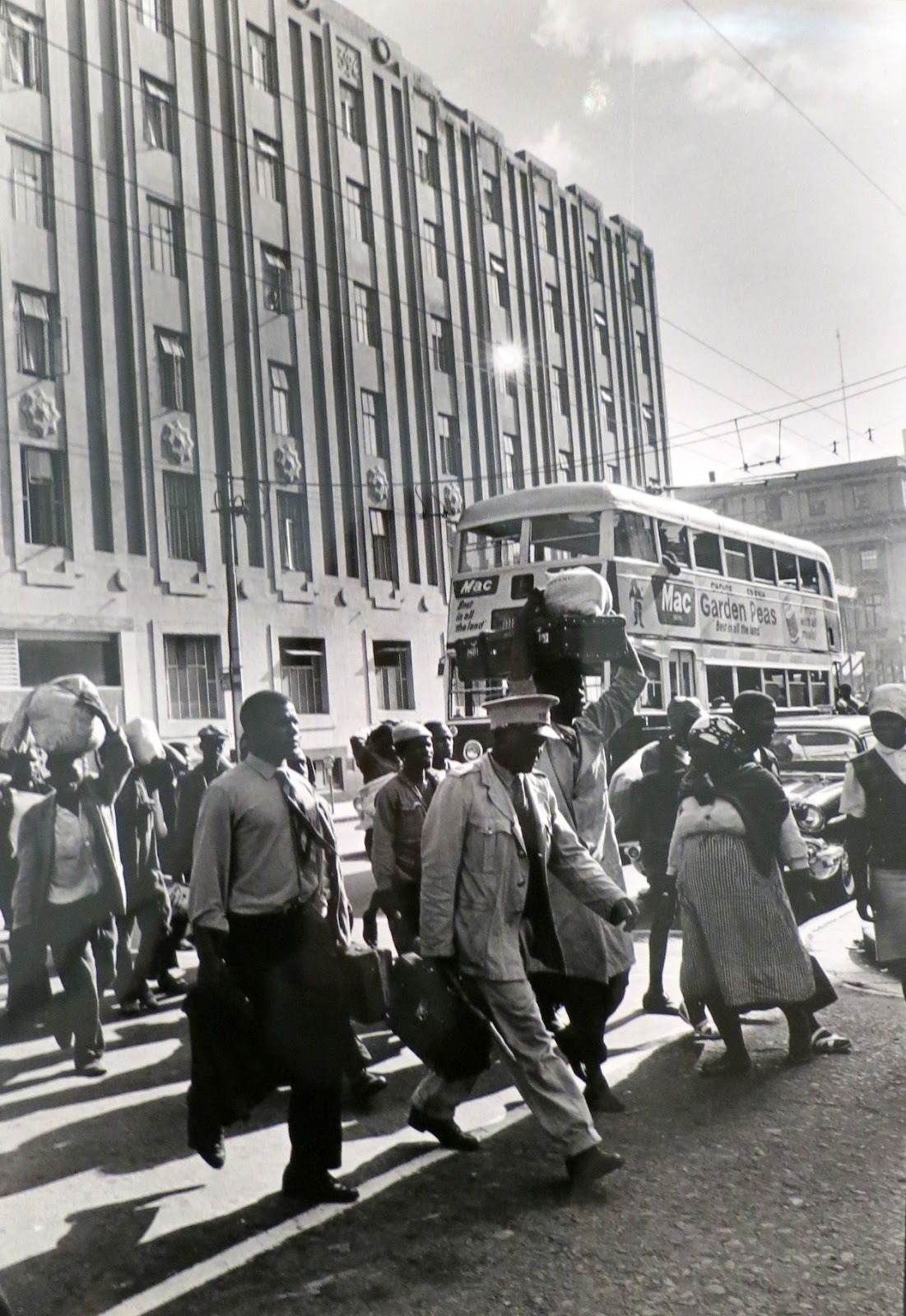
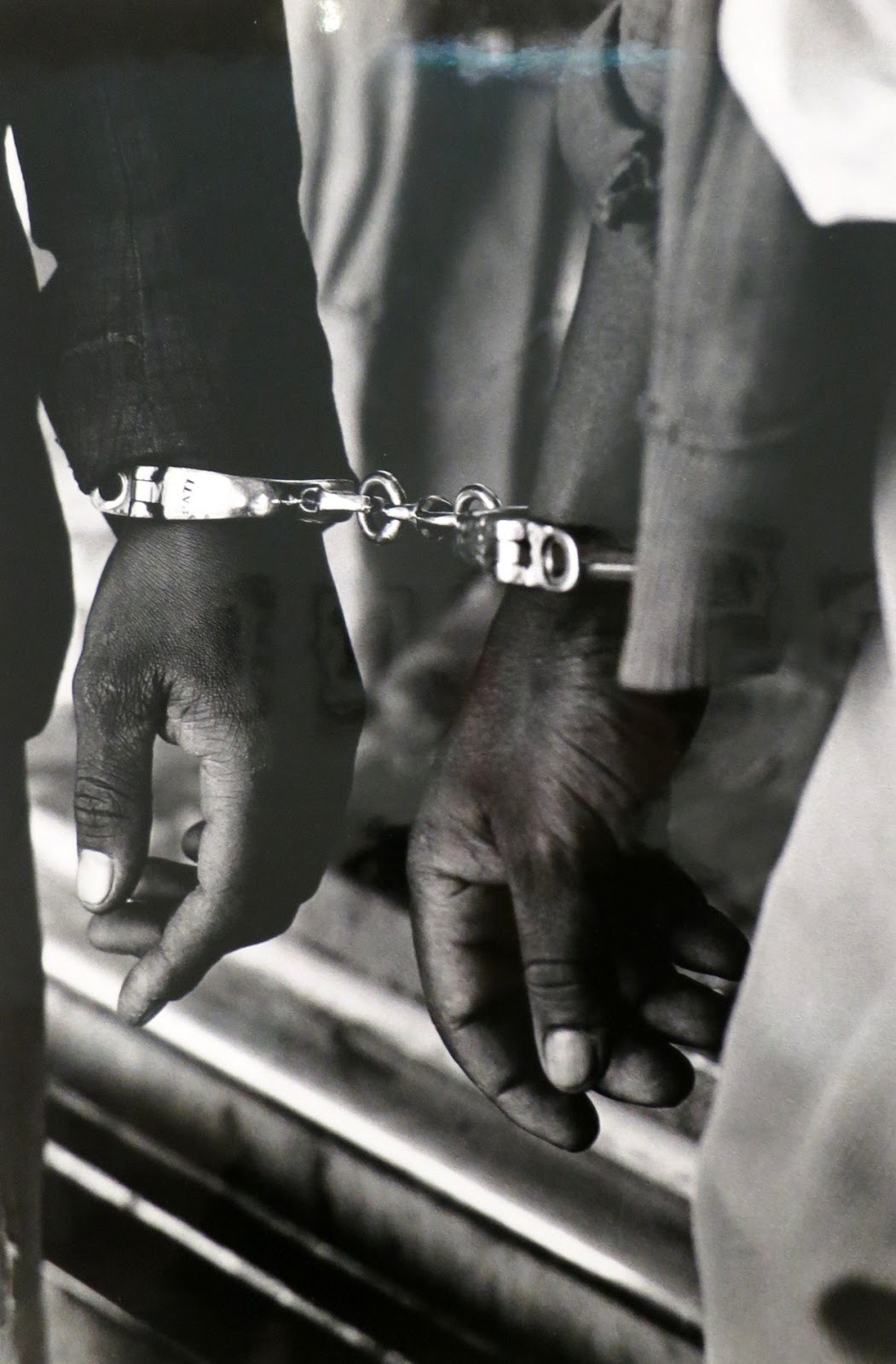
[I used ]a collection of European photographs that had been used as postcards showing Africans from the beginning of the last century. These photographs show the way the European colonists looked at Africans.
I did not draw black people walking in the street; I based my drawings on existing images of black people. There's a big difference between those two things, and it's an important distinction. As an artist, I am interested in images. So in that sense what I was doing was closer to Cindy Sherman's work - questioning representation, appropriation, and the media, past and present'. (M.D.)
'... As well as being about the politics of representation and the tension between seeing and being seen, [these portraits are] also about blackness as a positive state, and the work is a tribute to black as a beautiful colour...' (M.D.)
* * *
 The Image as Burden, 1993, (oil on canvas)
'A man carries a woman who stands for the 'image' - the representational subject of art, the allure of the visual, all that has been symbolised as woman. This has become a burden. Her head is thrown back in unconsciousness or death, and it is dark and schematically rendered, like the mask figures of Picasso's Cubism. Against her immaculate white robe, his hand creates a dark pubis for her, since her own sex is hidden. Unlike Titian's
Venus of Urbino
, or Manet's Olympia
, in which the woman's hand hides and at the same time presents her pubis in a visual simulation, here it is the man whose supporting hand must perform this scandalous ostentation, for she is no longer able to do so on her own...Since traditional depictions of female nudes are in fact male creations, it is only just that the man openly takes responsibility for designing this pubis, by his own hand.
The woman here - the female image - seems to be dead. Indeed, it is hard to avoid seeing the pose of the two figures as a secular pieta, with the sorrowing man a mournful Mary and the female image a crucified Christ. The fact that the sexes of the two are slightly ambiguous merely reinforces this reference.... The archetype of pictorial pathos until the Enlightenment, the crucified God is now replaced by a crucified woman - the symbol of the secular beauty and love and salvation that art promised when religion wanted, now sacrificed in their turn as well.
Dumas has revealed the source of this pose: a film still from the movie Camille
. This arch-romantic image shows the man strong and dark, the woman weak and pale. In Dumas' rendering, female beauty faints from a 'consumption' so pervasive in our culture that it threatens all images, all art, perhaps all women. The female 'image' is dead, and contemplating its demise - her demise - those who have witnessed this martyrdom or caused it are left to mourn, bereft, baffled, burdened with responsibility for the unaccountable crime'. (Wendy Steiner)
Liberty, 1992, (oil on canvas)
'The figure's black, naked, prepubescent body tears at the Western tradition of the art-historical nude. And it is one in particular that Dumas confronts: Eugene Delacroix's Liberty on the Barricades of 1830. Dumas' rendition counters with a wooden pose and broken wings.... These hands reach for nothing. Haunted, by the twin spectres of colonialism and pornography, Dumas' Liberty peers askance at the vexed convention of inscribing political transitions on the nude female body.
Rejecting the bared breasts of Delaxroix's Liberte - and the metaphors of 'naked' or self-evident truths that under-pin such depictions - Dumas edges toward the Nietzschean view that truth wears many masks. Liberty thus joins a trio of earlier paintings that contested political ideals through gossamer plays on veiling and unveiling: Give The People What They Want; Equality; and Justice. The three paintings each depict a prepubescent girl, shown frontally and cropped at the knees. Covering of various sorts bandage these bodies together: Justice's eyes are bound in cloth, Equality's face disappears behind an ashen mask, while Liberty's face, traced in blue, bears the memory of Justice's mien...' (Leora Matlz-Leca).
Give The People What They Want, 1992 (oil on canvas)
Equality, 1993 (oil on canvas)
Hierarchy, 1992 (oil on canvas)
Drunken Mermaid, 1993 (oil on canvas)
Reinhardt's Daughter, 1994 (oil on canvas)
In this painting Dumas engages with the problem of colour in another way. This painting is twinned with the painting below,
Cupid. 'The two works are based on the same photograph of the painter's sleeping child. The figure carries allusions to the sweetly coloured angel children of baroque churches and is clearly a white-skinned child. ... Dumas is interested here in Reinhardt's distinction between black and a symbol denoting the negative (e.g. of race or evil) and black as a colour devoid of any of these negative associations. She insists on exploiting both dimensions and on using the ambiguity to extend the expressive reach of the painting. With specific reference to Reinhardt's Daughter, Dumas has written: '
You change the colour of something and everything changes (especially if you're a painter)''. Marlene van Niekerk.
Cupid, 1994, (oil on canvas)
The Conspiracy, 1994 (oil on canvas)
The Cover-Up, 1994, (oil on canvas)
The Painter, 1994, (oil on canvas)
'The Painter
is a work in which the complex relationship between the (female) body and the painting, as well as between the artist and the work, are reflected in a paradigmatic fashion. The Painter
is a naked little girl whose defiant facial expression is directly proportional to her vulnerability... With her body which she seems to have partly painted herself, and in this undetermined spatial situation she finds herself in, ... in this flat non-space...the figure appears like a painting within a painting. The Painter and 'The Painting' thus confront each other ... It seems as though the 'Painter' has been caught in a 'cruel game' and were then, as a punishment, forced to appear in the painting.
The 'Painter' seems vulnerable and aggressive, innocent and guilty at the same time; apart from her mental and physical condition this status of ambiguity surrounding her also suggests an ambiguity in the structure of representation itself.... This linkage between the pictorial and real levels points to another conflict which continues at a different level - the conflict that the painter is at the same time the model.
In The Painter
Dumas alludes to an imaginary agreement within our symbolic system which has existed even since Pygmalion. According to this agreement, femininity is equated with a passive status 'as a Painting'. This symbolic and symptomatic description of the female body as representing the imaginary Other
has been both a challenge and a conflict for women artists, affecting them in their self-expression to this day.' (Silvia Eiblmayr).
Models (detail), 1994, (ink and chalk on paper)
Models (detail), 1994, (ink and chalk on paper)
The Magdalenas:
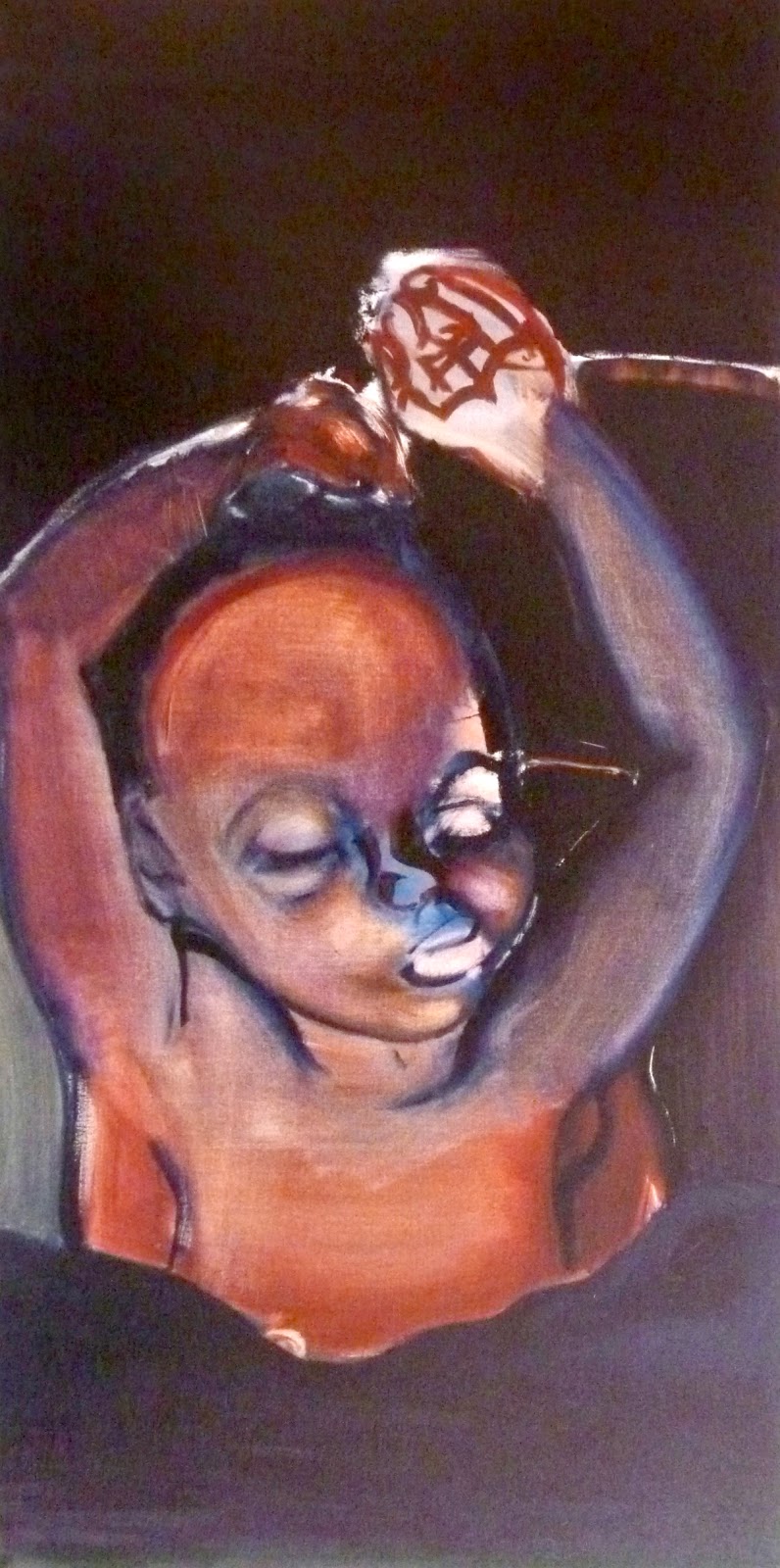
A series of tall and narrow canvases christened Magdalenas, a reference to the Biblical figure Mary Magdalene, who has often been portrayed as a penitent 'fallen woman', the counterpoint to the Virgin Mary.
'Dumas' Magdalenas are unswerving, awesome figures that assertively hold their heads upright... Hung next to one another, the individual images form a mass of distinctions. Dumas' women do not allow themselves to get trapped by one image of the feminine'. (Anke Bangma
)
Magdalena (Out of Eggs, Out of Business) 1995, (oil on canvas)
Great Britain, 1995-97, (oil on canvas)
A portrait of model Naomi Campbell
Magdalena I, 1996 (oil on canvas)
Magdalena (With the Large Breasts), 1996, (oil on canvas)
Strippers and Pornography:
A series of paintings devoted to the dynamic between the naked figure in art, pin-ups and pornography, exploring the great variety that can be found in the nude female form.
Leather Boots, 2000 (oil on canvas)
Suspect, 1999 (oil on canvas)
Silk Stockings, 2000, (oil on canvas)
 Fingers, 1999 (oil on canvas)
More Portraits:
Lucy, 2004, (oil on canvas)
Alfa, 2004, (oil on canvas)
Broken White, 2006, (oil on canvas)
For Whom the Bell Tolls, 2008, (oil on canvas)
Ingrid Bergman stares tearfully into the distance, part of a series of paintings about loss and loneliness, a response to the death of Dumas' mother.
Waterproof Mascara, 2008, (oil on canvas)
Dead Marilyn, 2008 (oil on canvas)
Conflict:
At the turn of the century, Dumas moved towards representations of war and conflict. She used images of dead terrorists, martyrs, suspects as well as the escalation of conflicts in the Middle East.

Stern, 2004, (oil on canvas)
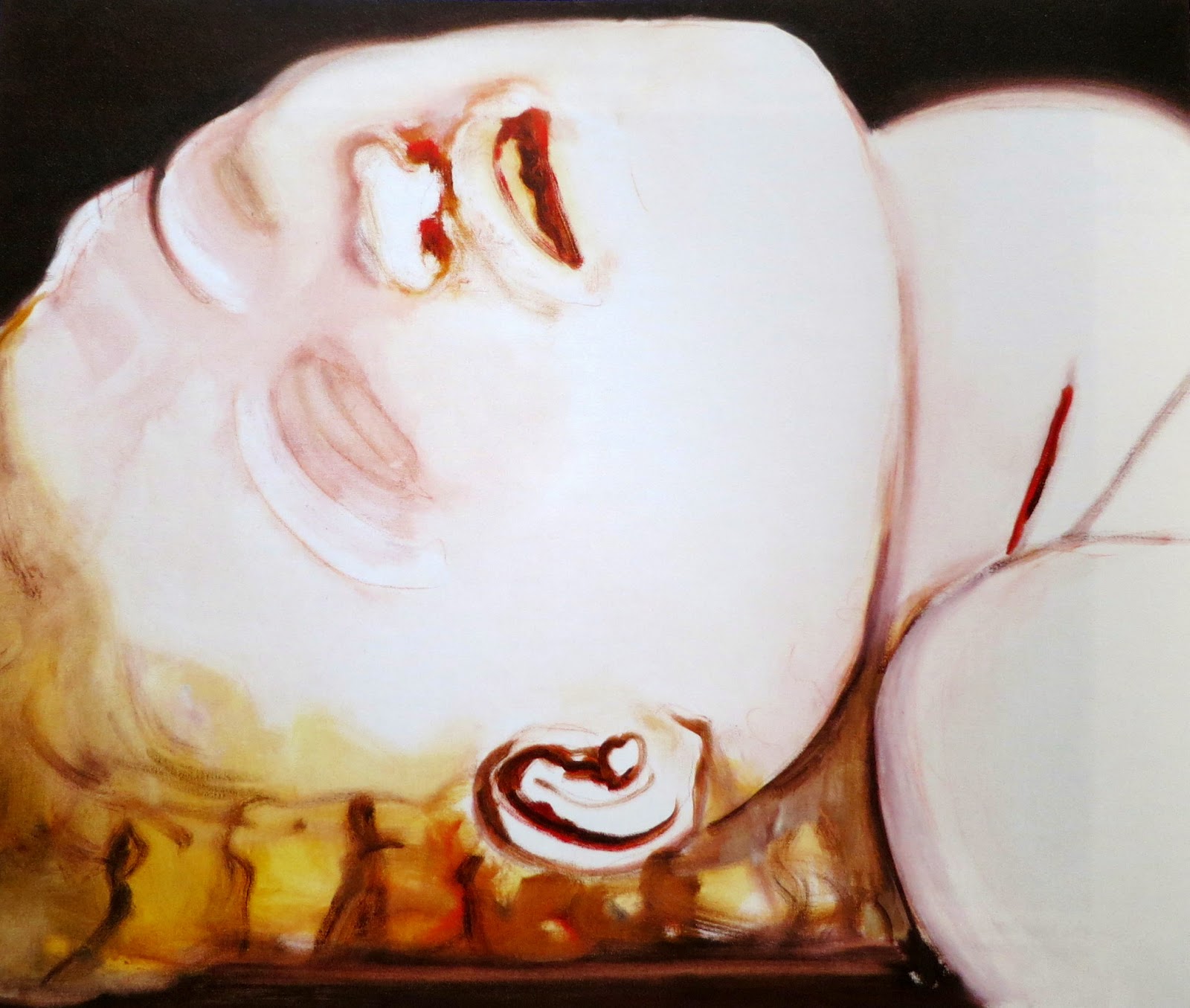
'The relative thinness and brevity of her painted touch matters. What can be shown, or not shown, is embedded in the painting - in its lapses, in the spaces between an ear and a cheek, as much as in the articulation of an eye or a mouth. Darkness sculpts the shape of an open mouth, as though the blackness were flowing in, to course down the throat and flood the body with death.
Looking at Stern, from 2004, I catch my breath at this exact thought. This is a dead portrait, named after the German news magazine that first printed the shocking photograph of the corpse of Ulrike Meinhof, the Red Army Faction terrorist who was cut down from the towel noose with which she either killed herself or was murdered (perhaps having been previously raped), in her Stammheim prison cell in 1976. We know this image because Gerhard Richter used exactly the same photograph for a number of paintings in his October 18, 1977 suite of paintings, now in the Museum of Modern art, New York.
Dumas' version, larger than Richter's three variations of the image, feels closer to Manet in its crisp pallor and lush blacks. The mark across Meinhof's neck - the burn-mark of the torn strip of towel that throttled her - is a painted cancellation of a life. That prow-like chin and open, gulping mouth are delineated and defined not by stark painted whiteness, but by the encroaching darkness that surrounds them. The light shadow under the chin and beneath the lower lip, like faint bruises, exert enormous pictorial pressure. (Adrian Searle, the Guardian, 13 November 2004).
(You can see Gerhard Richter's Baader-Meinhoff paintings
here )
The Blindfolded Man, 2007 (oil on canvas)
Dead Girl, 2002, (oil on canvas)
This painting derives from a magazine clipping, which Dumas had saved in her archive for nearly twenty years. It depicts the violent death of a young terrorist during a failed attempt to highjack a plane in the 1970s.
The Mother, 2009, (oil on canvas)
A black-robed Lebanese woman squats beside one of the many open graves with her son's photograph in front of her. Part of the series of paintings,
Against the Wall.
The Widow, 2013, (oil on canvas)
'Mrs Pauline Lumumba, walked bare-breasted through the streets of Leopoldville yesterday in mourning for her dead husband, Patrice Llumumba. With her were 100 followers of the former Congo Premier - women bare-breasted and men with heads low. They marched six miles from the African section to the U.N. headquarters carrying white flags as a sign to gendarmes and U.N. guards that they came in peace. While the others squatted silently outside, Mrs Lumumba carried her two-year-old son, into the building....Mrs Lumumba, barefooted and with a sarong around her waist, walked, crying silently, into a lift which took her to the office of the chief U.N. representative. (Sydney Morning Herald, 15 February, 1961).
The Widow, 2013 (oil on canvas)
The Woman of Algiers, 2001 (oil on canvas)
'About Algiers: Nelson Mandela had military training there, learned lessons of guerrilla tactics from their liberation war. Delacroix made a painting called The Woman of Algiers,
1834. Women relaxing in a peaceful female harem. In 1954, Picasso made (one of many) sensuous paintings inspired by this French-Algerian source. Little did he know where this orientalism would later go.
In 2000 I saw a photograph of a young girl standing naked, held by, 'exhibited' between two, posing French soldiers. The photo was taken in 1960 in Algiers. I painted the Woman of Algiers in 2001'.
The Trophy, 2013 (oil on canvas)
Solo, 2011, (oil on canvas)
Amy - Blue, 2011, (oil on canvas)
One of two portraits of Amy Winehouse, this one in blue.
Sources:
TATE exhibition notes.
Marlene Dumas: The Image as Burden, ed. by Leontine Coelewij, Helen Sainsbury and Theodora Vischer.