Approaching Surrealism

at the Museum of Contemporary Art in Andros. This was a very large exhibition which featured many artists and this is only a very small selection of what was on show.
One of the seminal art movements of the 20th century, surrealism was a vehicle for subversive protest, its founding principles the result of the social and cultural ferment that was Paris in the years between the two world wars. The movement drew from a wide range of philosophical concepts, from dialectical materialism to Freudian psychoanalysis and the interpretation of dreams.
Its concern was a shift from reason to the soul - to what is most obscure, primary or unknowable about the individual's life and which is repressed and effectively crushed. As it shed light into those dark aspects of the soul, Surrealism looked for meaning not on an external reality but on the intimations of an internal world and it brought to the fore a state of things that art could not possibly express through realism. Instead, there was complete surrender to the power of impulse and the dream, to automatic writing, to the creative imagination.
It acknowledged the great force of desire, love and the imagination.
Surrealism, a term invented by coincidence, has long since transcended its purely literary and artistic function and has found its way into everyday speech to suggest the uncanny or paradoxical, the extraordinary within the ordinary.

Some key concepts/ideas: revolt and subversion in politics, life and art; the role of the unconscious; the materialism/idealism dichotomy is fabricated; the distinction between wakefulness and sleep with its realm of dreams, is also fabricated, and needs to be replaced with a continuum between the inner life of the self and the world of the everyday; the significance of utopia, utopia as a guiding light; the marginal turned critical, carried onto centre stage; the importance of staying true to your principles in the most adverse of circumstances.

Man Ray, La Montagne de Cristal, 1950

Marcel Duchamp, La Boite en valise: de ou par Marcel Duchamp ou Rose Selavy

Rene Magritte, La decouverte du Feu, 1959

Man Ray, Noire et Blanche, 1926

Jean Arp, Nu Floral, 1957

Jean Arp, Etoile, 1968

Man Ray, Desert Plant, 1946
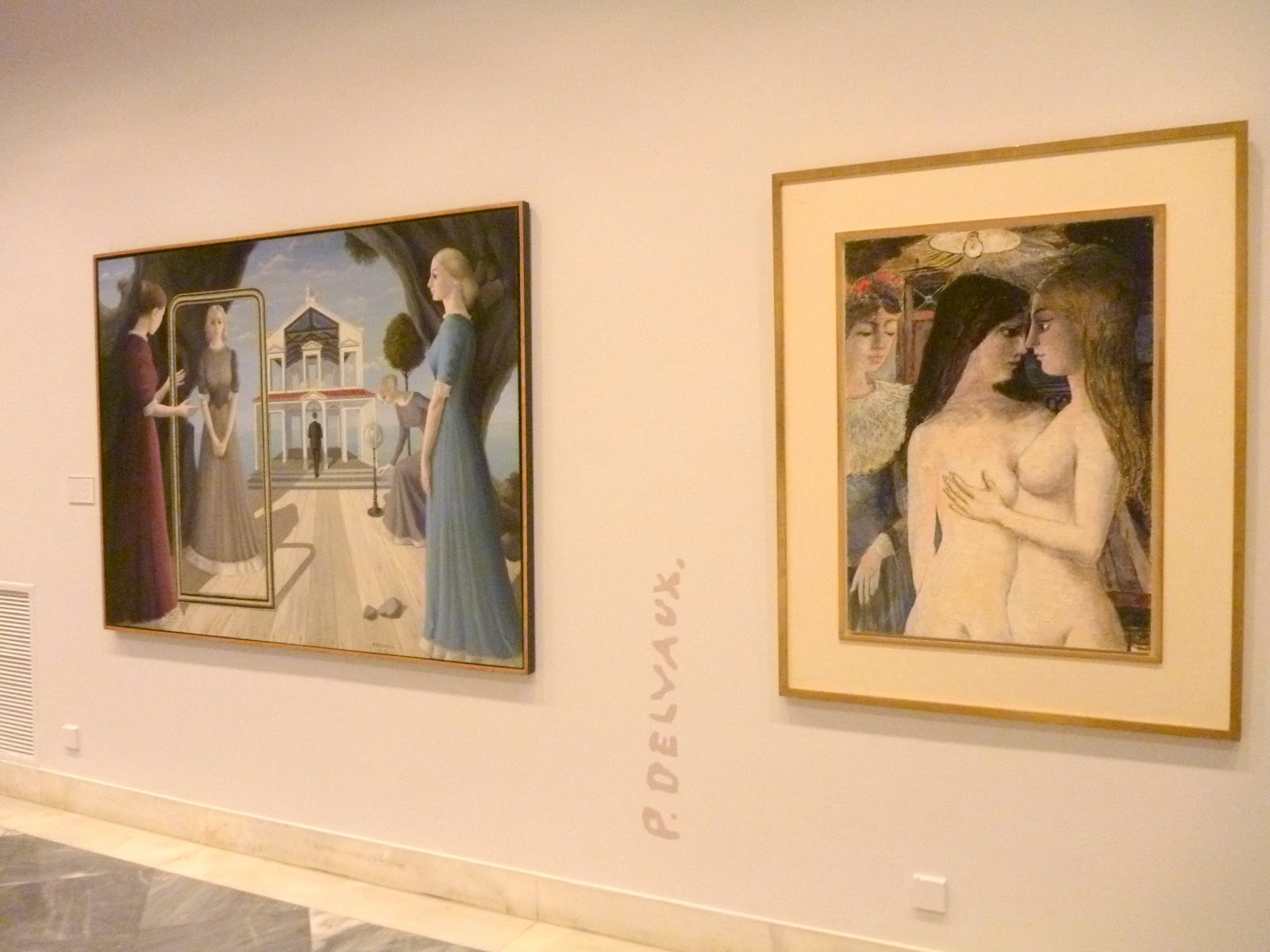
How do you tell if a work is surrealist? According to Andre Breton there are two criteria to be applied: firstly, is the work a product of automatism from which all sense of control, all reason is missing? Secondly, does the work have a spiritual quality to it?

Paul Delvaux, Les Vestales, 1972

Paul Delvaux, Regards et Contacts, 1982

Marcel Duchamp, Nu Descendant un Escalier, 1912
This painting deals with the idea of 'passage' in an external sense by picturing a body passing through space. The figure is shown in the painting from left to right and is not contained by the composition. The metaphorical suggestion is of perpetual motion but also of energy running down.
The artist's interest in Cubism is evident here, especially in the use of the muted, earthy colours that he discovered on his visits to the studios of Georges Braque and Pablo Picasso.
By the time he came to paint his second and final version of this painting he was already feeling sceptical about the activity of painting. He had begun to form an opposition to what he called the 'retinal shudder', in other words, the reduction of painting to the merely visual as opposed to its traditional function as a vehicle for conveying religious, philosophical and moral ideas.

Marcel Duchamp, The Passage from Virgin to Bride, 1912
In this painting the concept of 'passage' is taken even further, not only assuming a vaginal significance, but it also points to the invisible change of status, with all of its sexual and social ramifications incurred by a supposedly virginal woman when she consumates her marriage.
The sexual metaphor of 'passage' is carried here even further by both abstracting and mechanising it. Duchamp's image of the bride refers to nothing that we can see: instead, it presents us with a picture of sexual exchange in the instrumental guise of an imaginary fluid - we are implicitly asked to conceive of a liquid in 'passage' through a device that is pictured by the painting but is not its subject. It shows the 'virgin' as a 'motor' powered by the 'sex cylinder' and ignited by a spark to produce, beyond the limits of the canvas, the 'cinematic blossoming' of Duchamp's bride.

Joan Miro, Untitled, 1932

Man Ray, Le Violon d'Ingres, 1924

Man Ray, Coat Stand, 1920

Dorothea Tanning, L'Ocean S'Eveille

Meret Oppenheim, Homme Masque, 1973

Man Ray, Ray's Hand

Marcel Duchamp, Couple de Tabliers (Boite Alerte), 1959

Man Ray, Kiki dans 'Le Ballet Mecanique', 1924

Rene Magritte, Le Therapeute, 1967
Magritte's work is not automatic, but conscious: it signals a deliberate act of turning context on its head.

Victor Brauner, Reflection of a Dark-Complexioned Girl, 1945
Surrealism was influenced by the German Romantics, the Symbolists, Baudelaire, Rimbaud, Mallarme, Valery, Apollinaire. Andre Breton was greatly influenced by the work of Charles Fourier who 'was compelling for his noncomformist approach of the world, at once denouncing civilization as the root cause of humanity's sufferings and categorically rejecting the existence of the original sin. A visionary, he proclaimed his belief in a complete detachment from institutions, questionable disciplines and all systems of thought whatsoever'.

Andre Masson, Orphee, 1934

Masson, Coptic Mirror, 1942

Francis Picabia, Tete, (before 1949)

Joan Miro, Oiseau Zephyr, 1956

Film still from Luis Bunuel's and Salvador Dali's L'Age d'Or, first screened on Nov. 28, 1930


Antoine Mayo, Les Sens sont Cinq, 1970

Marios Prassinos, Visage, 1944

Gerassimos Steris, Lamentation, 1930

Gerassimos Steris, Figures, 1926-30

Odysseus Elytis, At the Piano, 1977

Odysseus Elytis, Figure of Victory (Flying), 1969

Andreas Embiricos, Untitled (before 1930)

Andreas Embiricos, (before 1930)

The issue of politics haunted Surrealism and resulted in successive ruptures within the group. During WWII the Surrealists refused to join the Stalinist-controlled resistance against the Germans. This was reversed during the Trotskyist period, but that was eventually renounced as well. Consequently, post-war Surrealism found itself politically adrift embracing Utopia, especially Fourier's Utopia and limited its political interventions to the occasional protest over issues such as colonialism, nuclear weapons, world peace.

Mexico, March-June 1938, Diego Rivera, Leon Trotsky and Andre Breton in the garden of Rivera and Kahlo's Casa Azul in Coyoacan.