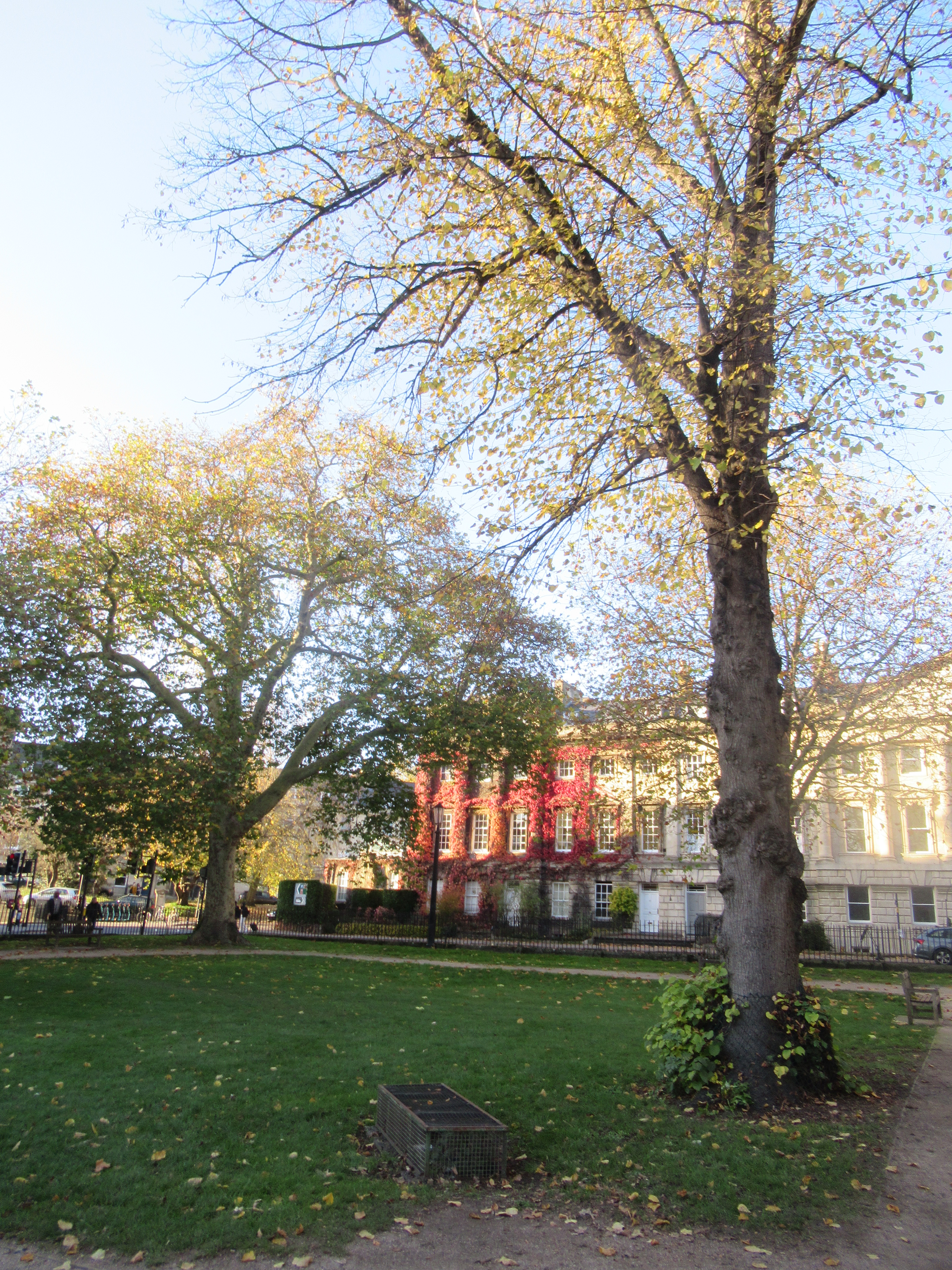
For this part of our exploration of Bath, we walked up Gay Street, past the Jane Austen Centre, turned left and found ourselves
on the edge of the Circus facing this group of large plane trees.
The Circus is a historic ring of large townhouses forming a circle with three entrances. Designed by architect John Wood, the Elder, it was built between 1754 and 1768 and is regarded a pre-eminent example of Georgian architecture.
The Cirus is divided into three segments of equal length, with a lawn in the centre. Each segment faces one of the three entrances, ensuring a classical facade is always presented straight ahead.
The central area was originally paved with stone setts, covering a reservoir in the centre that supplied water to the houses.
Today, the central area is grassed over and is home to a group of five large plane trees, which are believed to date to around 1820. They are contributing factors to the Grade I listing of the Circus.
We walked around the Circus and the central area, then took one of the exits, past Margaret's buildings

and arrived at the Royal Crescent, the most spectacular of Bath's terraces. It was built betwen 1767 and 1774, designed by the younger John Wood.
Wood designed the great curved facade of what appears to be about 30 houses with Ionic columns on a rusticated ground floor, but that was the extent of his input: each purchaser bought a certain length of the facade, and then employed their own architect to build a house to their own specifications behind it; hence what appears to be two houses is in some cases just one. This system of town planning is betrayed at the rear of the crescent: while the front is completely uniform and symmetrical the reat is a mixture of different roof heights, juxtapositions and fenestration.
No. 1 is a museum. It was closed this time, but we did visit last time we were in the city and you can see the results of our visit here
There is a large lawn area in front of the Crescent which is open to residents only
There is a ha-ha between the residents' green and the Royal Victoria Park so that non-residents cannot venture into the Crescent area
Right in the middle of the terrace a hotel is situated. We went in last time, and you can read about it here
View of the Crescent from the other end of the terrace
We moved on to the Royal Victoria Park and from there I was able to take a photograph of almost the complete Crescent
Victoria Park is an early 19th century park with an avenue of trees, a botanical garden, tennis courts, a bowling green, an irregularly shaped lake in imitation of that shown in the Chinese Willow Pattern.
.
We walked along Victoria Avenue. By Victoria Gate stands Victoria Column, a stone obelisk with three lions at its base, the whole being enclosed by a balustrate. West of the Column is the main part of the park. We walked in the opposite direction, towards Rivers Gate.
We could see the Crescent from here
In the middle of this lawn stands the wooden bandstand.
the back of the bandstand.
On either side of it are a pair of large classical vases which, according to the inscription on them, were presented by Napolen to Josephine in 1805.
 We arrived at the Rivers Gate, the main entrance to the park which is marked by two stone gate piers topped with lions.
After a few minutes we arrived at Queen Square, a square of Georgian houses, the final element in the 'most important architectural sequence in Bath', with the Circus and the Royal Crescent, designed by John Wood.
The obelisk in the centre of the square, was erected in honour of Frederick, Prince of Wales.
We then walked down Gay Street, past the Jane Austen house, and to the centre of town.