Thursday, 22 June 2023

The East End - Brick Lane


We love walking around Brick Lane, so after our visit to the Whitechapel Gallery we walked around Spitalfields, up Fournier Street, and then turned left into Brick Lane. Its history is rich. The first immigrants were the Huguenots followed by the Irish and the Ashkenazi Jews. Jewish immigration continued into the early 20th century followed by the Bangladeshis in the later 20th century who today are the predominant group in this part of the East End.

In the 1970s the National Front made their presence felt. The racist murder of Altab Ali in May 1978 led to a resistance movement beginning with the first ever Bengali march when some 10,000 Bengalis took to the street, supported by anti-racist organisations, trade unions and the Anti-Nazi League. The resistance of these groups against the National Front are legendary and continued until the early 1980s.


In the Rajmahal shop we found lots of sweets


but savouries too.


Lots of people around enjoying a Saturday afternoon, including lots of native and foreign tourists.


Recently, the area has broadened to being a vibrant art and fashion one, with considerable exhibition space. 


We walked past the Truman brewery which was established in 1683.


Some interesting street art


and lots of food for sale


including this chocolate shop which to me, exemplifies the continuing gentrification of the area


delicious chocolates, but very expensive


the parade of food shops continues


culminating in the Beigel shop which had the longest queue I have seen in a long time


and the Beigel Bakery a few doors up


I actually went across the road and tried to photograph the length of the queue and could not get it all in.


We got to the end of Brick Lane and then turned round and started walking down the other side of the street


A few stalls selling street food


'Pay as much as you can' art


We ended up where we started, the corner of Brick Lane and Fournier Street, by the Jamme Masjid (Great London Mosque). Originally, this was a Huguenot chapel, built in 1742. By 1908 it was used by missionaries as The Jews' Chapel, where Christianity was promoted to the expanding Jewish population. It was then adapted as a Methodist Chapel in 1819 for Protestant residents and in 1889 the building was consecrated as the Spitalfields Great Synagogue. In 1976, it was adapted again as a mosque to serve the expanding Bangladeshi community. All the changes of the area reflected in one building!




We came to the end of Brick Lane, turned into Whitechapel High Street and went to get our bus.


Monday, 19 June 2023

The East End - Spitalfields


We visited the East End of London a few weeks ago.


A nasty reminder the minute we got off our bus


and another one almost immediately. This is the area where Jack the Ripper murdered all those women, and I find it distasteful and upsetting that he should be remembered in such a way, almost celebrated.


First stop, the Whitechapel Gallery. Founded in 1901 to 'bring great art to the people of the East End of London', the building was designed by Charles Harrison Townsend. Combining elements of the Arts and Crafts and Art Nouveau styles, the building has a broad arched entrance and twin roof turrets.

Rachel Whiteread's Tree of Life sculpture has been added above the grand entrance - a frieze of golden leaves, inspired by the existing architecture which features a Tree of Life motif on its terracotta panels. 'It's connected with the architecture, the sociology and the anthropology of the aea', said Whiteread. 'I've worked with the local foundry, so it's all very much East End-based'.


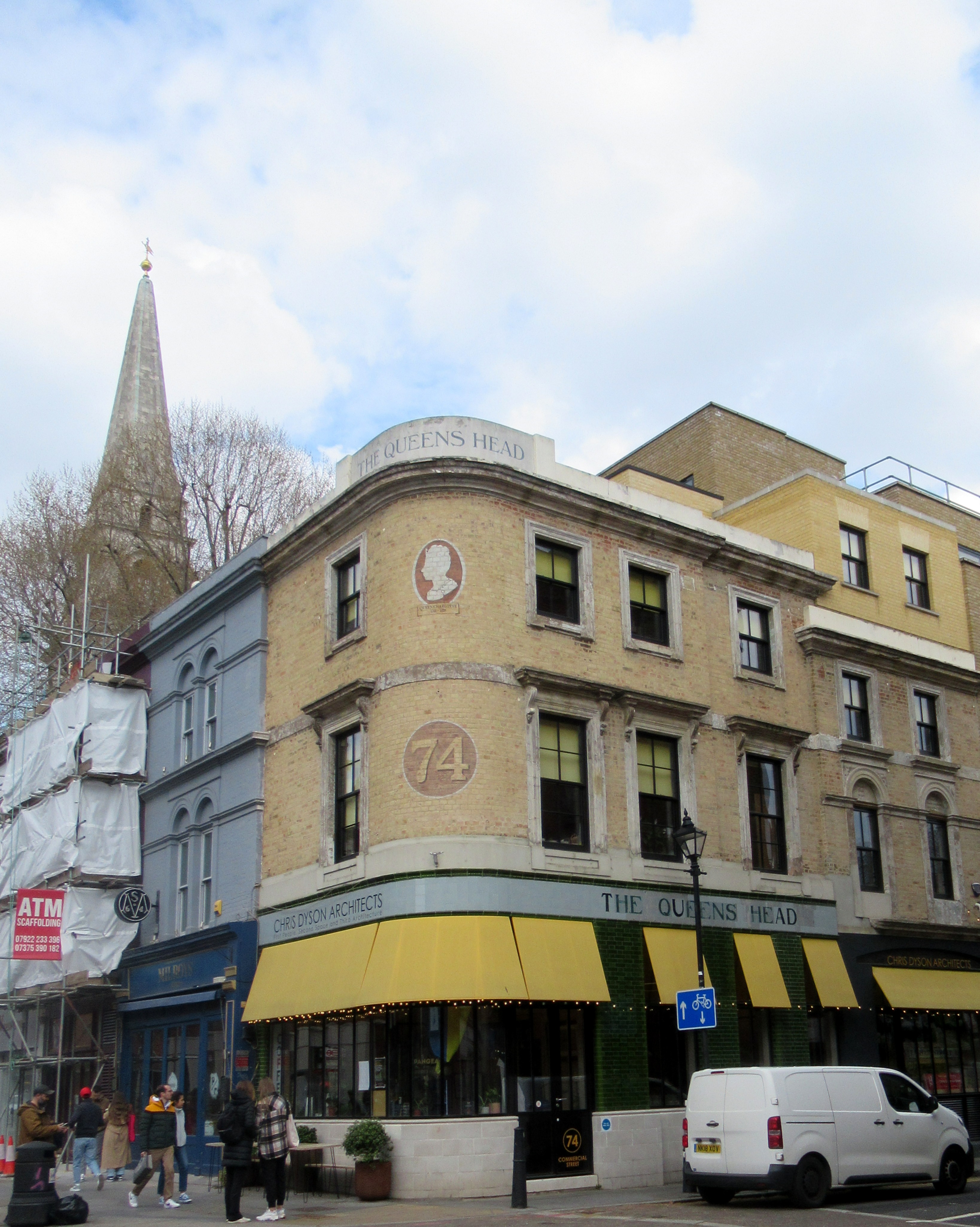
After the exhibition we wanted to explore the area so we walked up Commercial Street.


got a glimpse of the Gherkin


and reached Christ Church, so elegant and imposing.


It was designed by Nicholas Hawksmoor and built between 1714 and 1729, in English baroque style. 

Built in an area that was dominated by Huguenot immigrants at the time, the aim of the build was to establish Anglican authority.


We were ready for our lunch we so entered Spitalfields Market.


There has been a market on this site since 1638 when King Charles gave licence for flesh, fowl and roots to be sold on Spittle Fields, which was then a rural area on the eastern outskirts of London. After the rights to a market had seemingly lapsed during the time of the Commonwealth, the market was re-founded in 1682 by King Charles II in order to feed the burgeoning population of a new suburb of London.

The original Victorian buildings and the market hall and roof have been restored and today Spitalfields is one of London's major markets.


A lot of food stalls, a lot more than last time we visited


and lots of people eating


we decided to have Ethiopian food, which was delicious


Then we wandered around for a bit


decided we were too full to try Japanese sweets


exited the market


onto this square where lots of people were sitting around eating food from the market


popped into the Doc Marten shop to have a look at the sandals


I didn't know they made sandals!


past the All Saints shop


retraced our steps for a few yards


so that we could walk up Fournier Street which is full of Huguenot weaver's cottages. Escaping prosecution, a quarter of a million French speaking Calvinists came to this country in the 17th century and 25,000 settled in London. The silk weavers  came to Spitalfields and brought French fashion with them. The increase in the availability of silk affected British upper class fashions as new styles became popular incorporating more of the readly available material.


The wealthier Huguenots built large houses both for their families and for the weavers they employed. The houses are extremely distinctive, with enlarged windows in the attic to let in maximum light for the weavers.

Because different builders were involved, all the houses look different. They are 5 stories high, with three windows across as this was the length of the timber used. A law was passed at the time decreeing that windows should be recessed by one brick, but this was ignored in Spitalfields. Some of the houses are only one room deep.


By 1760 the area had lots its prosperity: competition from France and changes in fashion meant that master weavers could not pay journeymen anymore and family members had to undertake the work. Strikes and protests followed and journeymen started breaking into the cottages and smashing the machines. In 1773 the Spitalfields Act was introduced fixing wages and forbidding imports but this resulted in the sacking of more workers and the Act was replaced in 1824. The introduction of the Jaquard loom in the same year resulted in factories taking over the cottage industries and terrible poverty became the norm. Jewish immigrants started coming in, sweatshops were introduced and people lived in abject poverty so much that panelling in the cottages was ripped up and used for firewood.


 We had reached the end of Fournier Street and turned left into Brick Lane, but this will be the subject of another post.