Friday, 21 June 2024

The Almudena Cathedral in Madrid


The Cathedral of Saint Mary the Royal of the Almudena, commonly known as the Almudena Cathedral is a fairly young cathedral by Spanish standards, its construction began in 1883 and finished over a century later, when it was consecrated in 1993.


The outside of the cathedral has baroque nuances and has a double dome.


The imposing main facade has a great portico with two rows of columns. Their lower part shows a Tuscan influence, whereas the upper section imitates the Ionic order. There is also a baroque niche hosting the Virgin of Almudena, which was placed there after the consecration of the temple. There are also four statues by sculptor Ramon Chaparro: San Isidro Labrador, Santa Maria dela Cabeza, Santa Teresa de Jesus and San Fernando.


We were struck by the sculpted doors


The Neo-Gothic interior is uniquely modern, with chapels and statues of contemporary artists, in heterogeneous styles, from historical revivals to pop-art decor.


I loved the very modern stained glass


There was a long line of people queuing to kiss the icon.


My favourite part was the praying chapel, for its simplicity and beautiful mosaic drawings


The chest in this chapel is a funerary chest in which the body of Saint Isidro, the Patron Saint of Madrid, is preserved. It is one of the oldest pieces of furniture that exists in Madrid. 


It was made at the late 13th century. It consists of a parchment-covered pinewood frame with partially preserved linear Gothic paintings, depicting three miracles attributed to Saint Isidro.


After the Cathedral we visited the crypt


which follows a Neo-Romanesque style and keeps a 16th century depiction of the Virgin of Almudena.


The crypt has more than 400 columns with capitals. They mostly portray biblical figures and elements of nature.


Surrounding the perimeter of the crypt are 20 chapels. Each one is beautifully decorated with figures, paintings, mosaics and other works of art. There are also several colourful stained glass windows.


The floor was covered with tombstones, many of them very recent, and flowers or plant pots were placed on the graves


more graves on the wall in one of the chapels


Finally, a sarcophagus.


Wednesday, 19 June 2024

Royal Madrid, Plaza de Espana, Parque del Oeste and so much more....


This was by far our longest walk without a break - we did not intend to walk for five hours without stopping or having some water, it just sort of happened: we were immersed in what we were doing and in the end, could not find anywhere we liked to sit for lunch, so we kept walking. A memorable day, and we covered so much.


After breakfast we walked to the Basilica de San Francisco El Grande


stopped to admire the recycling bin which includes compartments for books, spray bottles, coffee, electrical appliances, receipts and lots of others - basically everything


We walked along Calle de Bailen


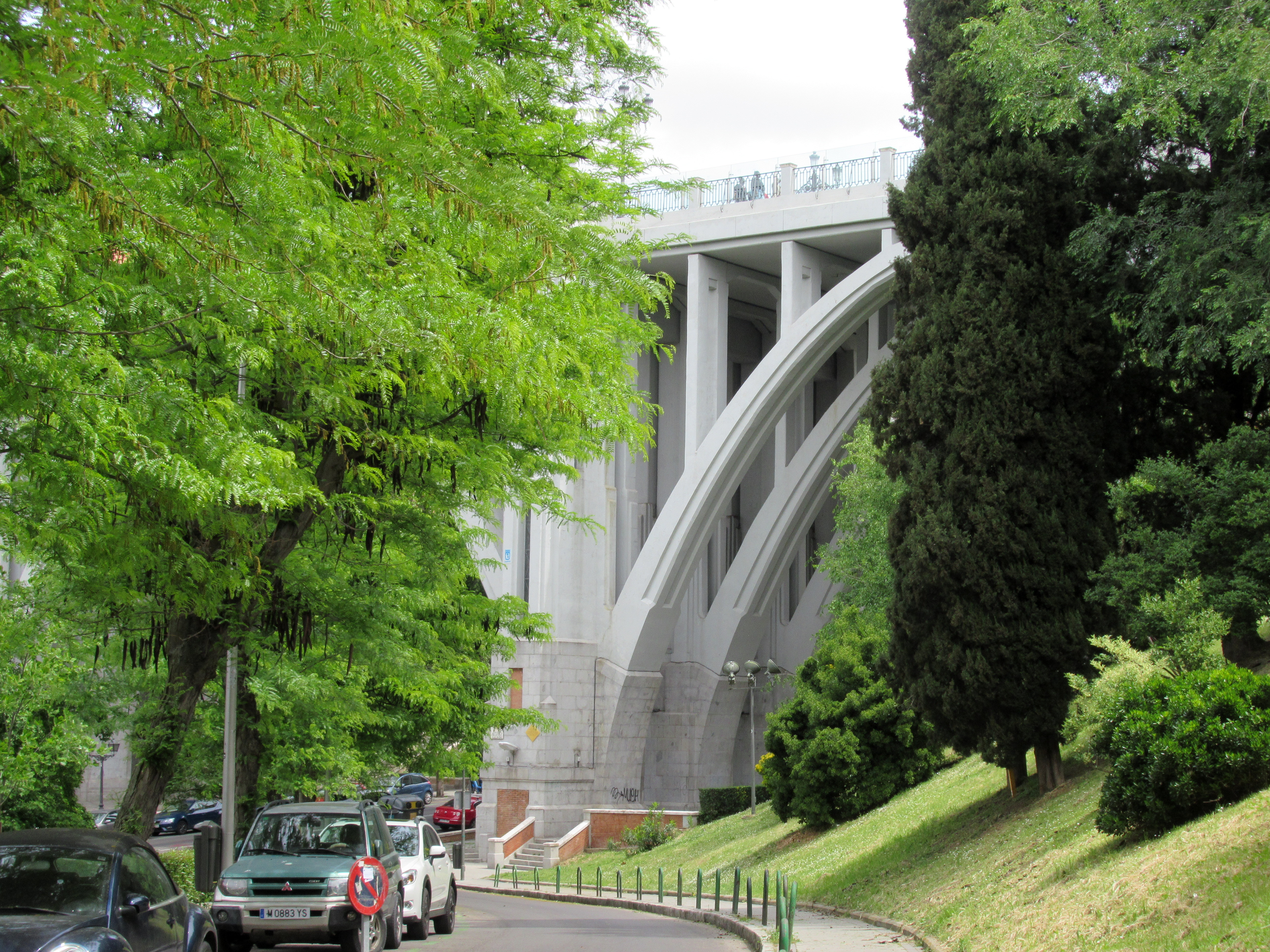
We got to the viaduct which connects La Moreria with the cathedral and royal palace. It was built in the 19th century and replaced by a newer version in 1942. There are plastic barriers on either side to prevent suicide jumps. 


We were really curious so we walked down the endless steps so that we could see the viaduct.


Since we were there, we walked around the little park 


Then made our way back. 


Visited the crypt of the Cathedral (post to follow)


Then the cathedral itself (post to follow)


Then, next door, to the Plaza de la Armeria (Plaza of the Armoury), the palace courtyard. 


This courtyard puts the sheer scale of the palace into perspective


it's massive.


Good views of the city from here


as well as the palace garden (post to follow)


We moved on to the Jardines de Lepanto which are situated just across the road


very calm and peaceful here.


We then moved on to the Plaza Oriente. This graceful square is one of Madrid's most beautiful, home as it is to a royal pal
ace that once had aspirations to be the Spanish Versailles


Sophisticated cafes watched over by apartments that cost the equivalennt of a royal salary


The Teatro Real, Madrid's opera house and one of Spain's temples to high culture. 


Nearby are some 20 marble statues, mostly of ancient monarchs. Local legend has it that those ageing royals get down off their pedestals at night to stretch their legs when no one is looking.


One the edge of the square a Tai Chi class


Another view of the palace which really dominates this whole area.


The walk from here to the Plaza de Espana was ever so pleasant


we diverged into Jardines de Sabatini for a while


walked past a group of kids on a school trip: so many school trips all around Madrid - they were everywhere


then back to the main path - lovely colour


Not a bear this time


We continued on our way


so many beautiful buildings all around


In a small, very pleasant square the Templo Nacional de Santa Teresa y San Jose is situated, a church in the convent of the Carmelite nuns (post to follow)


After visiting the church we continued on our way


and entered the Jardines de Ferraz


so lush


a lot of statues of women around here - I presume because it's all near the convent.


Our next destination was Plaza de Espana, a large square that is dominated by tall buildings, including the one above, the House of Gallardo, built in 1911 and considered one of the notable examples of Art Nouveau in the city. 

In 1808, the area was part of the Principe Pio hill. It was one of the locations used by French firing squads to execute prisoners taken during the May 2nd uprising and it is the subject of Goya's The Third of May painting. 


Tall buildings surround the square - this is Riu, a hotel


The square is dominated by this huge statue


with a cascading fountain on the back


There was a market on the day we visited


of Latin American food


And then as we were walking around the market we saw the other side of the statue, and its full glory. It's a monument to Miguel de Cervantes, which I understand was created at the same time as the square itself. In front of the statue are Don quixote and Sancho Panza. The figures of Dulcinea and Aldonza Lorenzo, also characters of the Cervantes novel, are part of the monument. 


Our next destination was Parque del Oeste (post to follow). 


We had been walking for a long time and we were ready for a sit-down and a drink of water. We hoped to find something in the park but there was nowhere that sold food and drink.


We spent quite a lot of time in the park and then walked down Passeo del Pintor Rosales, looking for somewhere to sit down


past the Escuela de Ceramica


We had to ask for directions here as we could not see how we could get to our next destination. We were told to keep going until we got to an ugly bridge


Just before the bridge we saw these huge square stones


As we continued walking we started being able to decipher what the stones were spelling out - very appropriate as out next destination was the chapel of Ermita de San Antonio de la Florida, also known as the Pateon de Goya. The chapel has frescoed ceilings painted by Goya in 1798.


We crossed the 'ugly' bridge


we could see the kiln of the ceramics school from here


and here was the chapel. Yes, you've guessed - post to follow.


We spent quite a long time in the chapel and then started walking down Paseo de la Florida in the direction of our hotel, but mainly looking for somewhere to sit, have a drink and lunch.


Not much here. We walked past this place, but it looked very formal, not what we were looking for, and anyway, it was indoors - it was a gorgeous day and we wanted to sit outside


We got to this vast complex that included a station


and stopped to look at this statue


and then realised it's an advert for the release of the latest film of Planet of the Apes!


A busy roundabout around this arch


is where we stopped for lunch - not something we would do by choice, but by then we had been walking for five hours and were desperate for a sit-down, a drink, and something to eat.