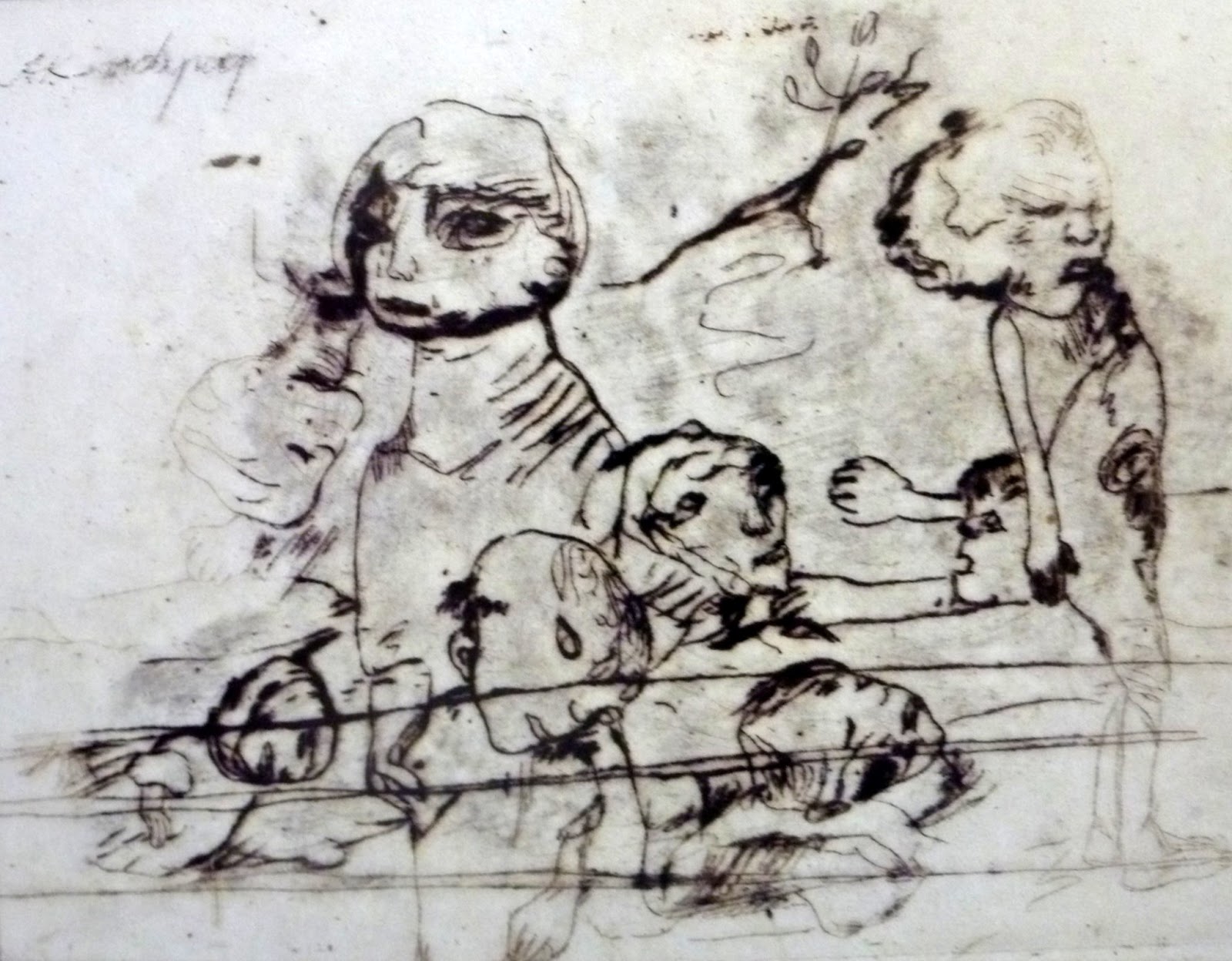
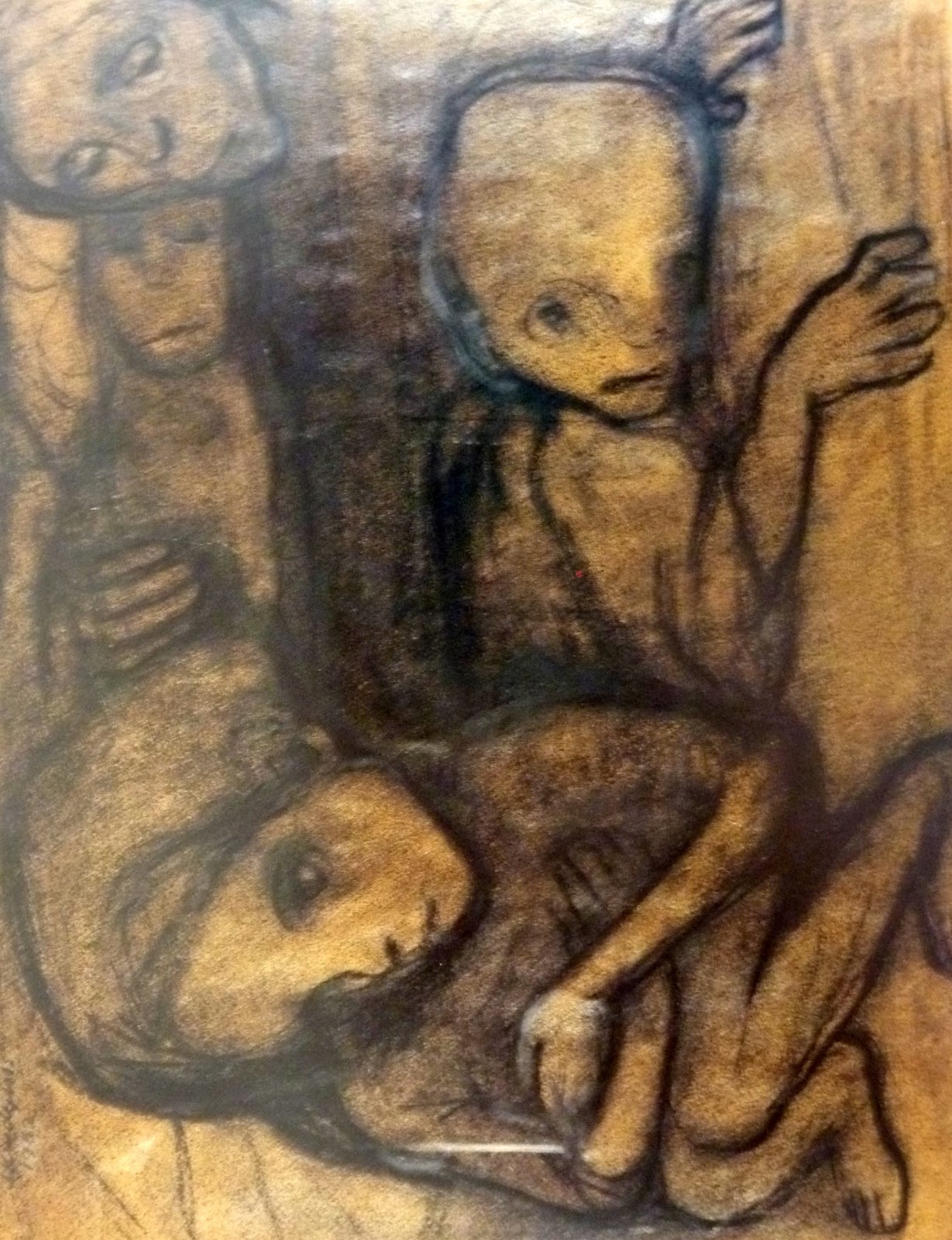
Showing posts with label Nazi occupiers. Show all posts

Sunday, 5 April 2015

The Karakolithos Memorial


While we were driving to Galaxidi we came upon the Memorial to the victims of the massacre in Karakolithos.


One hundred and thirty four men were executed by the German Nazi occupiers of Greece in Karakolithos on the 25th of April, 1944.


The monument is the work of sculptor Aggelika Korovesi.  You can see more of Aggelika Korovesi's work here .


During WWII Greece lost 13% of its population, some of it in battle, but mostly from the famine and from German war crimes. The Germans murdered the population of 89 Greek villages and towns, burned to the ground over 1,700 villages and many of their inhabitants were also executed. The country was reduced to rubble and its archaeological treasures were looted.

The area we were driving through suffered particularly badly from the Nazis, especially in the village of Distomo which is nearby. For over two hours, on June 10, 1944, Waffe-SS troops under the command of SS-Hauptsturmfuhrer Fritz Lautenbach went from door to door and massacred Greek civilians as part of a 'retaliation measure' for a partisan attack upon the unit. A total of 214 men, women and children were killed in Distomo.  According to survivors, SS forces bayoneted babies in their cribs, stabbed pregnant women and beheaded the village priest.

One of the survivors was four year old Argyris Sfountouris. Sfountouris lost both his parents and 30 relatives in the massacre. As a war orphan he was sent by the Red Cross to Switzerland. Even though as an adult he obtained a PhD in Mathematics and Physics, he has dedicated his life to humanitarian  and developmental aid projects. In 1944, fifty years after the massacre,  he organised a conference in Delphi. Under the heading 'Memory - Mourning - Hope' the issues of compensation, of overcoming hate and of reconciliation were discussed.

In 1995, Sfountouris and his three sisters submitted a legal claim for compensation. It was rejected. They then went to the European Court of Human Rights in Strasbourg where the complaint is still pending. Above all, Sfountouris is indignant about the fact that the German government called the massacre of Distomo a 'measure in the context of war', although it is clearly a war crime.

'A Song for Argyris', a documentary film by Stefan Haupt recounts what happened in Distomo.


Monday, 24 March 2014

Art and wine

 
Our first night in the Centre (of Athens) was last Thursday when we joined two members of the of Arts and the City team and went to two exhibition openings.


First stop, Zoumboulaki Gallery in Kolonaki Square


to see the exhibition  'Image and Illusion' by Giorgos Avgeros. Avgeros' black and white landscapes look three-dimensional. He achieves this by using charcoal on successive film transparencies.


Hidden Creek V, (charcoal on transparent film)


Forrest, (charcoal on transparent film)


Olive Tree (charcoal on transparent film)


We then moved on to Plateia Karitsi, the trendiest part of the city at the moment, full of interesting bars


and I just love looking in


each one decorated with taste and style


Our destination was the Black Duck


beautiful surroundings


with lots of interesting pictures on the walls.


We ordered our drinks and food


and then walked down the stairs


to the basement to see the second exhibition of the evening


of paintings by Christos Palamides.


The food was delicious


and we got quite merry.


On our way out we came across some interesting street art


more bars


and walked past Parnassos, where, along with other students, I gave two piano recitals when I was playing the instrument


The building was used as a military court when Greece was occupied by the Germans during WWII and this is a rough translation of the plaque: 'This temple of the Muses of the Arts was turned into a military court by the Nazi invaders. In memory of all those Greeks who were court martialled'.


Friday, 26 July 2013

The spectre of fascism is haunting Europe once more


More than 2,000 people queued on Wednesday to receive free food outside the fascists' headquarters in Athens after the neo-Nazi party was banned from conducting the hand-out in Attikis Square.

Athens Mayor Giorgos Kaminis said that he would not allow the neo-Nazis to use the central Square for its 'Greeks only' event so the venue was switched to the party's offices near Larissis Station. A queue of over 1,000 people snaked its way around the streets one hour before the food distribution was due to begin, and by 6:00 it had swelled to 2,000. Before the handing out of food began, their leader gave a speech declaring that the date was meant to coincide with the anniversary of democracy being restored to Greece after the collapse of the military junta - a dictatorship which the Nazis exalt. 'They are celebrating the so-called anniversary of democracy but in fact they are celebrating the arrival of klpetocracy, scandals and betrayal', he declared. He continued by saying that the food was not  'for blacks, or Pakistanis' and every time he mentioned a nationality or race of people, the supporters booed. From time to time, the black-shirted members of the Nazis would start shouting 'blood, honour', and the name of the party (that I do not want mentioned in this blog) and that would be followed by Nazi salutes.

At the end of this message of hate and division, the handing out of food started, and the people who were queuing had to produce their ID cards to prove that they were Greek.


The police stood by and at no point did they attempt to stop the proceedings.

Greece is being held hostage by a police force that increasingly appears beyond state control, and which has long forsaken its role of protecting citizens from the thugs they now side with. Meanwhile, the government's agenda is increasingly moving to the right, resembling the policies of the Weimar Republic and you can read more about this here .

In the middle of the severe economic, political and social crisis that is engulfing Greece, the neo-Nazi party and their message of hate is quickly gaining influence and power, emerging as the fastest-growing political force in the country.  They won 18 seats in Parliament in the June 2012 elections and had 14% of support in recent polls - a showing comparable to that of Hitler's  National Socialist German Workers' Party in 1930, three years before rising to power and setting the world on course for WWII. Antisemitism, xenophobia, hatred of immigrants, misogyny, homophobia, are at the heart of their vision of the world.


It is such an irony that this should be happening in the country that mounted such fierce resistance to fascism during WWII, during which more than 300,000 Greeks were killed.

Fascism is once again rearing its ugly head in Europe, and what are the EU leaders saying or doing about this? Nothing. Absolutely nothing. The only thing they seem to care about is that Greece repays its debts. Financial interests are the primary concern, with human rights, democracy and the rule of law totally sidelined. There is no recognition that the problem even exists. Could it be that European leaders realize how deeply implicated they are in the rise of this neo-Nazi group?

Never again, we used to say. We don't say it anymore.

                                                               
                                                                     *   *   *


For more information on how desperate things are for sections of the Greek population go here


Source:

http://www.ekathimerini.com/4dcgi/_w_articles_wsite1_1_24/07/2013_511058    (the Greek version of this article is much more detailed)


Thursday, 25 July 2013

Anna Kindyny


While writing up the post Hunger yesterday, I was reminded of Anna Kindyny whose work was exhibited in the Benaki Museum in 2009.

All the major events in Anna Kindyny's life run parallel to all the major events in Greece's history. She was two months old when her family had to leave Asia Minor in Turkey when all the resident Greeks were persecuted and expelled. 'I was two months' old when we had to leave our home and took refuge in the mountains, half naked, without water or food, and we stayed there for 3 nights. We then found a boat that took us to Lesbos', she recounted. In 1917-18, when she was 4 years old,  the German submarines besieged the Ionian islands and hunger hit the people there: she could see from her balcony all the emaciated dead being taken away: 'most days our only food was a handful of raisins', she remembered. Her family were able to return to Turkey in 1919 but had to leave again in 1922 when the Greek residents were all forced to flee the country: Anna was eight. Back to Lesbos. She moved to Athens in 1939 in search of work, and married in 1940.

The German occupation of Greece meant persecutions, mass executions, concentration camps and the awful hunger of 1941-42. She worked for the City Council and her job was to record the deaths of those who died from starvation. One of her sisters died from malnutrition. Kindyny and her husband moved to Paris in 1945 and she stayed there for 45 years. In 1947 her other sister, Irini, a political activist, was arrested and sent to exile to an arid island in the Aegean where she stayed for 4 years. Anna Kindyny found this very hard to bear and years later, did a whole series of sketches titled 'Women in Exile'.

She went to University in Paris and her friends included Braque, Picasso, Mondrian, Malevich and Kadinsky. Throughout her life she was politically active, and that included the uprising of May '68 as well as the feminist movement.

She was never able to forget the hunger of people in Athens during WWII and most of her work is influenced by those years: 'I had to recount my history and the history of my people. I used to sketch as if I was having a conversation with myself, a testimony, a confession....'


Despairing Motherhood, 1950s


Greece in 1941, 1950


Hunger, 1950s


Child, 1950s
 
 
'I saw this. This is how it happened', wrote Goya when referring to his masterpiece, Images of War.
 
It's the same with Anna Kindyny. Her work is a testimony to what she saw, what she experienced. The seemingly rough lines of her sketches, the dark tones, the silent, spectral forms, the tightly closed mouths of her haunting characters bear witness to what she saw and what she experienced. Her work is the recounting of the experiences of women, of female consciousness, of female suffering in a male-dominated world. Like Kathe Kollwitz's work, her work is about loss, suffering, and, ultimately, resistance.


Hungry Children, 1950s


Mother and Child, 1950s


Family of Immigrants, 1950s


Immigrants, 1950s


Bitter Motherhood, 1953


Hunger, 1954


 Child, 1955


German Occupation, 1955


Unprotected, 1956


Hiroshima, 1956


Child, 1956


Abandonment, 1959


Child and Grandmother, 1962


 Hungry, 1962
 

 A different theme:


Eros, 1981


Eros, 1985


Finally, a photograph of the artist at work.