Showing posts with label austerity. Show all posts

Sunday, 20 September 2015

Greek elections - caught between Scylla and Charybdis


I have just come back from the polling station, having cast my vote, the first time I have voted in Greek national elections. It should have been an historic occasion except that this is a non-vote. The agenda was set by former Prime Minister Alexis Tsipras who signed a third punishing bailout agreement and which was supported overwhelmingly by the Greek Parliament. This effectively gives Greece's sovereignty away with the country becoming a semi-colonial appendage of the EU. This full capitulation to the demands of the Troika will mean more suffering for the Greek people. Every 'red line' the Syriza government had maintained has been crossed, from pensions cuts to VAT increases, whilst the pace of spending cuts mandated guarantee continual misery.
 
Even worse, the deal contains two measures that strip Greece of its economic sovereignty. Greece will place £50bn of its government assets in a special fund, held as surety against its future good behaviour. The deal also demands that the Greek government 'consult and agree with the Institutions on all draft legislation in relevant areas with adequate time before submitting it for public consultation or to Parliament'. This is something more akin to a deal forced on a nation defeated in war. For all this, Greece gains almost nothing. Greece's debt is unsustainable on any plausible timescale. The 'bailout' is money for Greece to pay off its debts. The bailout, in other words, is a bailout of the banks, not of Greece.
 
The government that gets elected today will have to implement all of this. No wonder no one is excited about this election. Apathy and disgust are the predominant feelings. Most people I know are still undecided. They intend to either abstain or make a decision on the spot.


The turn-out looked good. Voting in Greece is compulsory.


Some of the parties had set out their stalls outside the school that served as a polling station.


Popular Unity: NO will prevail.


KKE (Communist Party): 'There is a way forward'.


Syriza: 'We will win the tomorrow'.


New Democracy: no caption, just a photograph of Vangelis Meimarakis.
 
 
                                                                                    *   *   *
 
Two images from social media encapsulate the situation:


'Who do I vote for tomorrow? The thief or the liar?'
 
Syriza's electoral victory was in part a reaction against the previous governments, New Democracy and PASOK, whose corruption, concern with lining their own pockets and total disregard for the suffering of the people of Greece were seen as totally unacceptable. PASOK is finished, and now, despite their crushing defeat in January New Democracy are seen as possible winners in this election. Meanwhile, the disillusionment with Syriza is overwhelming, and Tsipras is seen as a liar.


 'No problem. You can vote for whoever you like'.

A triumphant Wolfgang Schauble in this image has no worries about this election. Greece's sovereignty has been signed off - the result of this election is immaterial.

Greece is stuck between Schylla and Charybdis and whoever wins this election will make no difference to the situation the country finds itself in. Punishing measures will have to be implemented. The die has been cast. It was cast weeks ago by the so-called left wing government of Syriza, and its leader Alexis Tsipras, who lied to the Greek people.


Outside one of the classrooms of the school that served as a polling station is this mural, a copy of Guernica by Picasso. Appropriate for the occasion? I think so.


Thursday, 13 August 2015

Migration and the tragedy of Kos


This photo speaks more than a thousand words. It was taken by Yannis Behrakis during the chaos that ensued when water cannon, along with beatings with truncheons by riot police were used against Syrian refugees who have sought refuge on the island of Kos. While all this was going on, the refugees, these 'swarms' to use U.K. Prime Minister David Cameron's words, formed a human shield around a woman refugee and her child, to protect them from the beatings.

In order to be able to do despicable things to human beings one has to dehumanise them. So you call them 'swarms' as David Cameron has done, or 'cockroaches' as Katie Hopkins of the Daily Mail, did a few months ago. But, who is showing humanity here? In the middle of the attack by riot police, brought in by a 'left' government, the first thought of the Syrian refugees was to protect those who cannot protect themselves.

The governments of Europe have shown absolutely no humanity or compassion for those who have been driven out of their homes as a result of war and state disintegration. This is despite the central role that the West has played in most of these wars, fuelling the mass exodus of displaced people who have no choice but to risk their lives in the graveyard that the Mediterranean has become. Most refugees arriving in Europe come from Syria, Iraq, Afghanistan and Libya - countries that the West has waged wars against in the name of 'democracy'.


More than 180,000 have reached Italy and Greece by sea alone this year, and more than 2,000 have died making the crossing. And yet the only response of the European governments is to 'protect' their borders. 'Not in my back yard. Let these people go elsewhere. We don't want them here'. Fortress Europe has to be defended at all costs.


'War, violence and persecution left one in every 122 humans on the planet a refugee, internally displaced or seeking asylum at the end of last year, according to a stark UN report that warns the world is failing the victims of an 'age of unprecedented mass displacement'. UNHCR estimates that an average of 42,500 men, women and children became refugees, asylum seekers or internally displaced people every day last year - a four-fold increase in just four years', reports the Guardian.

Dr Dimitris Yannousis, has just come back from Kos where he spent 50 days working for Medicins sans Frontiers. He treated 820 people and he reports that 93% of those are refugees from countries that are at war, mainly Syria, Iraq and Afghanistan. 'I have treated war wounded, pregnant women, very old people who have walked for thousands of kilometres in an attempt to reach a place where there is no war... Most children suffer from post-traumatic stress and they bear their burden in silence... I remember a young man who was injured in Syria and had his leg amputated. He reached Kos with the help of his brother, walking through Syria, then Turkey and finally taking a boat to Kos. The conditions in which he found himself in Kos were horrendous... Another 18 year old was in a pre-diabetic coma - he could not get insulin during the three months he spent in Turkey while waiting for a boat to take him across'


Greek Prime Minister Alexis Tsipras made a statement last week saying that given the economic situation in Greece, it's impossible for the country to deal with all the people who are washing up on its shores. So he asked the European Union for help in dealing with the situation. A very sensible request.

But two days ago the situation on the island of Kos reached a climax. A policeman yielding a knife in one hand slapped a refugee with the other. Following this incident, and as a form of protest, the refugees staged a sit-in on the city's central road, obstructing traffic and damaging passing cars. The 'left' Greek government took the decision to send riot police to the island so that they could 'manage' the situation. What followed is unspeakable. Water cannon, truncheons, beatings, the use of fire extinguishers, stun grenades, and the 2,500 refugees were herded like cattle into a stadium where they were locked for nearly 24 hours. People started fainting in the heat, there was no access to shade, water or food. According to the latest reports ambulances are in constant use, taking starving children who are fainting, to the local hospital.


(image taken from here )

Medicins sans Frontieres issued the following statement: 'We have unconscious people being carried by their friends and family every 15 minutes. It is absolutely out of control. Nobody understands the sense behind it, or if there is any sense at all'. Furthermore: 'this is the first time we've seen this in Greece - people locked in a stadium and controlled by riot police. We're talking about mothers with children and elderly people. They've been locked in there after many hours in the sun'.

The key words here are 'this is the first time we've seen this in Greece'. Eight months ago Syriza were outraged by the condition of refugees in the camps in which they were being held. Eight months later what is occurring is much much worse than before they came into government.


Greece is heading towards its third bailout, a bailout that is much more savage than the two that preceded it: the country is expected to hand over 50 billion euros'  worth of 'valuable state assets' to an independent body under the control of European institutions who will proceed to sell them off; a broad programme of deregulation will declare war on workers, farmers and small businesses; pensions are to suffer rapid cuts; minimum wages are to be reduced; collective bargaining is to be severely curtailed and it's going to become easier to sack workers. As Nick Dearden has written, this is 'a cynical attempt to set up a corporate paradise in the Mediterranean, and must be resisted at all costs'. The bailout money will find its way to the pockets of European banks and it's never going to be possible to pay the debt off.

All of this has been 'achieved' by a so-called left government that is so blinded with its love of the European Union that it could not conceive of the only possible way out of this crisis, a Grexit. Prime Minister Alexis Tsipras keeps saying 'I don't like this, but I have no choice'.

Did he have no choice when he sent the riot police to attack people who have been misplaced, who are fleeing horrors in countries that have been ravaged by war and by neoliberal globalisation? Did he have no choice when he sent the riot police to attack women and infants?


Sources:
 
Bulletins from Alilegei Kos (Solidarity with Kos), an organisation in Kos who are doing their utmost to ease the suffering of asylum seekers on the island. https://www.facebook.com/pages/%CE%91%CE%BB%CE%BB%CE%B7%CE%BB%CE%B5%CE%B3%CE%B3%CF%8D%CE%B7-%CE%9A%CF%89%CF%82/654828261315599?fref=nf


Most images have been taken from Alilegei Kos (Solidarity with Kos),


Friday, 31 July 2015

Mikis Theodorakis: music and a life of political struggle


Thousands flocked to the Megaron Mousikis, the Music Hall, on the 29th of August to celebrate the 90th birthday of Mikis Theodorakis.


We were early, and yet, the streets around the Megaron were packed. It took us quite a while to get to the garden where the concert was to take place


The garden is made up of a series of 'rooms' so it was impossible to see the whole crowd


which was so tightly packed that we could not see the stage - but the sound was good.


Theodorakis is much more than Greece's favourite composer. He has become a symbol of modern Greece, and the most beloved Greek public figure. His life mirrors the history of Greece in the 20th century and his life-long struggle for freedom, equality and justice epitomises the struggle of the Greek people.


Born on the island of Chios in 1925, he knew from very early on that he was going to become a composer. His political involvement started very early too. He fought during WWII and was captured in Tripoli. He was tortured and when he was set free he joined the partisan army of Greece, EAM, the National Liberation Movement, and took part in the civil war during 1945-49. Arrested, he was exiled on the island of Ikaria in 1947 and was then transferred to the island of Makronisos in 1948 where he was tortured again and barely survived. When he was released he moved to Paris to continue with his studies in music.  He composed continuously.


After Lambrakis, an MP, was murdered, Theodorakis himself became an MP. During this time he wrote the score for Kostas Gavras' film Z, which is about the assassination of Lambrakis.


In 1967 when the junta seized power, Theodorakis founded the underground movement 'Patriotic Front'. He was arrested and held in a prison camp in Oropos. Following an international outcry he was released and exiled once more, abroad this time. His music was banned in Greece but people listened to it nevertheless, and it became an anthem of resistance. Meanwhile, while in exile in Europe, he called for resistance to the military dictatorship and for the restoration of democracy in Greece. Maria Farantouri, one of the artists who performed his songs and who was also in exile, has this to say about that time: 'during the military dictatorship in Greece and just before it, I started singing with Mikis and all of our songs had to do with social justice, peace, solidarity and humanity'.

Immediately after the fall of the junta, Theodorakis returned to Greece as a politician in 1974. At that time his compositional work focussed mainly on numerous large-scale song cycles, including Epitaphios, Epiphania, The Hostage, Zorba the Greek, Romiossini, Songs of the Struggle, March of the Spirit, State of Siege, The Trojan Women,  Axion Esti,


Mauthausen (about the Nazi concentration camp)


and Canto General (poetry by Pablo Neruda).
 
He has put to music the work of leading poets, such as Odysseas Elytis, Pablo Neruda, Brendan Behan, Federico Garcia Lorca, George Seferis and Yannis Ritsos. He has composed the national anthem of Palestine. He has become a symbol of resistance proving that music has no borders. Throughout his life, he has remained true to his principles, has never compromised and has fought during Greece's darkest and most difficult times always hoping for a brighter future. No wonder he is such a loved and respected figure in Greek public life.


Theodorakis has composed over 1000 songs. His repertoire also includes operas, film scores and symphony music. Orestia, Missa Greca, Canto Olympico, Medea, Elektra and Antigone are some examples of his work after the 1970s.
 
His political involvement has never wavered. The last demonstration he participated in was on February 12, 2012 along with Manolis Glezos, a Syriza MP and the guy who at 19, during the Nazi occupation of Greece, took the swastika down from the Acropolis and raised the Greek flag. 'Glezos was walking, I was in a wheelchair. It was a rally against austerity, which was what pushed us into the present misery. Then the police threw tear gas and I got some in the face because I had stood up to see and I fell back in the wheelchair. Some young people tried to help me and they put a gas mask on my face, but it was too late. My lungs suffered great damage and I had to stay in bed for weeks. I'm not the young Mikis anymore'. He is still suffering from the after effects of that 'encounter' with the chemicals.


Recently, he called on Alexis Tsipras not to follow in the steps of his predecessors and sign another damaging agreement with the creditors. 'Europe is ruled by money. To me it looks like a giant spider and those who are trapped in its web are lost.... The government's predecessors signed everything away. They sold the family silver... Now it's up to Alexis Tsipras to take it back. I hope he won't go in the same direction his predecessors did'.

Yesterday, the day after the concert, Theodorakis and other public figures have signed a letter asking for the third bailout agreement to be reversed in line with the wishes of the Greek people who voted an overwhelming OXI to a new memorandum.


The concert was disappointing. It was bland. The rich political life and activism of the composer, the things that mostly define him, were not mentioned and the singing was mediocre and did absolutely no justice to the richness and complexity of the music. Even though it was good to hear some of the favourites we cringed at how badly they were performed, and in fact, we left before the end.

I will post some of my favourites in the next post, as this post is already too long.


There were celebrations in other parts of Greece too. In Hania, Crete, thousands of people formed a human chain in the area of the Old Harbour and danced to the music of Zorba the Greek. (Image taken from here )


Friday, 17 July 2015

How much more can Greece take?


We have been in Athens for six days now, and life has shrunk: the political situation of the country has dominated our thoughts, our reading, our discussions, our communication with friends and family, and in my case, my sleep. I am experiencing the situation as being in trauma, and the thought of what lies ahead fills me with dread.

The deal that was agreed in principle between Greece and its creditors on Monday means never ending economic, political and social depression in Greece. Greek assets totalling 50 billion euros are to be held as a hostage to ensure the Greek government carries out the draconian measures demanded by the creditors.  Every 'red line' the government had maintained has now been crossed, from pensions cuts to VAT increases, whilst the pace of spending cuts mandated guarantee continual misery.

The leaders of the Eurogroup, European Commission and European Bank have dogmatically followed economic prescriptions which have nothing to do with making people's lives better. They are concerned with protecting the interests of their own financial sectors. European leaders have employed the myth that Europe's taxpayers are funding the unsustainable lives of the Greek people. However, Jubilee Debt Campaign has shown that at least 90% of the 'bailout' funds to Greece have not gone to Greece at all, but to shore up the European banks that lent the money in the first place. They stand to make between 10 billion and 22 billion euros profit out of lending to Greece. The 'bailout', in other words, is a bailout of the banks, not of Greece. Whilst bankers are off the hook, taxpayers in Europe are notionally placed on it. The events in the last week have shown how this is a political, not an economic problem, aimed at subverting a left wing government and ensuring everyone dances to the neoliberal tune of the EU.

European leaders have been hell bent on humiliating and destroying a government which has dared to expose them. Now the Greek government is committed to attempting to implement its side of this economically catastrophic deal which will turn this crisis into a total catastrophe for Greece. Worse still, the deal contains two measures that strip Greece of its sovereignty. Firstly, the 50 billion of government assets which will be held as surety against the country's future 'good behaviour'. Secondly, the deal demands that the Greek government 'consult and agree with the Institutions on all draft legislation in relevant areas with adequate time before submitting it for public consultation or to Parliament'. Total loss of sovereignty, and Greece becoming a colony. This is the kind of deal forced on a nation defeated in war; no wonder that Yanis Varoufakis has compared it to a 'second Versailles treaty'.


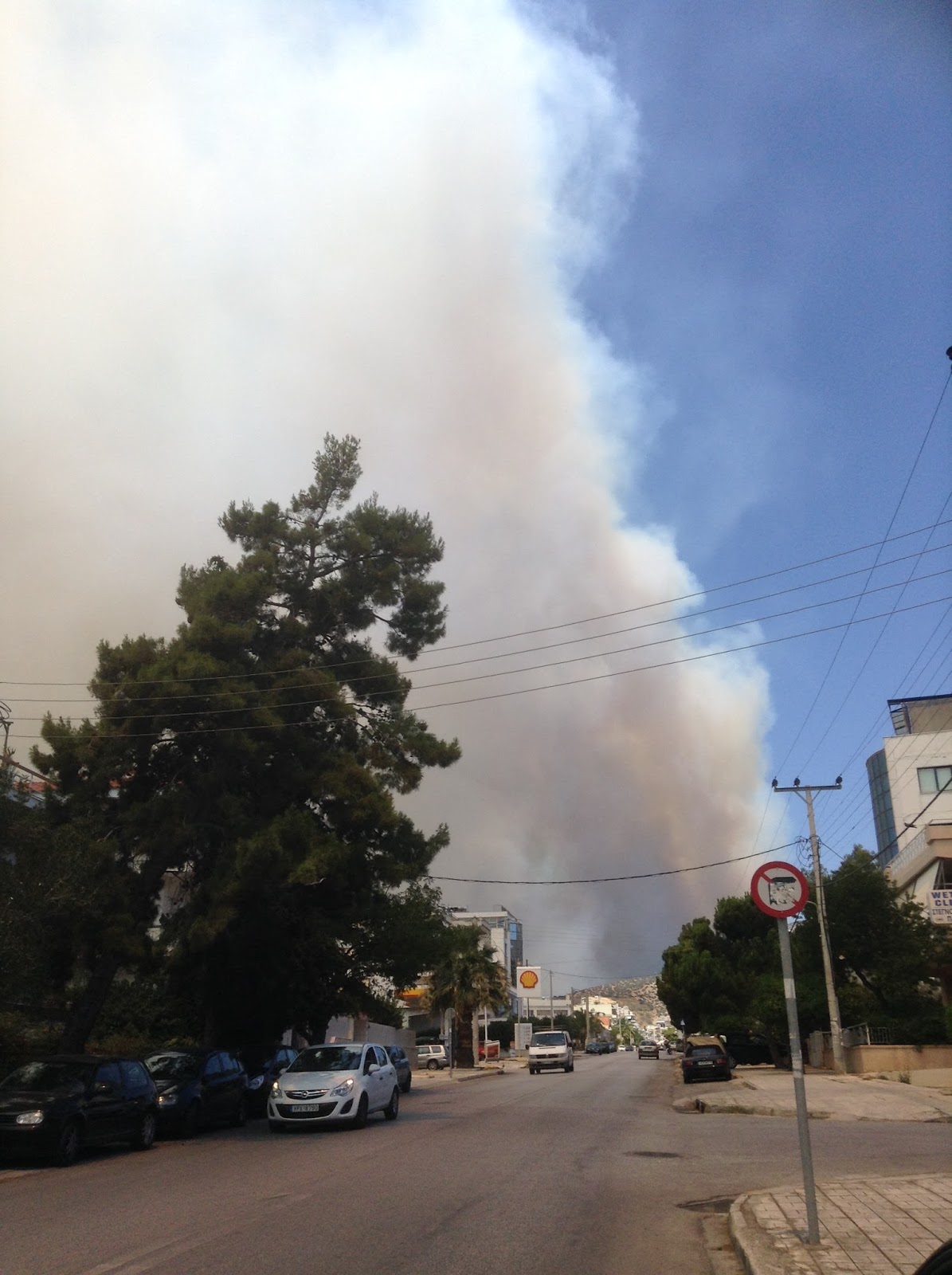
As we were driving back home this afternoon, our hearts sank. This is what we saw. A huge cloud over the Hymettus mountain, moving slowly towards the sea. Strong winds and high temperatures fanned the fire: we could not see the source, but we knew it was over Helioupolis, a district very near where we live.


Listening to the news when we got home, we found out that the fire was indeed in Helioupolis. A local playground has burnt to the ground and the flames have surrounded the local church.


We read on the online version of Kathimerini that 'wildfires burned through rural land on the island of Evia near Athens and in the region of Laconia in the Peloponnese where one fire-fighting aircraft was forced to make an emergency landing... State television reported the fire's front was over 15 km long and one health centre in the region was preparing to evacuate patients. A police source said a 58-year-died after inhaling fumes and suffering respiratory problems'.


Six hours after these photographs were taken by Elisabeth, we can still hear the fire-fighting helicopters droning over our flat, going back and forth as they fly to the sea to fill up with water.

How much more can this country take?


Update, two hours after originally posting:

There are 52 fires raging all over Greece. Experts are confirming that it's the work of arsonists.


Monday, 23 September 2013

Images of austerity


We went in search of art but found other things instead...

We are in Metaxourgheio intending to look at some of the exhibits of Remap4. Everything is very quiet and a lot of the places seem to be closed. We find a place that could be a likely venue. The door is open. Two young guys who are too stylish to be straight are coming down the narrow stairs so I think 'bingo'. We start climbing the stairs and I can see flashing lights, and anticipating a light installation, we reach the first floor. An empty room except for the flashing lights and some pictures on the walls - it's very dark so I cannot see what the pictures are. I take my camera out and start snapping. I then move towards the curtain that leads to the next room. I pull the curtain and see the Madam - don't know why she is a madam as I have not seen one before, but she is, I just know. No sex workers around, but I know what this  place is and my suspicions are confirmed when I ask the Madam if this is the place for Remap4 and she looks at me with incomprehension. 'Your search for art has led us to a brothel', says Ken as we go down the stairs.

This is the reality of the Metaxourheio district, where Remap4 is located.

Remap is an international contemporary art project, running from 8 September to the 31st. It is located in one of the most run down areas in the centre of Athens in an attempt at regeneration. I totally despair when I go there. We visited Remap3 two years ago, and I found the area so ravaged by austerity that I could not bring myself to do a post on it.

No art was appreciated this time, as I made a mistake about the opening hours, but here are some of the photographs of the area that I took.

Some are heart-breaking.


We started here, the Municipal Gallery which was moved to this location in 2010 as part of the attempt to regenerate the area. We looked at some of the works in their permanent collection, post will follow at some stage, but we are doing more than I can write about at the moment.


Avdi Square where the gallery is located.


The area is full of houses like this, derelict, abandoned


These posters were everywhere, connected to Remap4?


A row of abandoned houses, the leg sticking out from the first floor, related to Remap4, I presume.


Anger


The neon seen through the first floor window, part of Remap4 but we could not go in


Eloquent - since the advent of austerity drug abuse has rocketed:

Across Greece, the byproducts of six straight years of recession have been brutal and cruel. Depression, along with drug and alcohol abuse, has risen dramatically. Delinqency and crime have soared as Greece's social fabric has unravelled under the weight of austerity measures that have cut the income of ordinary Greeks by 40%. Prostitution - the easiest way of financing drug addiction - has similarly skyrocketed.

The drug of preference for thousands of homeless Greeks forced on to the streets by poverty and despair, shisha is described by both addicts and officials as a variant of crystal meth whose potential to send users into a state of mindless violence is underpinned by the substances with which the synthetic drug is frequently mixed: battery acid, engine oil and even shampoo.

In a climate of pervasive uncertainty - where suicides have also shot up and the spread of HIV infections has assumed epidemic proportions - drug addicts (a population believed to be around 25,000 strong), have become increasingly self-destructive. (The Guardian).


The whole area is like this


Empty streets


except for the odd passerby and people squatting on the ground, with nothing to do


or just hanging around - I don't need to spell out what these men are doing...


But Athens is a city of strong contrasts these days


An interesting building: the modern build at the back, while the front of the old house has been preserved, serving as the enclosure for the front garden.


Step 1: Wake up. They are scared of your power
Step 2: All your fears stem from Television


Finally, a Remap4 exhibit that we could access: 'Dialogue', a set of 5 murals that communicate with one another, depicting, fear, anger, jealousy, lust and hate.


I am tormented - this is literally all over Athens, voicing what large parts of the population are experiencing


A familiar picture in Athens these days - too familiar. People going through the rubbish to find anything that they can either personally use, or sell.

Seeing people going through our rubbish every day, we are now careful about what we put out - anything that could be of any possible use to someone we now put in separate carrier bags and leave next to the rubbish bins so that when they take it it's at least not soiled by the rubbish. Normally such carrier bags are gone within minutes.


Graffiti and street art everywhere


total desolation.


And now we have left Metaxourgheio, and have entered Gazi where regeneration was successfully accomplished before the economic crisis hit the city. This is one of my favourite buildings


modern, sculptural.


One more photograph.


This is Athens today. A city ravaged by austerity, suffering, tormented, hungry, its people sleeping in the streets - a city of contrasts where the rich are doing very well sitting alongside a mass of people who are on their knees. And, the poorer large sections of the population become, the richer the few... A city of contrasts.