Showing posts with label music. Show all posts

Wednesday, 5 January 2022

The recording of Ghost Town by the Specials


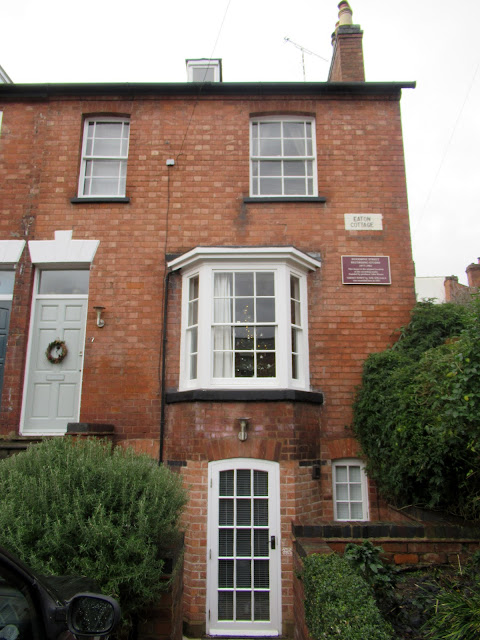
A Special Interest Plaque was unveiled recently in a small Victorian house in Leamington. The Coventry-based two-tone and ska revival band The Specials recorded their UK no. 1 song Ghost Town at 27 Woodbine Street, the original location of the Woodbine Street Recording Studio in 1981.


In 1973, John Rivers bought the house because 'it was the cheapest house in Leamington'. It had all the problems of old houses, but it also had a redeeming feature,  a cold, dark, damp and windowless cellar. Rivers bought an old Sony valve tape recorder and started recording musician friends in the front room of his new house. His growing reputation led to more ambitious recordings with even more musicians. In 1975 he bought a 4-track tape machine to improve the quality of his recordings. The problem was that the front room was too small to cope with the increasing number of musicians and the complexity of John's recordings. He consequently converted the windowless cellar into a recording studio. The new studio was incredibly successful with many new artists recording there, including The Shapes, Swell Maps and Eyeless in Gaza.

Most groups recorded playing live, squashed together in the studio's tiny space. However, this was not possible in the case of the most famous group, The Specials, as it was impossible for all seven members of the group to perform together, so each was recorded separately in the studio. The result was Ghost Town - 'one of the most evocative and provocative singles of all time and a graphic depiction of the inner city-deprivation and urban unrest prevalent throughout the UK in the early 1980s'.

Horace Panter, bass player in The Specials, who attended the unveiling said: 'The Specials recorded one of the most iconic pieces of 20th century pop music in a studio in the basement of a small Victorian house in Leamington. It was not only a snub to the unnecessary extravagance of the music industry, but a homage to the music that influenced us'.

Ghost Town was the Specials' most successful single ever, spending three weeks at No. 1 in July 1981. However, the ten day session in John's studio was the last time that The Specials would record together as they separated later that year.


At this point I would have liked to post the track of Ghost Town, but new blogger does not allow me to do that anymore.  

You can read more about 2 Tone  here


Monday, 8 February 2016

Oloi Ena, Fila me, with Stamatis Kraounakis


Oloi Ena, Fila Me (All for One, Kiss Me), Stamatis Kraounakis


at the Michalis Cacoyannis Foundation.

The non-profit foundation was set up by Cakoyannis himself in 2003 with the aim of supporting, preserving and promoting the arts of theatre and cinema.


Anthony Quinn and Alan Bates in Zorba the Greek

A Greek Cypriot filmmaker, Cacoyannis is best known for his 1964 film Zorba the Greek, a film that celebrated joie de vivre and which had an underlying pessimism and the echo of a Greek tragedy.


He made 15 feature films which included Trojan women with Katherine Hepburn, Vanessa Redgrave and Irini Papas. He was however primarily interested in the theatre where he not only directed, but also wrote, designed costumes, produced and translated dozens of plays.  He also directed opera productions in many of the world's great opera houses. He was devoted to Greek classical drama and directed many of Euripides' plays for the cinema and theatre.

During the six years of the military junta in Greece he went into voluntary exile: 'I could not have stayed in Greece, I would have ended up in prison because I speak up', he explained.


He died at the age of 90 in a non-cemetery burial, in the courtyard of the Foundation


his grave is behind this sculpture.


Stamatis Kraounakis is a music composer, music producer, lyricist, writer and director.


We thoroughly enjoyed the concert which featured a lot of Kraounakis' songs. The performance also incorporated his innovative technique of using songs as theatrical dialogue and the singers as heroes of fictional tales.


The backdrop to the stage was a series of paper carrier bags suspended from the ceiling which looked fantastic as the lighting changed and the shadows flickered on the wall.


Sunday, 2 August 2015

Mikis Theodorakis - Songs of resistance


As promised in my previous post here are four songs by Mikis Theodorakis.


To Gelasto Pedi (The laughing boy)


Written in honour of Irish revolutionary hero Michael Collins, this song has come to stand for various resistance figures in Greek history. It was linked with Sotiris Petroulas who was killed, aged 22, when police attacked demonstrators in July 1965. Since Kosta Gavras's film Z about the assassination of MP Grigoris Lambrakis, the song has been identified with Lambrakis.  It's very popular and one of the most recognised songs in contemporary Greece.


T'was on an August morning, all in the dawning hours,
I went to take the warming air, all in the Month of Flowers,
And there I saw a maiden, and mournful was her cry,
'Ah what will mend my broken heart, I've lost my Laughing Boy.
So strong, so wild and brave he was, I'll mourn his loss too sore,
When thinking that I'll hear the laugh or springing step no more.
Ah, curse the times and sad the loss my heart to crucify,
That an Irish son with a rebel gun shot down my Laughing Boy.
Oh had he died by Pearse's side or in the GPO,
Killed by an English bullet from the rifle of the foe,
Or forcibly fed with Ashe lay dead in the dungeons of Mountjoy,
I'd have cried with pride for the way he died, my own dear Laughing Boy.
My princely love, can ageless love do more than tell to you,
Go raibh maith agat for all you tried to do,
For all you did, and would have done, my enemies to destroy,
I'll mourn your name and praise your fame, forever, my Laughing Boy.

It was on an August morning, all in the morning hours,
I went to take the warming air all in the month of flowers.


The Slaughterhouse


The beatings have started in the office
I count the beatings, the blood I count
I am being fattened up, shut in a slaughterhouse
today you, tomorrow me.

In the evening they are beating up Andreas in the terrace
I count the beatings, the pain I count
behind the wall we will be together again

Tap tap from you, tap tap from me
Which, in this mute language, means
I am holding strong, I am holding on

In our hearts the festival begins
tap tap from you, tap tap from me.

Our slaughterhouse has started smelling of thyme
and our cell of red sky

(music and lyrics by M. Theodorakis)

This song is about the notorious headquarters of the security police at Bouboulinas Street in Athens where torture of political prisoners was an everyday occurrence. Theodorakis was in solitary confinement for 60 days there. He joined a hunger strike but fell unconscious and was taken to Averoff prison hospital with an internal abscess.

'I heard the cries of men undergoing torture. I saw comrades who had been so badly tortured with the falanga (beating of the soles of the feet) that they could not walk. In the Averoff prison hospital I saw men who had had the bones in their feet broken by the severity of the torture. I was a man called Petropoulos, a member of the Lambrakis Youth Movement (which Theodorakis founded) with the bones in his feet broken in this way and with no nails left in his toes' says Theodorakis, recalling these awful days.  (from the Guardian )


O Antonis (from the Mautsausen album)


The lyrics are by Iakovos Kabanellis who was incarcerated in the Mauthausen Nazi concentration camp for four years.


Asma Asmaton (The Song of Songs)

Another song from the Mauthausen album.


Oh! How beautiful my beloved is
With her care in her daily dress
And with the comb in her hair.
No-one knew she's so beautiful.

Maidens from Auschwitz,
Maidens from Dachau,
Have you seen my love, perchance?

We saw her on her long journey.
She no longer wore her dress
Not the comb in her hair.

Oh! How beautiful my beloved is
Pampered by her loving mother,
And her brother's kisses.
No-one knew that she's so beautiful.

Maidens from Mathausen,
Maidens from Belsen,
Have you seen my love, perchance?

We saw her standing in the frozen courtyard,
With a number on her white arm,
And a yellow star over her heart.


Friday, 31 July 2015

Mikis Theodorakis: music and a life of political struggle


Thousands flocked to the Megaron Mousikis, the Music Hall, on the 29th of August to celebrate the 90th birthday of Mikis Theodorakis.


We were early, and yet, the streets around the Megaron were packed. It took us quite a while to get to the garden where the concert was to take place


The garden is made up of a series of 'rooms' so it was impossible to see the whole crowd


which was so tightly packed that we could not see the stage - but the sound was good.


Theodorakis is much more than Greece's favourite composer. He has become a symbol of modern Greece, and the most beloved Greek public figure. His life mirrors the history of Greece in the 20th century and his life-long struggle for freedom, equality and justice epitomises the struggle of the Greek people.


Born on the island of Chios in 1925, he knew from very early on that he was going to become a composer. His political involvement started very early too. He fought during WWII and was captured in Tripoli. He was tortured and when he was set free he joined the partisan army of Greece, EAM, the National Liberation Movement, and took part in the civil war during 1945-49. Arrested, he was exiled on the island of Ikaria in 1947 and was then transferred to the island of Makronisos in 1948 where he was tortured again and barely survived. When he was released he moved to Paris to continue with his studies in music.  He composed continuously.


After Lambrakis, an MP, was murdered, Theodorakis himself became an MP. During this time he wrote the score for Kostas Gavras' film Z, which is about the assassination of Lambrakis.


In 1967 when the junta seized power, Theodorakis founded the underground movement 'Patriotic Front'. He was arrested and held in a prison camp in Oropos. Following an international outcry he was released and exiled once more, abroad this time. His music was banned in Greece but people listened to it nevertheless, and it became an anthem of resistance. Meanwhile, while in exile in Europe, he called for resistance to the military dictatorship and for the restoration of democracy in Greece. Maria Farantouri, one of the artists who performed his songs and who was also in exile, has this to say about that time: 'during the military dictatorship in Greece and just before it, I started singing with Mikis and all of our songs had to do with social justice, peace, solidarity and humanity'.

Immediately after the fall of the junta, Theodorakis returned to Greece as a politician in 1974. At that time his compositional work focussed mainly on numerous large-scale song cycles, including Epitaphios, Epiphania, The Hostage, Zorba the Greek, Romiossini, Songs of the Struggle, March of the Spirit, State of Siege, The Trojan Women,  Axion Esti,


Mauthausen (about the Nazi concentration camp)


and Canto General (poetry by Pablo Neruda).
 
He has put to music the work of leading poets, such as Odysseas Elytis, Pablo Neruda, Brendan Behan, Federico Garcia Lorca, George Seferis and Yannis Ritsos. He has composed the national anthem of Palestine. He has become a symbol of resistance proving that music has no borders. Throughout his life, he has remained true to his principles, has never compromised and has fought during Greece's darkest and most difficult times always hoping for a brighter future. No wonder he is such a loved and respected figure in Greek public life.


Theodorakis has composed over 1000 songs. His repertoire also includes operas, film scores and symphony music. Orestia, Missa Greca, Canto Olympico, Medea, Elektra and Antigone are some examples of his work after the 1970s.
 
His political involvement has never wavered. The last demonstration he participated in was on February 12, 2012 along with Manolis Glezos, a Syriza MP and the guy who at 19, during the Nazi occupation of Greece, took the swastika down from the Acropolis and raised the Greek flag. 'Glezos was walking, I was in a wheelchair. It was a rally against austerity, which was what pushed us into the present misery. Then the police threw tear gas and I got some in the face because I had stood up to see and I fell back in the wheelchair. Some young people tried to help me and they put a gas mask on my face, but it was too late. My lungs suffered great damage and I had to stay in bed for weeks. I'm not the young Mikis anymore'. He is still suffering from the after effects of that 'encounter' with the chemicals.


Recently, he called on Alexis Tsipras not to follow in the steps of his predecessors and sign another damaging agreement with the creditors. 'Europe is ruled by money. To me it looks like a giant spider and those who are trapped in its web are lost.... The government's predecessors signed everything away. They sold the family silver... Now it's up to Alexis Tsipras to take it back. I hope he won't go in the same direction his predecessors did'.

Yesterday, the day after the concert, Theodorakis and other public figures have signed a letter asking for the third bailout agreement to be reversed in line with the wishes of the Greek people who voted an overwhelming OXI to a new memorandum.


The concert was disappointing. It was bland. The rich political life and activism of the composer, the things that mostly define him, were not mentioned and the singing was mediocre and did absolutely no justice to the richness and complexity of the music. Even though it was good to hear some of the favourites we cringed at how badly they were performed, and in fact, we left before the end.

I will post some of my favourites in the next post, as this post is already too long.


There were celebrations in other parts of Greece too. In Hania, Crete, thousands of people formed a human chain in the area of the Old Harbour and danced to the music of Zorba the Greek. (Image taken from here )


Thursday, 25 September 2014

Jazz at the Numismatic Museum


An evening of listening to Jazz in the garden of the Numismatic Museum in Athens.

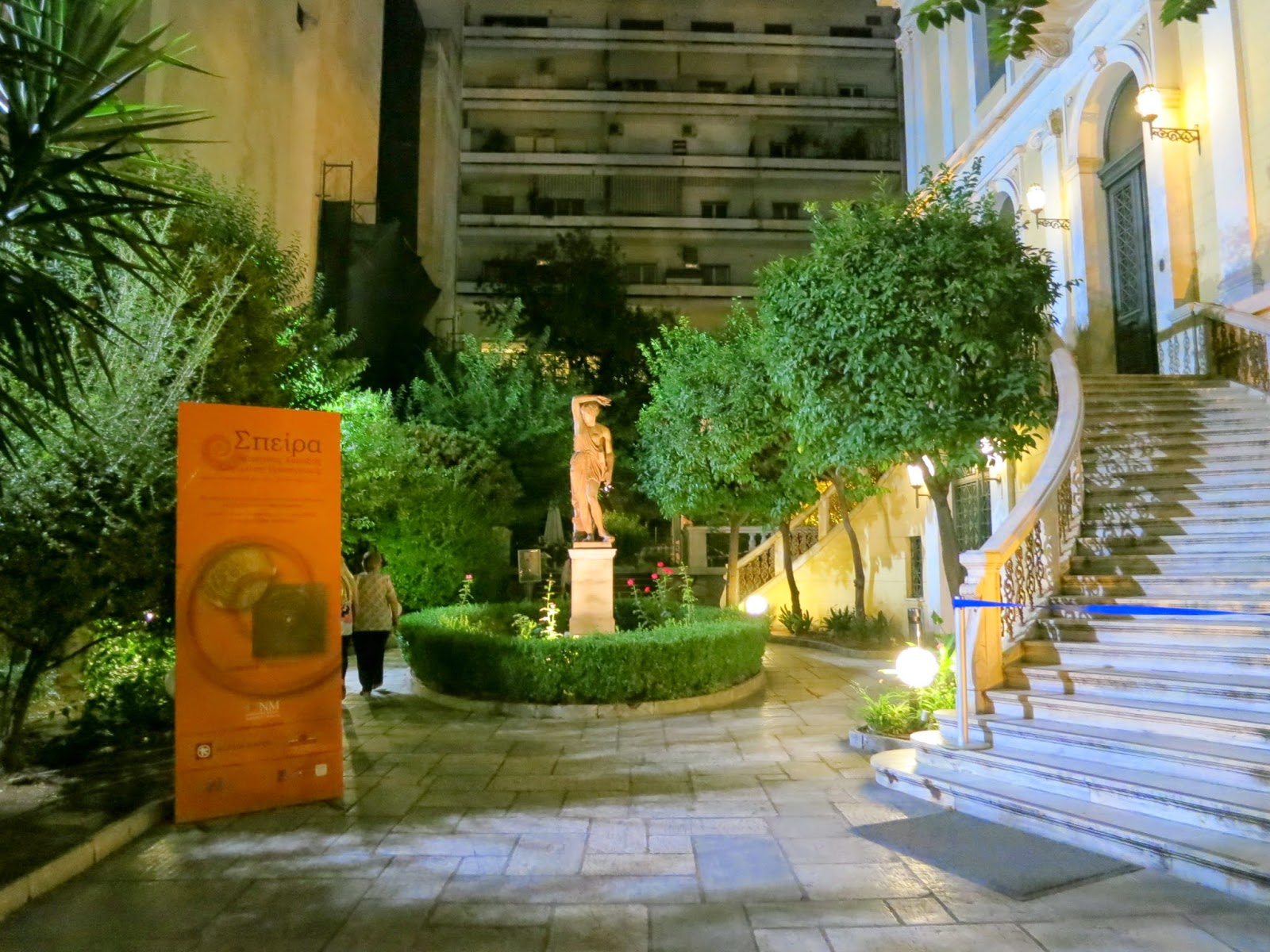
Every Thursday night is jazz night in the garden of the Numismatic Museum. The garden is delightful, and the building is imposing.


The museum is housed at the Iliou Melathron, a three-storey building on Panepistimiou Street in the centre of Athens.


It was built  by Ernst Ziller between 1878 and 1880 for Heinrich Schliemann the archaeologist. At the time of its completion, it was considered to be the most magnificent private residence in Athens. Its design was inspired by the Renaissance Revival movement as well as Neoclassicism, while the interior is influenced by the architecture of Pompeii. As a result, and appropriately, the rooms are decorated with mosaics and murals depicting either themes from the Trojan War or Greek mottos.


The concert was due to start at 9:00 but we arrived earlier than that as we wanted to get something to eat.


The grand staircase on our right


which leads to the main entrance of the building


looking up


a closer look at that statue


all very grand


the back (!) entrance


more sculpture in the garden


the musicians performed by the back entrance and the whole place was packed


zooming in on the singer and the band


It was a great evening and as we were leaving


I was able to have a more leisurely look at the entrance gates


looking closer


detail.


Tuesday, 24 September 2013

Maria Farantouri - 50 years


Maria Farantouri - 50 years,  at Irodou Attikou Theatre.

A concert to commemorate 50 years of Farantouri's singing career. A lot of old favourites, written by Mikis Theodorakis, Manos Hatzidakis, Manos Loizos.

Dionysis Savvopoulos appeared as a guest and sang a few songs with Maria.

The whole evening was extremely pleasurable, but also very moving.


The first part of the concert was the best, as all of the music was by Theodorakis, and not only is he my favourite composer, but I also think that Farantouri's voice is best suited to his music - but we loved all of it.


Antonito el Camborio, from Romancero Gitano, lyrics by Federico Garcia Lorca, music Mikis Theodorakis.


The ancient Roman theatre, a majestic setting.


Sou Eipan Psemata and To Sfageio, from Andreas' Songs, music Mikis Theodorakis


Theodorakis was in the audience, sitting here in a special chair, wearing a white jacket. At one point his picture was projected on to the walls and a recording of his voice told the story of how he and Maria met. He had been to a concert where school students were singing. He was very impressed with one 16-year old who sang Kaimos by Manos Loizos. When the concert finished he asked who that young student was and she was brought forward to meet him. He said to her; 'You were born to sing my songs'. and her reply was: 'I know'. This was the beginning of a 50-year collaboration that has brought so much pleasure to so many people.


But it's not just pleasure that the collaboration between these two musicians has given us. They gave us hope, courage and strength during the dark times of the military junta, where life seemed hopeless. I wrote at length about this when I posted on a concert I went to last year, which you can see here .


T'oneiro Kapnos, lyrics by Nikos Gatsos, music Mikis Theodorakis


I love what they do with the lights!


It is very impressive.


Maria, wearing blue, at the front of the stage.


A last look at the Acropolis on our way home.