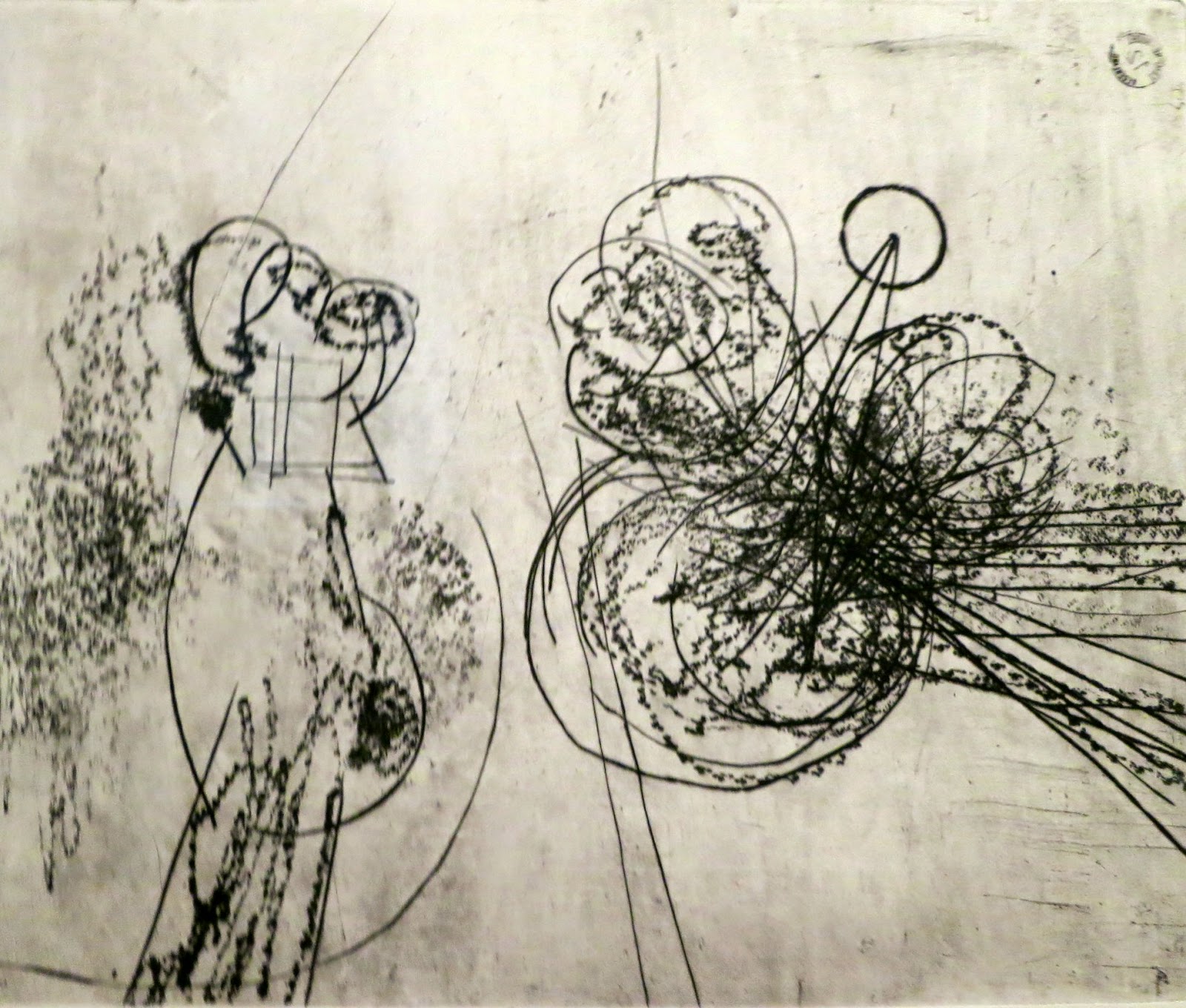
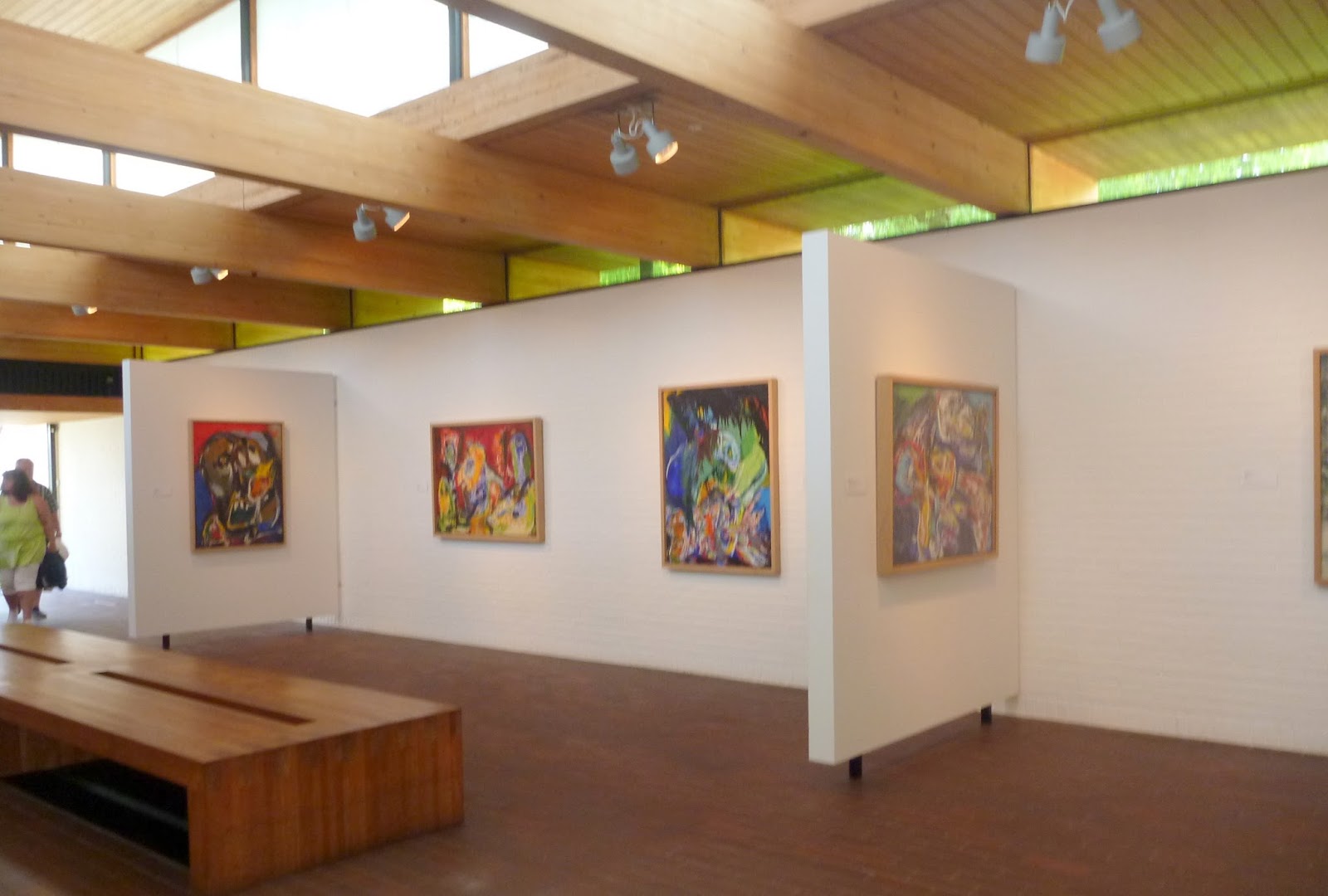
CoBrA was an avant-garde movement active from 1948 to 1951, its name coined from the initials of the members' home cities: Copenhagen, Brussels and Amsterdam. It was formed by Karel Appel, Constant, Corneille and Asger Jorn. Drawing inspiration from primitive art forms and from the work of Paul Klee and Joan Miro, they had an antipathy towards Surrealism and shared an interest in Marxism and modernism. Freedom of colour and form, as well as spontaneity and experiment were their main preoccupations. The primary focus of the group consisted of semi-abstract paintings with brilliant colour, violent brushwork and distorted human figures, sharing similarities with American action painting - they were a milestone in the development of European abstract expressionism.
At the Stedelijk Museum:

Karel Appel, Man and Animals, 1949, (paint on canvas)
Cheerful and outlandish human and animal figures, consisting of vast areas of vivid colour accented by bold contour lines - the work gives the impression of being spontaneous.
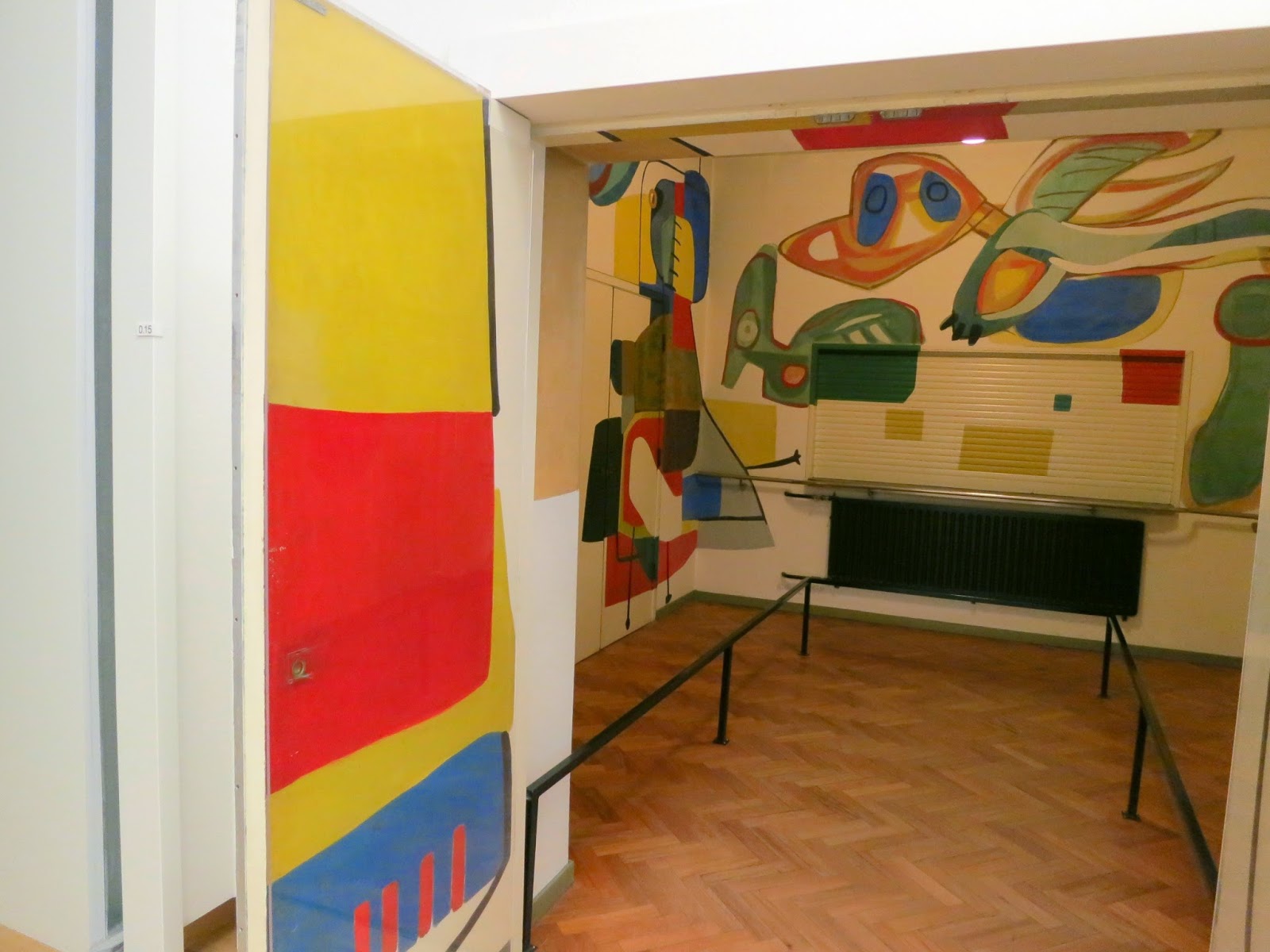
A small space painted by Karel Appel in the museum

a different view

the signature bright colours of the group

one more view

Karel Appel, Questioning Children, 1949, (wood, paint)
In the aftermath of WWII, while traveling through Germany on his way to Copenhagen to visit fellow artists, Kael Appel was deeply moved by the faces of the children he saw begging for food on railway platforms. As a result he produced a series of paintings on the theme of 'questioning children'.


Anton Rooskens, Composition in Black, 1955 (oil on canvas)

Constant, Barricade, 1949 (paint on canvas)
With the naively rendered half-moon and peculiar creatures, this painting resembles the work of a child. The flat, two-dimensional nature of the scene is typical of the CoBrA style, yet the fists, grimaces and the title of the work suggest markedly political overtones. The militant suggestion of Barricade hints at Constant's Marxist-inspired views of art. The artist believed that art should be a plea for freedom and human emancipation. He felt that CoBrA should do more than simply breach artistic conventions; the movement should also play an active role in shaping a new society.

Asger Jorn, In the Wingbeat of the Swans, 1963, (oil on canvas)
Jorn shifts between figuration and abstraction in this painting. Two figures can be discerned beneath red-tinged skies on a typically hilly Scandinavian Landscape. The bright
At the Rijksmuseum:

Karel Appel, The Meeting, 1952, (oil on canvas)
Taking shape in the jumble of coloured lines are the figures characteristic of Karel Appel's work: children with large eyes and imaginary creatures with beaked snouts. In this painting they 'meet' one another: nothing else is actually going on. The picture is about an artist's delight in painting and the freedom to conjure up wondrous new worlds with paint alone.

Karel Appel, The Square Man, 1951, (oil on canvas)
This male figure with a fierce gaze just barely fits into the almost square picture plane. Its head is about as large as its body. The composition is built up of flat planes and lines, which are intersected by a spine cutting through the body. Its arms spread wide apart and genitals boldly exposed, this colourful character forces itself on everyone.

In 1950 Appel visited Psychopathological Art, an exhibition of works of art made by patients undergoing therapy, which was on view in the psychiatric hospital of Paris. The accompanying brochure was not illustrated, so Appel decided to add illustrations himself. He drew and painted over the text of the brochure, deriving inspiration from the psychiatric patient's uninhibited powers of imagination.
* * *
For the artists of the CoBrA group the art of psychiatric patients was an important source of inspiration. In their work, these artists tried to achieve the same creative freedom and uninhibited expressiveness. The drawings below originated from the time Appel visited the Psychopathological Art exhibition.


* * *