Showing posts with label Russian avant-garde. Show all posts

Sunday, 11 October 2020

Light - Stephen Antonakos


Stephen Antonakos - Light, Stephen Antonakos and the Russian Avant- Garde.


At MOMus, Athens.

There are great roads that can be explored and bear fruit from the study of the relationship between the works of Russian pioneers and the specific and abstract geometry that I use in a variety of media, in my works',  wrote Antonakos in 2012.

In the early 1960s neon became Antonakos' primary medium. His art is based on light, scale, proportions, and the relations between geometric forms and their overall relation to their site. It has nothing to do with neon's previous uses, only with its new capabilities as purely abstract linear and spatial colour.


Beyond the obvious affinities with the constructivist geometry, light is another very essential component both in the work of Antonakos and in that of may artists of the Russian avant-garde. Mikhail Laionov, Ivan Kilum, Kazimir Malevich, Ivan Kudriashov and many others gave their works titles inspired by light, like Rayionism, Luminism, Electro-organism and developed a number of theories about the movement of rays and the characteristics of glow and glare stressing out that light is such an important element of painting.


Entrance, 1996, (construction with neon, wood, aluminium)


St Christopher, 1992, (colour on metal, neon)


Kazimir Malevich, Untitled, 1920, (lithograph on paper)


Nadezhda Udatsova, Untitled, 1916-17, (gouache on paper)


Stephen Antonakos


Wednesday, 11 July 2018

A few gems from the Albertina


A few gems from the Albertina, Vienna.


Natan Altman, Portrait of the Poet Anna Akhmatova, 1914


Natan Altman, Petrocommune, 1921

I had never come across Altman's work before and am extremely pleased to have discovered him. Only seven years separate the two works above, yet stylistically and in their worldview and ideology they are worlds apart. It is almost as if they were not by the same hand, as if they dated from different centuries: in one, the elegant, bourgeois 19th century, and in the other, the century that swept away  three centuries of tsarist rule. Taking the place of the elegant fin-de-siècle realism is the Suprematist construction, permeated by propaganda for the state of the future.

Whereas he presents himself as a classical portraitist adopting the techniques of  Cubo-Futurism with his Portrait of the Poet Anna Akhmatova, he demonstrates themes and an artistic language consistent with the new era in his work from the early 1920s. In Petrocommune there is a concentration of images and ideas connected with a single concept: the formation of a new state. The use of the elements of the circle and the rectangle is his tribute to Suprematism, proclaimed by Malevich in the 1910s.


Natan Altman, Portrait of a Young Jew (Self-Portrait), 1916

 In the search of forms of new expression, experiments with new materials, and the discovery of new artistic media during those revolutionary times, did not affect the artists' interest in such traditional genres as the portrait. What had changed was the use of unusual materials and their completely novel combination. In this sculpture Altman teamed plaster and copper with wood.


Beatrice Sandomirskaya, Composite Portrait, 1929


Sandomirskaya created a sculpture in the spirit of Cubism, with the head reduced to a few geometric shapes juxtaposing  contrasting surface textures of sheet metal and wood.


Wladimir Lebedew, Cubism: Washerwoman, 1922


Kasimir Malewitsch, Portrait of the Artist's Wife, 1933


Sunday, 22 April 2018

From Monet to Picasso - 2


From Monet to Picasso 


at the Albertina, Vienna.

Continuing with this amazing collection of classics of the 20th century, collected by two people, the Batliners.


Herbert Boeckl, Portrait of M.B., 1919

'The artist places some spot onto the canvas and then unconsciously gives it an essential shape. [He] doesn't know what this spot means. [He] adds a second, a third, and a fourth spot. [He] still doesn't know for a long time what it will be, yet [he] instinctively senses early on what the shape requires'. This painting is composed of large spots of colour, which, through the black contours, eventually took the shape of a human figure.


Franz Sedlacek, Evening Landscape, 1933


Franz Sedlacek, Mountain Landscape with Automobile, 1931


Josef Floch, Interior with a Black Folding Screen, 1947


Max Beckmann, Woman with Cat, 1942


In this painting Beckmann describes an existential situation - one he and Quappi, his wife, must repeatedly have experienced in their Amsterdam exile: an enforced leisure is evoked by the narrow, unusual room, which frequently had to be darkened because of the danger of air raids. Only the sleeping cat and the flowers seem to introduce a relaxed and easy-going tone.


Rene Magritte, The Enchanted Domain, 1953


Paul Delvaux, Landscape with Lanterns, 1958

Like all of Delvaux's paintings this has a mysterious dream atmosphere. This particular one may be understood as a melancholic, retrospective glance at the past. In the centre appears a woman in black looking after a funeral cortege moving into the picture's depth. On a path lit by gaslights, two men carry a shroud-covered corpse towards a hilly landscape from which several ancient ruins rise up.


Pablo Picasso, The Playing Cards, 1912


Pablo Picasso, Woman in a Green Hat, 1947


Pablo Picasso, Still Life with Guitar, 1942


Pablo Picasso, Nun Persecuted by the Devil, 1945


Pablo Picasso, Nude Seated in a Chair, 1963


Pablo Picasso, Nude Woman with Bird and Flute Player, 1967


Pablo Picasso, Sylvette, 1954


Pablo Picasso, Earthenware Vase with Two Figures, 1959


Georges Braque, The Sideboard, 1920


Joan Miro, Birds and Insects, 1938


Francis Bacon, Seated Figure, 1960

Bacon displayed disfigured and decrepit bodies which radiate vitality and aggressiveness. In Seated Figure, the deformation of reality has been pushed to the limit. Enclosed within a narrow black case, a man in street clothes appears to be lashing about desperately. His face and hands are severely injured, if not maimed. In Bacon's art, distortion is carried as far as the dissolution of form and motif. His works are essentially metaphors of life based on the dialectics of growing and perishing, of life and death.


Yves Klein, Work: ANT 88, 1960


Alberto Giacometti, Four Women on a Plinth, 1950


Alberto Giacometti, Landscape, 1952


Alberto Giacometti, Portrait of Annette, 1958


Alberto Giacometti, Slender Bust on Plinth (Amenophis), 1954


Thursday, 15 October 2015

The Russian avant-garde, at the Museum of Modern Art, Stockholm


The Russian Avant-Garde, at the Museum of Modern Art, Stockholm.

Although the Russian avant-garde is not a homogeneous group of artists, they were all intent on expressing the revolutionary political changes and social developments that were taking place during the first three decades of the 20th century in Russia and the Soviet Union. They were inspired both by the latest trends in contemporary art of the West, such as Cubism and Italian Futurism, and by the folk art and icon painting of the East. Many of the artists, including Tatlin, Popova, Ekster and Rodchenko,  travelled to Paris, one of the key centres for the start of abstract art, where they studied and lived. The Futurists championed modern life; they worshipped the city and progress, speeding automobiles, electric light and constant movement. The world of the 'beautiful' machines also set its stamp on the work of Fernand Leger, who was a key source of inspiration for many of the Russian artists.


Following the October Revolution in 1917 the new radical art of the Soviet state was first supported and then suppressed in the ideological and political struggles of the period. The turning-point came the years before Lenin's death in 1924, and from 1934 Socialist Realism was the only art form endorsed by the state. The Russian Constructivists moved away from painting pictures after the October Revolution; they were opposed to the idea of art as something independent and autonomous. Modern Soviet society was to be fashioned using abstract forms and functional environments. In contrast with the situation in the art metropolises of Paris and Berlin, a large number of women artists formed part of the Russian avant-garde and they were on an equal footing with their male colleagues.

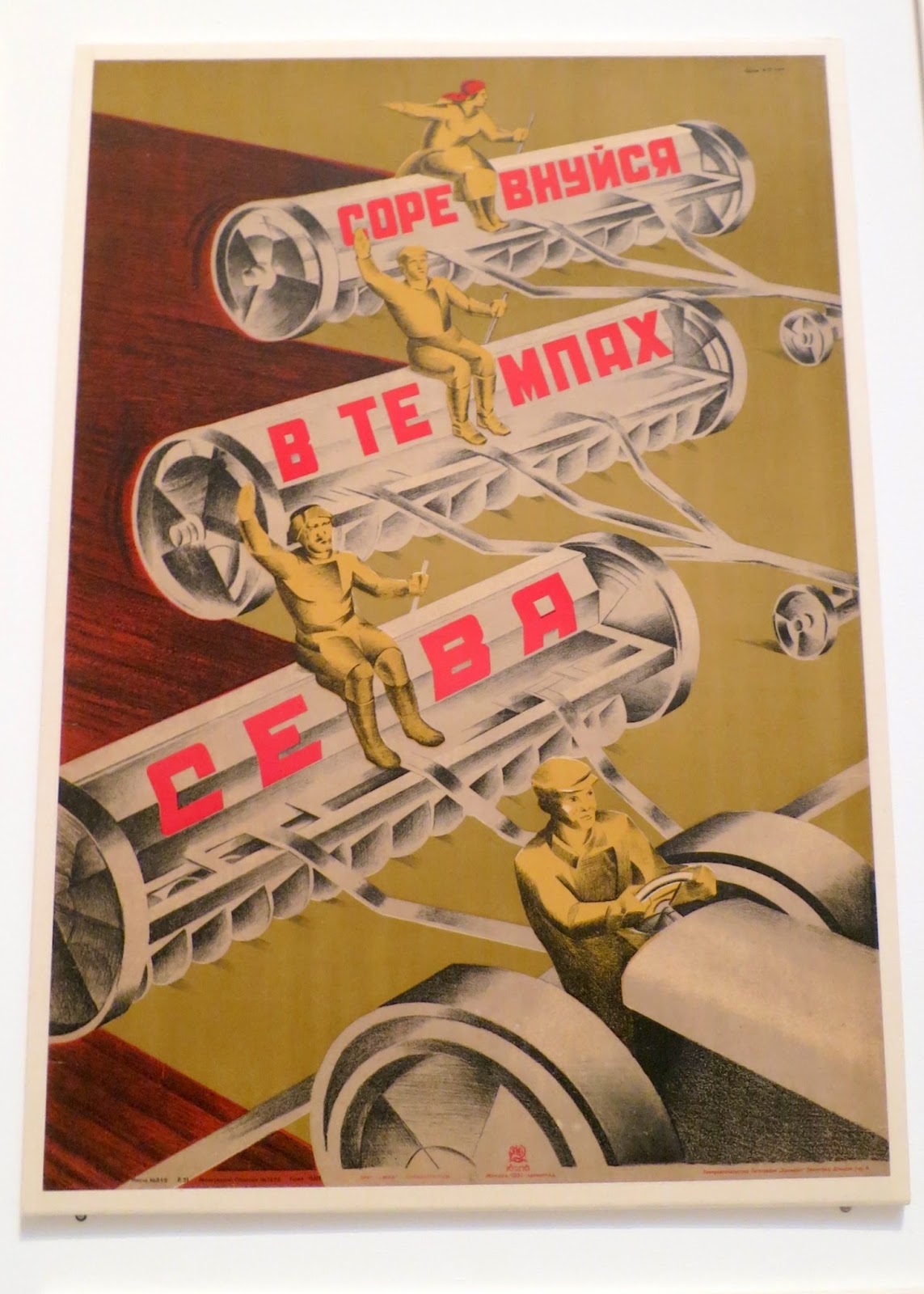
Until the death of Lenin and Stalin's takeover, the new Soviet state was the only country in which abstract art enjoyed official recognition. These artists were fascinated by the new media and experimented with the possibilities offered by photography and motion-picture film, which were closely associated with the modern city and the new society being constructed. The poster too, became a new form of expression and an important ideological instrument that many artists were keen to work with.


Vladimir Tatlin, Model for Monument for the 3rd International, 1919-1920/1968/1976

The architecture and utopian structure of the tower reflect the political vision of the Russian revolutionaries in the years immediately after the Bolshevik Revolution in 1917. The monument was supposed to be built with modern materials such as steel and glass. The geometric parts of the tower would house the administration headquarters of the International, and each part would rotate around its own axis at different speeds - the smaller the section, the faster it would spin. The monument, a synthesis of painting, sculpture and architecture, would have been taller than the Eiffel Tower. Several models were made in wood, but a full-scale version was never built.


Vladimir Tatlin, Reclining Nude, 1911-1913


Lioubov Popova, Space-Force Construction, 1921


Anna-Chaja Kagan, Syprematistische Komposition, 1922-1923


Alexandr Rodtjenko, Spatial Construction No. 9, Circle in a Circle, 1920-1921


Ivan Kljun, Composition with Yellow Sphere, 1921


Wassily Kandinsky, Green Split, 1925


Alesandr Rodtjenko, Spatial Construction No. 23, 1921


Vladimir Tatlin, Untitled, 1968


The museum has a considerable collection of Bolshevik posters and below are some of them: