Showing posts with label jugenstil. Show all posts

Monday, 16 May 2016

Secession


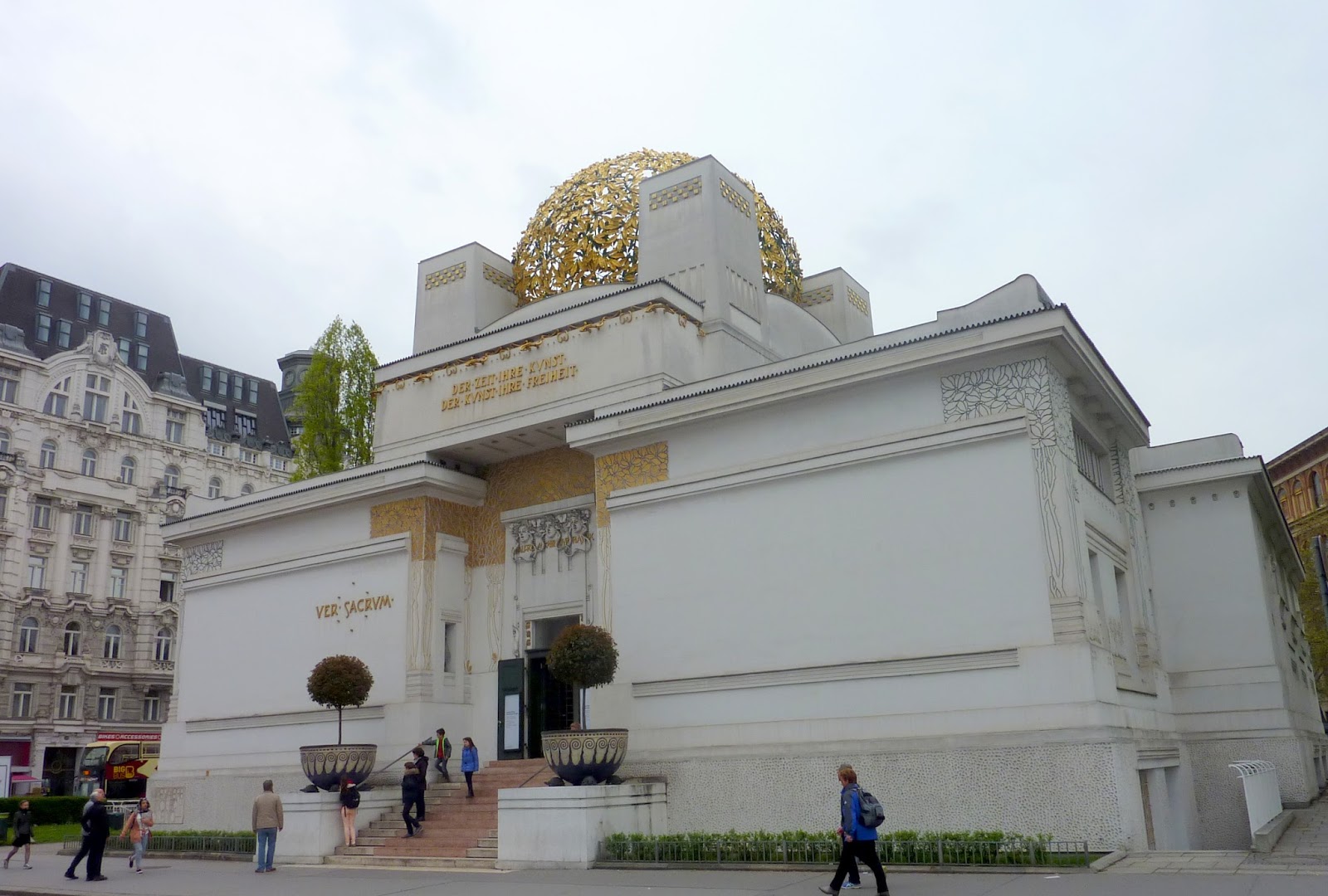
In 1897 a group of young artists headed by Gustav Klimt seceded from the Viennese Artists' Society to establish an association of their own: the Secession. When the founding members met on April 3, it was clear to them that above all they needed an exhibition building that would offer a suitable setting for the groundbreaking presentations of art they were planning. The foundation stone for the Secession was laid in April 1988. The building site on Linke Wienzeile had been provided free of charge by the Municipality of Vienna.


The architect Joseph Maria Olbrich designed the Secession as a 'Temple of Art'. While his plans show the influence of the buildings of his mentor and teacher Otto Wagner, they also refer to sketches made by Gustav Klimt. The building, which resembles a pavilion, is divided in two distinct parts: the ceremonial entrance hall and the exhibition rooms.


When the Secession first opened many critical voices were raised against its modern architecture. Epithets included 'an assault on good taste', 'a cross between a greenhouse and a blast furnace', 'a temple for bullfrogs', 'a bastard begot of temple and warehouse'. Today the building is widely regarded as one of the foremost works of the Viennese art nouveau style and its golden dome has become a Viennese landmark. The Secession has emerged as one of the best-known examples of European architecture at the turning point from historicism to modernism.


The gallery facades were decorated with frescoes by Koloman Moser and sculptural ornaments, some of which are still in place today. The floral elements adorning the walls resolve themselves into parts of a laurel bush with its upper branches joining to form a canopy. This articulates the 'return to the vital origin of art and culture' envisaged by the movement through the flowering of the 'ver sacrum' (sacred spring).


We walked around the outside of the building


detail


and then went in. Most of the building was closed to the public because they were mounting a new exhibition but we were able to view the entrance hall and one of the rooms that contains  the Klimt frescoes.


The foyer is minimalist, simple and austere.


Gustav Klimt's fresco, the Beethoven Frieze, takes its theme from Richard Wagner's interpretation of Beethoven's Ninth Symphony and depicts humankind's search for happiness.


To symbolise this yearning, Klimt chose floating genii who lead us into the story. This horizontal band is interrupted by one group of figures: a naked woman standing and a naked couple kneeling - symbols of suffering humanity - beg the knight in shining armour for help.


In the scene facing us as we enter the room, humanity must face the dangers and temptations of the 'Hostile Forces'. The giant Typhoeus, a hybrid monster with shaggy fur, blue wings, and a snake like body, extends across almost the entire wall, fixing the viewer with mother of pearl eyes. To his left stand his daughters, the three Gorgons, and above them, mask-like female heads stare out of the picture, allegorical representations of Sickness, Madness and Death. The women to the monster's right symbolise Lasciviousness, Wantonness and Intemperance, the latter identifiable by her large belly.


Slightly further to the right cowers the emaciated female figure of 'Gnawing Grief'. At the top right we see the head of a floating genie, that stands for humankind's wishes and desires overcoming the 'Hostile Forces'.


On the right-hand wall, humanity's yearning for happiness finds fulfilment in poetry, portrayed as a female figure with a lyre. This is followed by an empty section under which, in the original exhibition layout an opening gave a view of Klinger's Beethoven sculpture.


In the final scene, female figures symbolising the arts lead the way into the ideal realm of art.


Klimt's apotheosis of art consists of a kissing couple in front of the' Choir of Angels' referring directly to Beethoven.


In another small room we were able to see copies of Ver Sacrum, the official organ of the Association of Austrian artists. At their first general assembly on July 21, 1897, the founding members of the Vienna Secession resolved to produce their own art magazine in order to publicise their ideas about the integration of different media.

In the preface to the inaugural issue, titled 'Why we publish a magazine', the artists proclaimed: 'this magazine is meant to ... appeal to the population's artistic sensibility and stimulate, foster and spread creative engagement and creative independence'. Art, they argued, needed to become again what it once had been: a practice woven into the fabric of life.


The magazine featured contributions on the visual arts as well as works of avant-garde literature. Illustrations and typography, vignettes, margins, and selected original works of graphic art as well as the unusual almost square format made each issue a unique artefact. Ver Sacrum inspired generations of Austrian book designers.


Poster by Irma von Dutczynska


Friday, 22 April 2016

Stephansdom quarter in Vienna


We've just come back from Vienna having spent spent a week there. Even though I had been there before when I was twelve years old, I did not remember much so it was like visiting the city for the first time.

It's a very grand place, and evidence of Vienna's imperial past is everywhere: I have never seen so many lavish palaces in one small place before.


Large areas of the Innere Stadt, the centre of the city, are pedestrianised. St Stephen's Cathedral and the surrounding square, Stephansdom, sit right in the middle.


The Cathedral is one of the tallest religious buildings on the planet and you can see its spire from almost every corner of Vienna.

Most of the building that stands today, including the two large towers, dates from the 14th century when the church was reconstructed. The cathedral was badly damaged by the fire that spread through the Stephansdom Quarter in the chaos that followed the capture of the city by Soviet forces in 1945. Decades of painstaking restoration work have made the damage almost impossible to detect.

The towers are truly formidable. The South Tower rises 450 feet over Stephansplaz. During the Ottoman siege of Vienna, the tower served as the main observation and command post for the defence of the old walled city.

The glory of the cathedral is its ornately patterned, richly coloured roof, covered with 23,000 glazed tiles.

Ludwig van Beethoven discovered the totality of his deafness when he saw birds flying out of the bell tower as a result of the bells' tolling but could not hear the bells.


Unlike many other European cathedrals, the interior of St Stephen's was never scrubbed bare by Protestants.

The main part contains 18 altars, with more in the various chapels. The High Altar is the first focal point when entering, built over seven years from 16541 to 1647 as part of the first refurbishment of the cathedral in the baroque style.


Every one of its vast structural columns is decorated by life-size statues of biblical figures and saints; some are elaborately painted, while others have been carved from colourful and exotic stone.


Gold abounds


The entrance to the crypt and tombs which we did not visit.


The sheer scale of the interior space is overwhelming - these huge cast iron gates are the entrance to one of the chapels.


The buildings in this area are majestic


many of which are adorned with statues.


Different architectural styles sit comfortably next to each other


and because this is a shopping area and all the ground floors are taken up with shops, you have to keep looking up to see the details of the buildings.


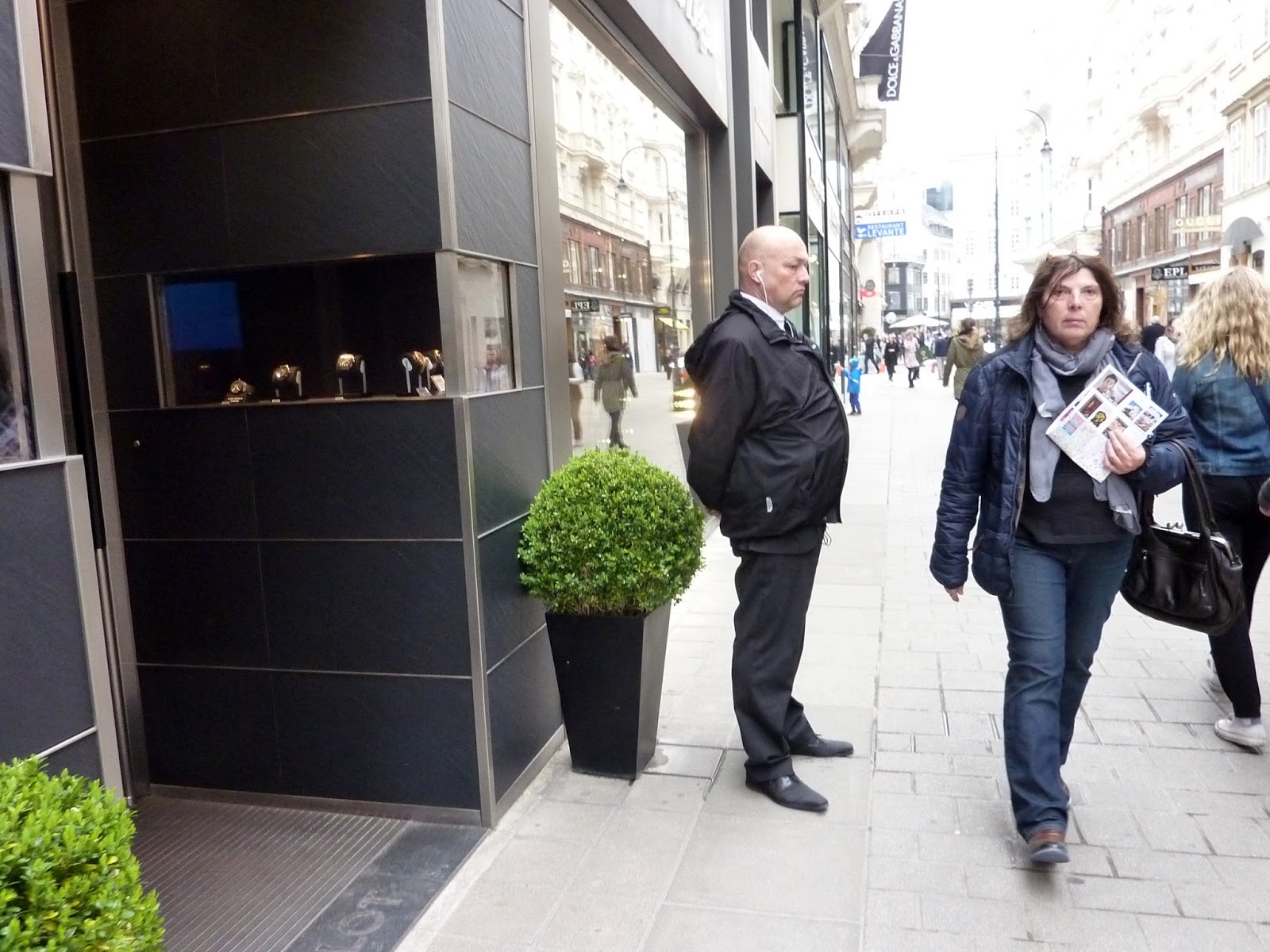
Quite a few of the exclusive shops have guards outside.


It's very busy here, even on a Sunday when the shops are closed, and one day we came across a group campaigning for freedom for Palestine, a cause that is very close to my heart


the displays were good and informative.


On Graben we came across these Jugenstil (the Austrian version of Art Nouveau)  public toilets


It is thought that they were designed by Adolf Loos, but some think that it was Wilhelm Beetz


I had to go in - the door gave a taste of what lay inside


dark, shining wood,


marble walls and elegant but simple lighting


bronze decoration.


By the public toilets, on Graben 16, is this Jugenstil building, designed by Pietro Palumbo


The corner of the building is rounded like a tower


and has mosaic reliefs by Leopold Forstner.


A closer look at the mosaic


The Plague Column is also on Graben. An 18 metre high gilded copper pyramid,  baroque in style, commemorating the bubonic plague epidemic of 1679.


Peterskirche, also on the Graben, was transferred in 1970 by the Archbishop of Vienna to the Opus Dei.

The oldest church building (of which nothing remains today) dates back to the early Middle ages. The construction of the new Baroque church was begun around 1701. The design was inspired by the St Peter's Basilica of the Vatican in Rome. The new church was the first domed structure in baroque Vienna.


The first impressions on entering the church are overwhelming due to its rich interior filled with golden stucco.


The baroque high altar was created by Antonio Galli Bibiena and Martino Altomonte.


The gilded ornate pulpit is a sculpture by Matthias Steinl with on top of the canopy a representation of the Holy Trinity.


Lots of pharmacies in the city, but this, on Bognergasse,  was our favourite


The mosaic of the two angels is typical of the period


great door, again typical of the period


while the interior dates before the turn of the last century.


This is a shopping area which is full of cafes and restaurants, with lots of seating outside for when the weather permits


Looking up is essential.


Chopin lived here


as the plaque testifies


detail.