Showing posts with label refugee crisis. Show all posts

Thursday, 22 February 2018

Face Forward ...


Face Forward ... 


at the Museum of Contemporary Art, (EMST) Athens.


Face Forward... is an ambitious and  thought-provoking, interactive art project focused on the stories of people who have been forced to leave their homelands and are rebuilding their life in Greece.  The project was proposed by EMST and supported by the UK Refugee Agency (UNHCR). Twenty refugees took part in the programme. As part of the project, the participants were introduced to artworks from the Museum's collection as incentives for discussion. Some were art lovers, some were being introduced to modern art for the first time. Through this process, a series of personal narratives emerged, all very different, but with a common need to communicate. The outcome of  many months of interaction and communication, as well as the refugees'  contact with works of art from the EMST collection, is this exhibition of photographic portraits and personal narratives.

The organisers wanted to move beyond the image of refugees' lives projected in the media as one of hardship, cruelty and despair. Instead, we are invited to see each refugee as an individual, full of  hopes for their future.  The aim is to cultivate solidarity, acceptance and social cohesion. Furthermore, the notion put forward by Alma Wittlin in 1970 that 'museums are not islands in space, but have to be considered in the context of life outside their walls', was at the centre of this project.


There were a number of school groups visiting the exhibition when we were there. I listened in on this particular group for a while: having looked at the exhibition, each member had to 'introduce' one of the refugees featured in the photographs and catalogue, detailing their life in their home country, their voyage to Greece, and their hopes and aspirations.

This is an ambitious project and one that I found fascinating and extremely touching. I also found the idea of using art as triggers for discussion an excellent one.


The art works:


Janine Anton, Slumber, 1994, (maple loom, wool yarn, bed, nightgown, blanket, artist's REM reading on computer paper, REM decoder)


Kostis Velonis, Swedish Flying Carpet, 2001, (wood, fringe)


Bill Viola, The Raft, 2004, (video, sound installation)
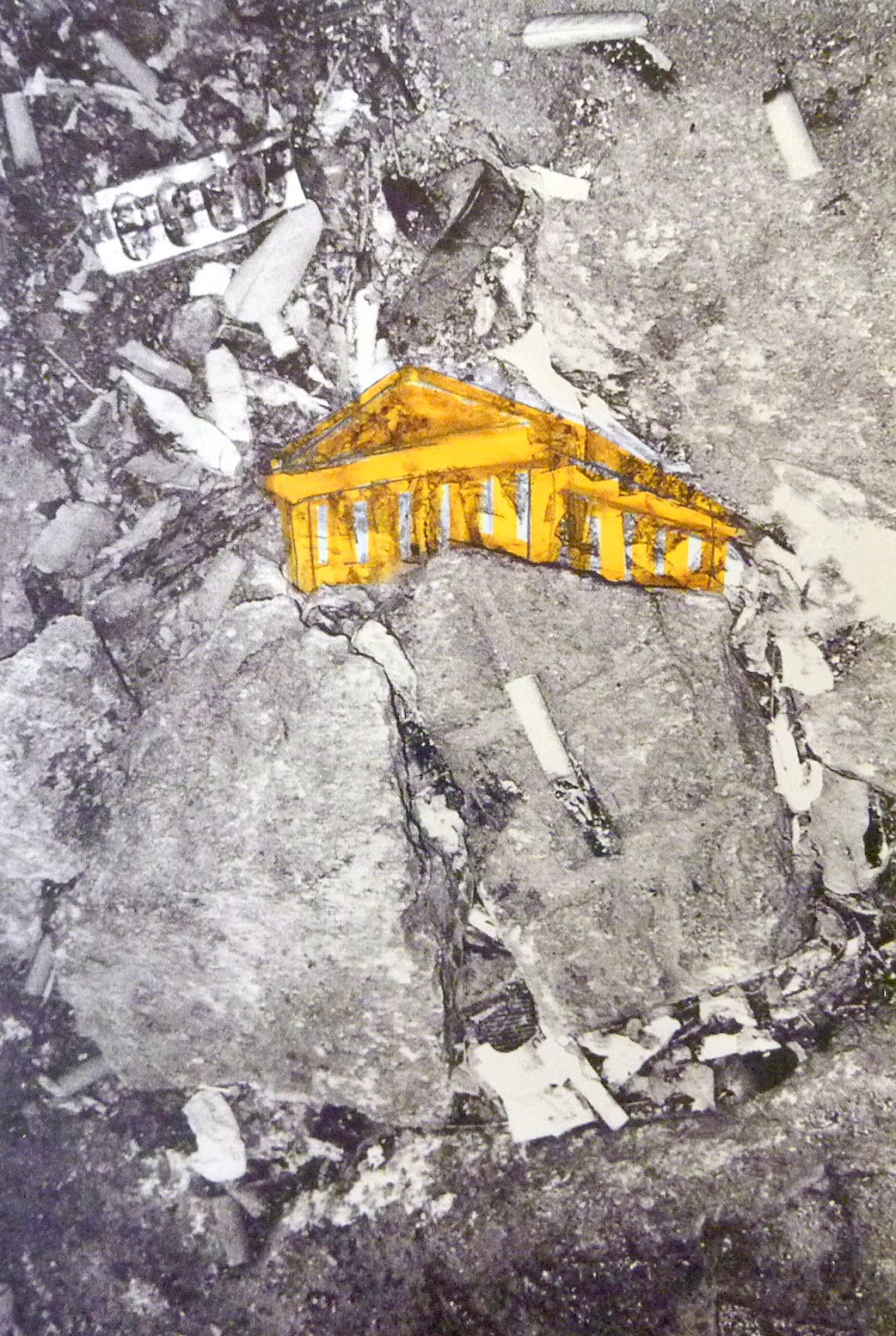


Alexandros Georgiou, Athens, Parthenon, 2007-08, (mixed media on photograph)


Yael Kanarek, Heart in Heart, 2004, (sheer organza ribbon, two metal meat hooks, aircraft cable)


Vlassis Caniaris, Hopscotch, 1974, (6 human figures, 9 suitcases, 1 cage, tar paper base and hopscotch chalk drawing)


Kimsooja, Bottari, 2005-17, (6 bottari made from traditional Korean bed covers and used clothes from Athens and Kassel)


Bia Davou, Sails, 1981-82, (fabric, ink)


Do-Ho Suh, Staircase II, 2004, (translucent nylon)


Costas Tsoclis, Portraits, 1986, (5 video projections in colour on 5 paintings with acrylic on cloth)


Mona Hatoum, Fix It, 2004, (factory fixtures and furnishings, light bulbs, programmable lighting equipment, electric cable, amplifier, mixer, 2 speakers)


The people:

As one would expect, the majority of the people who took part in the project are from Syria and most are men. I have tried to use a sample that is representative of those involved.


Ali, (40 years old), Syria

When I was informed about the Museum's programme, I was not sure I wanted to participate. I had never been to a museum and had never visited an exhibition. But something made me go to the first meeting and then to take the decision to take part...

Of the projects we saw in the Museum I was moved the most by Hopscotch by Vlassis Caniaris. I think that the work expresses all refugees. Personally, it reminded me of how I felt as soon as I arrived in Turkey. I did not know anyone, or the language and I did not know what to do, where to start and how to go on. My suitcase was the only object I could lie down on, rest and think for a while.

I identified with the man sitting on his suitcase, who looks as if he was tortured by the decision he had to take, by the dilemma of whether he should stay in his homeland or leave. I experienced this dilemma too. Deciding to leave was not easy for me. I had my doubts. I had to leave my wife and two daughters behind. This doubt still exists deep inside. Even now, I sometimes think I shouldn't have left them. But if my one hand was burdened by the concern for my wife and children, preventing me from leaving, the other hand was pulled by the need not to take part in such a war. I dislike violence. I do not want to hold a weapon. I do not want to harm anyone. I do not like blood. I want to live a peaceful and safe life with my family.

What worries me the most is that two years have passed since I left Syria and I haven't yet managed to do anything for my family, to be able to bring my wife and daughters here...

The last month and a half I've been living in a building, in a room of my own. I'm very happy that it has a balcony where I can sit and relax... You see, back in Syria I used to take my coffee on the terrace... On my balcony in Athens I have the opportunity to continue this favourite habit I have from home...


Maya, (26 years old), Tunisia

... I avoided going out in Tunisia because it was too dangerous.... I identified with the harpooned fish in Costas Tsoclis' artwork. For me, the people around the fish were like the members of my family, who ignored me. I was right there, but they couldn't see that I was suffering, that I wasn't comfortable with who I was and that I wanted to be something else. I wanted to live as a woman. That's why it was dangerous for me to walk down the street in my country. I had to hide who I was. I could only be myself when I worked on the stage. I have a mark on my body, just like the harpooned fish does, a scar from the time I was attacked on the street. But, in the end, the mental trauma it left was even bigger. It may not show, but I feel it inside me all the time. Maybe Tsoclis' work is talking about mental trauma. ..

In Alexandros Georgiou's work I could see cigarette butts, empty packets of medicine, and other garbage lying about. It could be a place that was destroyed in some war. At first I could not understand what this black and white environment had to do with the Parthenon, which is tinted gold. I thought maybe the work was talking about life itself, how anything can be destroyed unless it's very strong. And symbols which have lasted throughout the ages are very strong; they're the culture and values we've inherited from the past. When we come into contact with these values, we become stronger. That's why he made the Parthenon gold; to show that it's something of value...


Mahdi, (student), Iran

... One of the works we saw at the Museum which made a big impression on me was the Swedish Flying Carpet by Kostas Velonis. Its waves reminded me of a seagull, flying to leave a country where it's cold to go to one where it is warm. Just like I wanted to leave my country. That's what I kept saying - I want to leave - because I didn't like the situation there. I wasn't safe. And in the end, I managed to get away...

We played hopscotch in Iran too. In this artwork [Vlassi Caniaris] each square shows something a refugee has to go through when he gets to a foreign country. He waits for his papers and goes from office to office, to different agencies, and waits until the whole process is finished and he can stay there legally. There are a lot of people coming to Greece from a lot of different countries. ...

I liked Costas Tsoclis' work with the fish a lot. The fish has lost its freedom. I wouldn't like to be in its place, no way. If each painting of this artist shows a different country, then mine is the one with the harpoon in it. And because I didn't want to see all the awful things that were happening there, I wanted to go to a country which is at peace. Like the people in the paintings next to the fish, who are leaving to go to another country without looking at the fish. One of those people could be me, someone who doesn't want to live in a country that's being bombed...
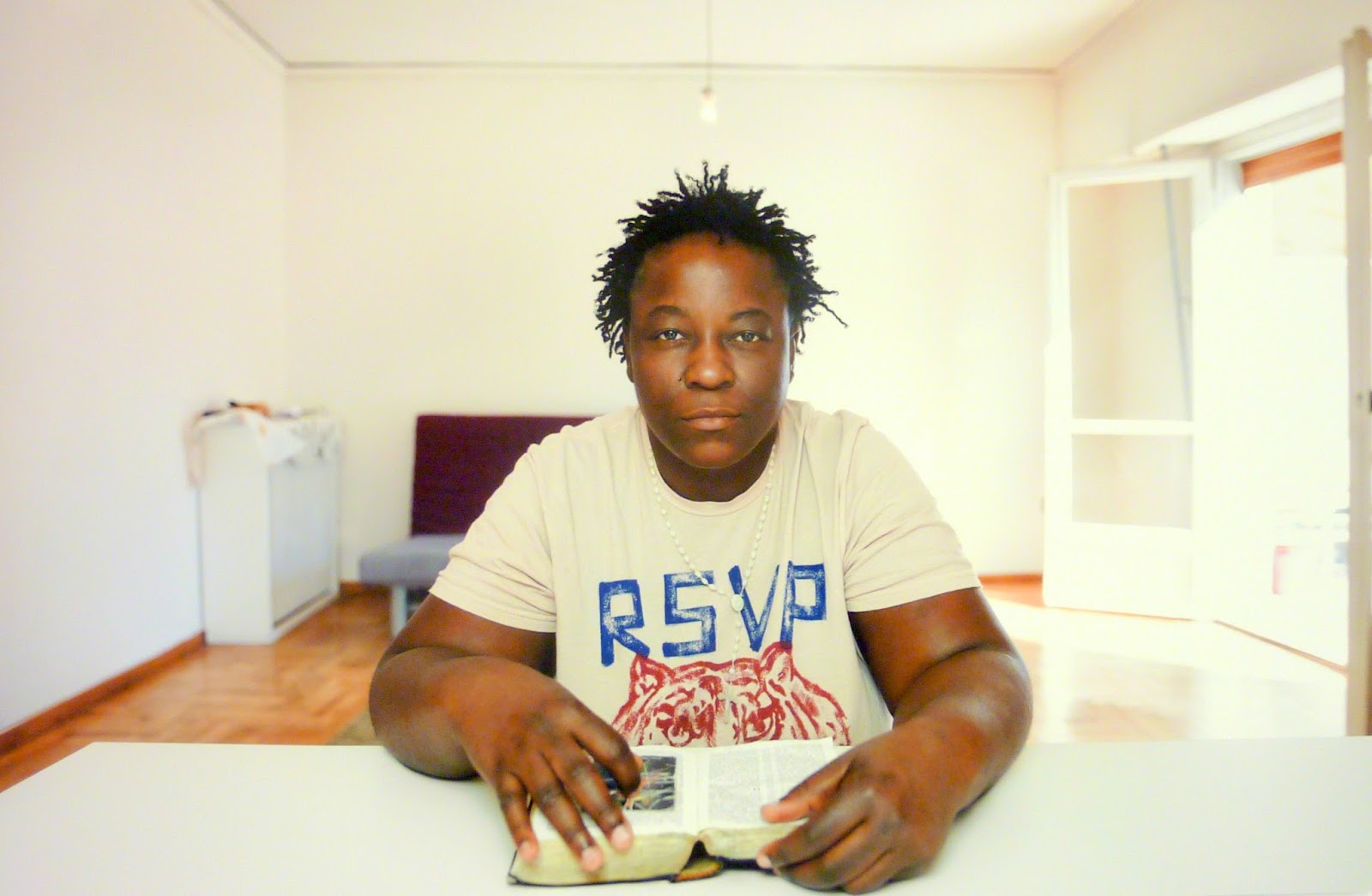


Patricia, (34 years old), Cameroon

... Although I had never visited a museum before and I had no previous contact with art, the projects and the discussions at the Museum created strong emotions and gave me the opportunity to focus on issues that concern me a lot. I kept thinking about them even after I got home. I saw in them pieces of myself, pieces of my life...


Kimsoja's Bottari reminded me of the boats we all started out in when we left Turkey for Greece. The Raft by Bill Viola brought to mind the time we got ashore; we left the inflatable and were so happy we all cried. It is a very powerful feeling, hard to describe. It is important when you become aware of your own existence and how close to death you can be at any moment. But once we set foot on land, we had already our first victory - a victory over death. I saw something like that happening in Viola's work, when all these different people, who were standing together in the same space, were suddenly hit by a jet of water. I saw it as a divine intervention, a threat, a shock sent by God, after which the people realised they needed to come together to better face danger. We, too, faced this danger in the boat in the rough sea, when we all tried to save ourselves.

What we experienced was a transition from dark to light. This is what Mona Hatoum's work Fix It, made me think. Light always symbolises life, regeneration. When light lights up this space, with the old, rusty objects, it resembles the moment you turn back to light, you find yourself after a deeply thoughtful or difficult phase of your life when you have sunk in the dark.

But the work that influenced me most is Heart in Heart by Yael Kanarek, which looks like a wedding dress hanging from hooks. There is something hard and violent about it, far from gentle, cheerful and pleasant. When I learned that the love letters of two people living apart from each other are written on the ribbons, my thoughts immediately travelled to my relationship, to my girlfriend who stayed back. It is the first time I've had a relationship from a distance, and I can see how painful it is. We think about each other, we communicate through social media. But as time goes by, I feel despair, because I see that, there can be no relationship....

Although thinking about all this made me cry, in the end I felt positive. I was even keener to work, earn money and be able to go for a few days to see my girlfriend and then return to Greece...


Friday, 29 September 2017

Sea Sorrow - a film about the refugee crisis


Sea Sorrow, a documentary film directed by Vanessa Redgrave and produced by Carlo Nero,


at the Megaron Mousikis, Athens.


This feature documentary on the refugee crisis is Redgrave's directorial debut. The film begins with a series of devastating interviews in which young immigrants recount the story of how they came to live in Italy. The element of perspective is central to Redgrave's message from the start and only grows increasingly more so as she contextualises this current exodus in the greater history of humanitarian crises: the rounding up of Jews across Poland;  the massive exodus of Jews during the Holocaust; the adoption of the Universal Declaration of Human Rights in 1948 as a response to the above; the absorption of thousands of refugees during the Hungarian uprising - are all a reminder that this is not a new situation. The point is made forcibly that political convenience should never be prioritised over basic humanity.

Redgrave recalls the wartime role her parents played in trying to secure visas for Jews who were fleeing Nazi Germany: 'if you know the history you're horrified by how obdurate the Chamberlain government was. Scandalous on anybody's terms and I'm afraid we're in the same situation today'.

An important part of the film is the plight of children in the Calais 'jungle' and Lord Dubs' efforts in the House of Lords to compel the last government to increase the number of children allowed in.  Dubs is furious at the heavy-handed way the Calais camps were demolished and their inhabitants moved on, a display of police power he attributes to the local need to appease the Le Pen National Front. He adds that fascism should rather be stood up to.

The insightful commentary offered by dramatist Martin Sherman was one of the most powerful aspects of the film for me. He persuasively argued that the refugee camps are occupied by people in a communal state of shock: pure adrenaline and courage have carried them on their horrible journey on which they have had to suppress their normal human reaction of the death of family members on the road. Now marooned at their journey's end in Calais, they are suffering a new unfolding trauma. But, now that they are stationary, the adrenaline has dropped, and they are left in a state of shock.

The film's title, taken from one of Prospero's monologues in The Tempest (and performed here by Ralph Fiennes) reminds us that even the Duke of Milan could be reduced to a man who survived certain death by floating on the 'rotten carcass' of a boat. The message is loud and clear: this could happen to any of us.


All proceeds from the screening of the film will go to Medicins Sans Frontieres and Safe Passage.


There was a discussion after the screening of the film. Members of the panel included Vanessa Redgrave, Alfred Dubs, Carlo Nero, (Redgrave's son and producer of the film), the head of Medicins Sans Frontieres in Greece, Praxis (a Greek organisation who works with and for groups that face social exclusion, including refugees), Mimi Denise, (director and actor), the translator and the chair.


The discussion was interesting and thought-provoking. Vanessa Redgrave was clearly very moved. She talked briefly about the making of the film and her intention to put the fight for the rights of refugees at the centre of her activism.


Alfred Dubs talked about his own experiences as a child on the Kindertransport. He talked about how the Greek people are in the vanguard of providing help for the refugees. This was reiterated by the rest of the panel and the audience, but the point was made that the Greek citizens are on their own in this, as the government has not helped, but continues to follow EU policy on refugees.


Mimi Denise talked about the Greek refugees who fled Asia Minor following the Greek genocide perpetrated by the Turks in 1914-1922. Many of them fled to Aleppo in Syria and what an irony it is that today so many people have to flee Aleppo to get to Greece.

In response to a question by a member of the audience about what we, as citizens, can do to help, Carlo Nero highlighted the situation in Pedion tou Areos, a park in the middle of Athens, near the hotel where they were staying. Refugee children as young as 8 and 10 have to sell their bodies for 3 euro an hour so that they can subsist. He talked about some of those children bursting into tears when they are told that they are too old for what the men who want to buy their bodies have in mind. This is a specific area that Athenians can get involved in by pressurising the government to end this appalling situation.


Saturday, 29 July 2017

Documenta 14 at the Athens Conservatoire


Documenta 14,


at the Athens Conservatoire.

We arrived in Athens at the tail-end of the Documenta 14 exhibition which lasted for 100 days and spread over 47 venues, so we tried to make the most of the 10 days we had before it ended. We were pleased with what we saw.


For the first time in its 62-year old history, Documenta, one of Europe's most important modern art exhibitions, is split equally between Kassel, its traditional home, and Athens. The tension between Germany and Greece over debt and bailout forms the backdrop to Adam Szymczyk, the artistic director's decision to divide Documenta. Szymczyk is keen to avoid clichés and allow us to 'learn from Athens', after first unlearning what we think we already know. He states that he has chosen Athens as 'a city that has become emblematic of global contemporary crises'. He continues: 'in Athens, the actual hardship of daily life is mixed with the humiliating stigma of 'crisis' imprinted on the communal body in a well-known, pseudo-compassionate, moralising and in its essence neocolonial and neoliberal formula'.


The starkly modernist Athens Conservatoire, an unfinished cultural complex, with its concrete shell of a performance space, is probably the most beautiful venue for this exhibition .


Kettly Noel, Zombification, 2017

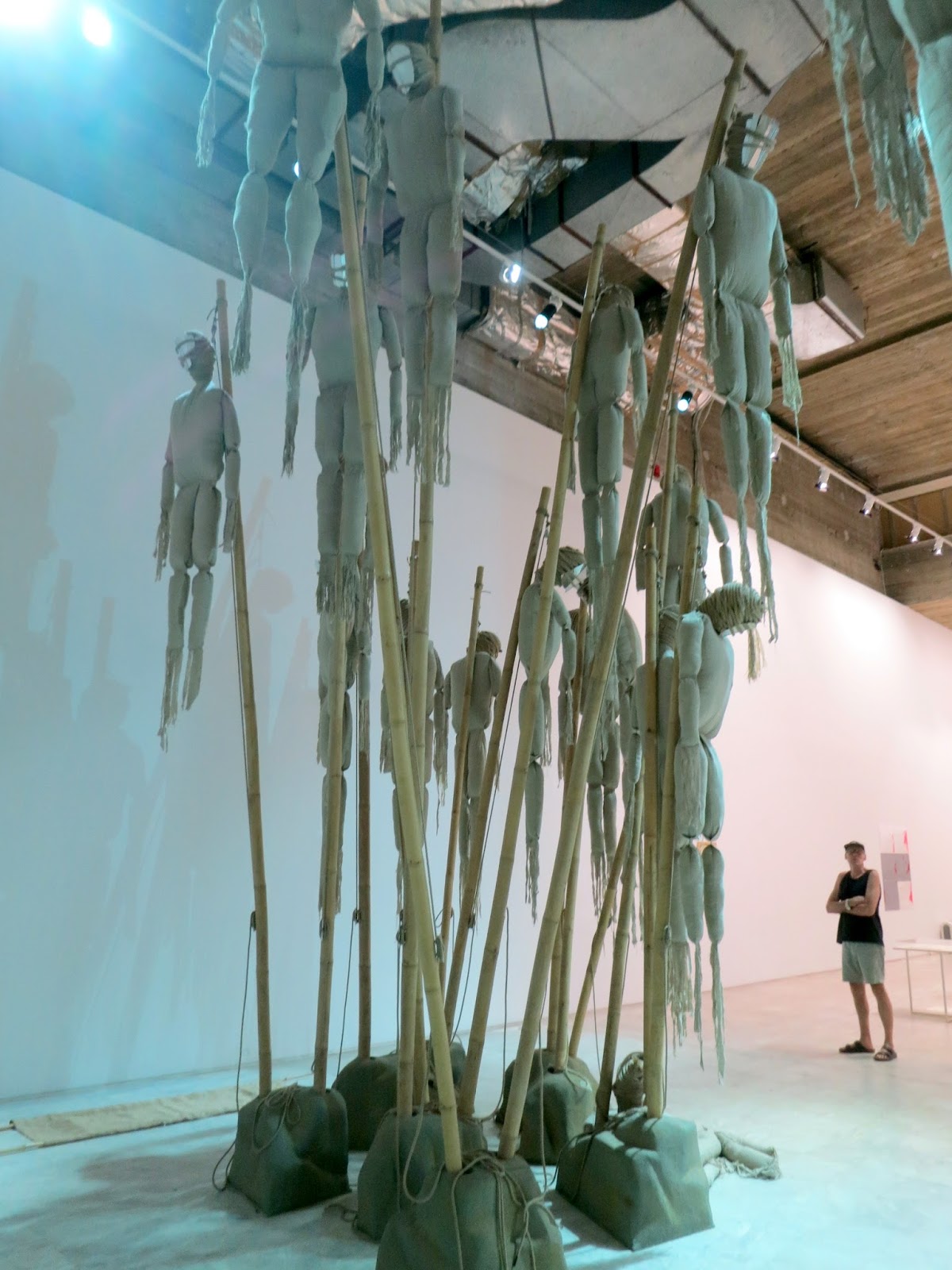
In Zombification by Haitian choreographer, dancer and artist Kettly Noel, the puppets are made from hessian bags and ropes and have mirror-panel faces reflecting the viewer's own face; these voodoo figures move as zombies within this bamboo-stick installation, seen as 'nonfolkloric figures responsible for current, real and globalised violence'. And they have our faces.


'A visual submersion in the shadows of memory, mingling the guedes -Voudoun's loas (spirits) of death - with the Sonderkommandos of Ebola, evoking at once slavery, lynchings, death camps, the killing fields of Vietnam or Rwanda, massacres past or future, and the blackest faces of our history.
Zombification refers to images that ceaselessly haunt contemporary people and that preclude the conception of modern visions.

A woman, a reincarnated Orpheus, attempts to survive amidst illusionary corpses in an incessant and absurd ballet of dehumanised bodies, served by enigmatic undertakers - an impossible task that conciliates Haitan surrealism and contemporary art. Zombification, the obliteration of all consciousness and free will, is global.

No one will escape'.
Kettly Noel.


There was no live performance while we were there, but we were able to see a video of the performances that have taken place


This was by far my favourite work of Documenta - a very powerful piece.


Pelagie Gbaguidi,  The Missing Link. Dicolonisation Education by Mrs Smiling Stone, 2017


This installation comprises walls of hanging paper, each scrawled with scratchy, disjoined figurative drawings made with lipstick, a series of school desks, a single video and a microphone wrapped in paper. On the desks, placed beneath large sheets of glassine paper, are images captured by South African photographer Peter Magubane of black figures caught within the violence of Apartheid. In covering these images of suffering - and fairly transparently, packaging the microphone - Gbaguidi draws attention to the way in which inconvenient legacies of oppression are circumvented - and thus preserved - through education systems and therefore official histories. If we are ever to truly learn, Gbaguidi suggests, we must remove the paper and confront the worst things that we have done.


Beatriz Gonzales, Interior Decoration, 1981


Interior Decoration is taken from a series of paintings chronicling the life and times of Colombian president Julio Cesar Turbay Ayala, whose regime was marred by endless accounts of corruption and loose morals. It was originally realised as a 140-metre-long curtain based on a newspaper photograph that depicted Turbay alongside a group of women united in festive song.


Ganesh Haloi, Untitled, (gouache on paper)


Ganesh Haloi, Untitled, (gouache on paper)


Ganesh Haloi, Untitled, (gouache on paper)

...

We then moved on to a different gallery where all the artworks were in one way or another related to music, very appropriate given that we were in the Athens Conservatoire.


Nevin Aladag, Music Room, 2017

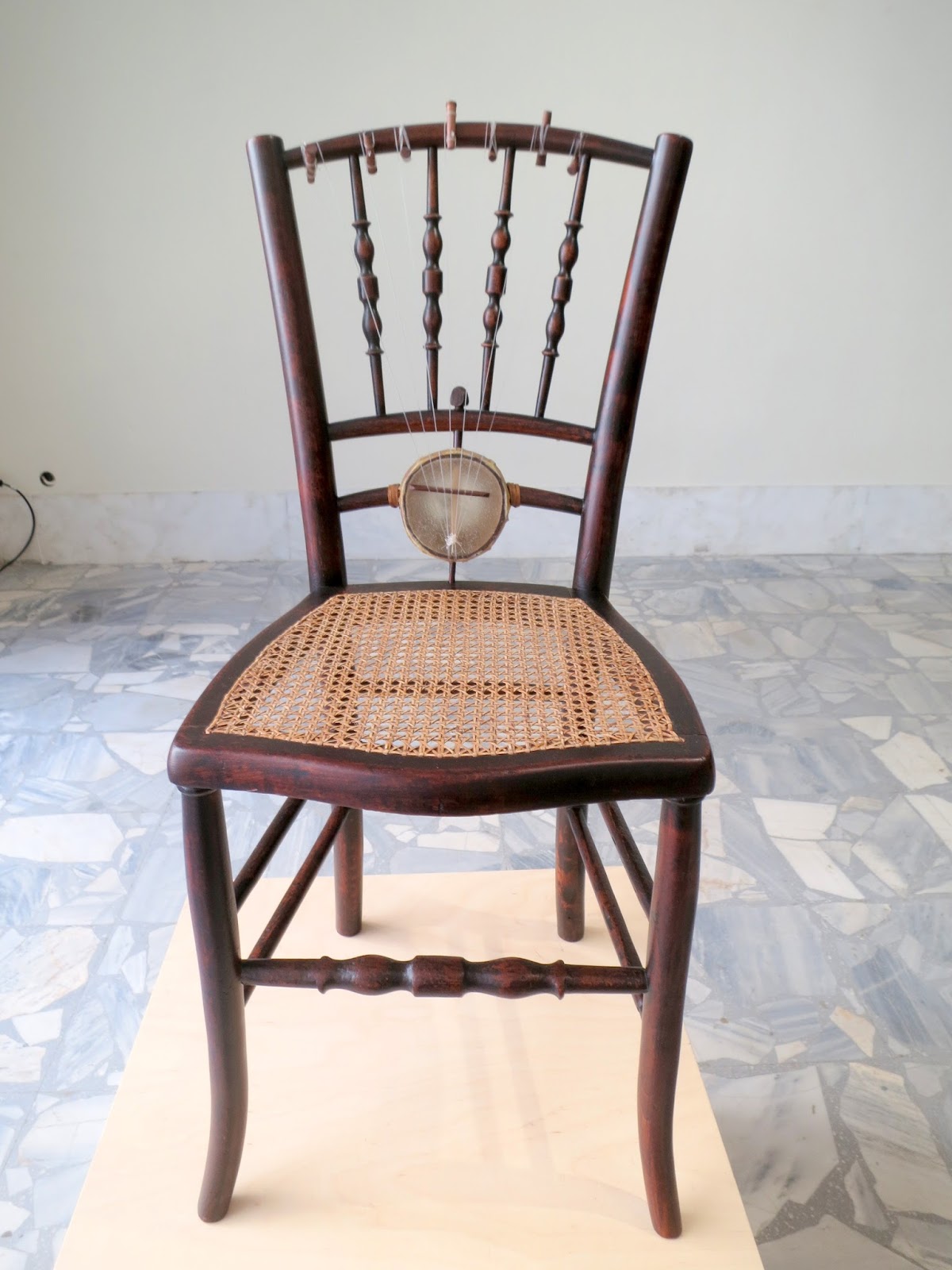
An assemblage of household furniture, each item of which has been reimagined and refashioned as a musical instrument. Chair becomes guitar, desk becomes wind-chime, stool becomes drum, and so forth. Aladag references tarantism, mainly practiced by women who 'dance away the pain of any poison'.

Unfortunately there were no performances while we were there.


This gallery space is truly amazing, a vast space, with just four paintings hanging on the walls


The 'A Tent on the Roof  of a Car', series by Edi Hila


I did not understand the relationship of the paintings to the title, but I enjoyed looking at them


and loved being in that vast, industrial space

...
We then moved on to a small gallery, where we looked at Sedge Hemon's geometric oil paintings


...


As we were leaving, just by the entrance we saw:

Yannis Tsarouchis' Semi-Nude Pianist, (1971) which was used as an illustration for Manos Hadjidakis' album Liturgical Songs


 Giullermo Galindo, Exit, (2016-17)

An ensemble of homemade instruments constructed from the detritus found at a refugee camp near Kassel. These odes to border crossings:  plastic combs, water bottles and boat parts reference how Mesoamerican peoples saw instruments as talismans for movement between worlds.

...

By one of the entrances to the building we came across:


European Everything, (2017), installation and performance

European Everything is a nomadic stage structure built from scavenged and found materials on site in Athens. During the exhibition period a variety of  politically aware artists and performers have been invited to contribute and interact with the space. Unfortunately, there were no performances while we were there.