Wednesday, 22 June 2016

Leamington Peace Festival


We had family visiting on Saturday and after lunch we walked down to the Leamington Peace Festival, one of the UK's longest running free festival. The festival takes place each year on the weekend before the Summer Solstice in the Pump Room Gardens. The first festival was held in 1978 with the aim of promoting peace and equality between people while living in harmony with the environment. 

There's always a mix of activities, free workshops, talks, live music, stalls of local activities and campaign groups, healing treatments and lots of food stalls.


Listening to the bands is the main attraction for the majority of people who attend


but wandering around looking at the various stalls and activities is equally pleasurable


face painting is a favourite with the children.


We tried to find the queen amongst the bees but were not successful


there were lots of religious stalls,


Amnesty International


an extremely informative stall for Justice for Palestinians


a space for supervised toddlers


lots of hula hoops


while this guy did some amazing things with this crystal ball.


Sunday, 12 June 2016

Amsterdam - the University area


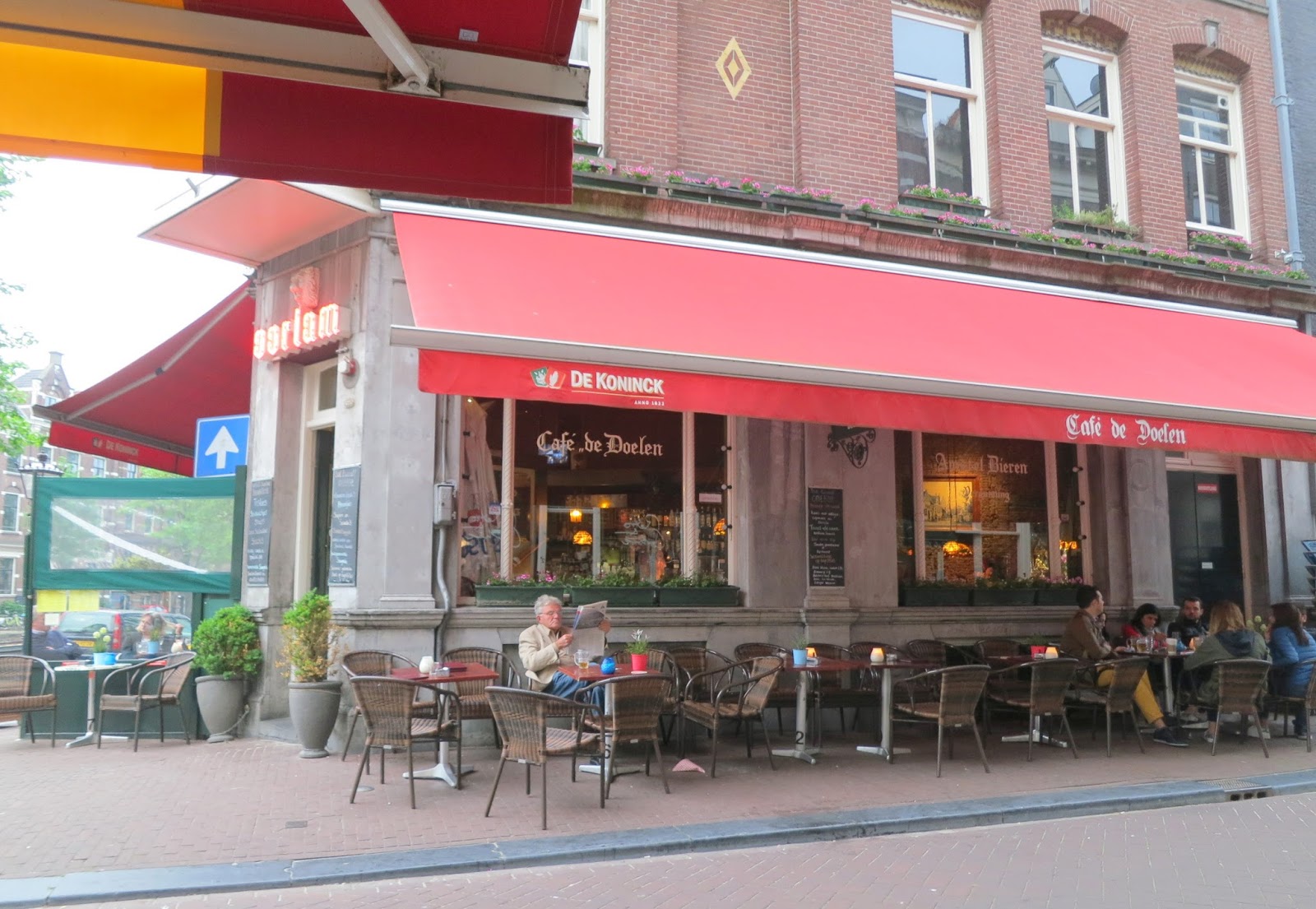
Our short stay in Amsterdam began with an evening walk around the University district which is where our hotel is located.  The bright lights in the corner in this photographs is Staalmeesters, where we always have our evening meal on our first night. Weather permitting, we like to sit outside


facing Café De Doelen.


Following our meal we walked around the area, enjoying the reflections of the lights on the canals


as the city winds down, the lights come on and people walk or ride their bikes at a more leisurely pace.


Hardly any cars around, a real plus


This is one of my favourite canals - the reflections are always wonderful and there is something magical about it, maybe because we have never seen any boats on this stretch


each crossing of a bridge affords great views along the canal and we always stop to have a look


and it's always rewarding.


Here's another bridge


and the views from it.


This is Nes, where our hotel is. One side of the street is a huge building site at the moment and it's all covered up with netting, so these lights have been added to detract from the ugliness - it's a great improvement


Some of the boats have been imaginatively done up - note the settee that's on top. On the left is a pissoir, and then the Grand Hotel.


This bridge is featured in one of Van Gogh's paintings.


In this passage, which is part of the University, books and prints are being sold.


It leads to this courtyard


and to this area which is in fact a pedestrianised street, Vendelstraat. We had never been here before, so we started to explore


On the side of one of the buildings is Located Text, Amsterdam, by Joseph Kosuth, 1998, and two pieces of Banksy-like street art.


On the wall of another house someone has painted a reproduction of Matisse's Dancers.


More street art


and some more here.


On the right of this bridge, which is where Staalmeesters is, there is another large bridge where you  cross the Amstel


and which leads to Rembrandtsplein


which is dominated by a statue of the artist and in front of it a sculptural representation of The Nightwatch, Holland's most iconic painting, symbolic of its people.


It's a painting that depicts democracy, a painting of a group of burghers, rather than royalty or religious figures. The burghers stand together, as a community, acknowledging one another's individuality and difference. It's an icon of tolerance, diversity and what makes a society work and in this it epitomises Dutch national pride.

As we sat on a bench looking at the sculptures, it hit me again, as it does every time we visit Amsterdam, that it's that tolerance, that diversity that draws me back to the city. There is such a rich variety of people, all peacefully co-existing, like in no other city I have visited before: businesspeople, bikers, people living alternative lifestyles, young and old, rich and poor, all getting on with their lives in a spirit of tolerance and acceptance. (I have to add here, that the rowdy British rugby fans got a bit too much this time, but the spirit of tolerance persisted). Even the means of moving around the city is non-hierarchical. There is none of the dominance of the car as in other cities: pedestrians, push bikes, trams and cars all make space for one another and peacefully co-exist - it's so refreshing, so liberating, so just right!


Wednesday, 8 June 2016

Simon Lewty - The SIGNificance of Writing


The SIGNificance of Writing, by Simon Lewty, Leamington Spa Art Gallery and Museum.

Simon Lewty's large drawings and paintings often integrate text, image and maps. The works are on paper, stuck together into thick layers and coated in varnish so that they seem like ancient parchments, cracked, dirty and ragged at the edges: Lewty's use of ink and paint evoke the intricate illuminations of medieval manuscripts. Rooted in medieval illumination and map-making traditions, his works create a compelling dream-like reality that recalls forgotten worlds and explores the inevitability of the passing of time.

Before falling asleep each night, and immediately on waking, he records dream images and snatches of text as well as scribbled notes and explanatory maps and diagrams. These notes are transferred to scraps of tissue paper and then worked up with ink, crayon and black acrylic and form the basic vocabulary of the finished work, a combination of the carefully distilled and refined with the accidental. The result is a dense personal narrative that functions like a map of the artist's unconscious mind. Many of the motifs - dotted lines, arrows, etc. - look very much like the lines on a real map. His scripts are all woven into what he describes as 'a calligraphic skin', as echoes of inscribed speech. He describes his work as 'automatic, spontaneous' and promotes drawing as a form of 'primary visual thinking', with 'no planned final outcome'.

From 2006 most pictorial imagery has disappeared from his work. Recent pieces consist of short snippets of declarative writing - overheard conversations, bits of dream narrative - arranged into huge, neat blocks of text. I found it impossible to follow all of the hundreds of miniscule lines, yet, this tension between looking and reading became after a while, just as dislocating, and as dreamlike, as his pictorial works.


The exhibition includes early works displayed alongside work recently produced.


The Men Who Lie in the Road, 1991, (ink and acrylic on tissue paper)

Lewty describes this work as a compendium of his work, as it represents all the images that remerge in many of his paintings and drawings. The piece depicts Old Milverton, a village near Leamington Spa. The piece comprises a number of separate panels: a field;  running legs with no body on top, just a face; a horse and rider. Graffiti between and over the images adds further complexities.


Inscriptions Without Blame, 2002 (acrylic, photocopy)


 The Passage Towards Stone, 1983, (acrylic, ink  on paper)


Colour Sequence, 2003, (pigment and photocopy on paper


Repetition and Dream II, 2003 (acrylic and graphite on paper)


The Voice that Sung of the World, 2001 (acrylic on paper)


Beach, 1.6.11.05, 2005 (pencil, pigment on tissue paper)


Letter to a Dismissed Servant, 2011 (inscribed ribbon, acrylic, ink on cotton)


List: Train - Face, 2010 (typescript on tissue paper)


looking closer


Abstract Script (2), 2014 (ink and crayon on paper)


Abstract Script (1), 2014 (ink and crayon on paper)


Legend, 1974, (pen, ink on paper)


Passing Days and Nights of Oblivion Will Drain Reason Before the Strength of the Flower, 2008, (pen, ink on paper)


looking closer


looking closer.


Saturday, 4 June 2016

Erota, Jenny Saville


Erota, by Jenny Saville, at the Gagosian Gallery, Mayfair, London.

'I'm trying to see if it's possible to hold that tipping moment of perception or have several moments co-exist.. Like looking at a memory'. Jenny Saville

Memory is fragmented, and you're never sure whether what you remember is truth, or whether our mind has manipulated it in the act of remembering - it's elusive. That elusiveness is tangible in Saville's latest exhibition of drawings.

When speaking of this show, Saville stated: 'Today we're used to so many perspectives our view is constantly shifting from screen to reality'. Championing this notion of seamless visuality, her charcoal and pastel drawings reveal fluctuating forms and contours of writhing, sprawling figures inspired in part by Rembrandt, Raphael and Titan sketches. The figures are in flux, like many moments captured in a single image.

You can see more of her work  here


Reflective Flesh Study, (Red), 2015, (charcoal and pastel on paper mounted on board)


Couple V, 2015 (charcoal and pastel on paper)


Couple, 2015 (charcoal and pastel on paper)


Online SAVILLE Ebb and Flow, 2015_GG

Ebb and Flow, 2015


 One out of two (symposium), 2016_GG

One Out of Two, 2016