Sunday, 7 April 2019

Open 2019


Open 2019: a showcase for artists based in the West Midlands


at Leamington Art Gallery.

I was somewhat disappointed with the Open exhibition this year. To begin with, the leaflets advertising the exhibition promised us a quilt by Annabel Rainbow which is not there.  (You can see some of Rainbow's work here ). Furthermore, the work of Wendy Campbell-Briggs which is featured on the exhibition poster is not to be seen either. 


Wendy Campbell-Briggs and Corinna Spencer, Extinct (ceramic, American oak, paper)


looking closer


Tim Florence, Purple Haze, (Giclée print from an ink on paper original)


Kathy Webster, Samuel's paintbrush, (acrylic) 


Janet Tryner, A Few Rough Hands... Garden Brush, (plaster of Paris, wood, string, brick)


Tanya De Lange, 7 Miles of Solitude - 2, (medium format film print)


DJ, Newgale, (oil on canvas)


John Martin, Blue Ladderway, (mixed media linocut)


 Robert Page, The First Time that you Kissed me, (bronze resin on Ancaster stone)


Jo Lewis, One Way Ticket, (photograph)


Lizzie Cariss, Freight Train 2, (oil on canvas)


John Murphy, Landing Place, (oil on linen)


Jenny Chan, Divas Wall Masks, (ceramic)


looking closer


Thursday, 4 April 2019

Magic Realism


Magic Realism: Art in Weimar Germany, at Tate Modern.


At a time of political and social upheaval, many German artists were turning away from the idealistic tendencies that prevailed in Germany before WWI, in favour of a new form of realism. There were two distinct approaches: there were 'classical' artists inclined towards recording everyday life through precise observation; the other group were the 'verists' who employed realism satirically to reveal the true nature of social inequalities. Some characteristics could be traced across both approaches, including an eye for the uncanny and grotesque. 


Paul Klee, Comedy 1921, (watercolour and oil on paper)

These mechanical characters relate to the student parties and theatrical performances at the Bauhaus where Klee was a teacher. The painting was made using his 'oil-transfer' method. Klee placed a finished drawing over a sheet of paper coated with black oil paint. He then traced over it with an etching needle, pressing the oil paint onto a black sheet of paper beneath. The resulting image provided the starting point for a new painting.


George Grosz, Self-Portrait with Model in the Studio, 1930-37


Conrad Felixmueller, Portrait of Ernst Buchholz, 1921, (oil on canvas)

This portrait captures the assured pose of a privileged bourgeois student. The sitter, Ernst Buchloz, later became a notable lawyer and art collector. He took on a number of cases defending freedom of expression. Here the angular form and heightened colouring of the face seem to echo the exaggerated forms of expressionism, a style more closely associated with the pre-war period.


Josef Mangold, Flower Still Life with Playing Card, (oil on canvas)


Otto Rudolf Schatz, Moon Women, 1930, (oil on canvas)


Sergius Pauser, Self-Portrait with Mask, 1926, (oil on canvas)


Hans Grundig, Girl with Pink Hat, 1925, (oil on canvas)


Marie-Louise von Motesidzky, Portrait of Russian Student, 1927, (oil on canvas)


Herbert Gurschner, Bean Ingram, 1928, (oil on canvas)


Max Beckmann, Anni (Girl with Fan), 1942, (oil on canvas)


Jeanne Mammen, Boring Dolls, 1929, (watercolour and graphite on paper mounted on cardboard)


Jeanne Mammen, At the Shooting Gallery, 1929, (watercolour and graphite on vellum)


Jeanne Mammen, Bruederstrasse (Free Room), 1930, (watercolour, ink and graphite on vellum)

Although born in Berlin, Mammen grew up in Paris. The outbreak of war forced her family to leave and eventually return to Germany. During the 1920s she regularly contributed to fashion magazines and satirical journals. Her observations of Berlin and its female inhabitants differ significantly from those of her male contemporaries. Her images give visual expression to female desire and to women's experiences of city life. When Hitler took power, the magazines that she worked for were either closed down or forced to comply with Nazi cultural politics. Mammen survived by selling second-hand books on the street, only resuming her artistic practice after WWII.


Josef Eberz, Dancer (Beatrice Mariagraete), 1923, (oil canvas)


Prosper de Troyer, Erik Satie (The Prelude), 1925, (oil on canvas)


Herbert Gurschner, Triumph of Death, 1927, (oil on canvas)


Albert Birkle, Crucifixion, 1921, (oil on canvas)


Albert Birkle, The Hermit, 1921, (oil on canvas)


Lovis Corinth, Magdalen with Pearls in her Hair, 1919, (oil on canvas)


This portrait depicts Mary Magdalene, a follower of Jesus who is often mistakenly represented as a prostitute. Corinth paints her as a powerful figure. Her bare torso fills the composition. The introduction of the skull is a reminder of passing beauty and mortality.


Monday, 1 April 2019

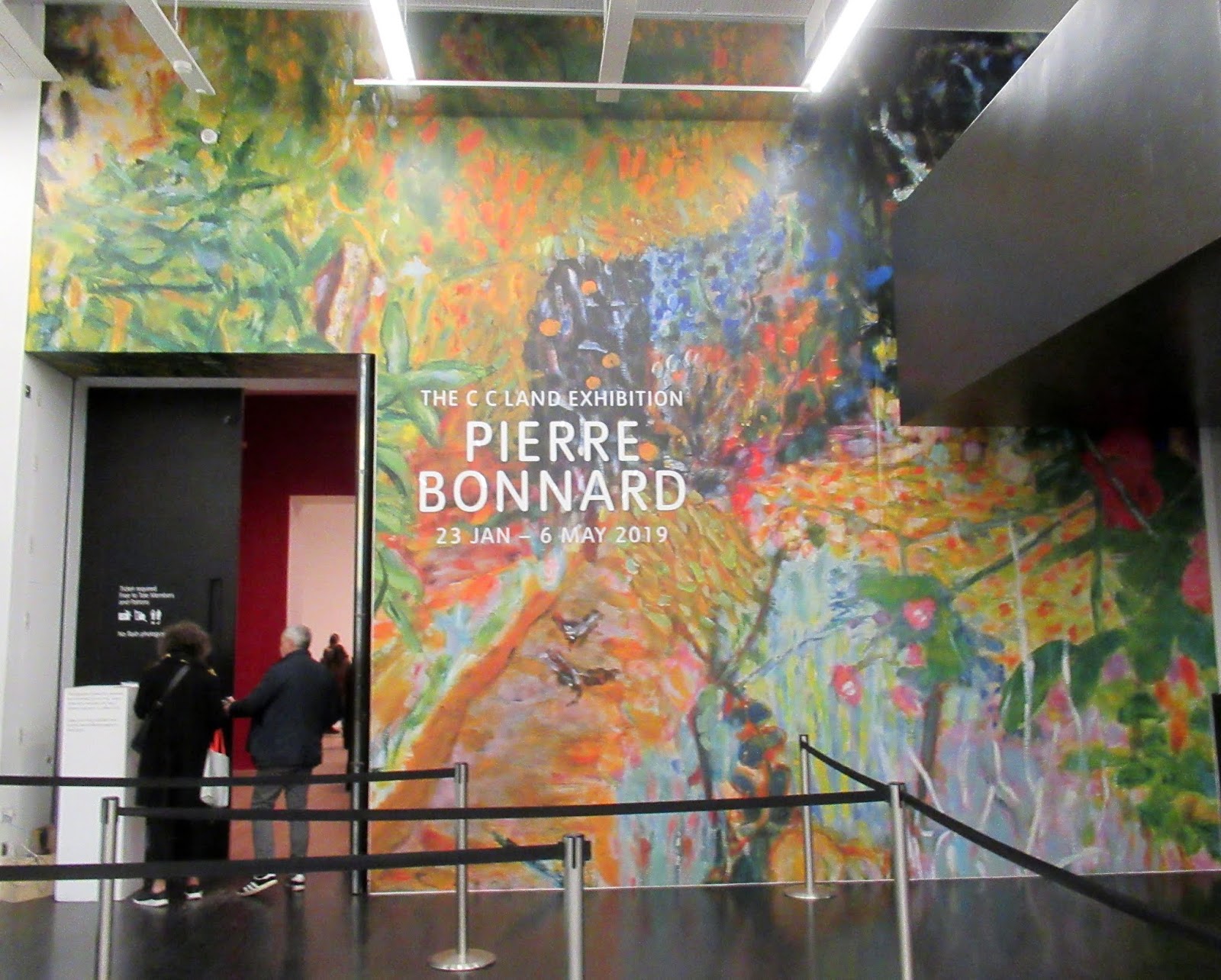
Pierre Bonnard


Pierre Bonnard,


at Tate Modern.

The paintings of Pierre Bonnard create a remarkable sense of intimacy. Many of them allow glimpses into a private world, depicting the domestic life that Bonnard shared with this companion, Marthe de Meligny. This exhibition focuses on his mature work, as he developed a highly individual command of colour.


Man and  Woman, 1900, (oil on canvas)


Mirror Above a Washstand, (oil on canvas)


Lane at Vernonnet, 1912-14, (oil on canvas)


Normandy Landscape, 1920, (oil on canvas)

The view from Bonnard's garden at Vernonnet was a constant source of inspiration for him. He felt an affinity for the land, which he explored on daily walks. He even spontaneously bought an ancient tree to save it from being sold for planking from a local farmer.


Balcony at Vernonnet, 1920, (oil on canvas)


Woman at a Table, 1923, (oil on canvas)

In this painting, Bonnard uses the small format to focus in on his companion. The viewpoint suggests that we are sharing the meal with the pensive woman, who is so close that her head is cropped by the top of the picture.


Terrace in the South of France, 1925, (oil on canvas)


Landscape, Young Girl with a Goat, 1925, (oil on canvas)


The Table, 1925, (oil on canvas)


The Dining Room, Vernon, 1925, (oil on canvas)

This work belongs to the series of paintings showing the related interior and exterior spaces in Bonnard's house at Vernonnet. As well as filling the canvas with colour, he included two figures, while a reflection on the door may indicate the presence of a third. De Meligny, who Bonnard had a relationship with for 50 years, is shown bending towards the dog whose expectant nose peeks just above the edge of the table. The two figures wear clothes that bring together all the colours ranged across the painting. This is an ambitious undertaking and Bonnard controlled the structure through the rhythm of vertical lines created by the door and window frames.


The Bath, 1925, (oil on canvas)

In this painting, de Meligny stretches across the width of the canvas, so that the composition can be divided into a series of horizontal bands: the titled wall, the white of the bath, the immersed body, the rim and the floor.


Nude in the Bath, 1925, (oil on canvas)


Nude in an Interior, 1935, (oil on canvas)

We face a patterned wall, upon which a full-length mirror is hung. An adjoining room is reflected in the mirror, allowing us to see the contour of a female body along the mirror's edge. The composition is formed from a series of interlocking rectangles. This interplay of horizontal and vertical lines suggests Bonnard's increased engagement with abstraction.


Nude in the Bath, 1936, (oil on canvas)

The water is blurry, the boundary between the bathtub and the rest of the room is obscured, making it look like De Meligny's frail, elongated body is being swallowed by her surroundings.


Large Dining Room Overlooking the Garden, 1934-35, (oil on canvas)


Landscape at Le Cannet, 1938, (oil on canvas)


In the Bathroom, 1940, (oil on canvas)


The Studio with Mimosa, 1939-46, (oil on canvas)


Almond Tree Blossom, 1946-47, (oil on canvas)

'Every spring it forces me to paint it', Bonnard said of the almond tree in the garden that he could see from his bedroom window.