Wednesday, 8 June 2016

Simon Lewty - The SIGNificance of Writing


The SIGNificance of Writing, by Simon Lewty, Leamington Spa Art Gallery and Museum.

Simon Lewty's large drawings and paintings often integrate text, image and maps. The works are on paper, stuck together into thick layers and coated in varnish so that they seem like ancient parchments, cracked, dirty and ragged at the edges: Lewty's use of ink and paint evoke the intricate illuminations of medieval manuscripts. Rooted in medieval illumination and map-making traditions, his works create a compelling dream-like reality that recalls forgotten worlds and explores the inevitability of the passing of time.

Before falling asleep each night, and immediately on waking, he records dream images and snatches of text as well as scribbled notes and explanatory maps and diagrams. These notes are transferred to scraps of tissue paper and then worked up with ink, crayon and black acrylic and form the basic vocabulary of the finished work, a combination of the carefully distilled and refined with the accidental. The result is a dense personal narrative that functions like a map of the artist's unconscious mind. Many of the motifs - dotted lines, arrows, etc. - look very much like the lines on a real map. His scripts are all woven into what he describes as 'a calligraphic skin', as echoes of inscribed speech. He describes his work as 'automatic, spontaneous' and promotes drawing as a form of 'primary visual thinking', with 'no planned final outcome'.

From 2006 most pictorial imagery has disappeared from his work. Recent pieces consist of short snippets of declarative writing - overheard conversations, bits of dream narrative - arranged into huge, neat blocks of text. I found it impossible to follow all of the hundreds of miniscule lines, yet, this tension between looking and reading became after a while, just as dislocating, and as dreamlike, as his pictorial works.


The exhibition includes early works displayed alongside work recently produced.


The Men Who Lie in the Road, 1991, (ink and acrylic on tissue paper)

Lewty describes this work as a compendium of his work, as it represents all the images that remerge in many of his paintings and drawings. The piece depicts Old Milverton, a village near Leamington Spa. The piece comprises a number of separate panels: a field;  running legs with no body on top, just a face; a horse and rider. Graffiti between and over the images adds further complexities.


Inscriptions Without Blame, 2002 (acrylic, photocopy)


 The Passage Towards Stone, 1983, (acrylic, ink  on paper)


Colour Sequence, 2003, (pigment and photocopy on paper


Repetition and Dream II, 2003 (acrylic and graphite on paper)


The Voice that Sung of the World, 2001 (acrylic on paper)


Beach, 1.6.11.05, 2005 (pencil, pigment on tissue paper)


Letter to a Dismissed Servant, 2011 (inscribed ribbon, acrylic, ink on cotton)


List: Train - Face, 2010 (typescript on tissue paper)


looking closer


Abstract Script (2), 2014 (ink and crayon on paper)


Abstract Script (1), 2014 (ink and crayon on paper)


Legend, 1974, (pen, ink on paper)


Passing Days and Nights of Oblivion Will Drain Reason Before the Strength of the Flower, 2008, (pen, ink on paper)


looking closer


looking closer.


Saturday, 4 June 2016

Erota, Jenny Saville


Erota, by Jenny Saville, at the Gagosian Gallery, Mayfair, London.

'I'm trying to see if it's possible to hold that tipping moment of perception or have several moments co-exist.. Like looking at a memory'. Jenny Saville

Memory is fragmented, and you're never sure whether what you remember is truth, or whether our mind has manipulated it in the act of remembering - it's elusive. That elusiveness is tangible in Saville's latest exhibition of drawings.

When speaking of this show, Saville stated: 'Today we're used to so many perspectives our view is constantly shifting from screen to reality'. Championing this notion of seamless visuality, her charcoal and pastel drawings reveal fluctuating forms and contours of writhing, sprawling figures inspired in part by Rembrandt, Raphael and Titan sketches. The figures are in flux, like many moments captured in a single image.

You can see more of her work  here


Reflective Flesh Study, (Red), 2015, (charcoal and pastel on paper mounted on board)


Couple V, 2015 (charcoal and pastel on paper)


Couple, 2015 (charcoal and pastel on paper)


Online SAVILLE Ebb and Flow, 2015_GG

Ebb and Flow, 2015


 One out of two (symposium), 2016_GG

One Out of Two, 2016


Saturday, 28 May 2016

The politics of hope - Owen Jones


The politics of hope: Owen Jones at the Royal Spa Centre, Leamington.

An inspiring evening at the Spa Centre on Thursday evening. Owen Jones was articulate, inspirational and funny. There was no podium, no notes, he just walked up and down the stage delivering a message of hope. He started off by congratulating Leamington residents on our activism in the last few months, citing the demonstration in support of junior doctors, the work on refugees, the anti-racist work, the exhibition of paintings and drawings by children from Syria, and many more.


Some of the points he made in his speech:

  • The gap between rich and poor is getting wider. Most people living in poverty are in work - they earn their poverty by going to work.

  • The government and the powers that be want us to believe that injustice is like the weather - there is nothing we can do about it. But this is not true, we can effect change by organising and resisting. He used the example of the Suffragettes, the Trade Union movement, and more recently, the demonstrations against TTIP across Europe.

  • Polarisation is the defining feature of politics today. On the one hand we have progressive movements, fuelled by anger at increasing inequality, movements like Syriza in Greece, Podemos in Spain, the election of Jeremy Corbyn by a huge majority of Labour Party members. On the other hand the rise of the right and the fascist parties, Golden Dawn in Greece, the Jobbik party in Hungary, Austria's Freedom Party. This polarisation is evident in the USA by Trump versus Sanders.

  • Governments use the politics of fear which in effect means kicking those at the bottom and a deliberate redirecting of people's justified anger at the rich and the banks, towards the neighbour next door, the so-called benefit scrounger down the road.  In fact, the lavish benefit claimants are the banks. The real problem is tax avoidance which costs the UK £69.9 billion a year, while benefit fraud costs £1.2 billion a year. The politics of fear have another target, the refugees and immigrants.

  • Those who want to improve society are branded as unpatriotic - the enemy within. The media frenzy against Jeremy Corbyn is a good example of this. And yet, what's patriotic about attacking the NHS and the BBC?

  • The politics of hope is about building societies run in the interests of working people, not run as a racket for the mean and the greedy at the top. By looking at some alternatives across the world, we can challenge the inevitability of widening inequalities and injustice. The problem is that we have lost the confidence for an alternative, and this is what we need to build on. Everything we have, our rights, the welfare state,  the vote, were not given to us, they were  fought for. The Suffragettes were hated, reviled, tortured - their struggle is the perfect example of how to effect change. We stand on the shoulders of giants and we have to continue their work and not let them down.

  • The Right use stories in their arguments and propaganda, while the Left use facts and figures. We are subjected to a constant stream of stories and this is what people respond to, people need stories: the refugee crisis came to the forefront of people's consciousness after the body of Aylan Kurdi was washed up on a Turkish beach. This should be a lesson to the Left.


Jones' one hour speech was followed by questions from the audience. The one that made me chuckle:  'if we were French, we would not be here listening to you, however pleasant that is, we would be out burning things. Why do you think that is?' The reply was that Britain has a  long history of resistance, starting from the Chartists to the recent strikes by the junior doctors.


A stimulating and uplifting evening.


Wednesday, 25 May 2016

Erwin Bohatsch


Erwin Bohatsch at the Albertina, Vienna.

This was the fourth (!) exhibition we saw in one day at the Albertina, and by the time we got to it we were totally 'arted out'. We did not linger long, just long enough to get a general idea and to take some photos. But, I am glad we did because I did not know the work of this artist, and seeing my photographs again has been a pleasure.

Erwin Bohatsch was an influential member of the Austrian group known as the New Savages, an 1980s movement whose aim was to counter the Conceptual art of the 70s, leading to a renewal of the aesthetic phenomenon of painting. Reflecting on Classical Modernism, the group's themes were guided by an interest in approaches to ethnographic research and the theories of Claude Levi-Strauss.

Since the 1990s Bohatsch has increasingly devoted himself to Colour Field painting. With his technique of applying bands of colour to create almost monochromatic paintings, of partially sealing off layers of the image and veiling them with paint, he focuses on colour and light, the determinant aspects of painting.


Untitled, 1999-2001


Untitled, 2014


Untitled, 2014


Untitled, 2014


Untitled, 2009


Untitled, 2009


Untitled, 2002


Untitled, 2004


Night Picture, 1992


Untitled, 2015


Untitled, 1996


Untitled, 2009


Untitled, 2006


Untitled, 1997


Monday, 23 May 2016

Contemporary Japanese art


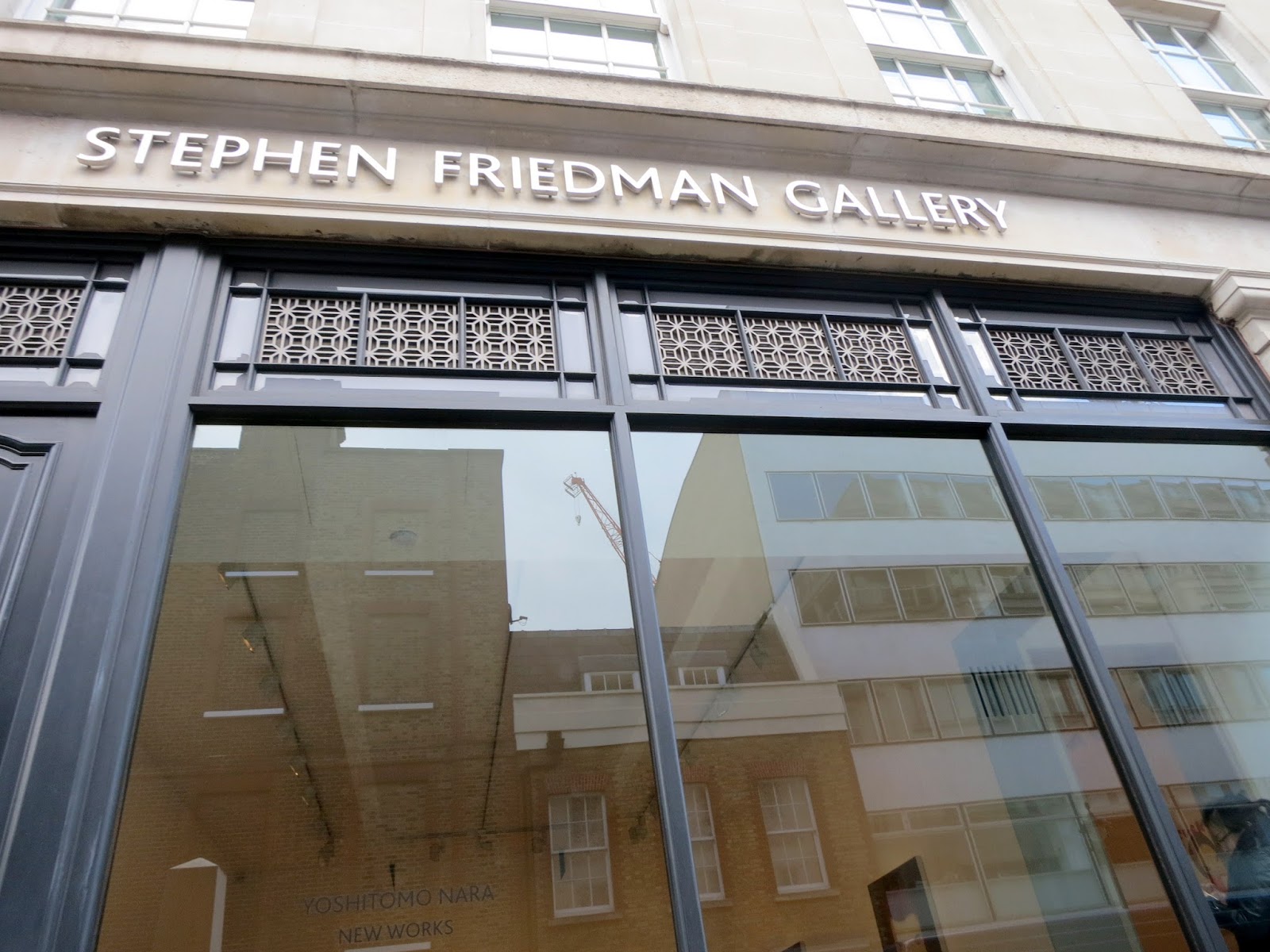
Yoshitomo Nara at Stephen Friedman Gallery, Mayfair, London.

This work is very different to what I usually choose to go and see and I am still not sure what my response to it is, but I am glad we went as it's given me food for thought.


'Yoshito Nara is one of the leading artists of Japan's Neo Pop movement and is best known for his depictions of simultaneously cute and devilish children and animals. Informed by elements of popular culture ranging from manga and anime to punk rock, Nara fuses Japanese visual traditions and Western Modernism to create adorable but menacing characters that possess a startling emotional intensity'. (Text taken from here )

The work we saw is painting and drawing in picture-book style depicting children with staring eyes, with little or no background. But these  children who appear at first to be cute and even vulnerable, sometimes brandish weapons; their wide eyes often hold accusatory looks that could be sleepy-eyed irritation or could be undiluted expressions of hate. Nuanced depictions of alienation, anger and curiosity are expressed in each work. The apparent naivety of the characters Nara depicts are juxtaposed with slogans and often strong language. The contrast illustrates the angst of adolescent experience. The characters are at once cheeky, vulnerable and threatening.

The paintings are super flat.


Marching on the Butterbur Leaf, 2016 (acrylic on cotton mounted on wood panel)


Knife, 2015, (pencil on paper)


 I don't Want to Grow up, 2016, (acrylic on cotton mounted on wood panel)


Fuck U, 2016, (acrylic on cotton mounted on wood panel)


Miss Margaret, 2016, (acrylic on canvas)


Dead of Night, 2016, (acrylic on canvas)


Anxious, 2016, (acrylic on canvas)


Hey Girl, 2016, (ballpoint pen on paper)


I have to say that the Dylan lyrics made Ken very happy....


Younger Than Now, 2016 (ballpoint pen on paper)


How Many Words, 2016 (ballpoint pen on paper)


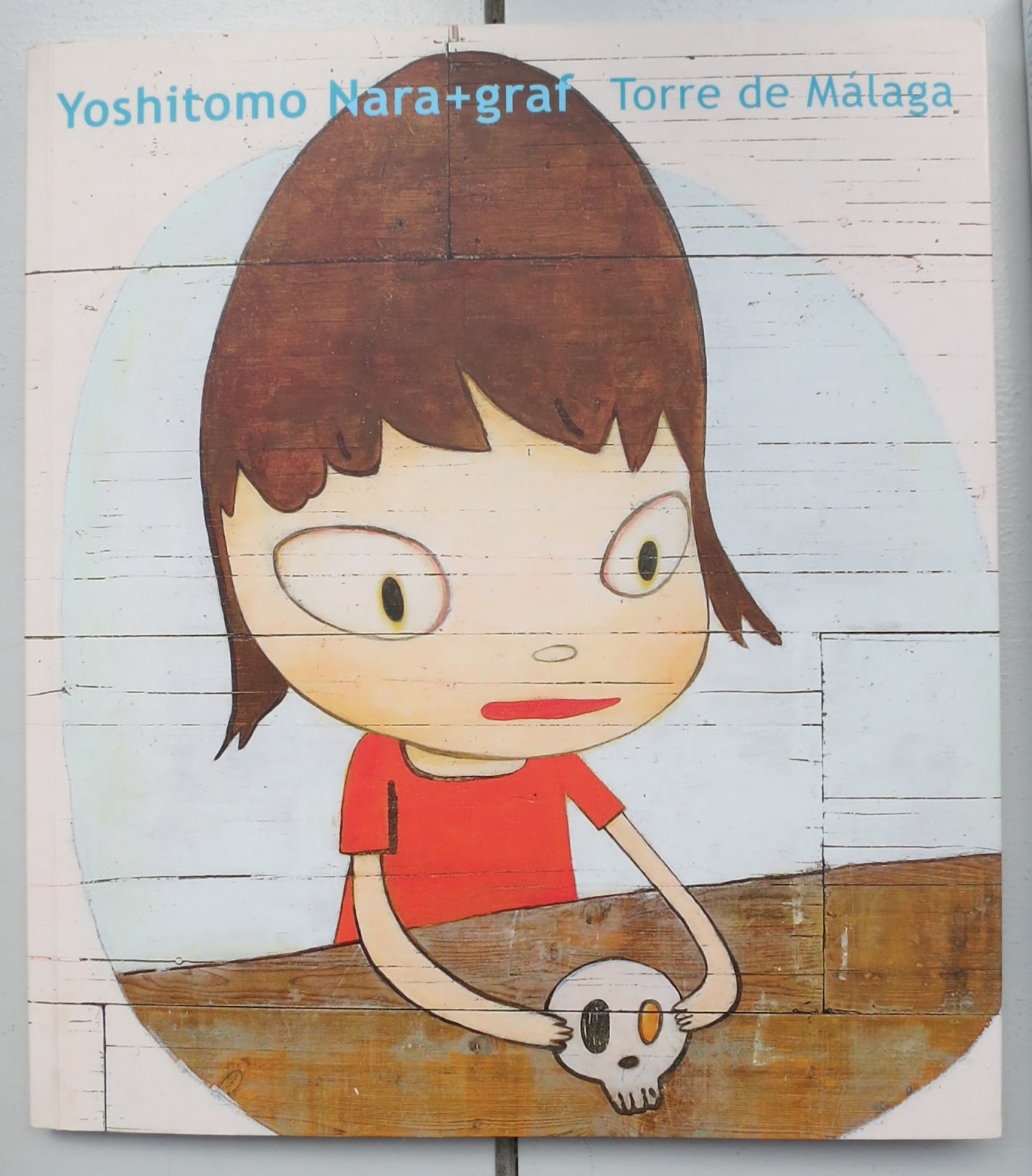
Below two of Nara's books that were also on display:


We then walked across the road to the second Stephen Friedman gallery: 'Horizon That Appears Out of the Sleepy Woods' , a group show of younger Japanese artists, all four selected by Yoshitomo Nara.


Takanobu Kobayashi:

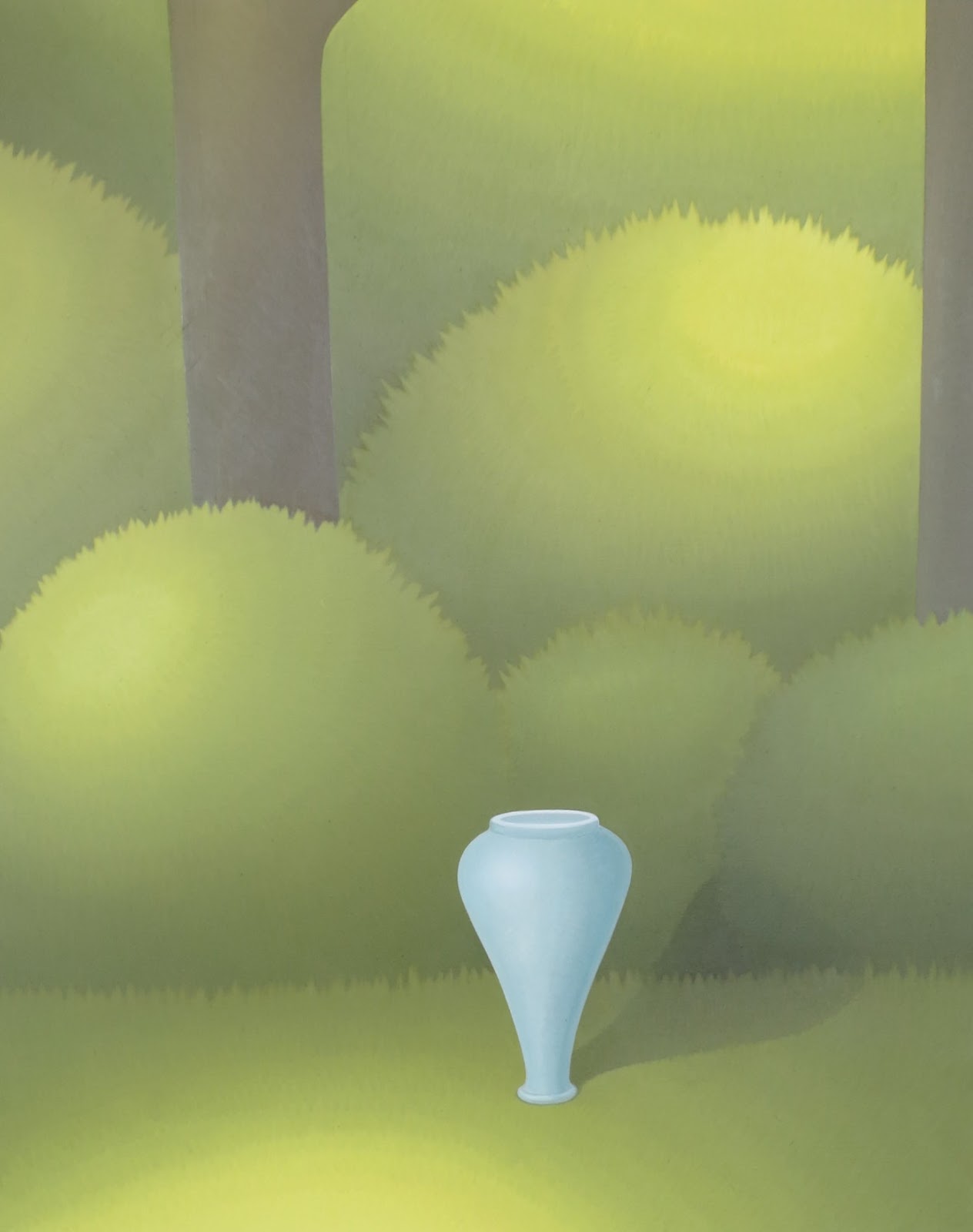
'I want to depict existence. Everything has a characteristic attribute and that's where its meaning comes from. Once you take away the meaning, you get down to the essence. My idea is to paint vessels, people, pillows or trees, all in the same way as 'things'.'


Inverted Vessel, 2015 (oil on canvas)


Block, 2014, (oil on canvas)


Block, 2015, (oil on canvas)


Pillow, 2016, (oil on canvas)


Kuomo Murase:

'It seems as if I am depicting a moment, but the image includes multiple histories including times of doubt and uncertainty, which may indeed be a kind of entry into the work. Even if you enter the work, however, you may find that things are in flux, which can be simultaneously comforting and disturbing'.


Plant the Flowers (Two Girls), 2013 (gouache, coloured pencil on paper)


Sloop (Orange), 2014 (gouache and coloured pencil on paper)


Sandy, 2012 (oil, crayon on cotton).