This exhibition explored Marcel Duchamp's legacy by tracing his interactions and exchanges with four post-war artists: composer John Cage, choreographer Merce Cunningham and visual artists Robert Rauschenberg and Jasper Johns
Often cited as the forerunner of conceptual art, and often considered the most influential artist of the 20th century, Duchamp radically altered what we think of as art.
This was a highly cerebral exhibition and I hope I have done it justice in this post.
on a kitchen stool. His practice emphasized ideas over objects, chance over taste and the notion of the artist as provocateur over illustrious creator.
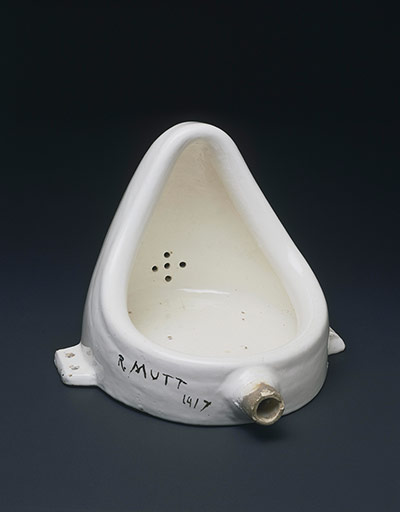
The readymade is often considered Marcel Duchamp's most influential contribution to 20th century art. His idea was to select a limited number of specific mass produced objects - ones that achieved what he defined as aesthetic or visual indifference - to be presented as works of art. The provocative nature of the readymade led to Duchamp being intrinsically linked with Dada, the anarchic movement of the late 1910s and early 1920s, dedicated to overturning established values within art and society.
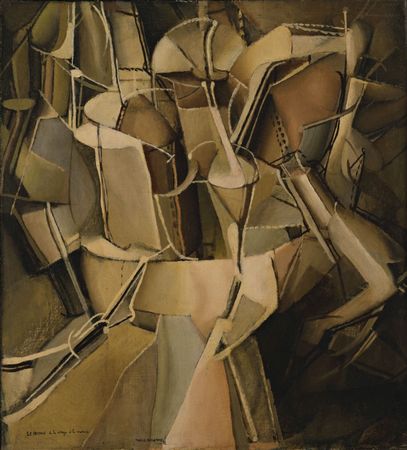
The change of status with all its sexual and social ramifications.
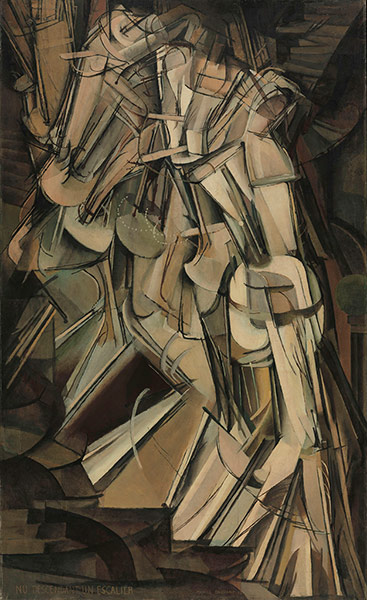
A cubic painting, depicting the passage of a body through space. The discernible body parts are assembled together in such a way as to suggest rythm and to convey the movement of the figure merging into itself.
(The light in the gallery was not condusive to good photographs, so I have downloaded a picture, where it is much clearer).
Duchamp worked on this piece from 1915 to 1923 creating two panes of glass with materials such as lead foil, fuse wire and dust. It depicts the erotic encounter between the Bride, in the upper panel, and her nine frustrated Bachelors, gathered below in the lower panel.
There are numerous interpretations of this piece. Marjorie Perloff interprets the painting as enigmatic, concluding that the piece is a critique of the very criticism it inspires, mocking the solemnity of the explicator who is determined to find the 'key' to the artwork. In this interpretation she follows the school of deconstruction established by Derrida and helps to break down the hegemony of interpretation held by the Enlightenment bourgeoisie. To back up her point she quotes Duchamp:
'I believe that the artist doesn't know what he (sic) does. I attach even more importance to the spectator than to the artist'.
Bride's Folly, Robert Rauschenberg, 1959
A development of Rauschenberg's 'combines', this is a merging of gestural paintings with found objects. He began this painting after having seen
The Large Glass.
The piano near the entrance has been 'modified' (a frequent practice by John Cage, an act directly comparable to Duchamp's 'assisted readymades') or 'prepared' to play Cage's
Music for Marcel Duchamp: there was no pianist, the piano just played by itself.
Main Stage:
At the centre of the exhibition is the main stage, featuring stage sets by Robert Rauschenberg and Jasper Johns positioned around the dance floor. Created during his tenure as artistic director of the Merce Cunningham Dance Company, Johns' original stage set is a prime example of the interdisciplinary collaborations that took place between these artists.
Johns transformed the two-dimensional elements of
The Large Glass into seven transparent inflatables that hang over the stage while the dancers moved to Cunningham's choreography.
We watched three performances of what Cunningham thought of as dance equivalents to Duchanp's readymades, a mixture of solos, duets and smaller group works.
You can see Johns' interpretation of
The Large Glass above the dancers' heads.
Upper Level:
A few works by
Jasper Johns. Johns used pre-existing symbols such as flags, targets and numbers,
'things the mind already knows'.
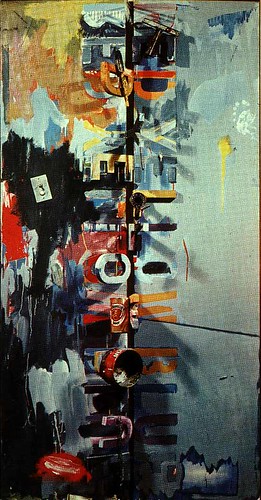
Field Painting, Jasper Johns, 1964
This painting is not flat: the primary colours red, yellow and blue are spelled out in letters hinged to the canvas. Attached to them are various studio tools. A Savarin coffee tin and a Ballantine beer can are also attached. Smeared paint, a footprint, a light switch and a neon R are also to be found here.
Painted Bronze (Ale Cans), Jasper Johns, 1964
In 1960 Johns began to create trompe d'oeil sculptures: painted bronze casts of everyday objects, such as these Ballantine ale cans
or this
Savarin coffee tin (painted bronze). Inverting Duchamp's creative approach to the readymade, Johns' carefully crafted simulations of common objects made in a traditional artistic medium. Far from a direct copy of a mass-produced object, it presents the tin into a paint-splattered brush holder emphasising the act of personal selection in the creation of a readymade. He signed his casts with a thumbprint.
Robert Rauschenberg.
Rauschenberg worked in what he called
'the gap between art and life'. In the early 1950s he began using found materials from the street to make assemblages which he called his 'combines', an innovative form of art that blurred the boundary between painting and sculpture.
Music Box, (Elemental Sculpture), after 1953
On his return to New York after travelling to Italy and North Africa with his lover Cy Twombly, he started on a series of assemblages made of wood, stone, twine, steel spikes and other materials found in his neighbourhood. In
Music Box, the wooden box was intended to be shaken, allowing the rocks to move against the protruding nails inside the work, thereby rearranging the parts and producing a changing, percussive sound. The sculpture's openness to chance, its acknowledgement of the audience's role in completing the work and flouting of the then current models of taste, reveals the audible trace of Duchamp whom he encountered for the first time that same year. Rauschenberg was undoubtedly thinking of Duchamp's sculpture
With Hidden Noise (1916) when conceiving of the work. On shaking
Music Box, Duchamp supposedly commented:
'I think I've heard that song before'.
In 1951 Rauschenberg created his revolutinary
White Paintings. This was the time when Abstract Expressionism was ascendant in New York and Rauschenberg's uninflected all-white surfaces eliminated gesture and denied all possibility of narrative or external reference. In this radical reduction of content he was presaging Minimalism by a decade. These paintings influenced John Cage who interpreted the blank surfaces as 'landing strips' or receptors for light and shadow, and he was inspired to pursue the corresponding notion of silence and ambient sound in music. His response was
4'33' (1952), consisting of a pianist sitting quietly at the piano without touching the keys for four minutes and thirty three seconds so that incidental sounds in the surrounding environment - the wind in the trees outside, the whispering of audience members - determined the content of the piece.
Chance:
3 Standard Stoppages, Marcel Duchamp, 1913-14
(We were not allowed to take photographs at the Barbican, so this photograph I took at MOMA in New York, which you can see
here ).
'This experiment was made in 1913 to imprison and preserve forms obtained through chance, through my chance. At the same time, the unit of length, one meter, was changed from a straight line to a curved line without actually losing its identity as the meter, and yet casting a pataphysical doubt on the concept of a straight edge as being the shortest route from one point to another'.
When asked which was his most important work, he replied:
'As far as date is concerned I'd say Three Stoppages of 1913. That was when I really tapped the mainspring of my future. In itself it was not an important work of art, but for me it opened the way - the way to escape from those traditional methods of expression long associated with art... For me Three Stoppages was a first gesture liberating me from the past'.
3 Stoppages was made at a time of widespread contemporary scepticism concerning the objectivity of scientific knowledge. Duchamp may have been influenced by popular science books which discussed the relativity of all standards of measurement.
Network of Stoppages, Marcel Duchamp 1914
This painting was not exhibited at the Barbican, but I took this photograph in New York, which you can also see
here . I have included it because it is relevant to
The Large Glass: Duchamp used each wooden template from
3 Stoppages three times to map the diagrammatic painting
Network of Stoppages (above) and which served as a means of positioning the elements of the Bachelors in
The Large Glass. I hope that makes sense.
After painting
Bride in 1912, Duchamp increasingly experimented with chance, creating both a musical score
Erratum Musical in 1913, and the
3 Stoppages sculpture, before beginning the construction of his greatest tribute to chance,
The Large Glass.
Influenced by this, John Cage adopted the hexagrams of the
I Ching, as a readymade system for what would become known as his 'chance operations'. Cage's
Music of Changes in 1951 is often considered the first modern music piece to be conceived wholly through random procedures.
Merce Cunningham also employed the
I Ching to determine aspects of his choreographies. In
Suite for Five in 1956, he created a dance using chance methods and recollects how the piece was conceived
: 'The space was done by taking pieces of paper... and marking the imperfections in each piece - if you look at any piece of paper you see little dots - I would number these dots, and by chance means decide where somebody started in space and to what space he (sic)
went next, the next one and so on'.
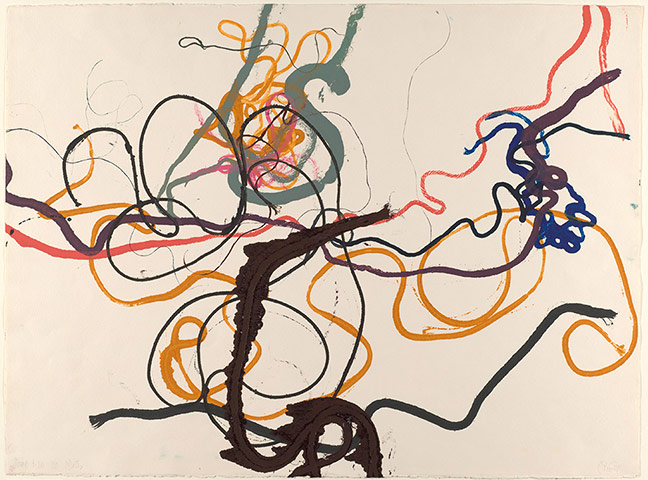 Strings, John Cage, 1980
Cage revolutionised the course of modern music by using chance-derived operations to diminish his own personal preferences in the compositional process. In an act reminiscent of
3 Standard Stoppages, Cage dropped ink-soaked strings of different lengths from a step ladder onto pieces of paper to create the series
Strings in 1980.
Veil, Robert Rauschenberg, 1974
Rauschenberg's
Veils coexist sympathetically with Cage's
Strings. They are lithographs created by dropping handkerchiefs randomly onto light-sensitive photo emulsion plates.
As I said at the beginning of this post, this was a highly cerebral exhibition which was also very enjoyable. We spent an awful long time there, trying to make all the connections between the five artists. What I have included in this post is only a small fraction of what was exhibited.