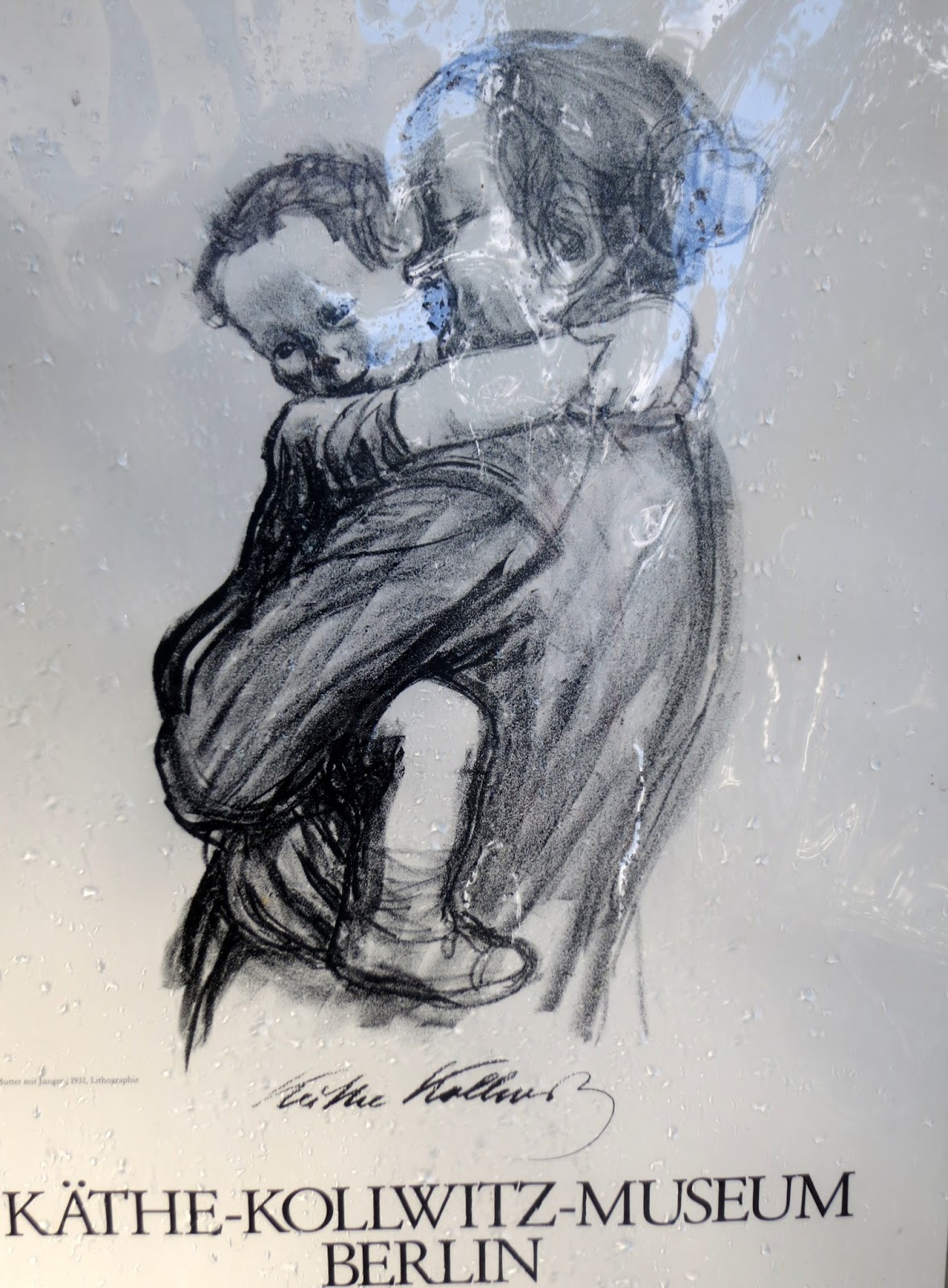
Situated in a leafy residential street in West Berlin

the Kaethe Kollwitz Museum in Berlin, is a real gem.

One of the artist's sculptures (Mother and Children) in the front garden

Kollwitz worked as a painter, printer and sculptor. Her printmaking work includes etching, lithographs and woodcuts. Despite the realism of her early works, her art is now more closely associated with Expressionism which together with the Bauhaus were major influences in her later years. The themes of most of her work are the effects of poverty, hunger and war on women and the working class. She was the first woman elected to the Prussian Academy of Arts.

Her husband tended to the poor in Berlin where the couple moved into the large apartment that would be Kollwitz's home until it was destroyed in WWII. The proximity of her husband's practice proved invaluable:
'the motifs I was able to select from this milieu (the workers' lives) offered me, in a simple and forthright way, what I discovered to be beautiful... People from the bourgeois sphere were altogether without appeal or interest. All middle-class life seemed pedantic to me. On the other hand, I felt the proletariat had guts. It was not until much later... when I got to know the women who would come to my husband for help and incidentally also to me, that I was powerfully moved by the fate of the proletariat and everything connected with its way of life... But what I would like to emphasise once more is that compassion and commiseration were at first of very little importance in attracting me to the representation of proletarian life; what mattered was simply that I found it beautiful'.
The works in this post are not necessarily the ones I liked best, or what I thought were the most representative of her oeuvre, but the ones that did not have reflection from the glass. I am not pleased with the quality of any of the images I have reproduced here, but I needed to do this post.

Colour drawing for Pieta, 1903

Self-portrait, (charcoal drawing), 1916

Hans Kollwitz with Nurse, (pen and ink drawing), 1894

Woman with Pained Face, (pencil drawing), 1900

Female Home Worker, (charcoal drawing), 1906

Poster for German Cottage Industry Exhibition in Berlin, 1906

Child in an Accident, (charcoal drawing), 1909-10
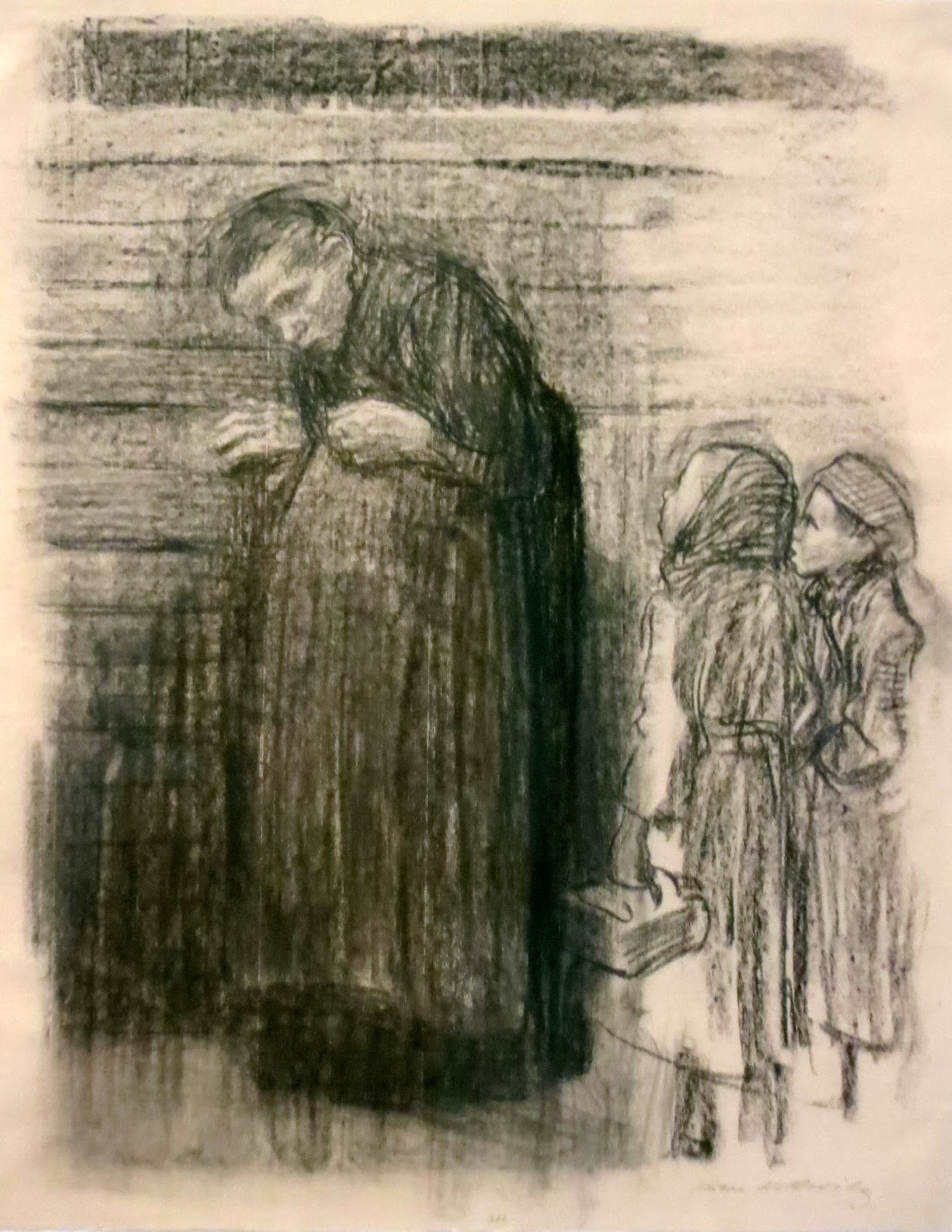
Christmas, (charcoal drawing), 1909

Welcome, (etching), 1892

Self-Portrait, (pen and ink drawing), 1890
The Weavers' Revolt, 1893-97:
A series of three lithographs and three etchings about the Silesian weavers' revolt of 1844: weavers protested against low wages and their revolt was crushed. Their desperate situation became public knowledge: Heinrich Heine wrote a poem about the revolt, and Gerhart Hauptmann, a play. Kollwitz saw a performance of this play in 1893 which prompted her to examine this conflict in more detail. Not a literal illustration of the drama, the works were a free and naturalistic expression of the workers' misery, hope, courage, and eventually doom. The series was a huge success and became her most widely acclaimed work.

Need, (lithograph)

Death, (etching)

Conspiracy, (etching)

March of the Weavers, (etching with aquatint and sandpaper)

Storming the Gate (etching with aquatint and sandpaper)

The End (etching with aquatint and sandpaper)
The Peasant War:
Kollwitz's second major cycle of works was the Peasant War. The German Peasants' War was a violent revolution which took place in Southern Germany in the early years of the Reformation. Peasants who had been treated as slaves took arms against feudal lords and the church. This too, ended in bloody defeat. Contemporary uprisings inspired Kollwitz to produce these works. The initial source of Kollwitz's interest in this revolt dated to her youth, when she and her brother Konrad playfully imagined themselves as barricade fighters in a revolution.

Black Anna, (chalk drawing)
The artist identified with the character of Black Anna, a woman cited as a protagonist in the uprising.
Works in this series include: Plowing, Raped, Sharpening the Scythe, Arming in the Vault, Outbreak, After the Battle (which features a mother searching through corpses in the night, looking for her son), and are Kollwitz's highest achievements as an etcher. Unfortunately, none of my photographs of those came out without reflection so I am unable to include them.
For Kaethe Kolwitz, old age began at the age of 47 when her younger son, Peter, died. As a war volunteer, he was killed during WWI. She bore a heavy sense of guilt for not stopping him.
It was then that she discovered wood-cutting with its hard lines, and henceforth renounced the smooth and smaller format of etching. She found more energetic and simpler forms.

Seed for Sowing Should not be Milled, 1941-42, (chalk lithograph)

Death is Recognised as Friend, 1937, (chalk lithograph)

Bread! 1924, (limestone printing block)

Mother with Young Boy, 1933, (lithographic limestone printing block)

Parents with Child, 1931, (lithograph)

Mothers, Share your Abundance! 1926, (lithograph)


Help Russia (poster without text), 1921, (lithograph)

Head Study of Karl Liebknecht on his Deathbed, 1919, (chalk drawing)

In Memoriam Karl Liebknecht, 1920, (woodcut)

Self-Portrait, 1922, (woodcut)

Pensive Woman, 1920, (chalk lithograph)

War, (one of seven lithographs), 1921-22

Kollwitz's printing press was discovered in the 1970s together with the lithography stones for Bread and Mother with Boy. The press and stones can be traced back to the time of WWII

Lithography is a planographic process. The chalk drawing is rich in grease. If the limestone is then wetted with a sponge, and colours containing grease are applied lightly with a roller, only the greasy parts accept the ink. Water and grease repel each other.