Showing posts with label women's art. Show all posts

Saturday, 16 November 2024

Now You See Us


Now You See Us - Women Artists in Britain 1520-1920


at Tate Britain.


The exhibition begins with the earliest recorded women artists working in Britain. It ends with women's place in society fundamentally changed by WWI and the first women gaining the right to vote. Across these 400 years, women were a constant presence in the art world. The exhibition explores these artists' careers and asks why so many have been erased from mainstream art histories.

Organised chronologically, the exhibition followed women who practised art as a livelihood rather than an accomplishment. The chosen works were often exhibited at public exhibitions, where these artists sold their art and made their reputations. These women were regarded differently and their fight to be accepted as professional artists on equal terms with men was hard.

Many of the works we saw reflected prejudiced notions of the most appropriate art forms and subjects for women. Others challenged the commonly held belief that women were best suited to 'imitation', proving they have always been capable of creative invention. From painting epic battle scenes to campaigning for access to art academies, these women defied society's limited expectations of them and forged their own paths. Yet so many of their careers have been forgotten and artworks lost. Drawing on the artists' own writings, art criticism, and new and established research, this exhibition attempted to restore these women to their rightful place in art history.

In this post I have concentrated on more recent artists and their work while at the same time, trying to give a brief history of these 400 years.


Angelica Kauffman, Invention, 1778-80, (oil on canvas)

This painting is one of four allegorical roundels representing the Elements of Art that Kauffman was commissioned to paint for the ceiling of the Royal Academy's Council Chamber. In this work, a figure representing 'invention' looks upwards for inspiration.

The Academy's first president Joshua Reynolds, claimed that a painter's gift for invention was their power of committing a mental picture onto canvas. At the time, this form of artistic 'genius' was considered the exclusive preserve of men. Women artists were regarded as 'imitators' incapable of complex creativity. Here, Kauffman presents invention as a woman.

(Of the 36 founding members of the Royal Academy's of Art only two were women: Angelica Kauffman and Mary Moser. It would be over 150 years before another woman was elected a member of the Academy)


Artemisia Gentileschi, Self-Portrait as the Allegory of Painting (La Pittura), 1638-1639, (oil on canvas)

Here, Gentileschi uses her own image to portray the allegorical figure of Pittura who she depicts in a working apron before an easel absorbed in the act of creation.


Artemisia Gentileschi Susanna and the Elders, 1638-1640, (oil on canvas)

I have written about these two paintings by Gentilseschi extensively here

For more on Gentileschi you can go here

    
                                                                            *   *   *

In the 17th century women writers, poets, playwrights and artists began to give voice to those questioning their secondary status and petitioning for women's rights. They argued that it was lack of education, not 'weak minds' that limited their opportunities. This fight for equality and access to education runs throughout the exhibition.

The first public art exhibition in Britain took place in London in 1760, and art shows soon became an important part of the city's social calendar. Women artists played an active part in this competitive world.

Kauffman is one of the few women artists of the 18th century whose profile has been sustained. Many others made names for themselves, but their careers are not well documented. 

Art critics of the time often criticised women for their 'weak'  figurative work, yet they were denied access to life-drawing classes. Painting for money was considered improper. After marriage, many switched their status from commercial to amateur.


Angelica Kauffman, The Return of Telemachus, 1775, (oil on canvas)

                                                                     *   *   *

In the 18th and 19th centuries, painting flowers was considered a suitably delicate pursuit for women. Imitating nature (rather than demonstrating creative or imaginative flair) was thought to be an appropriate outlet for women's artistic skills. Flowers were also at the heart of respectable hobbies like embroidery, botany and gardening. Many women were employed as professional illustrators, recording plant species for horticulturists and botanical publishers.


Augusta Innes Withers, An auricula in a pot with a wicker cache-pot, 1830, (watercolour and gum arabic)


Clara Maria Pope, Peony, 1822, (bodycolour on card)


Augusta Innes Withers, Crompton's Sheba Queen, (gooseberries), 1825, (watercolour on paper)


                                                                            *   *   *


From the 1850s women petitioned for equal rights to education and work, as well as women's suffrage.


Emily Osborn, Nameless and Friendless 'The rich man's wealth is his strong city: the destruction of the poor is their poverty', 1857, (oil on canvas)


Louise Jopling, Through the Looking Glass, 1875, (oil on canvas)


Anna Lea Merritt, Love Locked Out, 1890, (oil on canvas)


Louise Jopling, A Modern Cinderella, 1875, (oil on canvas)


Elizabeth Forbes, School is Out, 1889, (oil on canvas)


Marianne Stokes, The Passing Train, 1880, (oil on canvas)


Julia Margaret Cameron, The Return After Three Days, 1865, (photograph, albumen print on paper)

                                                                                *   *   *

Photography gave women new opportunities. Cameron was given a camera in 1863; within a year, she was elected to the Photographic Societies of London and Scotland.


Julia Margaret Cameron, Hypatia (marie Spartali), 1868, (photograph, albumen print on paper)

Women were excluded from enrolment at the Royal Academy Schools, Britain's principal art academy, until 1860. Laura Herford was the first woman admitted. She had submitted her work for consideration using only her initials and was assumed to be a man. Women were barred from the Academy's life-drawing classes until 1893. In 1871, the founding of the Slade School of Fine Art at University College London signalled a fundamental change of attitudes. From the outset, the Slade offered women an education on equal terms with men.


Laura Knight, Portrait Study, Girl's Profile, 1896, (charcoal on paper)


Ida Knox, Male Figure Seated, 1918, (oil on canvas)

With this study of a semi-draped male figure, Knox won joint first prize for figure painting at the Slade in 1918. Knox painted it in a mixed class. There were more women students than men at the Slade.


Elinor Adams, Female Seated Figure, 1906, (oil on canvas)

                                                    
                                                                *   *   *


Being Modern:

The first two decades of the 20th century saw rapid change for women, with their rights, roles and opportunities evolving at an unprecedented pace. WWI signalled a decisive change for women's place in society and in 1918 after decades of campaining, some women finally gained the right to vote.

At the same time, the art world was also changing. New art groups and exhibiting societies rejected tradition and promoted modernist aesthetics. Instead of figurative realism, they privileged form, colour and experimentation. Many saw modernism as an opportunity for greater artistic freedom. However, despite growing liberalism in art and society, women artists still faced challenges. Women however, forged their own paths and pursued professional careers with purpose and confidence. 


Laura Knight, The Bathing Pool, 1912, (watercolour on paper)

In 1907, Knight and her husband moved to Cornwall. The scenery, company and working conditions nurtured her productivity. Knight began painting outdoors in the open air, and her sunlit scenes of leusure, sun-bathing and sea-bathing are free from academic convention. This watercolour has similarities to a large canvas exhibited at the RA in 1911. As an ambitious work showing women at ease with their bodies, it challenged conservatives expectations of women's art.


Laura Knight, A Dark Pool, 1917, (oil on canvas)


Laura Knight, At the Edge of the Cliff, 1917, (oil on canvas)


Laura Knight, My Lady of the Rocks, 1917-18, (oil on canvas)


Arna Airy, Shop for Machining 15-inch Shells: Singer Manufacturing COmpany, Clydebank, Glasgow, 1918, (oil on canvas)


Clare Atwood, Olympia in War Time: Royal Army Clothing Depor, 1918, (oil on canvas)


Clare Atwood, The Terrace Outside the Priest's House, 1919, (oil on canvas)

Atwood, who went by both 'Clare' and 'Tony', enjoyed a public life working for prestigious institutions and a gay private life. The artist openly identified as a lesbian, and from 1916, lived in a menage a trois with the actor, theatre director, producer and designer Edith Craig and writer and playwright Christabel Marshall. Here, Atwood shows the three partners at their home, the Priest's House, Kent. 


Gwen John, Self-portrait, 1902, (oil on canvas)


Gwen John, Chloe Boughton-Leigh, 1904-8, (oil on canvas)

To see more of Gwen John's work go here


Vanessa Bell, Still Life of Dahlias, Chrysamthemums and Begonias, 1912, (oil on board)

In 1905, Bell founded the Friday Club, offering young artists the opportunity to connect and exhibit. It led to the formation of the Bloomsbury Group, a collective of writers, artists and intellectuals based in London. Artist and critic Roger Fry, a central figure of the group, invited Bell to exhibit at his landmark Second Post-Impressionist Exhibition at the Grafton galleries in 1912. This work was painted around the same time. It was painted a period of experimentation for Bell. The flowers are given a geometric simplicity that reflects Bell's semi-abstract style at the time.


Vanessa Bell, Still Life on Corner of a Mantelpiece, 1914, (oil on canvas)

Bell's use of an unconventional low viewpoint, fractured, abstracted forms and bright colours show her exploring different techniques associated with 20th century art movements.

To see more of Bell's work go here and here


Dolores Courtney, Still Life, 1916, (oil on canvas)


Nina Hamnett, Still Life with a Blue Jug, 1917, (oil on canvas)


Nina Hamnett


Ethel Walker, Decoration: The excursion of Nausica, 1920, (oil on canvas)

From 1912, Walker's focus shifted to what she called her 'decorations'. She moved to a more symbolist aesthetic on a large scale. Here, Walker's scene is based on Book VI from Homer's Odyssey. While washing clothes with her attendants, Nausica encounters a shipwrecked Odysseus. Walker transports this episode to a peaceful utopia comprised almost exclusively of women. Walker often placed women at the centre of her works, celebrating their bodies and sexuality.


Ethel Walker, The Thames at Chelsea, (oil on canvas)


Ethel Wright, The Music Room, Portrait of Una Dugdale, 1912, (oil on canvas)

This is a portrait of suffragette and women's rights activist Una Dugdale. Wright shows Dyvak as cultured and sophisticated, dressed in green, a suffragette colour. Wright made the work the same year Duval made national news for her refusal to promise to obey her husband during their marriage vows. In 1913, Duval published a pamphlet, Love and Honour but Not Obey.


Una Dugdale DUval, Love and Honour but Not Obey, 1913


Sylvia Gosse, The Printer, 1915, (oil on canvas)


Sylvia Gosse, The Nurse, 1920, (oil on canvas)

Gosse's fascination with working women makes her art distinct. The model for this work is likely to be her sister Tessa, who served with the Scottish Women's Hospitals at the front in WWI and was decorated for her work.


Anna Airy, Study for the 'L press: forging the jacket of an 18-inch gun, Armstrong.' 1918, (oil on canvas)


Monday, 1 January 2024

Monica Sjoo - The Great Cosmic Mother


Happy New Year to you all! Let's hope that 2024 is a better one.


Monica Sjoo - The Great Cosmic Mother


at Modern Art Oxford.


The Swedish artist, activist, writer and eco-feminist Monica Sjoo (1938-2005) anchored her creative work in an uncompromising fight for freedom from oppression in all its forms. Sjoo's works were created to be agents for change - both political and spiritual. Following the mantra 'no spirituality without politics', she came to be an influential figure in both the Women's Liberation Movement and the Goddess movement internationally. Tracing the artist's deep commitment to feminism and environmental justice, this retrospective exhibition considers Sjoo's artistic and activist practice - a practice that chimes with many social and political challenges and protest movements today.

Sjoo's political consciousness was formed early on by the Vietnam War protests, the anarchist movement, the independent art scene, and the women's movement. These experiences collectively shaped the foundation for her radical life as an artist and activist in Bristol, where she came to live for most of her life. Sjoo's work was controversial from the start. As a co-founder of Bristol Women's Liberation, Sjoo campaigned to end violence against women and protested for women's abortion rights, sexual autonomy and wages for housework. She visualised the demands of feminist activism through her vivid and bold paintings, merging forthright political slogans with images of women from across history and cultures. Sjoo also participated in several pioneering feminist group exhibitions at this time.


Gallery 1:


I loved the early paintings - such strong statements about women's oppression and the wish for liberation. I found the Great Mother ones difficult to relate to and I don't think they had the clear voice of the early ones.


Untitled, 1968, (oil on masonite, paper fragments)


Emma Goldman, 1967, (oil on masonite)

In protests and campaigns for abortion rights and sexual freedom, Sjoo would often cite Goldman's words: 'Women need not always keep their mouths shut and their wombs open' on posters that were widely distributed.


Aspects of the Great Mother, 1971, (oil on masonite)


Housewives, 1973, (oil on masonite)


Sisterhood is Powerful, 1972, (oil on masonite, textile)


Backstreet Abortion - Women Seeking Freedom from Oppression, 1968, (oil on masonite, textile)


Cretan Mysteries, 1980, (oil on masonite)


God Giving Birth, 1968, (oil on masonite)

Several of Sjoo's works depict her interpretations of ancient matriarchal societies, where religion centred on the figure of the Great Mother. In Sjoo's view, the Great Mother who is the motif of this painting, was the source of all life. When the painting was exhibited in the 1970s, it provoked strong reactions. At one point, Sjoo was reported to the police and accused of blasphemy and obscenity, but the charges were ultimately dropped.


Cosmos within her Womb, 1971, (oil on masonite)


Study for Birth and the Struggle for Liberation, 1970, (graphite and distemper paint on paper)


Birth and the Struggle for Liberation, 1970, (oil on masonite, textile)


Cosmos within her Womb, 1971, (oil on masonite)


Our Bodies Outselves, 1974, (oil on masonite, textile)


Gallery 2:


The multiple, parallel forms of oppression Sjoo experienced in her life time led her to believe that only total transformation would create meaningful change. This would not solely be a revolution of human social relations, but also  in our relationship to nature. Sjoo's life was also shaped by an awareness of the threat to the cosmos, as she often noted, 'the splitting of the atom, the first nuclear fission, took place the very year and month that I was born - December 1938'. For Sjoo, the destructive potential of nuclear weapons resulted from skewed patriarchal logic that sought to control rather than sustain life. Her growing environmental consciousness took on renewed energy in the 1980s through her involvement in anti-nuclear protests and the growing women's peace movement in the UK.

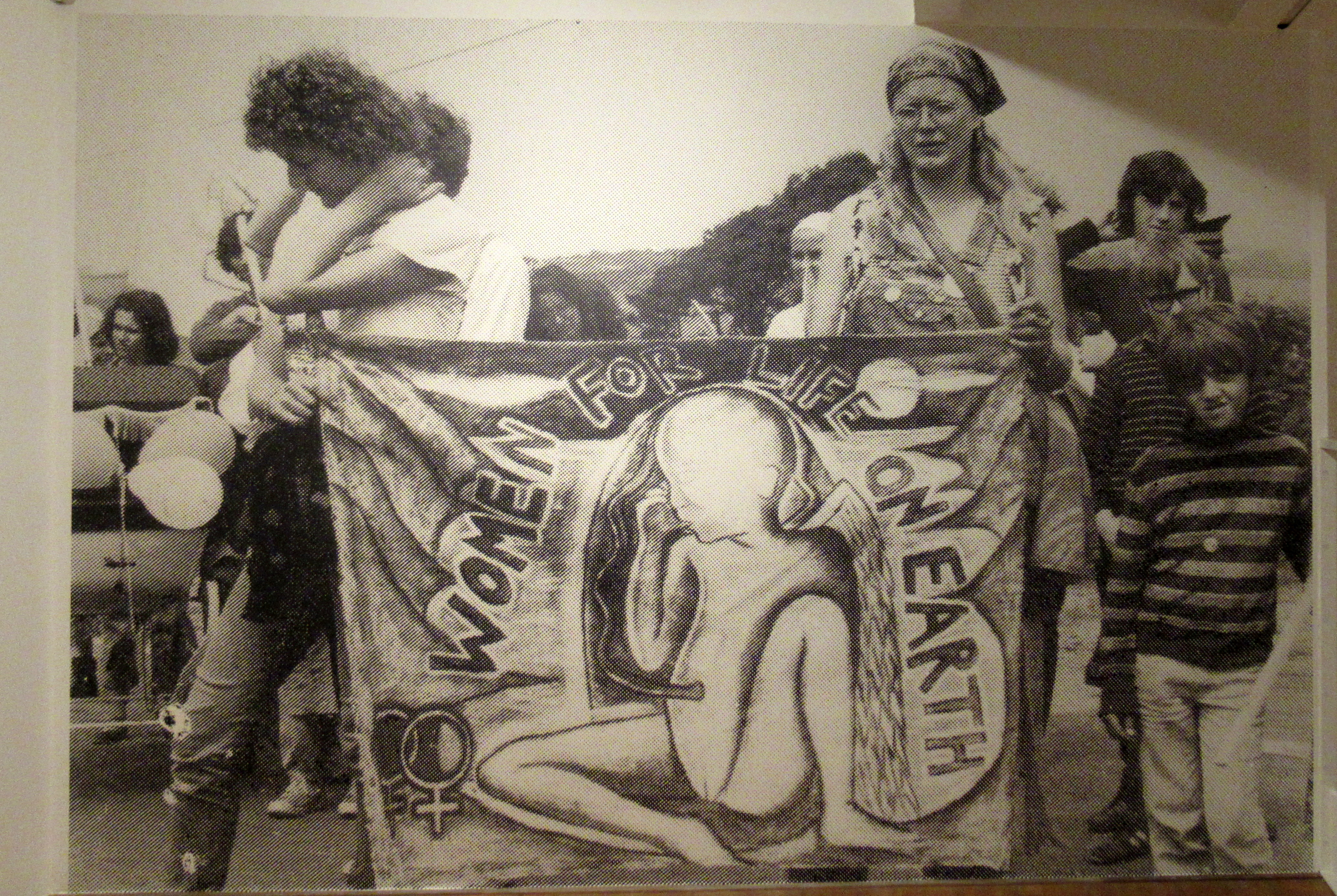
During a heightened period of Cold War tensions, the British government agreed to house 'first-strike' nuclear weapons at a US Air Force base at Greenham Common in Berkshire in 1980, as well as mobilising a US naval presence at Brawdy in Wales, close to Sjoo's home. Sjoo responded by setting up a branch of the Campaign for Nuclear Disarmanent (CND) in Fishguard and making a banner for the emerging women's campaign at the request of Ann Pettitt, organising of the women's peace camp at RAF Greenham Common. The campaign group were eventually titled 'Women for Life on Earth'  and expressed eco-feminist principles by significantly invoking 'life', rather than political resolution such as disarmament. Sjoo created another banner for the 'Women for Life on Earth' peace march from Cardiff to Brawdy in 1981, which she later collated onto a wooden board to create the painting Lunar Child of the Sea (1982).


Lunar Child of the Sea, 1982, (oil on canvas and masonite)


The Goddess in Her Manifestations at Greenham Common, 1984, (oil on masonite)

Sjoo travelled to Greenham in December 1982, joining the Embrace the Base action in which 30,000 women linked hands around the military airbase perimeter fence, singing, chanting and decorating the grid of chain links. Sjoo understood the women's peace camp as a contemporary channel for the Great Mother to reassert her influence against the acute threat to life on earth. Despite the increasing Cold War hostilities and fear of nuclear destruction, a women's community flourished at Greenham Common women's peace camp, interweaving anarchism, eco-feminism, ecological activism and spirituality in devotional acts of protest, dance and song.


Monica Sjoo depicted on a postcard from the Women for Life on Earth Peace March, 1981, (PVC free wallpaper)


Gallery 3:


Sjoo spent many years of her life travelling to sacred sites across the world to connect with the Goddess and immerse herself in the 'Lunar Thinking' of prehistoric cultures. Her devotion to the Great Mother is articulated through her life-long relationship to Neolithic ritual sites, which she considered to be the sacred remains of ancient matriarchal societies. She was drawn to painting sacred landscapes following the transformative awakening she experienced when she sensed the presence of the Great Mother at Avebury in 1978. She writes: 'this experience of intense openness to all organic and growing Nature, feeling its breath and vibrating life, staying with me for a long time. As a result, the sea, stones and  mountains have appeared more and more in my images since then'.

Her eco-feminism dynamically merges with forthright environmental activism in this period. She worried about the heightened climate threat and was frequently engaged in different protest movements  against man's abuse of the Earth. She sought to unite eco-feminist, political and spiritual messages in her painting, and anticipated the climate crisis protests of today.

Her political involvement in the women's and environmental movements were inextricably linked to her spiritual conviction. Her politics always included action. Her actions included her art, and she believed that her art was her activism.


Meeting the Ancestors at Avebury, 1993, (oilo on masonite, textile)


St Non's Sell - Holy Grail, 1996, (oil on masonite, textile)


West Kennet Long Barrow - Abode of the Light/Dark Mother, 1989, (oil on masonite)

Sjoo was drawn to the womb-like underground burial chamber of West Kennet Long Barrow. The darkened entrance to the tomb is depicted in this painting. Sjoo writes of the stone chamber, 'this is the place of the Winter/Death/Cosmic Waters/Rebirth/the Dark aspect of the Goddess... we are here within Her season and we are welcome'. The painting was later acquired by the Glastonbury Goddess Temple, where it is currently displayed.


Rebirth from the Motherpot, 1986, (oil on masonite, textile)


The Goddess and Green Man/Tree of Life, 1999, (oil on masonite, textile)


Mother Earth in Pain, Her Trees Cut Down, Her Seas Polluted, 1996, (oil on masonite, textile)

Sjoo made this work in 1996 after visiting protests against the development of the Newbury bypass in Berkshire, where a dual carriageway was being built. Despite protests by climate activists, hundreds of acres of ancient woodland were destroyed to make way for the new road. Around the same time a gigantic oil spill took place outside Milford Haven in South Wales, causing great pollution along the  Pembrokeshire coastline and the death of thousands of birds.