Sunday, 24 November 2024

Li Jin - Simple Pleasures


Li Jin, Simple Pleasures at the Ashmolean, Oxford.

Li Jin, a prominent ink artist active from the 1980s, is best known for his playful and witty depictions of the sensory pleasure of the ordinaries, in contrast to the ideal and elegant life presented in traditional Chinese literati painting. The time he spent in Tibet after graduating from the Tianjin Academy of Fine Arts has left a lasting mark in his art, relaying the artist's contemplation of the pleasures and desires in life in relation to its impermanence.


Man and Dog, 1992, (ink and colour on paper)

This painting was made in Tibet. Li Jin's sojourn in Tibet profoundly impacted his art, transforming both his pictorial vocabulary and his ideas about self-existence and the material world, which have continued to inform his works.


Picture of a Beauty, 2001, (ink and colour on paper)

This looks like a traditional Chinese painting of a gentlewoman, consisting of an inscription and seals. Even the red lines and circles marking the inscription and the title resemble the traditional annotations used in Chinese classics. However, the inscription compares the figure's face with a flower in the rain and her waist with a willow in the wind.  This is an expression of sexuality and seduction, an element that Li Jin and his fellow 'New Literati' artists do not shy away from in their paintings.


Painting the Flower from its Reflection, 2002, (ink and colour on paper)

The most established imagery of geese in Chinese culture is associated with the calligraphy master Wang Xizhi (303-361), whose wrist movements were said to have been inspired by the graceful goose neck. However, a delicate female body in water is depicted here instead of a literati figure that represents Wang, dissolving a traditional literati imagery closely associated with geese.


Man Swimming in Lily Pond, 2021, (ink and colour on paper)

Water is an important element in Li Jin's works. He once claimed to have 'a special sensitivity towards wetness and moisture'.  Here the water is murky and overwhelming, only gradually becoming clearer towards the lilies, seemingly echoing the pure and noble quality of the flower in Buddhism and Chinese literature.


Nude Figure Diving, 2001, (ink and colour on paper)


Bath, 2001, (ink and colour on paper)

Instead of the western style bathtub as in this painting, what appears more often in Li Jin's works is the Chinese wooden bath barrel placed in a lush garden scene. For many in China, bathing and splashing in the courtyard in the summer is probably one of their fondest childhood memories.


Relieving his Bowels, 2001, (ink and colour on paper)


Sweet, 2001, (ink and colour on paper)

Mundane activities, such as bathing, eating or sleeping, are not typical subjects in Chinese ink painting but a signature theme of Li Jin, who renders the under-appreciated pleasures in these activities in life in an extraordinary way. Both the title and the warm tones here evoke the cosiness of being lost in a dream world, leaving one to wonder what the open book is about.


Beauties, 2002, (ink and colour on paper)

Both men and women in Li Jin's paintings are imperfect. Men are usually pot-bellied, and women come in all shapes and sizes. Their expressions do not clearly display any stereotypical masculinity or femiminity either and there is a characteristic absence of theatrical stances. Whether nude or clothes they often look as if they are solitary and no one is looking at them, or they simply do not care.


Monk (from the back), 2001, (ink and colour on paper)

Despite the inscription 'Enjoying the changing colours of the autumn mountains', there are no mountains at all in this painting, and the depicted figure is only showing his back. However, through the pose of the figure, whose hands clasp behind him, the artist has expressed an open and  calm attitude towards the passage of time implied in the inscription.


Figures Against a Background of Buddhist Text, 2000, (ink and colour on paper)

In stark contrast to the secular man (probably the artist himself) and man in the painting, the inscription that fills up the space is taken from Buddhist scriptures, a common element in Li Jin's work. The lasting concern for and interest in Buddhist throught in his works demonstrates the significant impact of his sojourns in Tibet in his art, while alighing with his chosen approach and subjects, which emphasise the significance of 'being present' even in the most 'insignificant' day practices.


Figures and cat, 1995, (ink and colour on paper)


Fang Lijun, Portrait of Li Jin, 1963, (ink on paper)


Friday, 22 November 2024

To Those Sitting in Darkness


To Those Sitting in Darkness, by Pio Abad


at the Ashmolean, Oxford.


An interesting exhibition and very different to what is usually exhibited in museums and galleries.

New drawings and objects by London-based artist Pio Abad. The title 'To Those Sitting in Darkness' is a reference to American writer Mark Twain's satire 'To the Person Sitting in Darkness' which strongly criticised imperialism. Deeply informed by the history of the world and particularly the Philippines, where Abad was born and raised, his works draw out transnational lines between historical incidents and people, and our lives today. Concerned with colonial history and cultural loss, Abad's works are exhibited together with select works by other artists and 'diasporic' objects chosen by the artist.

Abad views the exhibition as 'an act of illumination that puts unexamined histories on display and addresses objects that have been confined to the margins of story-telling'. Representing the artist's own voice, the commentary on each piece adds an important narrative layer to his visual work.


Carlos Villa, 1971

This portrait By Filipino American artist Carlos Villa looks to ethnographic imagery as a way of linking the past with the present. An Itek print is covered with ink designs on Villa's face, suggesting the tatooing culture prevalent in Pacific Islander cultures. While the facial marks are the artist's own design, the motifs reference transoceanic cultures, from Aotearoa to the Philippines, Hawaii to the American Pacific Northwest. This work has become emblematic of Villa's celebration of the self as a product of syncretic solidarities.

When I was invited by the Ashmolean, Villa's act of defiant re-construction in the face of immeasurable cultural loss was an important starting point.


Pio Abad, Giolo's Lament, 2023

This work is based on an etching by John Savage. Reading an account of Giolo's life, a passage about his journey to England struck me: 'This Indian prince was taken prisoner by an English man of war, as he and his mother were going out upon the sea in a pleasure-boat. His mother died on ship-board; at which the prince, her son, showed abundance of concern and sorrow.

Giolo's Lament traverses his tattooed hand through engravings arranged on the walls like a musical score. A spectral limb grasping for something out of reach, perhaps reading out for a body lost at sea. Inscribed on pink marble, Giolo is at once monoment and flesh, etching the forgotten man into permanence but also reminding us of his fragile humanity. In freeing Giolo from the archives, I wanted to portray him as a trafficked body and a grieving son, not a specimen of curiosity.


Bladed Weaponry from Mindanao, 19th century

The most recurrent object from the Philipines in museum collections is the bladed weapon from Mindanao, where indigenous tribes adapted Islam into their belief system. The founding collection of the Pitt Rivers Museums included kris swords, wavy dougle-edged weapons with precious handles. They were made for individual warriors carrying a spiritual potency bestowed upon its owner. Most of them were gathered during the Philippine-American War in the early 20th century, when American colonisers waged asymmetric battles against the Moros, the local Muslim population in Mindanao. Since the arrival of the Spanish on Philippine soil, the indigenous Mindanao people have waged a seccessionist struggle against a national government that has inherited the dehumanised depiction of Moros from their colonisers. The very categorisation of Moro weaponry as Philipine artefacts could be considered as an act of violence, appending them to a national category that they have resisted.  Here, Moro weapons from the Pitt Rivers collection are exhibited for the first time since accession.


Sinaglata, Woven fabrics, 2017

The Moro swords encounter contemporary fabrics from Mindanao. Outside the Philippines, little is known about the siege of Marawi in 2017, when the national government under then President Rodrigo Duterte, aided by the American military, rained bombs on the northwestern Mindanao city of Marawi, in a quest to capture a militant group affiliated with the Islamic State. The conflict levelled the entire city and devastated hundreds of thousands of lives. Sinagtala is a community of weavers built on the ashes of this under-reported war. Established by Jamela Alindogan, a journalist covering thesiege, Sinagtala (starlight in English) supports displaced women, who wove as the bombs fell. The jagged motifs on the traditional fabric represent the tremors that reverberated around the weavers. Amidst the inhumanity of war, the loom became their site of refuge, their grief woven ferociously into colour and pattern.


Pio Abad, 1897.76.36.18.6, 2003

I came across a startling discovery, reading Dan Hick's book The Brutish Museum. My flat is located in what used to be the Great Stores of the Royal Arsenal in Woolwich. In preparation for the punitive Benin expedition in February 1897, an act of retaliation to the killings of a small British delegation to the Kingdom a month earlier, the Grand Stores became the staging post for the British Army.

I started seeing things in my flat in terms of the language of theft. Tropical plants that grow in a climate that they weren't accustoned to; ingredients in my kitchen that were products of painful histories of extraction; objects of personal significance that echo kidnapped rtefacts carrying specific spiritual significance. 

In these drawings, Benin bronzes from the British Museum are measured and arranged next to objects in my home. I want to find a non-empirical way of accounting for these stolen artefacts, tracing the narrative of dispossession according to personal and emotional dimensions. The title mimics the format of museum accession codes, linking the year of the raid with my address. Home becomes the site where shared histories of loss can be contemplated.


Pio Abad and Frances Wadsworth Jones, For the Sphinx, 2023, (bronze)

In the gardens of Blenheim Palace sit a pair of Sphinx sculptures bearing the likeness of Gladys Deacon, the Duchess of Marlborough, who lived in the palace during her tumultuous marriage to Charles Spencer-Churchill. I ended up in Blenheim after coming across a photograph of Deacon with a pearl and diamond diadem. This diadem, patterned after a traditional Russian folk headdress, was originallhy owned by the Romanov family. After their execution in 1918, the tiara was nationalised by the Bolshevik regime. On behalf of Joseph Stalin's government it was auctioned off by Christies in 1927 and acquired by Deacon.

My first glimpse of the Kokoshnik tiara, previously owned by Gladys Deacon, was during a press conference in Manila in 2016. It unexpectedly appeared as the centrepiece of a horde of jewellery that the government had confiscated from the Philippine kleptocrat Imelda Marcos. It seemed that Mrs Marcos had purchased the diadem shortly after Deacon's death in 1978. Today, the Kokoshnik is locked in the central bank vaults in Manila.

Here, the tiara appears as a pair of identical sculptures, reconstructed by my wife and collaborator, jeweller Frances Wadsworth Jones. Facing each other akin to the Blenheim sphinxes, the diadems bear witness to each other, their outrageous provenance and recurrence in history, turning them into intimate testimonies to endless cycles of violence, upheaeval and impunity.


George Le Clerc Egerton, Sacrificial Altar, Benin, 1897

George Le Clerc Egerton was the chief of staff of the 1897 Benin expedition. He kept a journal of the raid with each page beginning with heading 'Orders for Tomorrow' - imperial plunder reduced to a banal language of British bureaucracy. As it approaches the 18th of February, the violent climax of the expedition, the diary gets increasingly stained, the pages bearing the residue of an entire city set ablaze, its people decimated, and the bronzes looted.

Alongside the journal, Egerton produced a watercolour depicting a scenely shortly after the attack: a Benin altar with eight bronze heads and three ceremonial bells arranged in a row, lying on what appear to be pools of blood. Forty three of the Benin bronzes in the collection of the Pit Rivers Museum are on loan from the Le Clerc Egerton Trust.


Tuesday, 19 November 2024

Loughborough Fair


Last Friday we went to Loughborough to see some friends and then to the fair which takes over the whole of the centre of the town. Loughborough fair is the second biggest in the country.


So many memories of both Loughborough and the fair... We hadn't been to Loughborough for 15 years? and the fair much longer.


We got there around 3:00 and it was very quiet.


Lots of rides, some of which I had not seen before


and lots of junk food and sweet things


The whole atmosphere completely changed once it got dark - lots of people around, and it got busier and busier


This one looked gentle enough


until it got going


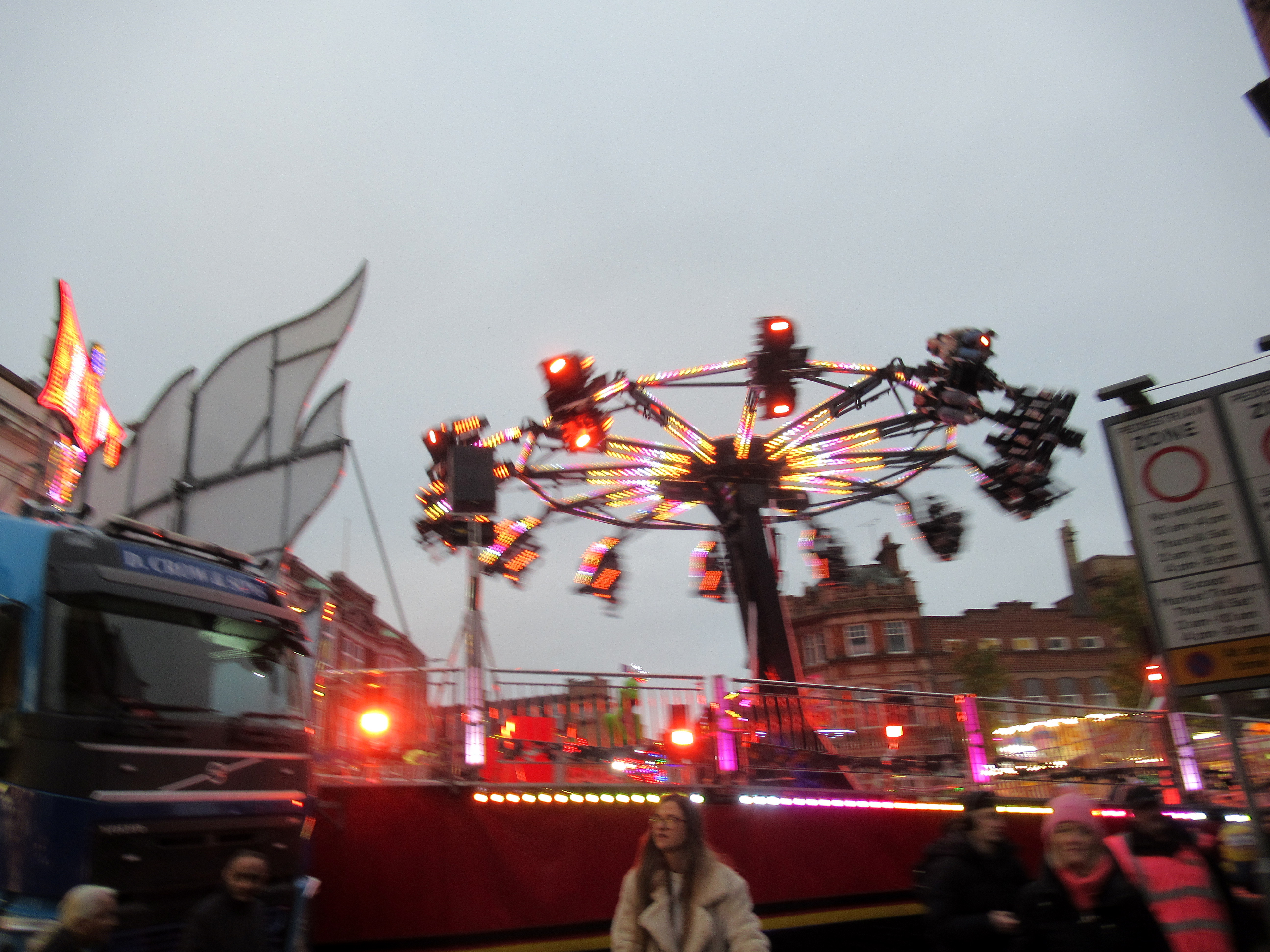
Not only did this one go up and down and around, but also the seats spun around at the same time


Not very nice


The house of horror


The wings on this one go all the way up to the top


Again, this one spun around in all sorts of directions, and it was very fast


All strapped up and going up and down


they're all the way up now


I'm sure you've gathered from my descriptions that I don't know much about these rides. Fairs have not really interested me much, but we did used to go a lot in the past when we used to go to Loughborough on a regular basis. But, I did enjoy it this time very much, it was such a lovely atmosphere, everyone having a good time, really enjoying themselves.


Loud music everywhere. Saw a baby in his dad's arms screaming while covering her ears, and I could really sympathise.


There was duplication of most of the rides


and the fair was getting busier all the time.


We left early, at 6:00. All the way to our friends' house we could see people walking down towards the fair. We had a quick cup of tea with our friends at their house, and then we drove back as we had to be home that evening. It was all great fun.