
Kusama has been working since the 1940s and her body of work is extensive. In the 1960s and 1970s she became a major figure in the New York avant-garde.

Most of her art has an almost hallucinatory intensity that reflects her intense vision of the world.

She regularly has herself photographed in front of her works, establishing a focus on the artist as author and controller of her environment, and creating a kind of Kusama-world with the artist at its centre.

Here with her fabric phalli.

God of the Wind, 1955, (oil on canvas)
Her early work is characterised by the surfaces being carefully worked, with tiny, hieroglyphic details that have become part of her personal vocabulary: eyes, dots, tadpole forms.

Dot Abstraction, 1958-60 (oil on canvas)
In the middle of the 1950s she made her first attempts to leave Japan. "For art like mine - art that does battle at the border of life and death, questioning what we are and what it means to live and die - Japan was too small, too servile, too feudalistic and too scornful of women. My art needed a more unlimited freedom, and a wider world".

Dot Abstraction, 1958-60 (oil on canvas)
She moved to the USA in 1957 and went to live in New York where she transformed her painting. Large scale canvases that got known as the Infinity Net paintings are covered in seemingly endlessly repeated brushstrokes of a single colour on a contrasting background, in a gesture that is both obssessive and meditative.

Pacific Ocean, 1960 (oil on canvas)

The Accumulation Sculptures in which a range of domestic objects such as furniture, clothing and accessories are covered with stuffed fabric phalli. She refers to these works as her Sex Obssession series.

These works have a surreal quality, suggesting a dreamlike world in which an internal obssession is projected into the physical realm.

The Accumulation sculptures were first exhibited in a group show alongside work by Andy Warhol, George Segal and others of the NY avant-garde.

Aggregation: One Thousand Boats Show, a whole room installation first time exhibited in 1963. A white painted, fabric phallus-encrusted rowing boat complete with oars, is installed in a room whose walls, floor and ceiling are covered with black and white posters depicting the same boat from above. The actual boat was scavenged by Kusama and Donald Judd from the street. The viewer is yet again invited to submerge herself in Kusama's obssessively charged vision.

(A pity about the reflections, but it is so difficult photographing where glass is involved)
In the early 1960s she began to make collages, some of which consisted of tightly packed air mail stickers repeated ad infinitum, until the recognisable verges on the abstract.

Looking closer.
These collages are clear references to the fact that she was not in her own homeland.

Accumulation of Faces, No. 2, 1962 (newspaper and ink on paper)

The Clouds, 1984, (sewn stuffed fabric, paint - 100 unique silver and white painted cushions)
In 1973 she returned to Japan, but the transition to life back there was very difficult for her and in 1977 she voluntarily admitted herself to a psychiatric hospital where she has remained ever since. She initially set up a studio within the medical faculty.


Leftover Snow in the Dream, 1982 (plasticine, wood, paint)

Sprouting (The Tramsmigration of the Soul), 1987, (acrylic on canvas)
This period saw her return to painting with acrylics, on huge canvases, with repeated abstract patterning. One critic likened these new shapes to 'sprouting polka-dots' or 'eggs hatching into tadpoles'.

Weeds, 1996, (acrylic on canvas)


I'm Here, but Nothing
A darkened sitting/dining room. Everything in the room is covered with fluorescent sticker spots which glow in the very dim light.

Walls, floor, ceiling, furniture, crockery on the dining table, coats on the coat stand, television - everything is covered with the fluorescent dots. In the corner, on the television (also covered in dots) Kusama talks about her art.

I sat on the sofa for quite a while - the atmosphere in the room is surreal and uncanny but at the same time oddly comforting. I did not want to leave the room and came back twice to sit and look around. The photographs certainly do not make it justice. People who walked in gasped and then giggled and chatted animatedly.
The woman sitting next to me on the sofa turned to me at one stage and said: "Now, these are real painted dots" a clear reference to the Damien Hirst exhibition on the lower floor, and I had to heartily agree with her.
For Kusama the polka dot is a visual shorthand signifying her hallucinatory visions, as she apparently senses the physical world as overtaken by endlessly repeated forms.

In recent years Kusama has been working from a large studio across the road from her hospital home.

The canvases are large, with a shallow surface, with elements from her earlier years: flowers, eyes, her hieroglyphics, dots and nets, but this time, rather than repeating the same motif, she now combines different imagery.
As for the titles:

My Self-Portrait in the Early Afternoon Makes my Heart Tremble with Happiness, 2009, (acrylic on canvas)

Women Wait for Love, but Men Always Walk Away, 2009, (acrylic on canvas)

Look at the Gathering of Women in Search for Love, 2009, (acrylic on canvas)

Love Arrives at the Earth Carrying with it a Tale of the Cosmos, 2009, (acrylic on canvas)
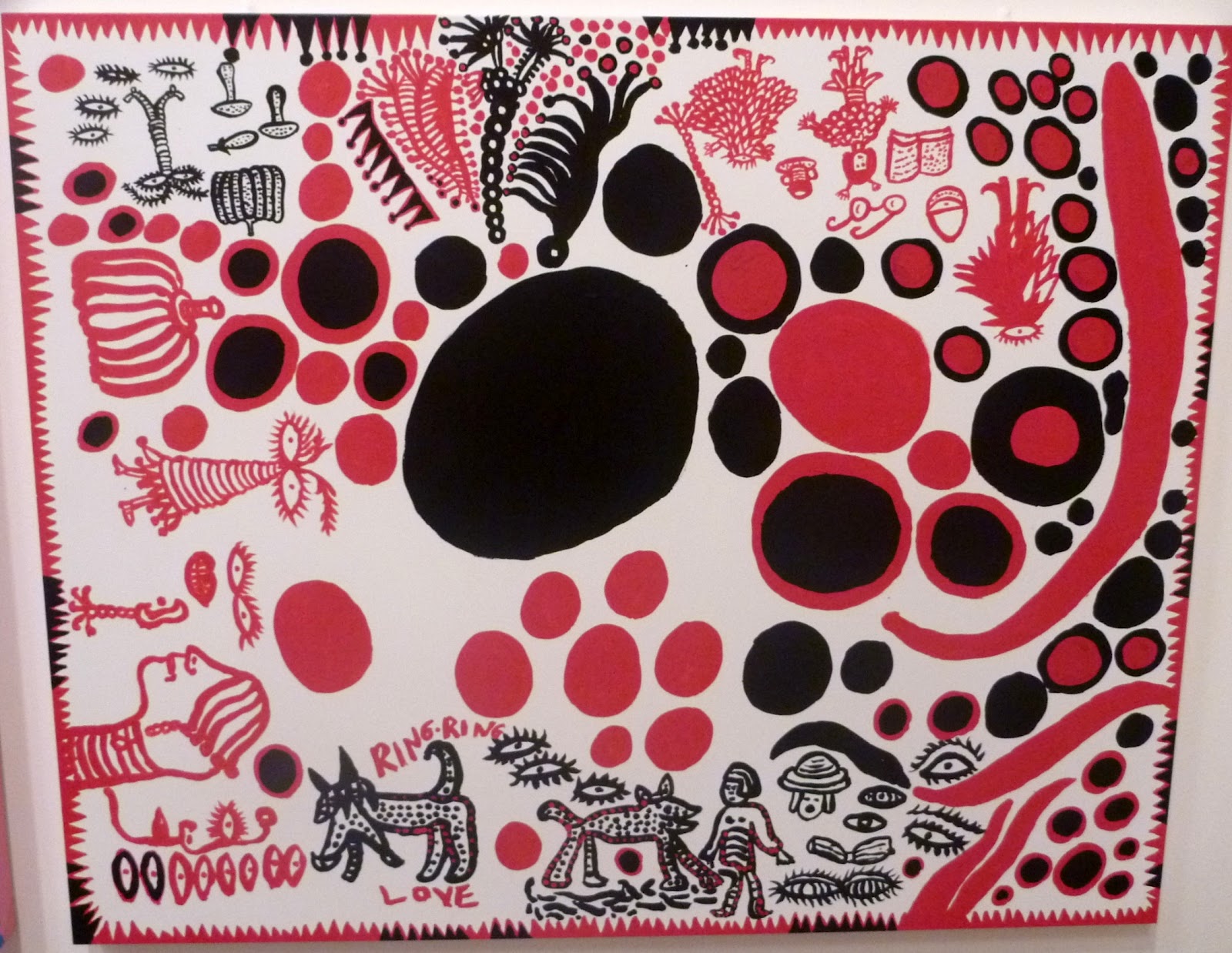
Captivated by the Brightness of Early Spring Now, 2009, (acrylic on canvas)
The above were really difficult to photograph because they were hung very high, but I had to include these amazing titles.

Infinity Mirrored Room - Filled with the Brilliance of Life
Created specifically for this exhibition - mirrors everywhere, small, round LED coloured lights. We were able to walk through this room to explore, surrounded by our own reflected image. The lights kept changing and the colours were fantastic - the effect was magical. Dots again, of course.

One of Kusama's enduring obssessions has been the depiction of infinite space, and this concept has been explored to the full in this.

The high point of the exhibition.
Finally, some more pictures of the artist:


