A post from our trip to Lisbon in May.
Splendour - Gerard Fromager
at the Centro Cultural de Belem.
A painter who also employed collage, sculpture, photography, cinema and lithography, Fromanger was associated with the French artistic movement of the 1960s and 1970s called Nouvelle Figuration, somewhat like Pop Art. He was also associated with photorealism.
The Nouvelle Figuration movement (sometimes called Figuration Narrative or Representation Narrative) is considered to have been a reaction against abstract art, with a more political slant than American pop art. Fromanger has been described as a social critic who takes a political position without neglecting the poetic dimension.
One of the pioneers of the return to figuration in the late 1950s and early 1960s France, he became a leading figure of figuration narrative. Depicting urban environments and anonymous passers-by, his painting technique was close to photography. As a founding member of the Atelier Populaire at the Ecole des Beaux-Arts in Paris, he also produced various collective and political serigraphy works during the May 1968 events.
One of the works that he submitted to his peers at Atelier Populaire was the serigraphy of his Album The Red 1968, depicting the French flag with the red stripe dripping across the rest of the lower portion of the flag suggesting the loss of blood. Although the work was rejected, he created a series of twenty other serigraphs to accompany this first work. Developing the thematic of the flag, Fromanger realised nine other serigraphs of capitalist and communist nations' flags, the red elements of which are dripping, along with serigraphs of scenes of urban protests in which the figures are transformed in red silhouettes. From these anonymous urban scenes, he reused the red silhouettes throughout his future work. When presented for the first time to the public, this series of silkscreens was quickly hailed as a milestone for the political and subversive stance it embodies.
Album The Red established not only Fromanger's artistic career, but also reinforced the divergence between the figuration narrative artists, whose approach to art was distinctly politicised, and the American pop artists' approach.
The exhibition was organised in a number of series that characterise the artist's work: twenty six in all, including more than sixty major paintings. I have reproduced only a fraction of the works exhibited.
I have not translated the titles of the paintings, and I would like to apologise for not putting on the accents on some of the letters.
Le siege de Lacedemone par Pyrrhus repousse par les habitants eux-memes de tout sex et de tout age, 1989, (oil on canvas)
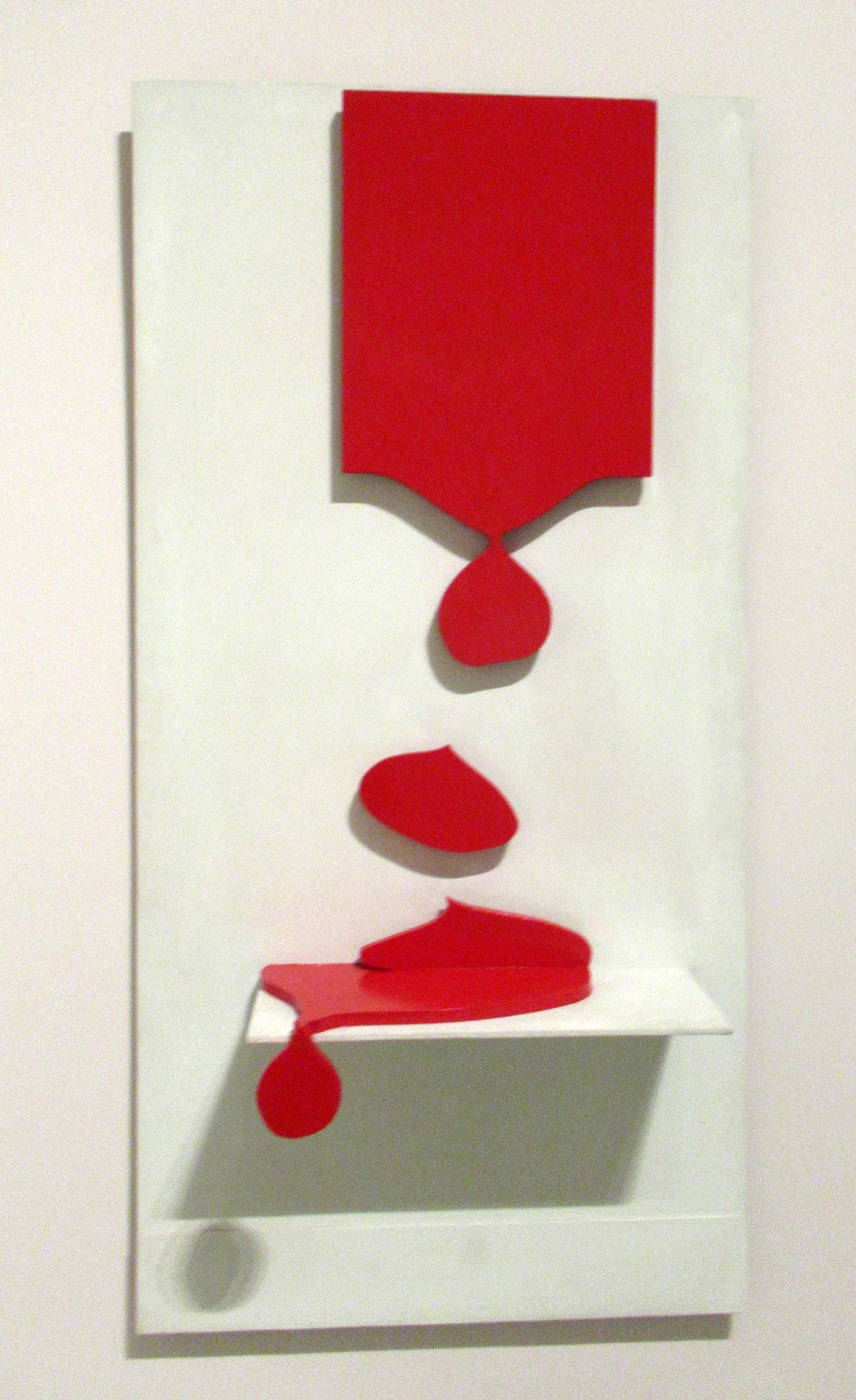
Le Soleil Inonde ma Toile, 1966, (acrylic on cut-out wood)
Mon Tableau S'Egoutte, 1966, (acrylic on cut-out wood)
Alberto Giacometti, Portrait of a Woman, 1965, (oil on canvas)
For Fromanger, seeing a Giacometti painting was like entering a temple. He often confided that as a young man Giacometti's painting, with its silvery shimmer, fuelled his desire to paint. Throughout his life as an artist, Fromanger remained attached to the mysterious intensity of Giacometti's work, and would come to know the artist as a friend.
Autoportrait, 1962, (oil on canvas)
Noir, Nature Morte, 1994-95, (oil on canvas)
looking closer
Comment Dites-Vous? 1973, (oil on canvas)
Boulevard des Italiens, 1968-2007, (acrylic on canvas)
looking closer
La Conquete de L'Impossible, 1964, (oil on canvas)
Salon de The, 1971, (oil on canvas)
La France Est-Elle Coupee en Deux? 1974, (oil on canvas)
La Vie d'Artiste, 1975-77, (oil on canvas)
Quel Est le Fond de Votre Pensee? 1973, (oil on canvas)
Eclaboussures, 1976, (oil on canvas)
Florence Rue d'Orchampt, 1975, (oil on canvas)
En Week-End a Dammarie-en Puisaye, Devant la Mairie, on Vous Embrasse Tous, Eduardo et Gerard, 1984, (oil on canvas)
looking closer
Entre le Ciel et la Terre, 1974, (oil on canvas)
Je Suit dans l'Atelier en Train de Peindre, 1978-79, (oil on canvas)
De Toutes les Couleurs, Peinture d'Histoire, 1991-92, (oil on canvas)
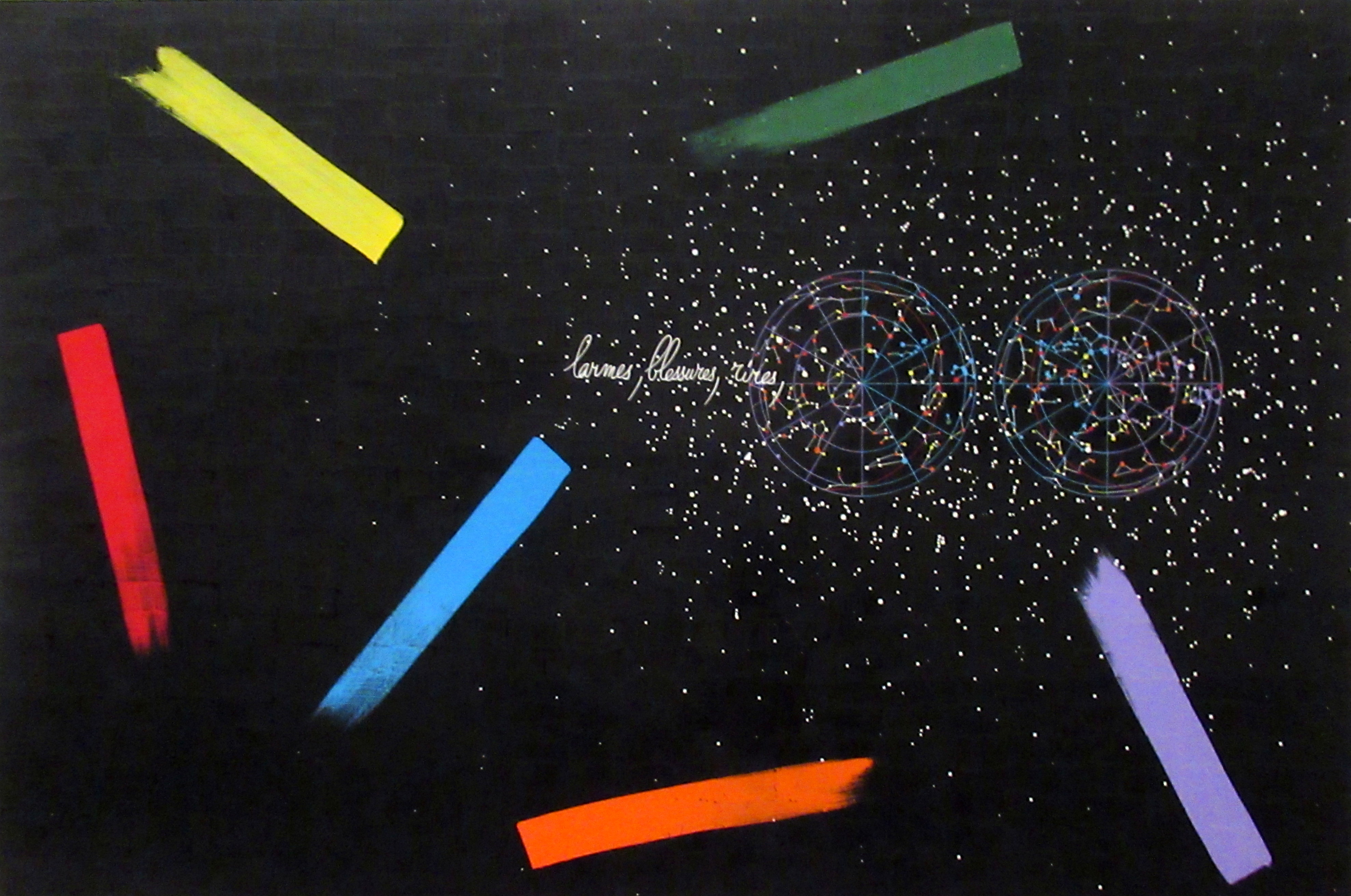
Larmes, Blessure, Rites, 1979, (oil on canvas)
Corps a Corps, Bleu, Paris-Sienne, 2003-06, (oil and acrylic on canvas)
Rouge-Jaune-Noir, 2008, (acrylic on canvas)
Impression, Soleil Levant, 2019, (acrylic on canvas)
Boulevard de la Bastille, 1988, (oil on canvas)