Monday, 9 June 2025

Yoko Ono - Music of the Mind. Part 2


Yoko Ono - Music of the Mind


at Tate Modern.

This is the second post on this exhibition. If you would like to see the first post go here .   As I would like to stand each post on its own, I have included the introduction from the first post, so, if you have read that already, scroll down to: The Message is the Medium.

I am a great fan of Ono's work so it was a real pleasure seeing this exhibition, which by the way, was on quite a while ago. 

I also saw a retrospective of her work in Copenhagen, and you can see that here

Music of the Mind celebrates the work of artist and activist Yoko Ono. The exhibition explores Ono's conceptual practice, foregrounding ideas over objects, alongside her ongoing campaign for world peace. It takes its title from the artist's desire to stimulate the imagination. Ono notes: 'The only sound that exists to me is the sound of the mind. My works are only to induce music of the mind in people... In the mind-world, things spread out and go beyond time'.

The exhibition traces Ono's radical approach to art, language and participation, from her early 'instruction' pieces to her recent, large-scale installations. It covers seven decades of her expansive practice from 1955 to today. During this time, Ono moved between Japan, the US and the UK, before settling in New York in 1971.

Following a loose chronology, the exhibition highlights recurring ideas and themes in Ono's work, making connections across time and place.

Ono's art takes many forms. It includes scores, performances, objects, film, music, sound and events. In 1964, Ono published Grapefruit, her foundational book of instruction works. These concise texts, somewhere between poem and score, aim to unlock the mind. Instructions are presented throughout the exhibition, calling you to participate, often with others.

Ono invites one to realise her artworks - to construct paintings in the mind, perform inside a bag, play a game of chess and share memories and wishes. But, most importantly, she invites us to imagine. This collective call to action is a provocation to change the world, one wish at a time.

A dream alone is only a dream.
A dream you dream together is reality.
Yoko Ono.

It's been very difficult getting these posts together, given the nature of Ono's art, its conceptual nature which is very cerebral, but I hope I have done it justice.


The Message is the Medium:

Ono stayed in England for five years, between 1966 and 1971. During her stay she connected with artists, musicians and writers, including John Lennon, her future husband and long-term artistic partner.

In the context of the US civil rights movement, second-wave feminism and growing opposition to the American War in Vietnam, Ono's campaigning work gained mainstream interest. Working in collaboration with Lennon, Ono used her art and global media platform to advocate for humanitarian causes and world peace. In the late 1960s, they wrote to world leaders, created billboard campaigns, recorded songs and staged Bed-in events. Their message of nonviolence resounded in their song 'Give Peace a Chance', which became an anthem of the international peace movement.


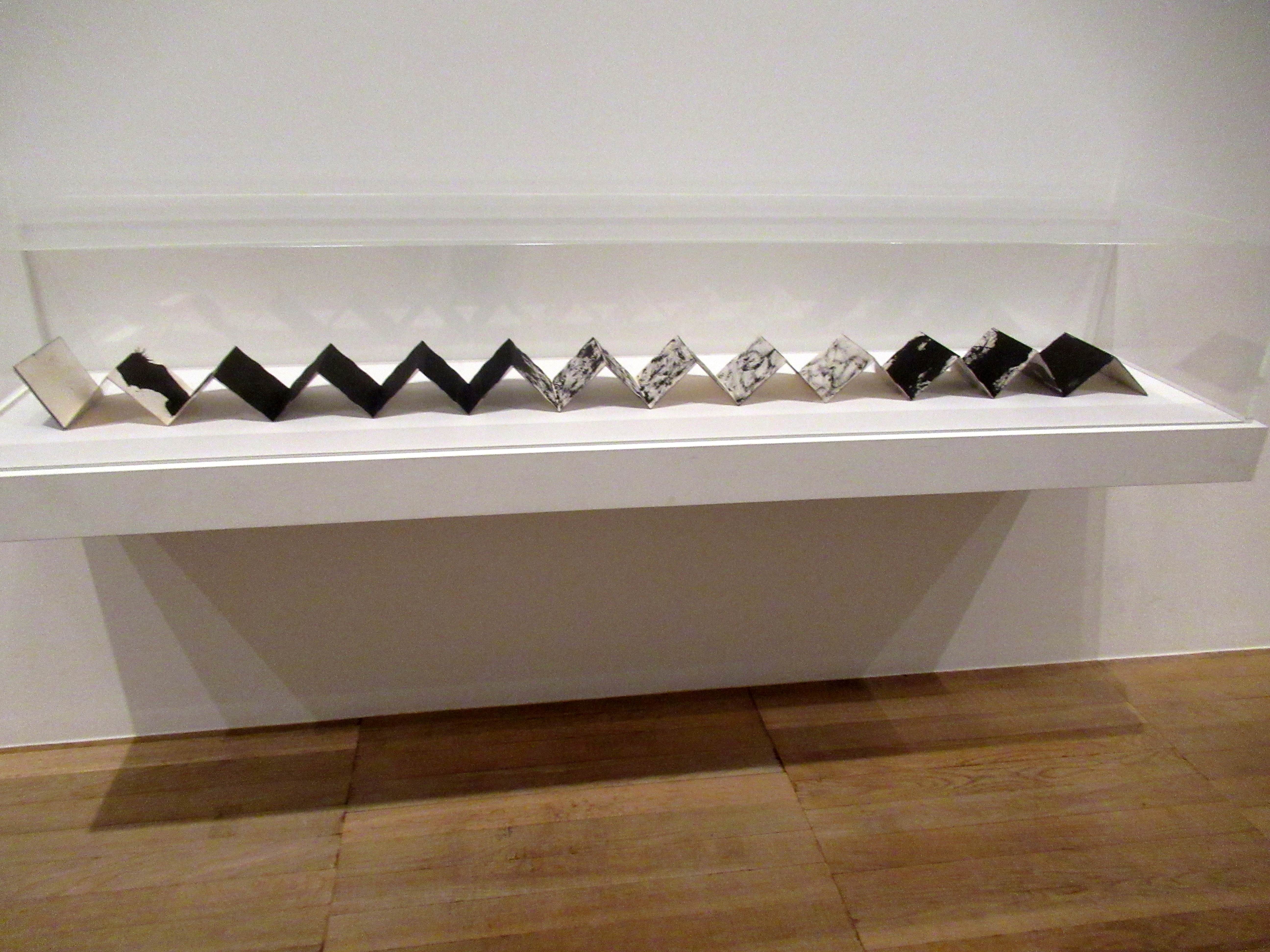
Painting to Hammer a Nail, concept 1961, first realised 1966, (painted wood panel, nails, chain, painted hammer)

Hammer a nail into a mirror, a piece of glass, a canvas, wood or metal every morning. Also, pick up a hair that came off when you combed in the morning and tie it around the hammered nail. The painting ends when the surface is covered with nails.


Poster for Unfinished Paintings and Objects

In the exhibition Unfinished Paintings and Objects each work required completion by the viewer, either in their imagination or as a physical participant. 


Mending Piece, 1966, (photograph, gelatin silver print on paper)

Yoko Ono preparing the piece for Unfinished Paintings and Objects at Indica Gallery, London, 9-22 November 1966.
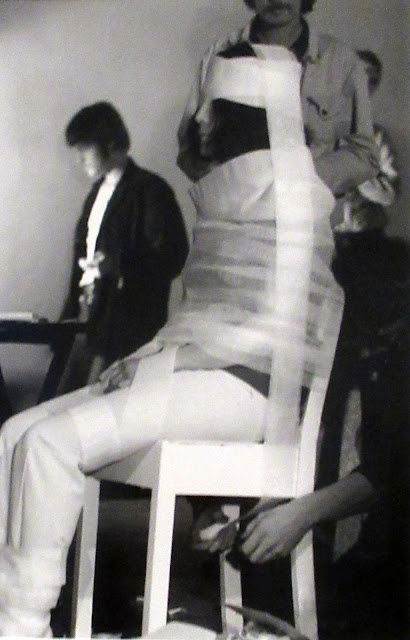


Wrapping Piece,1961, photographed 26 September 1967


These photographs show Ono in Liverpool, performing works that encouraged audience participation.  During Wrapping Piece, Ono invited viewers onstage and asked them to wrap her in gauze until she disappeared. The performance was part of a series of concerts called Music for the Mind that Ono put on in Liverpool and London.


During Peek Piece, she silently peered out at the audience from behind a while box.


Lion Wrapping Event, 1967


Yoko Ono, John Lennon, Bed Peace, 1969


Following their marriage in March 1969, Ono and Lennon hosted week-long Bed-in For Peace campaigns in Amsterdam and Montreal. The couple created a media frenzy by inviting peace campaigners and activists to join them in their hotel rooms. While in bed in a hotel in Montreal, joined by Timothy Leary, Petula Clarke, Dick Gregory and Alan Ginsberg, they recorded the track Give Peace A Chance. It was quickly adopted by those protesting the American War in Vietnam. Ono explained, 'we're using our money to advedrtise our ideas so that peace has equal power with the meanies who spend their money to promote war'.


Yoko Ono, John Lennon, WAR IS OVER! If you want it, 1969

Ono and Lennon used their public platform to promote peace. They co-opted the techniques of advertising and political propaganda, using mass media to quickly spread and amplify their message. They created artworks such as WAR IS OVER. If you want it, which was distributed in 12 cities around the world through billboards, posters, posters and radio and newspaper adverts.
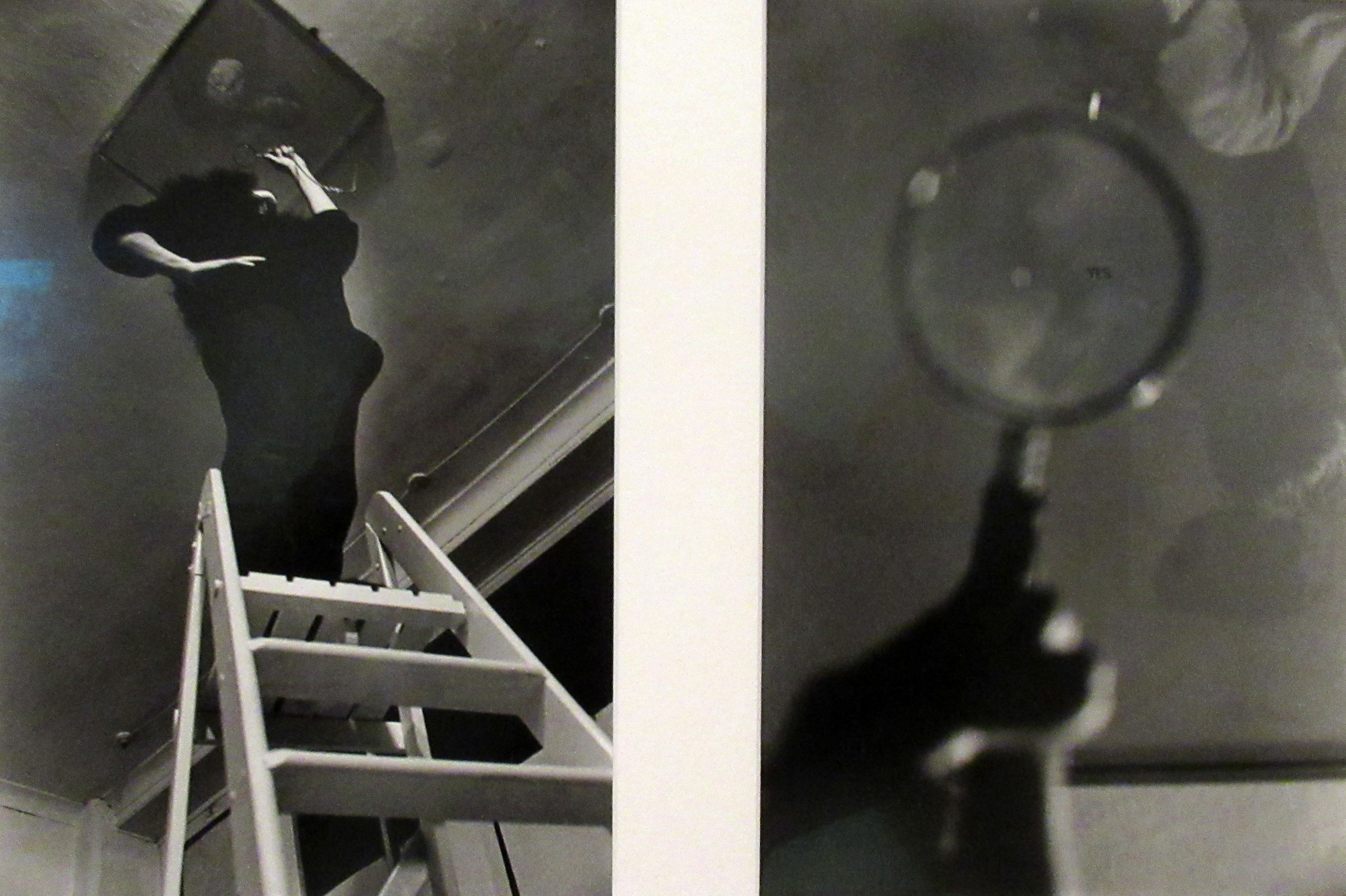


Ceiling Painting, 1966, (photograph)

This was not mentioned at the exhibition, but I understand that this is how Ono and Lennon met. He went to an exhibition and for one of the pieces you had to climb a ladder and with the magnifying glass look at a painting that was positioned inside a trap door. Lennon climbed up, looked at the painting and then said: 'What an amazing artist. I would like to meet them'. And the rest is history....


White Chess Set, 1966, (white chess sets, tables, chairs)


Thursday, 5 June 2025

Yoko Ono - Music of the Mind. Part 1


Yoko Ono - Music of the Mind


at Tate Modern.

I am a great fan of Ono's work so it was a real pleasure seeing this exhibition, which by the way, was on quite a while ago. 

I also saw a retrospective of her work in Copenhagen, and you can see that here

Music of the Mind celebrates the work of artist and activist Yoko Ono. The exhibition explores Ono's conceptual practice, foregrounding ideas over objects, alongside her ongoing campaign for world peace. It takes its title from the artist's desire to stimulate the imagination. Ono notes: 'The only sound that exists to me is the sound of the mind. My works are only to induce music of the mind in people... In the mind-world, things spread out and go beyond time'.

The exhibition traces Ono's radical approach to art, language and participation, from her early 'instruction' pieces to her recent, large-scale installations. It covers seven decades of her expansive practice from 1955 to today. During this time, Ono moved between Japan, the US and the UK, before settling in New York in 1971.

Following a loose chronology, the exhibition highlights recurring ideas and themes in Ono's work, making connections across time and place.

Ono's art takes many forms. It includes scores, performances, objects, film, music, sound and events. In 1964, Ono published Grapefruit, her foundational book of instruction works. These concise texts, somewhere between poem and score, aim to unlock the mind. Instructions are presented throughout the exhibition, calling you to participate, often with others.

Ono invites one to realise her artworks - to construct paintings in the mind, perform inside a bag, play a game of chess and share memories and wishes. But, most importantly, she invites us to imagine. This collective call to action is a provocation to change the world, one wish at a time.

A dream alone is only a dream.
A dream you dream together is reality.
Yoko Ono.

It's been very difficult getting these posts together, given the nature of Ono's art, it's conceptual nature, which is very cerebral, but I hope I have done it justice. 


There were two Wish Trees directly outside the exhibition galleries


where people left their wishes or read other people's.


Yoko Ono spent most of her childhood in Tokyo, also living for short periods in the US. Music and performance were an important part of Ono's family life and early education. She studied classical music and learnt how to translate everyday sounds into musical notation.

In the spring of 1945, during WWII, US Army Air Forces bombedf Tokyo. Ono, aged 12, was evacuated to the countryside, where food and other essentials were in short supply. Ono and her younger brother would lie on their backs, look up at the sky and escape in their imaginations. She remembers, 'we exchanged menus in the  air and used our powers of visualisation to survive'. Ono describes this as 'maybe my first piece of art'.

In August, the US army dropped the first atomic bombs on the cities of Hiroshima and Nagasaki, bringing about Japan's surrender and ending the war. Ono notes that 'those experiences of the early days cast a long shadow in my life'.

Following the end of the war, Ono returned to Tokyo, later attending Gakushuin University as its first female philosophy student. She left after two semesters to join her parents in New York State. In 1953, she enrolled at the liberal arts college Sarah Lawrence, studying poetry and musical composition. During this period, Ono developed some of her earliest instructions.

These include:


Lighting Piece - 'Light a match and watch till it goes out'. Concept, 1955.

Ono was highly sensitive to sound. At times, she tried to block out the noises around her, hiding in a dark room at her parents' house and covering her ears with sanitary pads held by gauze. She repeatedly lit a match and watched it flicker and burn until the sounds in her mind disappeared along with the flame.


This concept was made up of 'inaudible sounds', 'sounds that reached the sky' and breaths', according to her then husbandf, Toshi Ichiyanagi. Ono noted: 'I wanted most things to be performed in the dark, thereby asking the audience to stretch their imaginations. A glimpse of things was seen by occasionally lit matches and torches. This went on for four hours'.


Part Painting or Painting Until it Becomes Marble 'To Richard', 1961, (sumi ink on paper)


Concerts and Instructions:

In 1956, aged 23, Ono moved to New York City, eloping with Japanese composer and pianist Toshi Ichiyanagi. 

In July 1961, Ono's first solo exhibition opened at AG Gallery in Manhattan. It included more than fifteen Instruction Paintings which were realised through the participation of the artist, visitors or the environment. A few paintings had written instructions, but Ono communicated most by word of mouth. The gallery owned by George Maciunas who later founded Fluxus. An international network of artists and composers, Fluxus opened up definitions of what art could be, promoting 'living art', anti-art'. Ono played an active role in this.

Less than a year later, Ono exhibited more than 30 instructions for paintings at her exhibition in Tokyo. This time, her words were presented without accompanying canvases. It marked a decisive conceptual shift in her practice and the history of ideas based art. Paint was replaced by language and the viewer 'completed' the art work, either physically or simply in their mind. The idea took primacy over object. During this period, she also performed a series of concerts and events.

These Paintings comprise both an instruction and a physical artwork for the viewer to engage with. They are only an instruction. The idea itself is the work of art. This shift marked a key moment in the history of conceptual art. 


Painting to Be Stepped on, 1961, (sumi ink on canvas, ink on paper)

'When people came, I took them around to each painting and explained what the function of each piece was... I remember Isamu Noguchi stepping on Painting to Be Stepped On with a pair of elegant Zohri slippers'.


Painting to Let the Light In


Painting to Be Constructed in Your Head

Look through a phone book from the
beginning to end thoroughly.
List all the combinations of figures
you remember right after that.

1961 winter


Painting to Enlarge and See

Write five hundred telephone
numbers on a canvas in a space as
large as your palm. The numbers 
can be overlapped with one another.
Also, the numbers can all be the
same.
Observe the drawing by enlarging it
with a microscope. Also, you may
take a picture of the drawing and
enlarge it to the size you prefer.

1961 summer


Painting to See the Sky


Painting to be Constructed in Your Head

Go on transforming a square canvas
in your head until it becomes a 
circle. Pick out any shape in the
process and pin up on the
canvas an object, a smell, a sound,
or a colour that came to your mind
in association with the shape.

1962 spring


Cut Piece:

Ono travelled to Tokyo in 1962 and ended up staying for two years. During this time, she connected with many artists, some of whom she had already met in the US. She was part of an artistic community challenging and subverting mainstream culture.

During this period, Ono met and married US filmmaker Anthony Cox. During this time she performed Cut Piece for the first time. She sat silently onstage wearing her best suit while the audience cut away pieces of her clothing.


Cut Piece, 1964), filmed 21 March 1965

Ono kneels motionless onstage while audience members cut away pieces of her clothing with a pair of scissors. According to Ono, 'it was a form of giving, giving and taking. It was a kind of criticism against artists, who are always giving what they want to give. I wanted people to take whatever whey wanted'.


Cut Piece is one of Ono's most well-known works and she has performed it several times. She states that her performance in Paris in 2003 was 'against ageism, against racism, against sexism, and against violence'. She has also invited others to perform the work. 


This piece has been performed by other artists as well, most notably Marina Abramovic where, at times, some members of the audience took too much, some reverting to violence and sexual abuse. You can see parts of that performance here


Before returning to New York in 1964, Ono held a farewell concert where she performed Cut Piece, Bag Piece and Striptease for Three. She explained: 'to strip means not to reveal to others but to discover something hidden in humans' and a 'stripping of the mind'. The idea of exploring one's self united many of the pieces Ono presented at her Japanese concerts.


Bag Piece, 1964, (performance, sewn cloth, wall hooks)

In Bag Piece, one or more performers remove their shoes, enter a black bag onstage and carry out various activities while inside. This may include moving around, removing their clothes or even taking a nap. The movements of the performers within the bag create a fluctuating sculpture.

During the 1966 exhibition The Stone at Judson gallery in New York, viewers were invited to fill in a questionnaire that asked absurd, philosophical questions before entering the bag.


Ono said: 'By being in a bag, you show the other side of you, which is nothing to do with race, nothing to do with sex, nothing to do with you know, age, actually. Then you become just a spirit of soul. And you talk soul to soul ... I like that idea. To become something totally different'.


Painting to Shake Hands (painting for cowards)

Drill a hole in a canvas and put your hand out from behind. Receive your guests in that position. Shake hands and converse with hands.


Shadow Piece, concept 1963, first performed 1966, (performance, instruction, pen, spotlight)

Please use the pencils provided to trace around another person's shadow, or your own, on the canvas.


Shadow piece

Put your shadows together until they become one.


Draw Circle Event, 1964-65, (print on paper, ink, pigment, mixed media, selection of 5 postcard responses sent by the following artists: Charlotte Morrman, Carolee Schneemann, George Maciunas, Ay-O, George Brecht)

For Draw Circle Event, Ono distributed postcards with the instruction Draw Circle, a related questionnaire and a return address for the Empire State Building. I have included 3 responses from fellow artists here.


Tuesday, 3 June 2025

Annabel Rainbow - The Windrush Series


Annabel Rainbow, the Windrush Series, part of the Unravelling History exhibition


at the Leamington Spa Art Gallery.


Fading memories... A history to record

This series of quilt portraits by Annabel Rainbow celebrates resilience, adaptation and identity, reflecting the lives and legacies of the Windrush Generation. This generation of Caribbean migrants arrived in the UK between 1948 and the early 1970s to help rebuild the nation after WWII. They were named for the HMT Empire Windrush, the ship that carried the first arrivals across hte ocean into an uncertain future. They were answering Britain's call for workers, but faced harsh realities of racism, inequality and cultural dislocation.

The quilts weave together the struggles and triumphs of those who journeyed to the UK, seeking new beginnings while navigating these challenges. Each quilt tells a history, blending imagery, intricate stitching, and painted details to capture the essence of their experiences. Faces and hands remain vivid and present, while the facing painting blending into the background fabric is a metaphor for the sense of gradual erasure of identity and culture many imigrants feel as they assimilate into a new society.

The text that makes up the background of each quilt is taken from the sitter's own words. Together these quilts create a visual space where the voices of the Windrush Generation can be preserved, their courage and determination affirmed, and their place in modern Britain celebrated.


George Saunders - Tailor, Birmingham (mixed media: free-hand machine quilting, acrylic on cotton)

George Saunders had a tailor's shop on Hurst Street, Birmingham, which is now a National Trust property (Back to Backs). He learned his sewing skills from his father in the Caribbean, but initially struggled to put them to use in England due to racism. For a time, he worked in a biscuit factory before he was able to grow a client base and open his own successful business.


Marcia Watson - Validation, (mixed media: free-hand machine quilting, acrylic on cotton)

Arriving in the UK at the age of 8, Marcia's life quickly became a battle against prejudice, even from her teachers at school. Marcia's gaze seems to reflect a lifetime of resilience and the gentle tolerance of the beloved teacher she became.


looking closer


Rachel Thomas - Most Racism Was in White Church, (mixed media: free-hand machine quilting, acrylic on cotton)

Rachel rests her hands on a stick as she sits beside a plate of fish and chips - her favourite meal and a symbol of adaptation in a new land and culture. The title of this quilt reflects Rachel's experience of prejudice from a space where she would have hoped to find community and acceptance.


looking closer


Iciline Brown - Rehema Motherland, (mixed media: free-hand machine quilting, acrylic on cotton)

Rahema means mercy in Swahili. Iciline can trace her routes back through slavery to Zanzibar in East Africa. Her words recall her early life in Jamaica and her arrival in England. She was later a victim of the Windrush Scandal, when after a trip to Jamaica, she was refused entry back to the UK and her family. It took three years of struggle to get a biometric card allowing her to travel freely.


looking closer
 

Benjamin Zephaniah - The Background's Too Strong, it Needs to be Whiter, (mixed media: free-hand machine quilting, acrylic on cotton)

Zephaniah was one of Britain's most influential contemporary poets. His mother came to Birmingham from Jamaica in 1957. The ground cloth was printed with original sketches of Birmingham by Rainbow. She then used white paint to tone it down and bring balance. This act of whitewashing the backbround resonated with the experience of many of Rainbow's subjects and inspired the quilt's title.


Benjamin Zephania, Icon, (mixed media: free-hand machine quilting, acrylic on cotton)

The image used for this portrait was provided by Benjamin's wife Qian and captures a moment of pure joy on their wedding day. Extracts from his poet The Men from Jamaica are Settling Down, are stitched on the ground cloth.


looking closer


Finally, not by Annabel Rainbow but by 


Women of the African Caribbean Project - Our Journeys and First Impressions (mixed media)

This is one of three quilts made by members of the African Caribbean Project, which brought together a group of women who came to Leamington in the 1950s and 60s to work in hospitals, in factories, on buses, and in other professions.

Together the group used various fabrics, patterns and applied detail to translate their memories and experiences of migrating to England from the Caribbean. Many of these are mirrored in Annabel Rainbow's Windrush SeriesThe group meet weekly, and the quilts took just over two years to make. 


Monday, 2 June 2025