Showing posts with label Greek Revolution against the Turks. Show all posts

Sunday, 3 October 2021

Christos Bokoros - The Feast

Quiet here: relics
Of the saints sleep;
Quite quiet: do not disturb
The sacred rest
             of the dead.

(Andreas Kalvos)


Christos Bokoros - The Feast, at the Benaki Museum

This year marks 200 years after the Greek uprising of 1821 against the Turkish occupation which lasted for 400 years, and which resulted in the emergence of the new Greek State. Feast is a celebration of this anniversary. 

Feast is organised in four parts:
  • The Blue and White: its aftermath
  • History: its light and its darkness
  • The Heroes, illustrious and unknown: their shadow, their blood
  • Glory Alone: the top of a long desert table, bearing laurels; below, a lamb standing staring at us.
The works were specially made on the occasion of the commemoration of the 200 years from the Greek revolution. They are painted on fabrics and wood. They constitute an 'overflowing of the soul' of the painter, his private tribute to the 'common and substantial'. To those 'shadows of substance' which define him.

Do these shadows also define us? What does the Hero and his/her Virtue mean today? What is our measure for measuring our lives? Against what shadows are we measuring ourselves? Painting thrives in silence. It speaks, reflected on the unprejudiced gaze of the viewer.

Born in 1956, Bokoros studied law. Following his graduation and a brief period of indecision, he entered the School of Fine Arts in Athens and held his first exhibition in the 1980s.  During the 1990s, he sought to portray shared memory and the Temptations of the Invisible, Light and Dark.

In 2004, with The Impenetrable Forest he addressed the disputed legacy of the WWII Greek Resistance and the Civil War that ensued. In 2013 at the Benaki Museum he presented The Bare Essentials, a call for a modest prosperity and the rediscovery of measure in our everyday life, followed in 2016 by Glimpses of the Obscure which you can see  here and here

Feast was a complex exhibition to navigate and follow, I hope I have done it justice in this post, as, like all of Bokoros' work it was complex, thought-provoking and (I can't think of another word) mind-blowing.


The Blue and the White Flag: its aftermath


A huge Greek flag dominates one wall next to the entrance to the exhibition.


Blue and White Flag, 2020-21, (coloured fabric and glue on old wooden panels from mountain bridges)


History: its light and its darkness

An anteroom, completely dark, the four paintings illuminated:


History: Weaving Light, 2020-21, (pigments with glue, oil paints, weaving comb, linen and wood on plywood)


looking  closer at the weaving comb at the base of the painting


History: Weaving Light, 2020-21, (pigments with glue, oil paints, weaving comb, linen and wood on plywood)


Talisman of the Unseen: the Dark, 2020-2021,  (pigments and oil paints on carved wood)


Talisman of the Unseen: the Light, 2020-2021, (gold polished on carved wood)


Heroes, Illustrious and Unknown: their shadow, their blood

Another small room, totally dark, the paintings illuminated:

an angelic portrait of Solomos,
a demonic, dark one of Karaiskakis
and a sorrowful Glory, dressed in black
an invisible gathering of unsung heroes
at a long table, set, stained,
where, instead of treats, drinks and food,
memorial offerings lie,
marks of time, desolation
and at its head a lamb
to stare us in the eye

(Christos Bokoros)


Solomos 1, 2020-2021,  (pigments with glue and oil paints on old wood)

(note: Dionysios Solomos, 1798-1857, was a Greek poet, best known for writing the Hymn to Liberty, which was set to music and became the Greek and Cypriot national anthem in 1865 and 1966 respectively. He was the central figure of the Heptanese School of poetry and is considered the national poet of Greece - not only because he wrote the national anthem, but also because he contributed to the preservation of earlier poetic tradition and highlighted its usefulness to modern literature).


Solomos 2, 2020-2021, (pigments with glue, oil paints, fabric, old wood and gold embroidery on plywood)


Solomos 3, 2020-2021(pigments with glue, oil paints, fabric, old wood and gold embroidery on plywood)


Solomos 4, 2020-2021(pigments with glue, oil paints, fabric, old wood and gold embroidery on plywood)


Solomos 4, 2020-2021
(pigments with glue, oil paints, fabric, old wood and gold embroidery on plywood)


Solomos 4, 2020-2021(pigments with glue, oil paints, fabric, old wood and gold embroidery on plywood)


Karaiskakis I, (pigments with glue and oil paints on old wood).

(note: Georgios Karaiskakis was a Greek military commander and leader of the Greek War of Independence. He helped lift the second siege of Missolonghi in 1823. His most famous victory was at the battle of Arachova. He was killed in action in 1827). 


Karaiskakis 2, 2020-2021, (pigments with glue, oil paints, fabric and old wood on plywood)


Karaiskakis 3, 2020-2021, (pigments with glue, oil paints, fabric and old wood on plywood)


Karaiskakis 4, 2020-2021, (pigments with glue, oil paints, fabric and old wood on plywood)


Karaiskakis 5, 2020-2021, (pigments with glue, charcoal, fabric and old wood on plywood)


Glory Alone: The top of a long table, bearing laurels; below, a lamb standing, staring at us.


The main exhibition room, dark, paintings illuminated.


Glory Alone, 2020-2021, (oil paints and old fabric on plywood)


Table 1, (laurel leaves, linen and cotton fabric, stained with tea on blockboard)

Note: Eleutheria i Thanatos, (Freedom or Death) was the rallying cry of the Greek Revolution.


Table 2, (laurel leaves, linen and cotton fabric, stained with tea on blockboard)


Table 3, (laurel leaves, linen and cotton fabric, stained with tea on blockboard)


Table 6, (laurel leaves, linen and cotton fabric, stained with tea on blockboard)


Table 13, (laurel leaves, linen and cotton fabric, stained with tea on blockboard)


Table 17, (laurel leaves, linen and cotton fabric, stained with tea on blockboard)


Table 20, (laurel leaves, linen and cotton fabric, stained with tea on blockboard)


Table 28, (laurel leaves, linen and cotton fabric, stained with tea on blockboard)


looking closer at the embroidery on the sides


Table 29, (laurel leaves, linen and cotton fabric, stained with tea on blockboard)


Monday, 5 September 2016

The convent of St Vlasios


The convent of St Vlasios near Ano Trikala, Korinthias.


The convent was closed to visitors the first time we tried to visit, so we came back the next day. Ken had seen the nuns tending to their gardens on his walks up the mountain and we really wanted to have a look around. It was well worth it, and in some ways it was one of the highlights of our visit to this region of Greece. I found the place very peaceful and calm, the nuns were very friendly and exuded an  aura of contentment and tranquility - the whole place had this atmosphere of harmonious communal living, of being at peace with the world and it was furthermore, very beautiful. I was seduced.


The ubiquitous shrine outside the main gate. 


The convent dates back to the 14th century when the icon of St Vlasios was discovered in a cave in the nearby mountains - about that later. The church was built during the 18th century. Originally it was a monastery and it played a significant role during the Ottoman occupation of Greece, not just in terms of providing refuge and support for the Greek people, but it also functioned as a krifo scholio, a secret school, where Greek language and literacy were taught to children at a time when those were forbidden by the Turks. In 1818 a branch of the Filiki Etaireia, the group that spearheaded the Greek revolution against the Turkish occupiers was formed here - again, more about that later.


looking back


In 1918, following the hard work and dedication of Thekla Stauropoulou  the site became a convent, with originally just two nuns. Even today there are only 5 nuns living here, and I really do not know how they manage to look after this place - so much hard work must be involved in keeping the extensive grounds in the condition they're in, tending to the church, the two chapels, plus all the other work that's involved.


Everything has been lovingly restored and is immaculately kept


with great attention to detail.


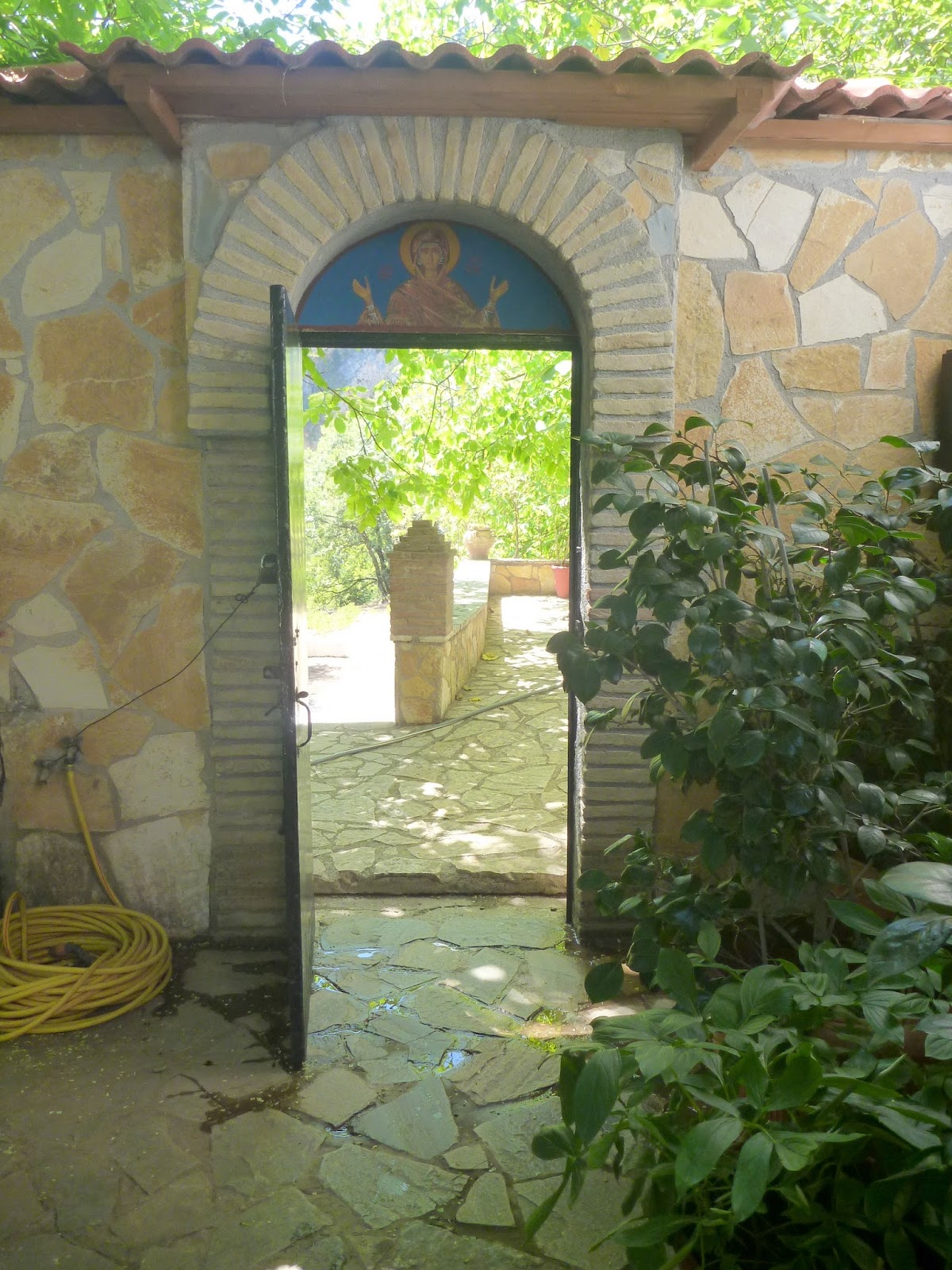
We walked through the entrance which on our second visit was open


through this arch


and entered one of the most beautiful gardens


the hydrangeas were stunning


as were all the flower beds and pots.


The bells and behind them the church


a chapel


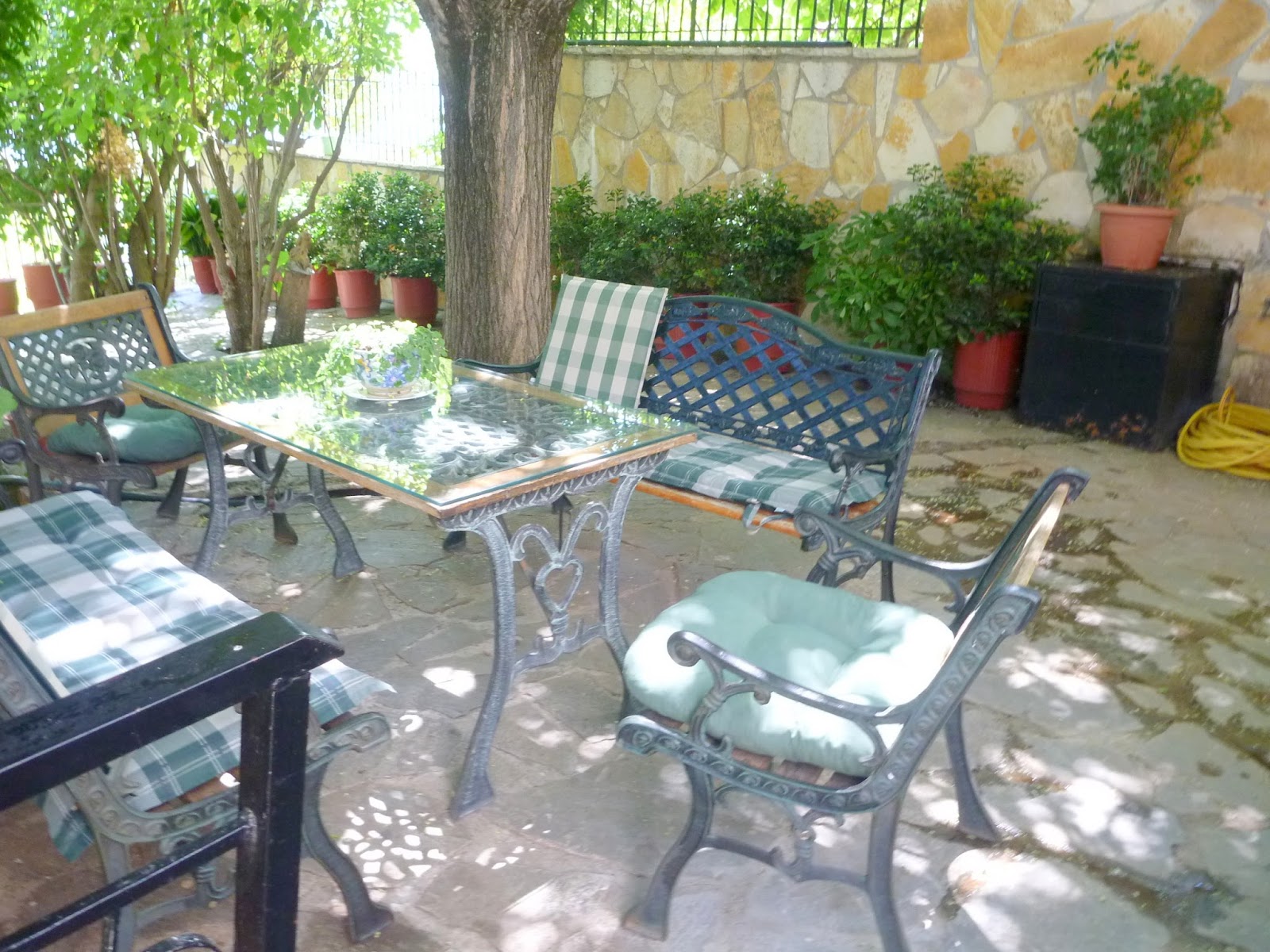
The garden consists of a series of' rooms' - this was a particularly inviting seating area


doorways and arches that lead to more garden 'rooms'


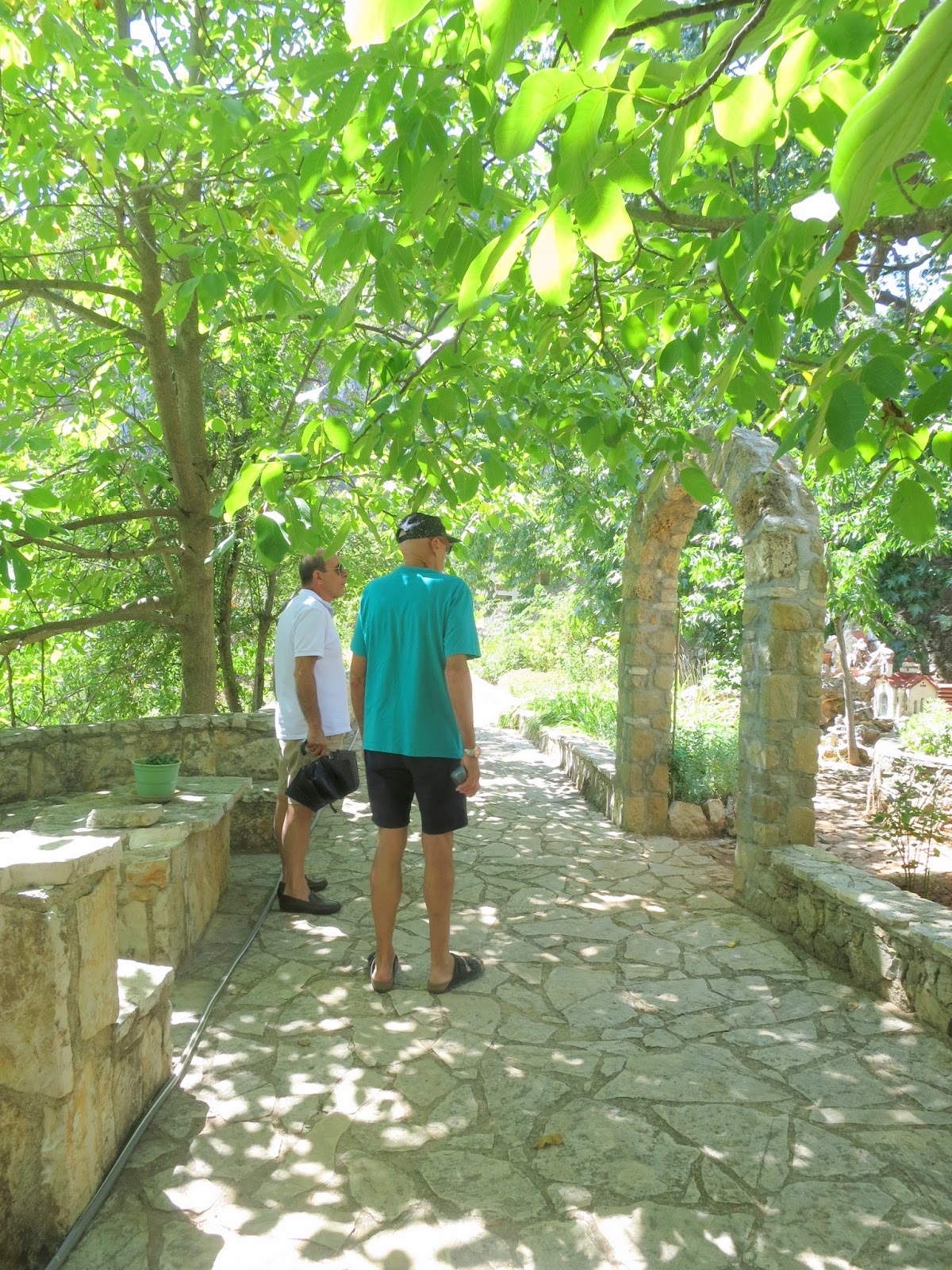
paved walkways and everywhere, the light is filtered through the trees


We were welcomed


and then continued our enchanted walk


until we reached the church.


The elaborate carved woodwork dates back to the 17th century while the icons were painted in the 16th century by the brothers Skordili.


looking closer


The icon of St Vlasis that was found in the nearby cave was restored and covered with silver in 1920


We left the church and continued exploring the grounds


came upon this chapel 


Dappled light everywhere


another seating area


an arch leading to another room


I presume this is an old well turned flower bed


a fountain that is dry in summer


More seating under this enormous tree with views of the mountains


This path leads to a chapel and to the mountains


We walked to the edge of the path


which led to another path


but we were interested in the entrance to the cave (on the right) where the icon was found. Legend has it that a strong light was emanating from the cave which led some of the inhabitants to use ropes to lower themselves into the cave where they found the icon. This led to the building of the first church.


Further to the left there is another opening in the rock


which you can see more clearly here and which leads to a passage that connects with the other opening shown before. Apparently a large section of the mountain is hollow and this is where Greek freedom fighters used to hide when they were escaping from the Turks.


We then turned our attention to the small chapel


the iron gate was locked


but we were able to have a look inside


Retracing our steps with came upon this very old tree  


the inscription reads:


'It was here, on this historic site, in 1821, on the eve of the Greek Revolution, that Papaflessas spoke to the people about resistance against the Turks' . Papaflessas was a priest who was one of the leaders of the Greek Revolution. He was shot dead by the Turks in 1825.


The path led us back to where we had started


past this cross that I am told symbolises the Holy Trinity


to this outdoor refectory which is for the use of visitors


and which overlooks the convent's orchard and beyond that, what else? the mountains


it's a shady spot 


it was almost 1:00 by then, the convent was about to close to visitors and we dashed into the shop (which they call The Exhibition Room), bought lots of spoon sweets made by the nuns, and left. It had been an informative and extremely peaceful morning - as I said in the beginning, I found their peaceful and tranquil lives interesting, and a lot of prejudices I've had were challenged.