Showing posts with label Impressionism. Show all posts

Sunday, 3 May 2026

Six Modern masterpieces


Six Modern Masterpieces, at Compton Verney, Warwickshire.

These paintings are on loan from the Barber Institute of Art, University of Birmingham.


Vincent Van Gogh, A Peasant Woman Digging, 1885, (oil on canvas)

Made when Van Gogh was living in the Netherlands, this is one of several paintings that focused on local peasant figures. Here, Van Gogh has matched the painting's palette to the hard earth the woman is digging. The woman bends in an awkward pose, emphasising the effort of her labour.  'One must paint the peasants as being one of them, as feeling, thinking, as they do. I personally am convinced I get better results by painting them in their roughness than by giving them a conventional charm'.


Maurice Denis, Portrait of Arthur Huc, 1892, (oil on millboard)

Denis famously said in 1890: 'Remember that a picture - before being a war-horse, a nude woman or some anecdote - is essntially a plane surface covered with colours assembled in a certain order'. This painting fuses abstraction with reality, combining the figurative depiction of the sitter with the rhythm of the smoke and the highly stylised surface design of the wallpaper - a fusion that was typical for Les Nabis.


Edouard Vuillard, Madame Vuillard Arranging her Hair, 1900, (oil on cardboard)

A member of Les Nabis, Vuillard's interest in decoration shines out of this work. Vuillard captures an intimate scene - his mother sitting with her back to us in the apartment she shared with the artist, fixing her hair. However, it is the pattern in the image that is the artist's focus: his mother's dress, the wallpaper, the carpet and within the reflection in the mirror. In fact, his mother is almost presented like a still life object, alongside the patterned textiles and furniture. A quiet charm infuses the painting as Vuillard expresses the wonder of colour, shape, pattern and form to be found in the everyday.


Pierre Bonnard, The Evening Meal, 1903, (oil on canvas)

Does the door on the left-hand side of this painting swing open or closed? Are we intruding on this intimate family moment or have we been invited in by the artist? The scene shows Bonnard's sister and her two children seated by lamplight at the table, the dark shadows contrasting with the single light source to create a cosy, intimate atmosphere. This interest in light seems to aligh with Impressionist thinking, but Bonnard was in fact a member of Les Nabis, a group of artists who set themselves apart from the Impressionists and focused on decorative motifs and domestic life.


Andre Derain, Portrait of Bartolomeo Savona, 1906, (oil on canvas)

When Detain and his close associate Henri Matisse exhibited in Paris in 1905, they were dubbed Les Fauves, (the Wild Beasts) due to their use of bold brustrokes and unrealistic colour, often used directly from the rube of paint without mixing. Derain revels in the use of colour in this portrait, in the bright yellow of the background and the streaks of red and blue in the sitter's hair. The portrait also reveals the influence of Van Gogh and Paul Gauguin.


Pierre-August Renoir, Young Woman Seated, 1876-7, (oil on canvas)

Unlike most Impressionists, Renoir focused on figurative subjects rather than landscapes. Here, he captures Nini Lopez, one of his favourite models, with loose swirls of oranges, reds, greens and blues typical of the Impressionist palette in this period. Renoir imbues the work with a sense of femininity and sensuality, slowing the model lounging in her chair and reaching up to touch her pink mouth and cheeks. Rather than seeking to depict an individual, here he is interested in colour and feeling. 


Tuesday, 2 September 2025

Impressionism at the Museo Thyssen-Bornemisza

I saw so much art in Madrid, wonderful art, and yet I have hardly posted on any of it. The problem is that there is so much of it, and after finishing the posts on the city itself, other things came up that I wanted to write about, and all this wonderful art got neglected. I hope that slowly, I will rectify this omission, as, posting about things is a way of reliving them but also, remembering.

The Thyssen-Bornemisza Museum is part of the so-called Golden Triangle of Art which you can read about here and unlike the other two, the Prado and the Centro de Arte Reina Sofia, the Thyssen is manageable - one is not overwhelmed by the sheer number of what is on show.


Impressionism at the Museo Thyssen-Bornemisza, Madrid

I enjoyed looking at the Impressionist paintings in this Museum: some known and beloved classics but also a lot of artists I had not come across before. Furthermore, any exhibition that features work by Kandinsky is a pleasure.


Berthe Morisot, Reclining Nude, Shephdrdess, 1891


Camille Pissarro, Winter Sun and Snow, 1870


Childe Hassam, Fifth Avenue at Washington Square, New York, 1891


John Henry Twachtman, Boats Moored on a Pond, 1902


Paul Serusier, Two Breton Women under an Apple Tree in Flower, 1892


Emile Bernard, Bathers, 1889


Paul Gauguin, An Orchard under the Church of Bihorel, 1884


Paul Gauguin, 1892


Wassily Kandinsky, The Ludwigskirche in Munich, 1908


Wassily Kandinsky, Murnau, Houses on the Obermarkt, 1908


Jean Metzinger, Bathers (Two Nudes in an Erotic Landscape), 1905


Henri-Edmond Cross, Beach, Evening Effect, 1902


Theo Van Rysselberghe, Entrance to the Port of Volendam, 1896


Maurice de Vlaminck, Fields, Ruel, 1907


Henri Manguin, The Prints, 1905


Georges Braque, Seascape, L'Estaque, 1906


Andre Derain, Landscape, 1904-05


Maurice de Vlaminck, Blue Vase with Flowers, 1906


Heinrich Campendonk Couple, 1915


Conrad Felixmuller, Portrait of Eifriede Hausmann, 1917


Robert Delaunay, Portuguese Woman, 1916


Max Pechstein, Bathers, 1912


Natalia Goncharova, Fishing, 1909

Such a rare pleasure seeing a painting by Goncharova - there don't seem to be that many around, not in the West, anyway. My favourite painting of hers is Aplesinia and I have posted twice about it: here and here. The second link is about an exhibition of hers I saw at Tate Modern - in the post I say how I was slightly disappointed by the exhibition, but having looked at it again, I think I was too harsh - a lot of it is wonderful work.


Finally, I remember so clearly this group of school children because they were so engrossed, listening to their teacher talking to them about the artworks.


Thursday, 3 July 2025

19th and 20th Century Art - Bristol Museum and Art Gallery


19th and 20th entury Art - Bristol Museum and Art Gallery

The paintings in this post show how French artists broke with academic tradition and found new ways to paint nature and the modern human-made world around them.

The Impressionists were reacting to a changed, industrialised and increasingly globalised era, which was chronicled by writers such as Charles Baudelaine and Emile Zola, and round a radically different aesthetic and scientific approach to depict the visible world. They were interested in the role of light, its changing qualities and the part the human eye plays in the perception of colour. They painted outdoors using brighter colours and visible brushstrokes to capture movement. They also used cropped compositions, which illustrate the influence of photography and the new experience of Japanese prints in Europe.

The British paintings in this post show the lasting international influence of French 19th century art and how artists adopted the radical changes in style and subject matter in their own work.


Lucien Pissarro, The Turkeys, 1893, (oil on canvas)

The recreation of the dappled light shows the artist's interest in (Neo-) Impressionist techniques and their views of the roles of light and the human eye. Lucien Pissarro was taught to paint by his father, Camille Pissarro, and both artists were interested in Seurat's theory of the optical mixing of colour. Here, the brushstrokes keep each colour separate, achieving a vibrant effect in the lush foliage.


Lucien Pissarro, La Frette, 1924, (oil on canvas)


Edouard Vuillard, Interior with Madame Hessel and her Dog, 1910, (oil on cardboard on panel)

Vuillard's harmonious colour scheme was achieved by his choice of materials. The picture was painted directly onto unprimed cardboard, its warm mid-tone often left untouched by any pigment. The surface of the cardboard is visible in all areas of the painting, particularly in the sofa and floor.


Eva Gonzales, The Donkey Ride, 1880, (oil on canvas)

Here, Gonzales chose a scene of contemporary life, but deliberately made a narrative reading of this painting impossible. After Gonzales' sudden death aged thirty four, the unfinished painting was found in the artist's studio. The area around the man's jacket is unresolved. Donkey Ride is the only work by Gonzales, who is one of a number of female Impressionists, in a public collection in the UK.


Stanhope Alexander Forbes, Beach Scene, St Ives, 1886, (oil on canvas)

The influence of Forbes' time in Paris can be seen here in his practice of painting outdoors (en plein air), his focus on modern life and the daring composition, which was influenced by Japanese art and contemporary photography.


Alfred Sisley, The Entrance to the Village, 1870, (oil on canvas)

Sisley was born in Paris of English parents and lived in France all his life.


Edward Lear, The Mouuntains of Thermopylae, 1852, (oil on canvas)

The intense colours Lear used show the influence of the Pre-Raphaelites.


looking closer


Edward Lear, The Tiber near the Ponte Molle, Rome, 1878, (oil on canvas)


William Janes Muller, The Carpet Bazaar, Cairo, 1843, (oil on canvas)


Jean Marchand, The Aspidistra, 1912, (oil on canvas)

The Aspidistra is a still life, interior and city scape all in one.  The leaves of the pot plant seem to sway rythmically, while the folds of the curtain have a solid, sculpted appearance. The rooftops outside are heavy geometric blocks of colour and form.


Winifred Bourne Medway, Portrait of Miss Annie Kenney, 1910, (oil on canvas)

Annie Kenney was a Suffragette and member of the Women's Social and Political Union, a militant wing of the women's suffrage campaign, led by Emmelline Pankhurst.

Kenney worked in a cotton mill from the age of 10. After hearing Christabel Pankhurst speak she led women factory workers in the campaign in Lancashire. Between 1907 and 1911 she was based in Bristol leading the South West branch of the WSPU. She was arrested 13 times and endured force-feeding, which possibly shortened her life. When she recalled the day women won the vote in 1918, she said 'though I had no money I had reaped a rich harvest of joy, laughter, romance, companionship and experience that no money can buy'.

Medway and her sisters grew up in Bristol and were also involved in the campaign. Medway's portrait shows Kenney five years into her activism.


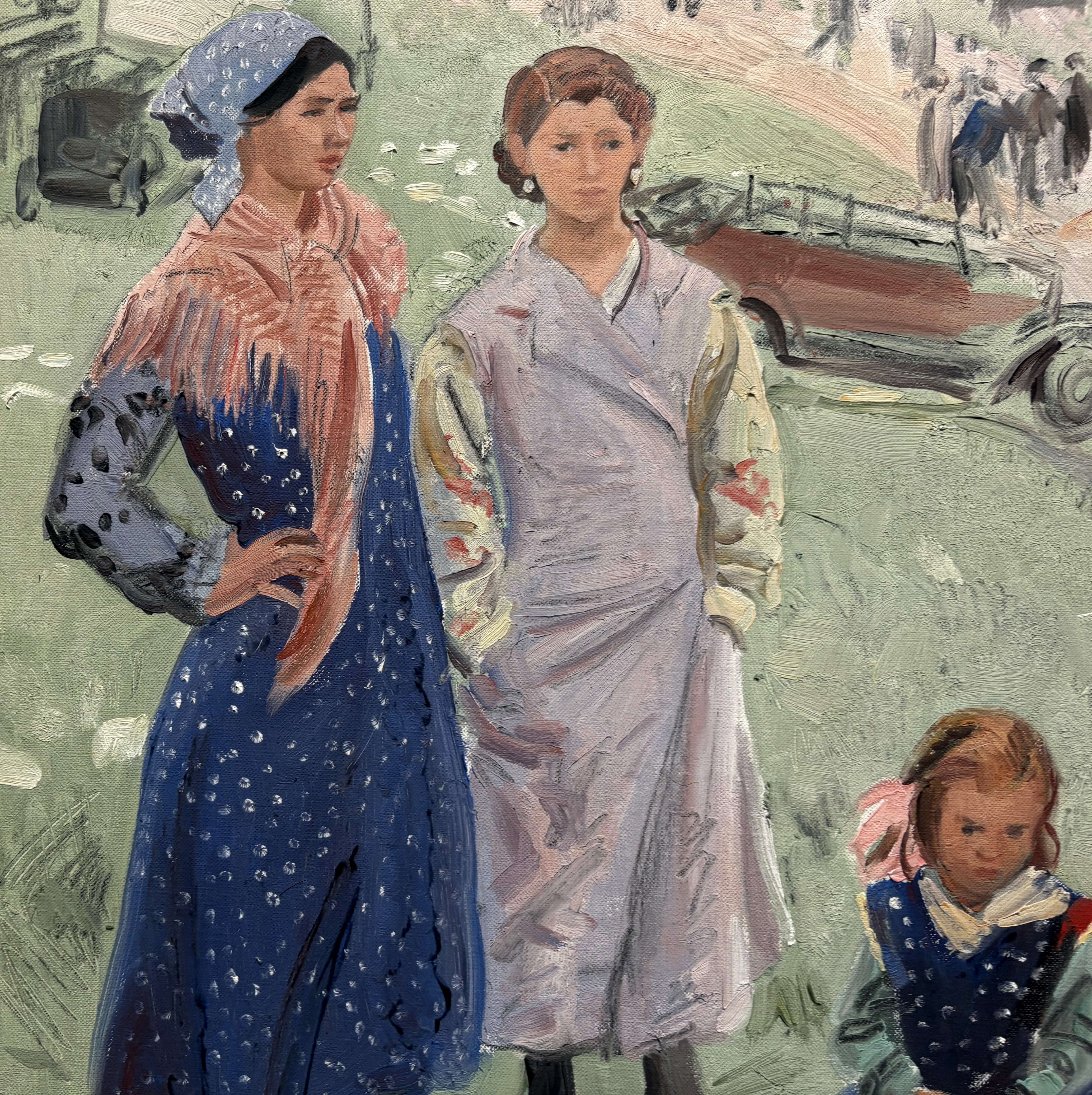
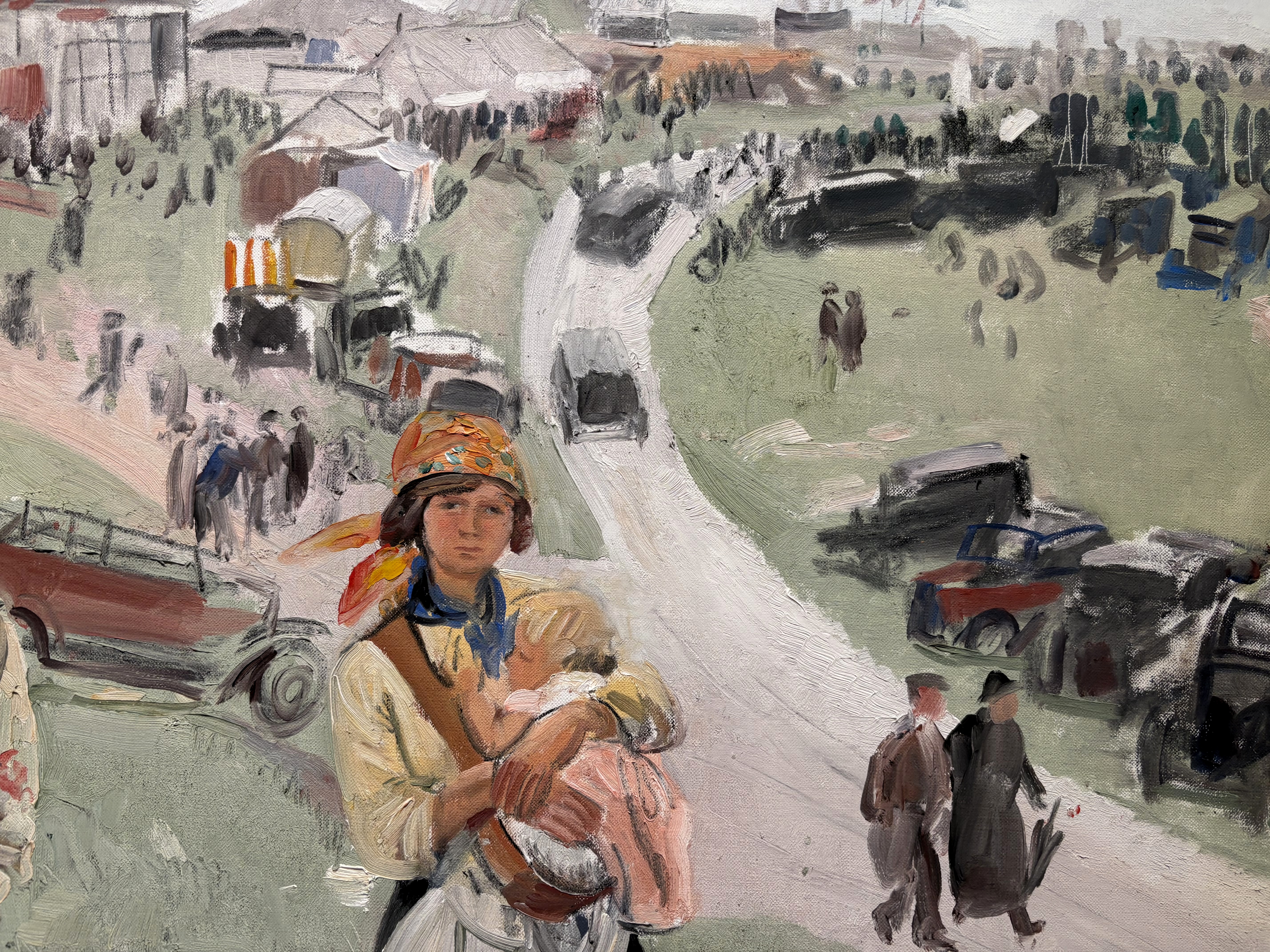
Laura Knight, Epsom Downs, 1936, (oil on canvas)

'Even today [1965] a female artist is considered more or less a freak and may be undervalued or overpraised by sole virtue of her rarity and her sex'. Laura Knight.

Knight borrowed a Rolls Royce to travel to Epsom where she painted these Romani fortune-tellers in the fairground by the racecourse.

Knight was taught to draw by her mother before entering Nottingham School of Art, aged 13.  She and her husband lived in Newlyn from 1907 to 1919 where they knew Dod Procter and Stanhope Forbes. Sometimes seen as part of the art establishment, Knight was the first woman to become a member of the Royal Academy since Angelica Kauffman in 1768. She often chose marginalised people for her subjects: dancers, the Black patients and nurses in a racially-segregated hospital in 1920s Baltimore, women munitions workers, and travellers at Epsom, which had had a Roma community from the 16th century.


looking closer


looking closer


Dod Procter, Winter Scene from the Artist's House, (oil on canvas)

'Dod' Procter was born Doris Margaret Shaw in Hampstead. She attended Stanhope Forbes' school in Cornwall aged 15 when her family moved to Newlyn. She was considered the most talented student and she travelled to France, meeting Cezanne and Renoir. Procter experimented early on with the geometric pre-Cubist style of Cezanne and this undated wintery view is possibly a later work from whe had settled in Zennor. Procter was friends with Laura Knight, Alfred Munnings and Alethea Garstin.


Henry Scott Tuke, Boys Bathing, 1898, (oil on canvas)

Tuke felt that painting outdoors was the best way to capture 'the truth and beauty of flesh in sunlight by the sea'.


Harry Watson, Holidays, 1920, (oil on canvas)