Showing posts with label artists' studio. Show all posts

Wednesday, 10 April 2013

Francis Bacon's Studio


Francis Bacon's Studio at The Hugh Lane, Dublin City Gallery.

Francis Bacon was born in Ireland but left at the age of 16 following a disagreement with his father. He travelled to Berlin and then on to Paris where he found a sense of purpose. An exhibition by Picasso inspired him to become an artist and Poussin's Massacre of the Innocents at Chantilly showed him how the human scream could be captured in paint. Eisenstein's Battleship Potemkin caught his attention with the powerful close-up of a screaming nurse.

He first gained recognition as a painter with Crucifixion in 1933 but it was in the mid-1940s that his career took off with the success of his Three Studies for Figures at the base of a Crucifixion in 1944 and established him as a force in post-war art. He spent most of his life in London.


In 1998, John Edwards, his sole heir, donated the studio and its contents to the Hugh Lane Gallery. In August of that year, the Hugh Lane team removed the studio and its entire contents from London to Dublin. The team made a survey and elevation drawings of the small studio, mapping out the spaces and locations of the objects. The wall, floor, doors and ceiling were also removed, including the dust.


'For some reason the moment I saw this place I knew that I could work here. I am very influenced by places - by the atmosphere of a room....'


'This mess here around us is rather like my mind; it may be a good image of what goes on inside me, that's what it's like, my life is like that'.


'I can only paint here, in my studio. I've had plenty of others, but I've been here for nearly thirty years now and it suits me very well. I cannot work in places that are too tidy. It's much easier for me to paint in a place like this which is a mess, I don't know why but it helps me'.


'I feel at home here in this chaos because chaos suggests images to me. And in any case I just love living in chaos. If I did have to leave and I went into a new room, in a week's time the thing would be in chaos. I do like things to be clean, I don't want the plates and things to be filthy dirty, but I like a chaotic atmosphere'.


Sunday, 27 January 2013

Artist's living quarters


This is a follow-up of my previous post on Nikos Hadjikyriakou-Ghikas' house, which is now an annexe of the Benaki Museum. We were able to view the sitting room and the dining rooms on the fifth floor.


The sitting room which leads to the small study


the area which is to the right of the previous photograph


outstanding features are the striking use of concrete for the columns, the ceiling,


the bookcases


and door frames


The walls feature perforated brick elements


a further sitting area in the living room


a closer look at the tapestry which was inspired by one of his paintings


another aspect of the living room


the study


portrait of the artist's father, 1948


a smaller, cosier sitting room


the other end of the same room,


looking closer at the painting that hangs above the fireplace


the landing at the top of the stairs that connects the living room with the dining room


a closer look at portrait of Nikos Hakjikyriakos-Ghikas by Nikos Kessanlis


the dining room


Kifissia, 1951, (egg tempera on wood) dominates the dining room


The Artist and his Wife, 1990, (oil on canvas).


More paintings as we go down the stairs to the fourth floor:


Cosmas Xenakis, Composition, 1955 (oil on canvas)


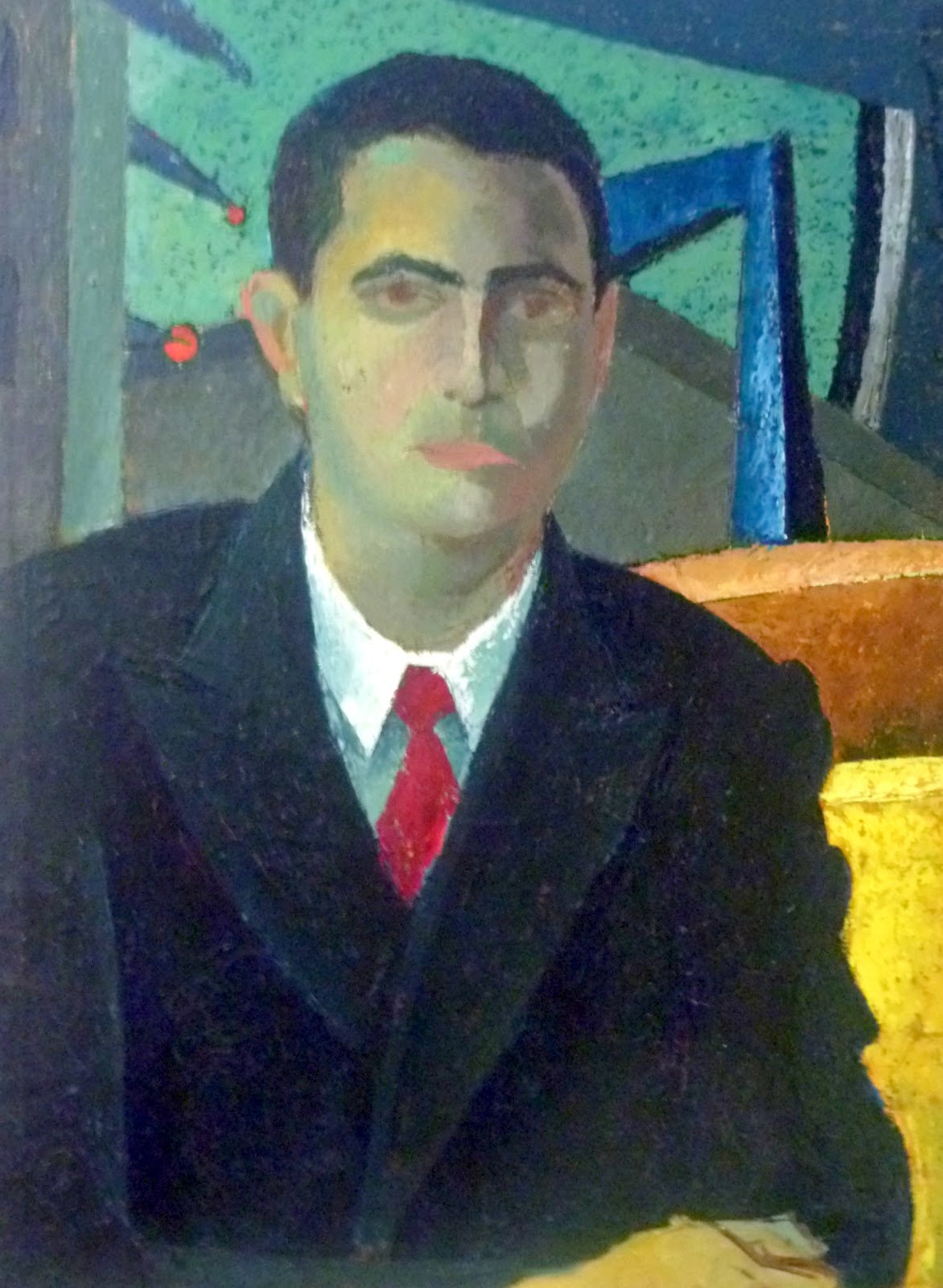
Yiannis Gaitis, Portrait of a Man, 1945, (oil on canvas)


Yiannnis Gaitis, Windmill, 1945, (oil on canvas)


Friday, 25 January 2013

Artist's studio


The house of Nikos Hadjikyriakos-Ghikas, on 3 Kriezotou Street, donated to the Benaki Museum by the artist, now a museum.


The artist started living in the house in the 1950s. He lived on the fifth floor and used the sixth floor as his studio, a large area divided into different sections:


the sitting area


with bare concrete pillars, concrete ceiling, brick walls


a closer look at the painting on the left


the area to the right of the previous picture


and books everywhere.


Additional shelves in a small adjacent room which served as a library


the entrance to the library


a closer look at the painting from the previous picture


a section of the area where the artist painted


a closer look at the painting on the left from the previous picture


artist's materials arranged against one wall


detail.


Going down the stairs to the fifth floor and the artist's living quarters, some paintings on the wall:


Dimitris Galanis, Pines at Saint-Raphael, 1928 (woodcut)


Dimitris Galanis, Panther (woodcut)


Pablo Picasso, Composition with Nudes (etching and collage on paper).  Apologies for the reflection but it could not be helped


Pierre Bonnard, Paris, 1937 (copper engraving).