Showing posts with label asylum seekers. Show all posts

Monday, 1 August 2016

Refugee routes - Athens Photo Festival


Refugee Routes -  Athens Photo Festival, 2016,


at the Benaki Museum, Pireos, Athens.
 
 
Sofie Amalie Klougart:

Klougart's photographs tell the story of refugees who have arrived in the Italian coastal town of Pozzollo, where they are locked up in the city's reception center, a temporary camp built to hold refugees for a maximum of three days. The system having broken down however, people are detained here for much longer: they stay in one large room where they sleep, eat and wait. There is no privacy except for the bathroom.


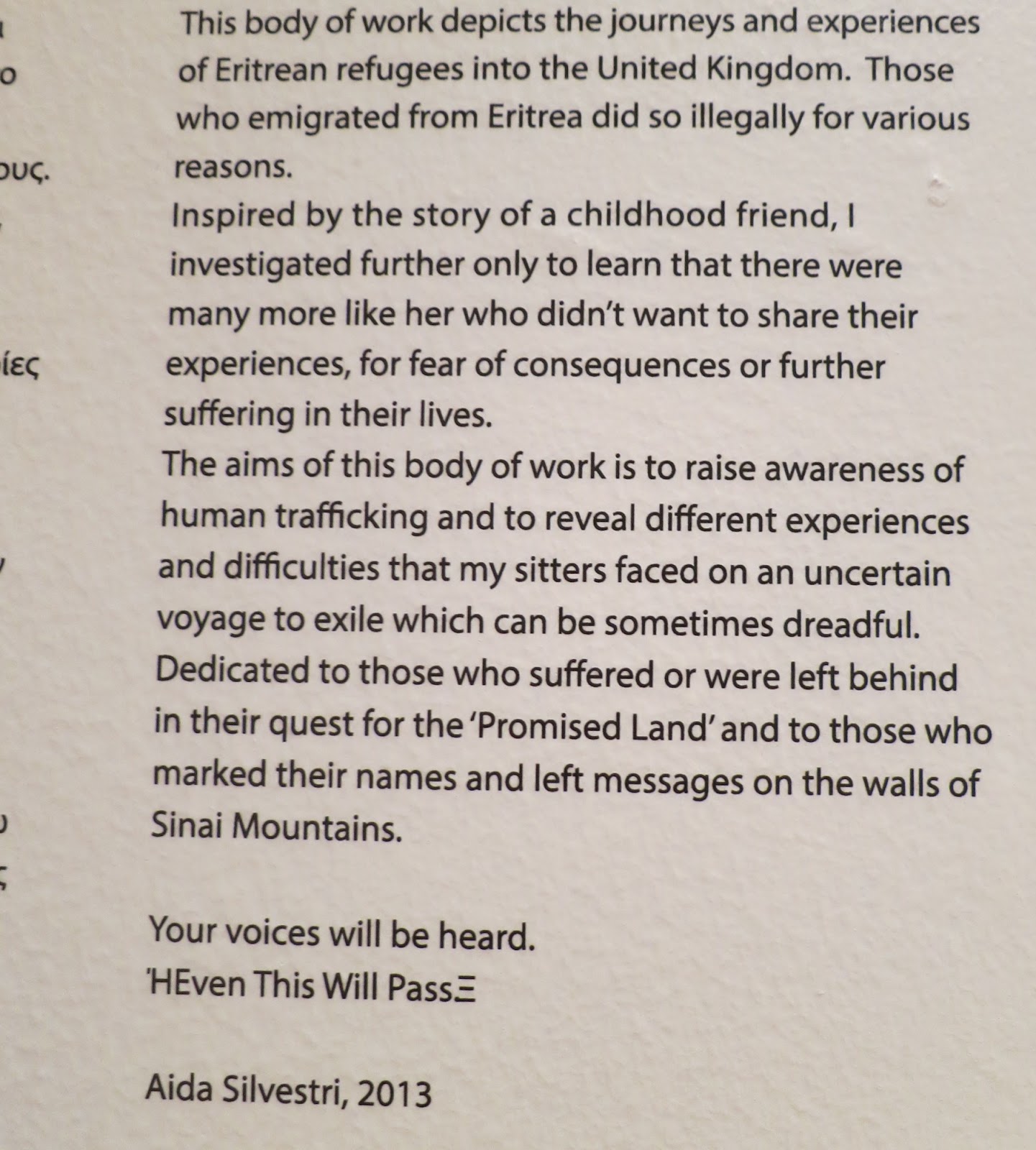
Aida Silvestri:

Silvestri's photographs depict the journeys and experiences of Eritrean refugees in the United Kingdom. Each photograph is accompanied by the testimony of the person photographed.


Bereket's testimony:

'I am told I have to behave and contribute more because I am an academic.
I am witnessing atrocities and ill treatment.
I am being chased, chased for several days.
I need to hide.
I am hiding.
I am moving. I am moving from one house to the other house.
I am betrayed.
I am unique, different than them.
I cannot blend in.
I am being spotted easily: I am dirty.
I am sleeping rough.
I cannot speak their language.
I need to find someone who can speak my language.
He wants money. 'I already gave you what I had'.
He thinks I have more. 'I am not a millionaire'.
He is asking questions.
I am smuggling myself into a lorry. Checkpoint after checkpoint.
I am still here.
I don't know who to trust. Everyone wants money, even people like me.
They always want more'.


Dawit's testimony:

'I am hiding as they are looking for me.
I am walking and walking for days. I am tired.
I stupidly fall into the wrong hands.
Into the hands of bad people.
I am blindfolded.
The bad people are taking me somewhere, somewhere far.
I am in someone's house. I am not alone.
I can feel and hear lots of people breathing.
I am hot... very hot, hungry and thirsty.
I hear lots of bad things.... bad things done to people.
I am scared.
I am tortured and burned.
They want money.
I don't have money.
I am in a different house now.
I am a slave. I am building someone's house.
Someone who became rich by inflicting pain.
That someone is my new owner...
I have to escape.
I escape'.


Biniam's testimony:

'I am persecuted there.
I am persecuted here.
I lose my job.
My landlord kicks me out.
I live in the forest with animals as an animal.
I expect a better life in a so-called 'civilised world' not worse.
One will keep a watch. One will buy food.
The police are like dogs. They can sniff a migrant instantly.
They caught my friend before I had a chance to warn him.
My poor friend is arrested and the food is in a bin.
I run.
After hours of walking, I hear loud screams.
The screams get louder.
The screams are amplified by the mountain's echo.
My hiding place is discovered.
They are beating my friends.
They are beating them with sticks.
'We don't want you here'.
'Go back to your country'.
Within a few hours, I have lost everything.
Everything... my friends, my hiding place and my food.
Why the world is ignoring our cry?
Why the world is ignoring us?
Are we not humans?'


Rehsom's testimony:

'I am experiencing a lot of atrocities.
I am imprisoned under harsh conditions.
In a hot place...
It is very hot... hotter than hot...
I don't understand what they are saying.
I don't speak their language.
I only know how to ask for food and drink.
I am naïve.
I am leaving.
I am travelling on top of a lorry which has a full load of goods.
I am not alone... some look like me and are from my country.
I am learning to share my personal space with others.
Some people are not strong enough.
They are dropping from the lorry... they drop like flies.
Seven in total.
They don't get the burial that they deserved.
I am smuggling myself into a container.
I am detained.
I am free'.


Kidan's testimony:

'I am sentenced for two months for not obeying orders and for reporting someone for rape.
I am carrying the innocent fruit of the rape.
I have money, plenty of money. I can buy my way there.
The journey is overwhelming.
Very harsh weather conditions.
Very harsh leaving conditions.
I am dehydrated and not eating well.
I am worried and scared for the baby.
I can feel it...
I am losing the baby.
I lose the baby; maybe it is best this way even though I never blamed the baby.
The journey doesn't get easier. I am not feeling well.
I think I have an infection.
I do have an infection, a very bad infection.
I cannot have another baby.
But I am healthy now.'
 
 
Andrea Gjestvang:

Gjestvgang's photographs tell the story of young refugees who have settled in Norway while their parents' asylum applications are being processed. After four to nine years, the applications of many are rejected and they are sent back to their country of origin where they find it very difficult to settle. In a lot of cases, the journey for a better life begins all over again.  Gjestvang has visited the youths after their deportations back in their home countries. She has also photographed what was left behind in Norway - best friends, schools, bedrooms.


Sam Ivin:
 
Scratched portraits that attempt to convey the loss of identity that many asylum seekers experience whilst waiting to know whether they will be granted refugee status in the U.K.


Samuel Gratacap:

Choucha, a refugee camp located in Tunisia, where several hundred thousand refugees were in transit in 2011 during the Libyan civil war and the NATO attacks.


Giorgos Moutafis:
 
' I see refugees reaching the Greek shores and kissing the ground.

Unaware of what comes next in a crisis-ridden country with no functioning reception system, most of them believe they have reached their Promised Land. Having just survived an enormously dangerous sea crossing, the refugees must immediately make one of the most difficult choices: where to go next.

The absence of a common European asylum system forces them to seek out those EU countries with the strongest asylum systems, where they also have a greater chance of integrating. Thus, after reaching Greece, most embark on a new journey to the north.

Along the Greece-FYROM border the situation is even more chaotic. Many refugees remain stranded in between the two countries, their passage subject to daily negotiation. It was here that, a few months ago, police officers attacked refugees as they held their babies in their arms. I have documented violence, despair and helplessness more times than I can possibly remember. But I have honestly never seen anything like that before: terrified and beleaguered people trying to cross the borders, children screaming and crying and families being separated between the two countries.

Hell by the border'.


Thursday, 13 August 2015

Migration and the tragedy of Kos


This photo speaks more than a thousand words. It was taken by Yannis Behrakis during the chaos that ensued when water cannon, along with beatings with truncheons by riot police were used against Syrian refugees who have sought refuge on the island of Kos. While all this was going on, the refugees, these 'swarms' to use U.K. Prime Minister David Cameron's words, formed a human shield around a woman refugee and her child, to protect them from the beatings.

In order to be able to do despicable things to human beings one has to dehumanise them. So you call them 'swarms' as David Cameron has done, or 'cockroaches' as Katie Hopkins of the Daily Mail, did a few months ago. But, who is showing humanity here? In the middle of the attack by riot police, brought in by a 'left' government, the first thought of the Syrian refugees was to protect those who cannot protect themselves.

The governments of Europe have shown absolutely no humanity or compassion for those who have been driven out of their homes as a result of war and state disintegration. This is despite the central role that the West has played in most of these wars, fuelling the mass exodus of displaced people who have no choice but to risk their lives in the graveyard that the Mediterranean has become. Most refugees arriving in Europe come from Syria, Iraq, Afghanistan and Libya - countries that the West has waged wars against in the name of 'democracy'.


More than 180,000 have reached Italy and Greece by sea alone this year, and more than 2,000 have died making the crossing. And yet the only response of the European governments is to 'protect' their borders. 'Not in my back yard. Let these people go elsewhere. We don't want them here'. Fortress Europe has to be defended at all costs.


'War, violence and persecution left one in every 122 humans on the planet a refugee, internally displaced or seeking asylum at the end of last year, according to a stark UN report that warns the world is failing the victims of an 'age of unprecedented mass displacement'. UNHCR estimates that an average of 42,500 men, women and children became refugees, asylum seekers or internally displaced people every day last year - a four-fold increase in just four years', reports the Guardian.

Dr Dimitris Yannousis, has just come back from Kos where he spent 50 days working for Medicins sans Frontiers. He treated 820 people and he reports that 93% of those are refugees from countries that are at war, mainly Syria, Iraq and Afghanistan. 'I have treated war wounded, pregnant women, very old people who have walked for thousands of kilometres in an attempt to reach a place where there is no war... Most children suffer from post-traumatic stress and they bear their burden in silence... I remember a young man who was injured in Syria and had his leg amputated. He reached Kos with the help of his brother, walking through Syria, then Turkey and finally taking a boat to Kos. The conditions in which he found himself in Kos were horrendous... Another 18 year old was in a pre-diabetic coma - he could not get insulin during the three months he spent in Turkey while waiting for a boat to take him across'


Greek Prime Minister Alexis Tsipras made a statement last week saying that given the economic situation in Greece, it's impossible for the country to deal with all the people who are washing up on its shores. So he asked the European Union for help in dealing with the situation. A very sensible request.

But two days ago the situation on the island of Kos reached a climax. A policeman yielding a knife in one hand slapped a refugee with the other. Following this incident, and as a form of protest, the refugees staged a sit-in on the city's central road, obstructing traffic and damaging passing cars. The 'left' Greek government took the decision to send riot police to the island so that they could 'manage' the situation. What followed is unspeakable. Water cannon, truncheons, beatings, the use of fire extinguishers, stun grenades, and the 2,500 refugees were herded like cattle into a stadium where they were locked for nearly 24 hours. People started fainting in the heat, there was no access to shade, water or food. According to the latest reports ambulances are in constant use, taking starving children who are fainting, to the local hospital.


(image taken from here )

Medicins sans Frontieres issued the following statement: 'We have unconscious people being carried by their friends and family every 15 minutes. It is absolutely out of control. Nobody understands the sense behind it, or if there is any sense at all'. Furthermore: 'this is the first time we've seen this in Greece - people locked in a stadium and controlled by riot police. We're talking about mothers with children and elderly people. They've been locked in there after many hours in the sun'.

The key words here are 'this is the first time we've seen this in Greece'. Eight months ago Syriza were outraged by the condition of refugees in the camps in which they were being held. Eight months later what is occurring is much much worse than before they came into government.


Greece is heading towards its third bailout, a bailout that is much more savage than the two that preceded it: the country is expected to hand over 50 billion euros'  worth of 'valuable state assets' to an independent body under the control of European institutions who will proceed to sell them off; a broad programme of deregulation will declare war on workers, farmers and small businesses; pensions are to suffer rapid cuts; minimum wages are to be reduced; collective bargaining is to be severely curtailed and it's going to become easier to sack workers. As Nick Dearden has written, this is 'a cynical attempt to set up a corporate paradise in the Mediterranean, and must be resisted at all costs'. The bailout money will find its way to the pockets of European banks and it's never going to be possible to pay the debt off.

All of this has been 'achieved' by a so-called left government that is so blinded with its love of the European Union that it could not conceive of the only possible way out of this crisis, a Grexit. Prime Minister Alexis Tsipras keeps saying 'I don't like this, but I have no choice'.

Did he have no choice when he sent the riot police to attack people who have been misplaced, who are fleeing horrors in countries that have been ravaged by war and by neoliberal globalisation? Did he have no choice when he sent the riot police to attack women and infants?


Sources:
 
Bulletins from Alilegei Kos (Solidarity with Kos), an organisation in Kos who are doing their utmost to ease the suffering of asylum seekers on the island. https://www.facebook.com/pages/%CE%91%CE%BB%CE%BB%CE%B7%CE%BB%CE%B5%CE%B3%CE%B3%CF%8D%CE%B7-%CE%9A%CF%89%CF%82/654828261315599?fref=nf


Most images have been taken from Alilegei Kos (Solidarity with Kos),


Monday, 26 August 2013

Crimes of the State

The policies of the present Greek coalition government are reminiscent of what was happening in Weimar Germany in the 1930s, policies that contributed to the rise of fascism and the consequences that we all know of.

Minister for Law and Order, Mr Dendias, established the Xenios Zeus operation where under the name of 'hospitality' (the irony of this is staggering), thousands of people of colour are arrested, beaten and terrorised and taken to detention centres that have been condemned by human rights organisations throughout the world, but are called 'hospitality centres' in the warped rhetoric of this repressive government. In the name of this 'hospitality law' aimed at 'clearing' the country of illegal immigrants, even tourists are arrested and in some cases, beaten, because the colour of their skin is not white.

'Greece's failure to respect the rights of migrants and asylum-seekers is taking on the proportions of a humanitarian crisis... Greece is proving itself incapable of providing even the most basic requirements of safety and shelter to the thousands of asylum seekers and migrants arriving each year', said John Dalhuisen from Amnesty International in 2012.

There are now at least 5,000 people languishing in these internment camps which are being used for anyone who is 'different' as this policy has now been extended: the Greek government has just announced that the camp capacity is about to double.  The next victims were the drug users and now, it is the turn of transgender men and women who have been warned  to 'return to normal' , or else.....

The new Minister of Public Health's first 'achievement' is the re-establishing of a law that was scrapped earlier this year, law 39a/2012, which under the aegis of defending public health, states that anyone who is suspected of having the HIV virus can be arrested, tested without their permission and put under forced quarantine. The targets of this barbaric law are obvious: immigrants, gays, sex workers and anyone who is deemed to be 'different'. It is not unreasonable or far-fetched to compare what is happening in Greece at the moment with dictatorships where people are thrown in prisons or put in psychiatric hospitals for any kind of reason that the authorities deemed reasonable - sexual preference for instance.

Hundreds of sex workers were arrested last May in the name of this law that was condemned by the EU, repealed and has just been re-introduced. When dozens tested positive, the attack was swift and vindictive: photographs and the names of those who tested positive were posted online by the police. They were then charged with causing bodily harm and locked in jail. Some websites posted the photographs of the women and within days vigilante mobs assembled outside the homes of the women's families shouting abuse. 26 of the women who were arrested remain in jail. They insist that they did not know they were HIV positive but no one is listening and no one cares.

The list of people who are being targeted keeps growing:

The beating in police cells of four young anarchists who were suspected of robbing a bank in the North of Greece hit the headlines in February. Despite the fact that the photographs were digitally altered by the police, the suspects' injuries were clearly visible. When The Guardian published the photographs, Public Order Minister Mr Dendias threatened to sue the newspaper.

In December 2010, 29-year-old anarchist Kostas Sakkas was arrested in Athens and was held in prison without a trial. On 4 June 2013 he went on  hunger strike, demanding an end to his detention. According to Greek law, pre-trial detentions can extend to 18 months, or 30 in exceptional circumstances. On 4 June, having already reached his legal maximum time in pre-trial detention, it was extended by another six months by an Athens court of appeal. While clearly stating his own anarchist convictions, both Sakkas and the Conspiracy of Cells of Fire group have denied his active participation. But whether Sakkas was indeed a member or not, is no longer the issue. As is becoming altogether too common in these cases of a breach of legality, the government has not attempted to defend its actions, but has instead lashed out against Syriza, the Left opposition party,  for defending 'any sort of accused who are charged with anarchy and terrorism'. 

Sakkas was released on the 38th day of his hunger strike: a bail of 30,000 euros, a ban on meeting or communicating with his fellow defendants, confiscation of his passport and I.D. and compulsory residence at his parent's house were the terms of his release.

The irony of the whole situation should not escape us: here is a young anarchist who was making the simple demand that a law-breaking State should obey and uphold the law: he was making this demand by putting his life in danger.

Such stories of police violence, governmental injustice, intrusion into citizens' lives and a total rupture between state and society is not occurring in Greece alone: neo-liberalism has resulted in the rise of a corrupt, self-aggrandizing political class that does not care about anything but its own interests, resulting in austerity policies, impoverishment of large sections of society and the rise of a repressive state that will not tolerate any form of opposition or dialogue.  Unlike any other country in Europe however, the government in Greece is turning the clock back at such rapid pace that we are indeed nearing the state of the Weimar Republic in the 1930s.


For more on Xenios Zeus go to:http://a-place-called-space.blogspot.gr/2013/01/the-starkness-of-streets.html
http://a-place-called-space.blogspot.gr/2013/02/the-terrorism-of-law-and-order.html
http://a-place-called-space.blogspot.gr/2012/08/these-racist-attacks-must-stop-now.html
http://a-place-called-space.blogspot.gr/2012/08/shame.html
http://a-place-called-space.blogspot.gr/2012/08/abdhullah-a.html
http://a-place-called-space.blogspot.gr/2013/01/the-ugly-face-of-racism.html
http://a-place-called-space.blogspot.gr/2012/10/hypocrite.html


Sources:

http://www.ekathimerini.com/4dcgi/_w_articles_wsite1_1_09/07/2013_508395
http://act.watchdog.net/petitions/3322?share_ref=CO7pX-NO0hA
http://www.guardian.co.uk/commentisfree/2013/jul/04/greece-kostas-sakkas-hunger-strike?INTCMP=SRCH

Saturday, 17 August 2013

Greece's Guantanamo?


An uprising broke out in the Amygdaleza detention centre outside Athens on Saturday night. Greece has become a point of entry for immigrants and asylum seekers, mainly from Asia and Africa, who seek a better life in Europe, and who end up in detention centres instead: 1620 are held at Amagdaleza.

Just over a year ago Operation Xenios Zeus was put in place aimed at arresting and detaining illegal immigrants of mainly Asian and African origin who are transported to make-shift detention centres and kept there in appalling conditions. The number of those detained has grown to 5,000, with Dendias, the Minister for Public Order, recently announcing that camp capacity is to double.

The conditions in the camps are dreadful and are routinely condemned by international human rights agencies, but little changes. There was no soap for a month and a half in Amygdaleza according to Syriza MP Vasiliki Katrivanou and in some cases the detainees are kept in cells that have no daylight. Over 300 cases of scabies have been treated in the past few months. Inmates with tuberculosis, diabetes and kidney infections are also held there with little access to healthcare. A lot have started experiencing severe psychiatric problems and there are quite a lot of suicide attempts. There were three reported suicide attempts in Amygdaleza recently, where inmates broke windows and attempted to slit their throats with the shards of glass. A number of detainees went on hunger strike last month, demanding their release.


The windows of the old army barracks that is now the detention centre have bars while other detainees are held in shipping containers. Following the hunger strike, ten representatives from various humanitarian groups were allowed to go inside the camp. They issued the following statement: '...detention conditions remain appalling... overcrowding, minimal hygiene, inadequate or no courtyard, inadequate or no medical care, cases of police brutality. Thousands of people are herded into the cells of the detention centre without any concern for their welfare, without even any rights as prisoners'.

There are 45 boys kept in the detention centre for minors in Amygdaleza. There is no daylight in their cells so they mainly live under artificial light. When asked, they say they don't know why they are there.

On Saturday night, having discovered that they were now to be held for 18 months rather than the original 12 under which they were initially detained, the detainees had had enough! They refused to return to their sleeping quarters and set fire to their mattresses. According to one report electricity at the camp had been cut off a number of days previously. Sotiris Douros, the mayor of the region, told the media he regarded the rebellion as inevitable and noted that the municipal government had long warned about the risk of such an event. He described conditions at the camp as unbearable.


This video, following a visit of Green MEPs on 30 November 2012 in Amygdaleza, says it all.

Unfortunately, Greece is not the only European country exhibiting such racist, inhumane behaviour. The government in Switzerland just passed a law which segregates immigrant groups from public spaces and which will also relegate them to detention camps. New rules mean that people can no longer seek asylum for being conscientious objectors or deserting foreign militaries. Local authorities are introducing restrictions on asylum seekers, with the establishment of exclusion zones in public spaces which they cannot enter - these include swimming pools, libraries and churches. They are to be put in detention centres which will be guarded by the police and where they are subjected to a curfew which forbids them to leave the premises after 17:00.

Racism is rearing its ugly head all over Europe making life for people of colour intolerable.


Sources:

Kathimerini
The Guardian
The Independent

Thursday, 11 July 2013

What is it you don't want us to forget?


This is our fourth full day in Greece and I have already started having this feeling of living in a parallel universe, a feeling that fills me with dread, and a heaviness that permeates my very being. I fear for what is in store, I fear for the country and its people, and I fear for the future of Europe and the world. And I ask myself the same old question: 'where is this going? What will it lead to?' And the possible scenario(s)  frighten me.


I am furthermore gobsmacked by the empty rhetoric and the hypocrisy of politicians. One of the headlines in yesterday's Kathimerini: 'Greek President Karolos Papoulias stressed the importance of remembering Nazi war crimes during a visit to the site of Auschwitz'. Mr Papoulias made the following statement: 'I am here to pay my respects to the thousands of victims of Nazi atrocities, including thousands of my fellow citizens.... It is the duty of us all to ensure our memories of the tragic historic fact of Nazi barbarism do not become rusty'.

What is wrong with that? you may ask. What is wrong is that the policies of this present Greek government are reminiscent of what was happening in Weimar Germany in the 1930s, policies that contributed to the rise of fascism and the consequences that we all know of. I have written at length about this in earlier posts, and you will find the links at the end of this post, but an update is necessary.

The present government's Minister for Law and Order, Mr Dendias, established the Xenios Zeus operation where under the name of 'hospitality' (the irony of this is staggering), thousands of people of colour are arrested, beaten and terrorised and taken to detention centres that have been condemned by human rights organisations throughout the world, but are called 'hospitality centres' in the warped rhetoric of this repressive government. In the name of this 'hospitality law' aimed at 'clearing' the country of illegal immigrants, even tourists are arrested and in some cases, beaten, because the colour of their skin is not white.

'Greece's failure to respect the rights of migrants and asylum-seekers is taking on the proportions of a humanitarian crisis... Greece is proving itself incapable of providing even the most basic requirements of safety and shelter to the thousands of asylum seekers and migrants arriving each year', said John Dalhuisen from Amnesty International in 2012.


There are now at least 5,000 people languishing in these internment camps which are being used for anyone who is 'different' as this policy has now been extended: the Greek government has just announced that the camp capacity is about to double.  The next victims were the drug users and now, it is the turn of transgender men and women who have been warned  to 'return to normal' , or else.....

Pastor Niemoller's 'First they Came' poem could not be more appropriate.  I just read in the paper that new Minister of Public Health's first 'achievement' is the re-establishing of a law that was scrapped earlier this year, law 39a/2012, which under the aegis of defending public health, states that anyone who is suspected of having the HIV virus can be arrested, tested without their permission and put under forced quarantine. The targets of this barbaric law are obvious: immigrants, gays, sex workers and anyone who is deemed to be 'different'. It is not unreasonable or far-fetched to compare what is happening in Greece at the moment with dictatorships where people are thrown in prisons or put in psychiatric hospitals for any kind of reason that the authorities deemed reasonable - sexual preference for instance.


Hundreds of sex workers were arrested last May in the name of this law that was condemned by the EU, repealed and has just been re-introduced. When dozens tested positive, the attack was swift and vindictive: photographs and the names of those who tested positive were posted online by the police. They were then charged with causing bodily harm and locked in jail. Some websites posted the photographs of the women and within days vigilante mobs assembled outside the homes of the women's families shouting abuse. 26 of the women who were arrested remain in jail. They insist that they did not know they were HIV positive but no one is listening and no one cares.

Meanwhile, Mr Papoulias, the President,  tells us that we must not forget what happened during the Holocaust.

The list of people who are being targeted keeps growing:


The beating in police cells of four young anarchists who were suspected of robbing a bank in the North of Greece hit the headlines in February. Despite the fact that the photographs were digitally altered by the police, the suspects' injuries were clearly visible. When The Guardian published the photographs, Public Order Minister Mr Dendias threatened to sue the newspaper.


Voir l'image sur Twitter


In December 2010, 29-year-old anarchist Kostas Sakkas was arrested in Athens and has been held in prison without a trial since. On 4 June 2013 he went on  hunger strike, demanding an end to his detention. According to Greek law, pre-trial detentions can extend to 18 months, or 30 in exceptional circumstances. On 4 June, having already reached his legal maximum time in pre-trial detention, it was extended by another six months by an Athens court of appeal. While clearly stating his own anarchist convictions, both Sakkas and the Conspiracy of Cells of Fire group have denied his active participation. But whether Sakkas was indeed a member or not, is no longer the issue. As is becoming altogether too common in these cases of a breach of legality, the government has not attempted to defend its actions, but has instead lashed out against Syriza, the Left opposition party,  for defending 'any sort of accused who are charged with anarchy and terrorism'.

The irony of the whole situation should not escape us: here is a young anarchist who is making the simple demand that a law-breaking State should obey and uphold the law: he is making this demand by putting his life in danger.

Sakkas is on the 38th day of his hunger strike and the doctor who is looking after him has stated that 'his condition is critical'.

Such stories of police violence, governmental injustice, intrusion into citizens' lives and a total rupture between state and society is not occurring in Greece alone: neo-liberalism has resulted in the rise of a corrupt, self-aggrandizing political class that does not care about anything but its own interests, resulting in austerity policies, impoverishment of large sections of society and the rise of a repressive state that will not tolerate any form of opposition or dialogue.  Unlike any other country in Europe however, the government in Greece is turning the clock back at such rapid pace that we are indeed nearing the state of the Weimar Republic in the 1930s.

What exactly is it that you do not want us to forget, Mr Papoulias? The abuse of human rights? The use of the courts to further the interests of the few? The suppression of any dissent? The incarceration of people who are 'different'? The setting up of camps to detain people that your government does not deem to be desirable?


P.S. A few hours after I posted this, Kostas Sakkas was released: a bail of 30,000 euros, a ban on meeting or communicating with his fellow defendants, confiscation of his passport and I.D., compulsory residence at his parent's house.


For more on Xenios Zeus go to:

http://a-place-called-space.blogspot.gr/2013/01/the-starkness-of-streets.html
http://a-place-called-space.blogspot.gr/2013/02/the-terrorism-of-law-and-order.html
http://a-place-called-space.blogspot.gr/2012/08/these-racist-attacks-must-stop-now.html
http://a-place-called-space.blogspot.gr/2012/08/shame.html
http://a-place-called-space.blogspot.gr/2012/08/abdhullah-a.html
http://a-place-called-space.blogspot.gr/2013/01/the-ugly-face-of-racism.html
http://a-place-called-space.blogspot.gr/2012/10/hypocrite.html


Sources:

http://www.ekathimerini.com/4dcgi/_w_articles_wsite1_1_09/07/2013_508395
http://act.watchdog.net/petitions/3322?share_ref=CO7pX-NO0hA
http://www.guardian.co.uk/commentisfree/2013/jul/04/greece-kostas-sakkas-hunger-strike?INTCMP=SRCH


For more information on Greece and lots more on current affairs, go to: http://99getsmart.com/


Saturday, 2 February 2013

The terrorism of 'law and order'

Basic and fundamental human rights are being abused in Greece in the name of 'law and order'. Adopting a policy of zero tolerance to anything it deems as 'lawlessness', the Greek government believes that a society that has been brutalised and beaten by the economic crisis will accept its policies of repression. The ideology of the Neo-Nazi party, that has seen such a spectacular rise since the last elections, is being put into practice by a coalition government that has no ideology of its own.

These policies of repression and terrorism are being implemented by the Minister of Law and Order, Nikos Dendias whose first 'achievement' was the introduction of the so-called 'koukoulonomos'  in 2009, a law that decrees that anyone who wears a hoodie can be arrested. This was the beginning of a series of attacks on civil liberties. Under this law hundreds of people have been arrested and prosecuted because some police officer or other has attested that these people were wearing a 'hoodie' or something resembling a 'hoodie' during the time of their arrest.


Mr Dendias's second major 'achievement' was the establishment of the Xenios Zeus operation, where under the name of 'hospitality' thousands of people of colour are arrested, beaten, terrorised and taken to detention  centres that have been condemned by human rights organisations throughout the world, but are called 'hospitality centres' in the warped rhetoric of this repressive government. In the name of this 'hospitality law' aimed at 'clearing' the country of illegal immigrants, tourists are arrested and in some cases beaten because the colour of their skin is not white. The cases of Korean backpacker Hyung Young Jung, American Christian Ukwuorji and visiting academic S. Kumar Rai are cited by the BBC as examples of such police brutality.  'Anyone who looks like a foreigner or who looks suspicious can be stopped and investigated'  is the police's response to allegations of abuse of tourists.


This terrorism by the state continues with impunity. When the torture of 15 anti-fascist demonstrators were reported in the Guardian newspaper (initially not reported in the Greek press) Mr Dendias's sole response was that he would sue the Guardian. When journalists challenged Mr Dendias's version of the above events, the television programme was censored and taken off the air. The Minister's paranoia reached unprecedented heights when he accused Syriza of being a terrorist organisation and asked for a written guarantee that the party does not condone terrorism.


The attack on the 'centres of lawlessness', places that in most cases are owned and abandoned by the state, and had been taken over by squatters, was the next violent assault.  The squatters who were using the buildings as community centres were violently evicted and used as sacrificial lambs in this war of repression.

The use of an emergency law, the civil mobilisation order, to break the strike of the metro workers is yet another draconian measure used by the Greek government to smash any opposition to its austerity measures. This law which is intended to be used in cases of threat to public health is deemed to be unconstitutional  by the legal profession, as the strike posed no threat to public health. The threat of arrest and dismissal led to an end to the strike.

The government has now decided that given its 'success', this model of breaking strikes is going to be used on future occasions when workers mobilise against austerity. We have moved beyond the repression of a few minorities (as we are daily told in the news), to repression of large sections of the population.

The right to demonstrate is constantly being violently challenged as excessive use of force by the police and the constant use of tear gas is making it increasingly difficult for people to exercise this basic democratic right. One by one, freedoms that were laboriously fought for and gained over the last decades are being eroded with violence.


The rhetoric of the far right has been adopted, assimilated and imposed. This flirting with the Far Right that this government is adopting was shown clearly during the funeral of the last, unrepentent junta colonel, Dertilis, on Thursday. Five Neo-Nazi MPs and tens of members of that organisation attended. 30 gunshots were fired and yet, the Greek police stood by and let all this happen. When challenged on this by Syriza, Mr Dendias's response was that one man was arrested at the end of the funeral. All is well, then.

'When the face of the beast stops frightening us, then this means that we have started to resemble the beast', said Manos Hadjidakis. The beast is here. We have allowed it to come in and live among us.


'We should not allow ourselves to live like slaves', is written on the wall.


As I have said before in this blog, the streets say it all. This one reads: 'It's worth living for a dream, my friend, even if its fire will burn you'.


For more information on:

Xenios Zeus go to: http://a-place-called-space.blogspot.gr/2012/08/shame.html
                             http://a-place-called-space.blogspot.gr/2012/08/these-racist-attacks-must-stop now.html
                             http://a-place-called-space.blogspot.gr/2012/08/abdhullah-a.html
                             http://a-place-called-space.blogspot.gr/2012/10/hypocrite.html
                             http://a-place-called-space.blogspot.gr/2013/01/the-ugly-face-of-racism.html
The squats go to: http://a-place-called-space.blogspot.gr/2013/01/living-in-state-of-fear.html


Sources:

Kyriakatiki Eleutherotipia
Kathimerini


For further information on Greece plus more on current affairs, go to: http://99getsmart.com/